
Blog
Decision Intelligence insights, structured thinking frameworks, and best practices for organizations that take their decisions seriously.
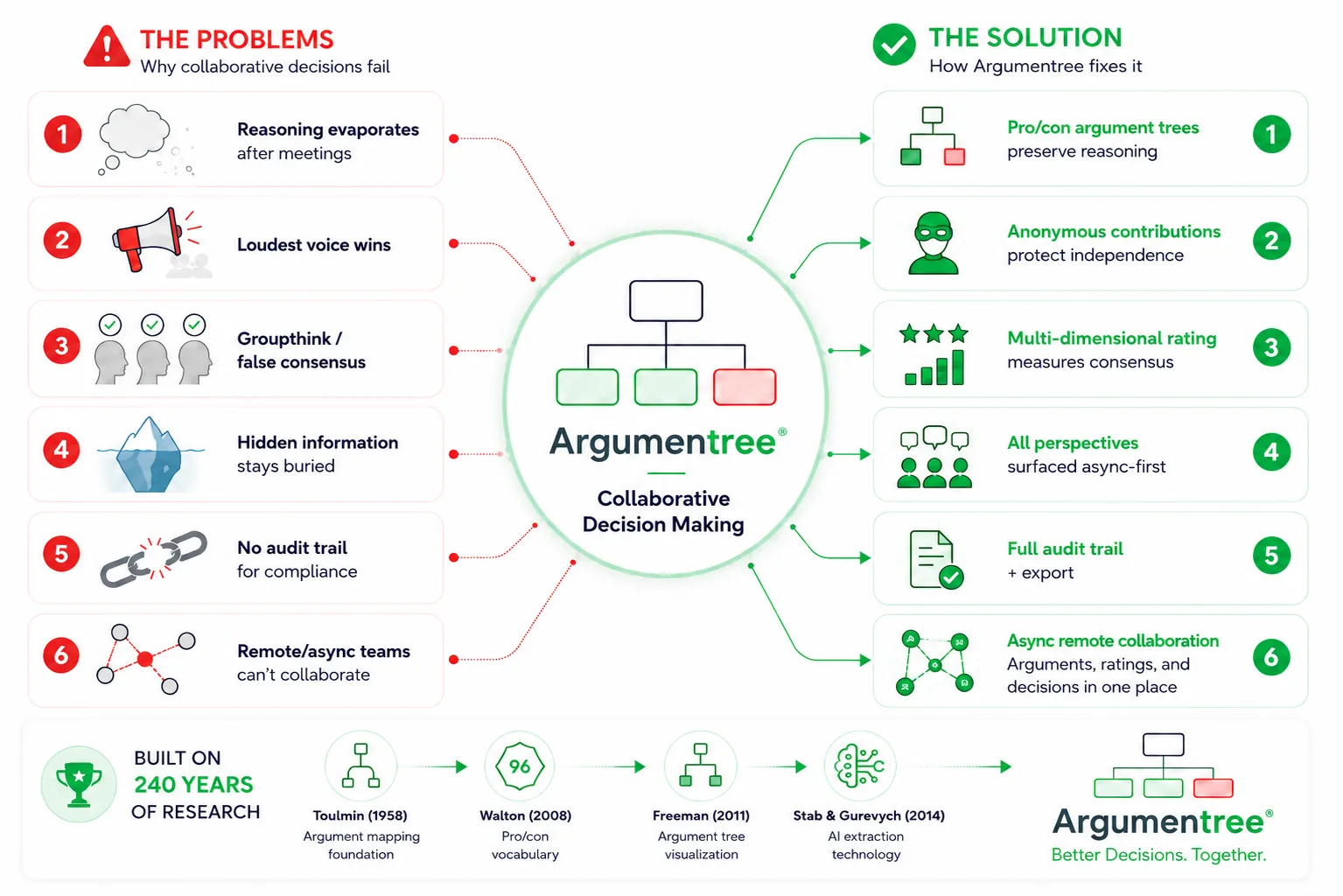
Collaborative Decision Making: 240 Years of Proof That Groups Beat Individuals
In 1785, Condorcet proved mathematically that groups outperform individuals when perspectives are properly aggregated. Google's Project Aristotle confirmed it: psychological safety predicts team effectiveness better than who's on the team. Here's what the science says — and when NOT to collaborate.
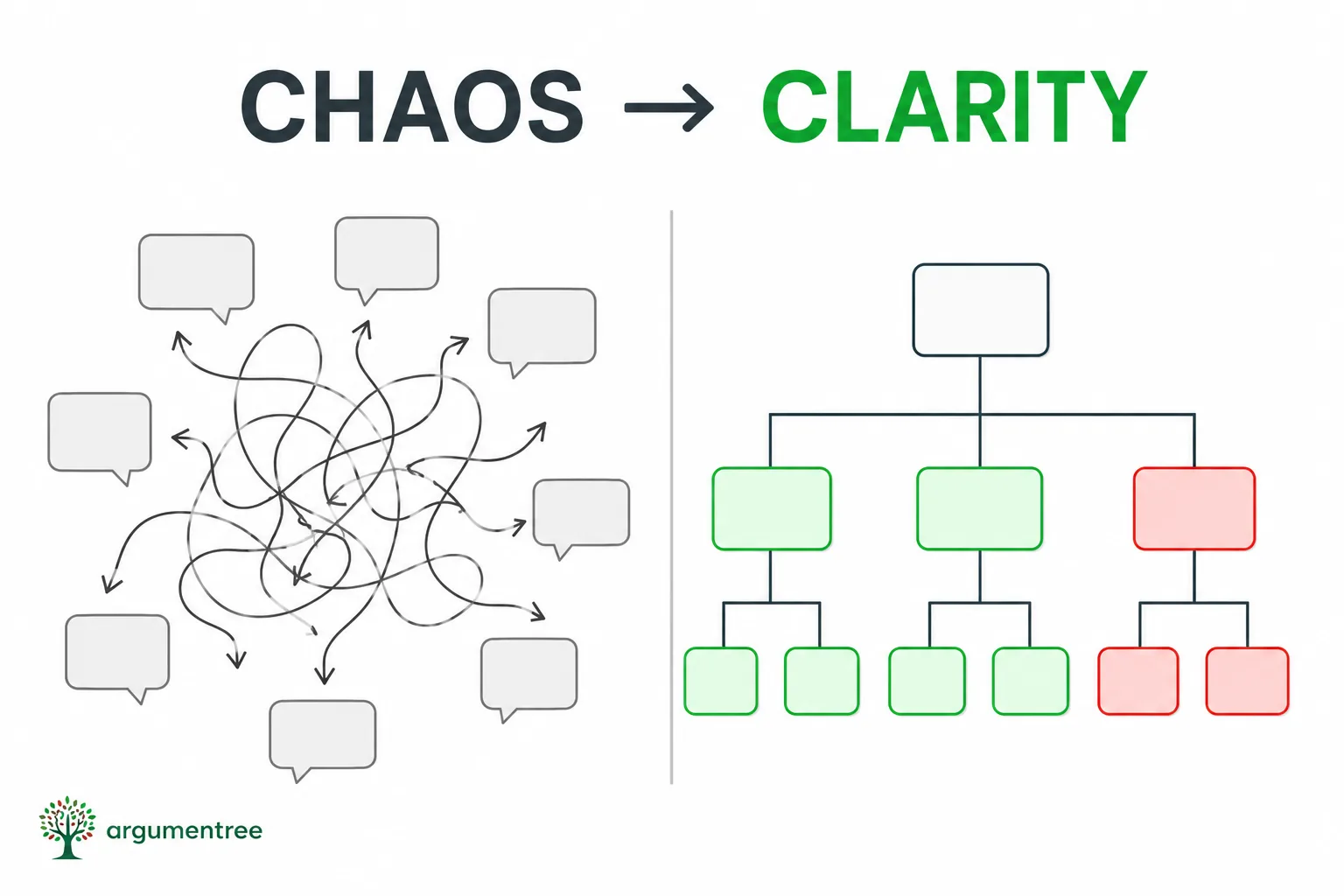
The Meeting Intelligence Revolution: Turning Meetings Into Traceable Decisions
Tired of meetings where people talk without saying anything? Learn how to transform wasted meeting time into focused, efficient decisions with pre-meeting argument preparation, real-time rating, and full decision traceability — grounded in the published research on meeting waste.
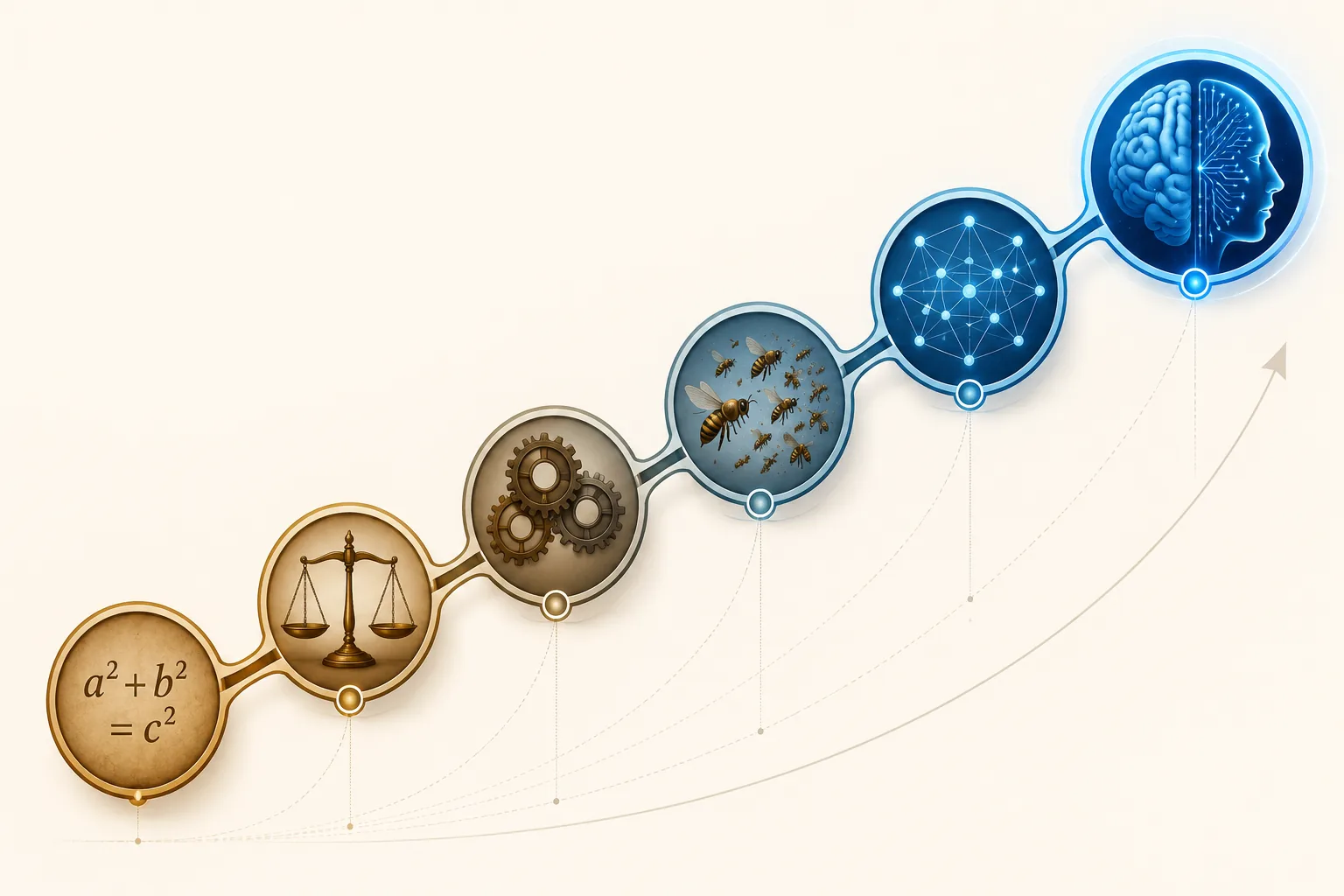
Collective Intelligence: 240 Years of Research — From Condorcet to AI
From an 18th-century French mathematician to MIT AI labs, the science of group intelligence has evolved through six eras. Here's the complete history.

Diversity Beats Ability: Why Your Smartest Hire Isn't Your Best Decision-Maker
Research shows teams of diverse thinkers outperform teams of high-IQ experts. Here's the science—and why it's more nuanced than the headlines suggest.
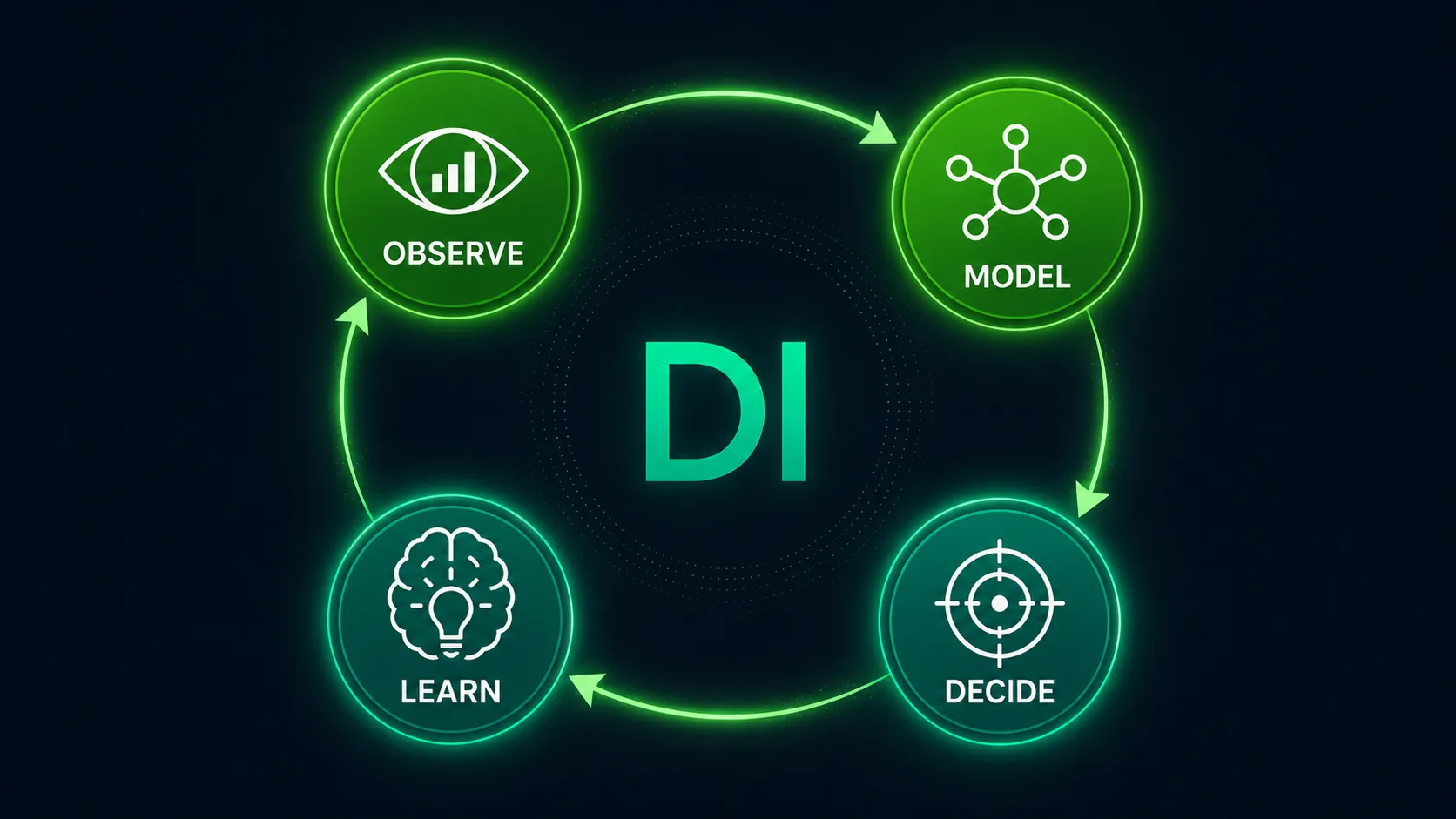
Decision Intelligence: From Data to Action at Enterprise Scale
In 2018, Google created a new job title: Chief Decision Scientist. Why? Because having data isn't the same as using data well. Decision Intelligence — coined by Lorien Pratt, operationalized by Cassie Kozyrkov — closes the gap between insight and impact. Here's the framework behind the $68B market.

Jeff Bezos's 3 Decisions a Day: The Warren Buffett Method Behind Amazon
In 2018, Jeff Bezos revealed his decision-making philosophy: "You get paid to make a small number of high-quality decisions." He credits Warren Buffett's approach. Here's the full interview, the 10am rule, and why "gut decisions" aren't what you think.
Warren Buffett's Decision Philosophy: The 20-Slot Punch Card That Built $900 Billion
Jeff Bezos credits Warren Buffett for his decision philosophy. But what does Buffett himself actually say? His 20-slot punch card rule, Ted Williams sweet spot analogy, "lethargy bordering on sloth," and why he reads 500 pages a day. The real philosophy behind $900 billion.

Elon Musk's $100 Million Decision Hour: The Lex Fridman Clip Every CEO Should See
In a recent Lex Fridman conversation, Elon Musk did the math out loud: "The marginal value of a good decision can easily be, in the course of an hour, a hundred million dollars." Bezos counts decisions per day. Buffett reads 500 pages to prepare. Musk prices the hour. Here's why the number isn't bravado—and what it means for every organization at every scale.

Steve Jobs Fired Board Members for Agreeing With Him: The Unusual Truth About Pixar's Board
During Pixar's decade as a public company, Steve Jobs removed two board members—not for incompetence, but because they never disagreed with him. Ed Catmull's firsthand account: the arenas of disagreement, the Toy Story 2 reboot, the rock tumbler metaphor, and why the "reality distortion field" caricature misses how Jobs actually decided.
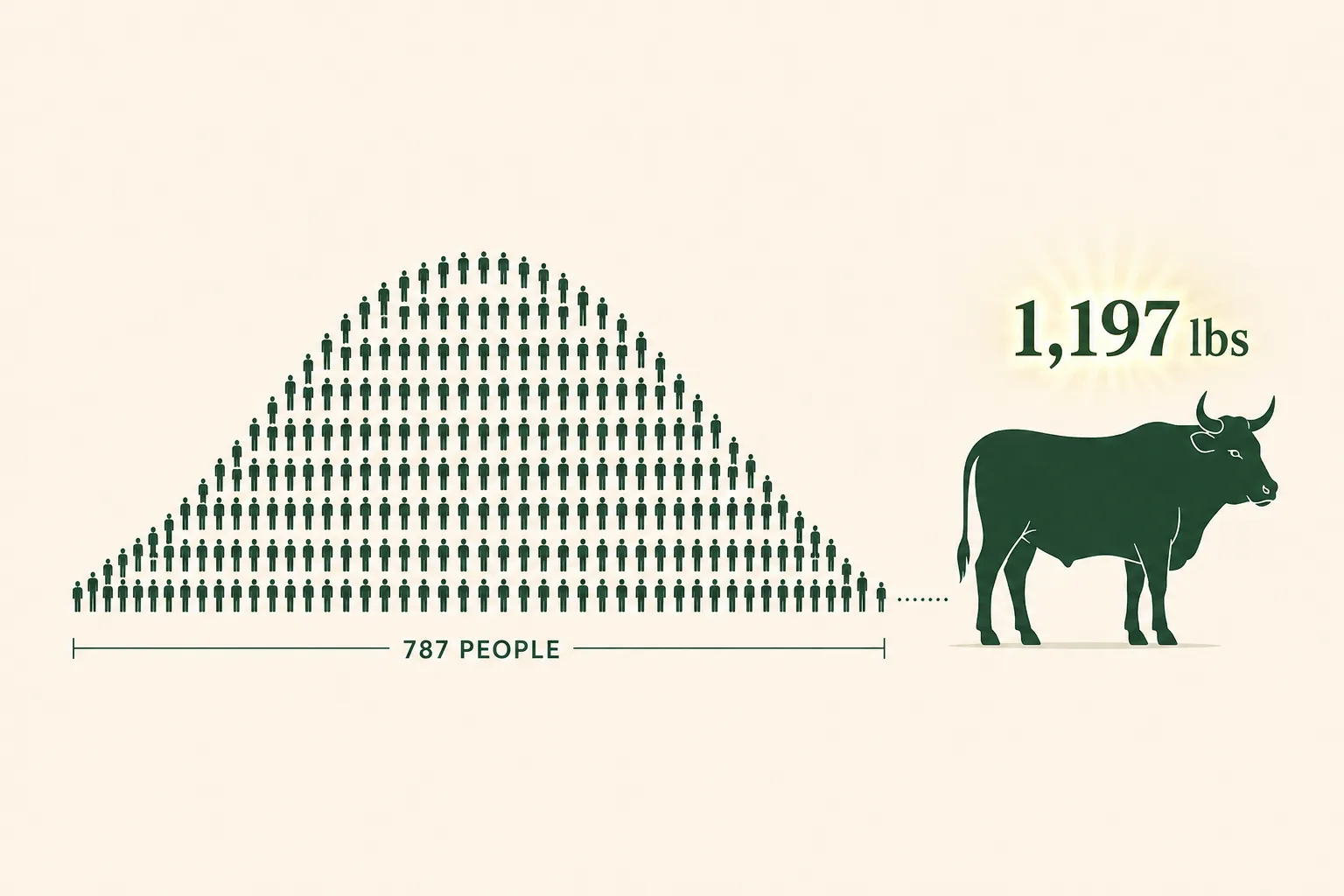
Wisdom of Crowds: Galton's Ox — The 1906 Experiment That Proved Crowds Beat Experts
Francis Galton went to a country fair expecting to prove the average voter hopeless. Instead, the median of 787 guesses at an ox's dressed weight landed within 1% of the truth — better than the cattle experts. The full story of the experiment that founded the wisdom of crowds: the methodology, the statistics, the caveats, and what it means for how teams decide today.

The Condorcet Jury Theorem: The 240-Year-Old Math Behind Better Decisions
In 1785, a French mathematician proved that majorities are almost always right—if each voter is more likely right than wrong. The theorem now powers ensemble AI.
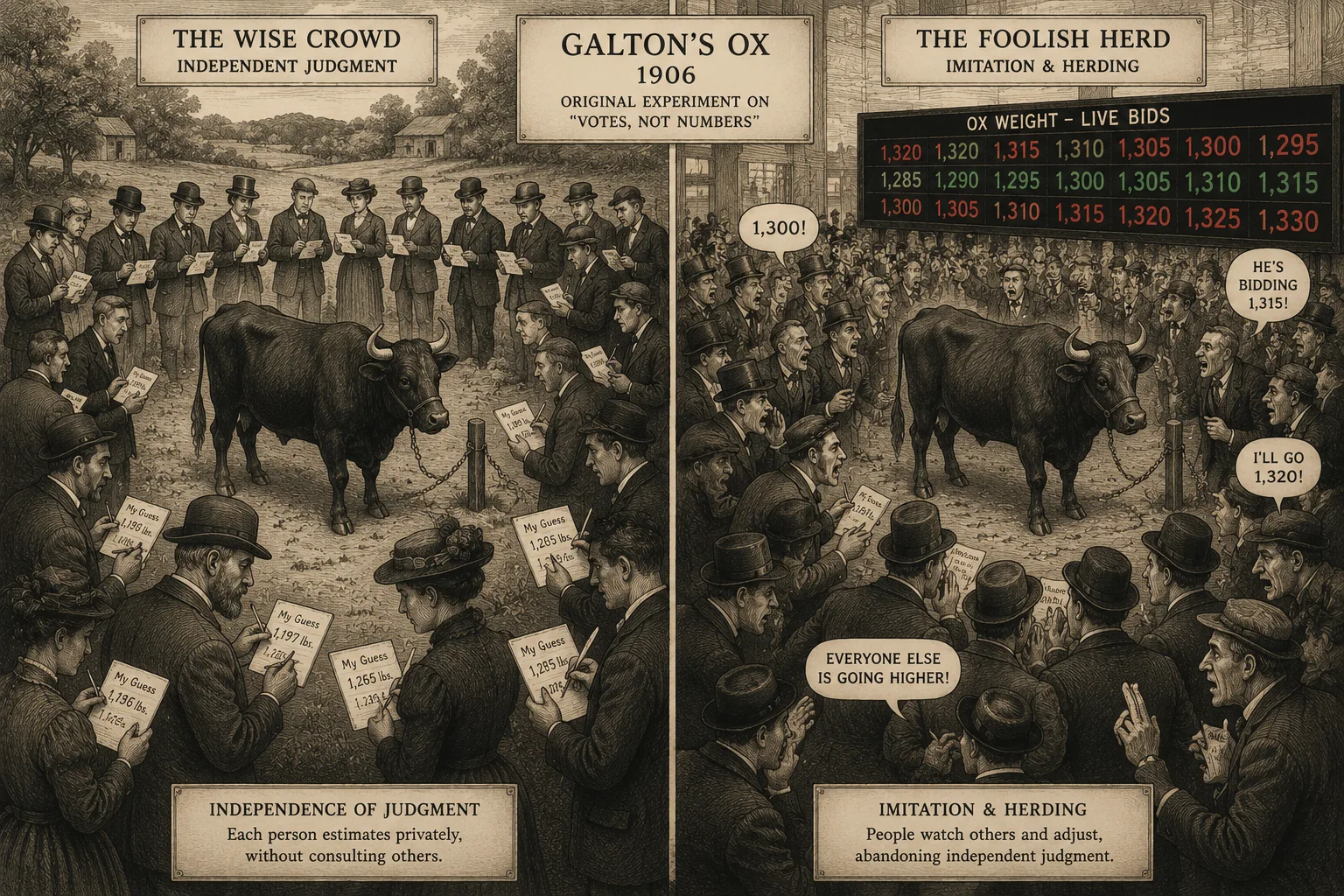
When Crowds Go Wrong: Bubbles, Cascades, and the Madness of Herds
The same crowd dynamics that produce wisdom can produce madness. From tulip mania to Twitter mobs, here's the science of collective failure—and how to prevent it.

The Steel Man: Why the Best Negotiators Argue Against Themselves First
In 2013, Warren Buffett invited a short-seller betting against Berkshire on stage at his own annual meeting—to make the strongest case against him. That's steelmanning. Rapoport's rules, moot courts, McKinsey red teams, the real research—and the trap that makes performed devil's advocacy backfire.

How McKinsey, Bridgewater, and Amazon Turn Disagreement Into Decisions (The Protocol)
Bezos greenlit a show he didn't believe in with six words: "I disagree and commit"—and hoped it would succeed. McKinsey's obligation to dissent, Bridgewater's believability weighting, Amazon's 6-pager: the five structural elements all three share, and how to implement them in your next meeting.
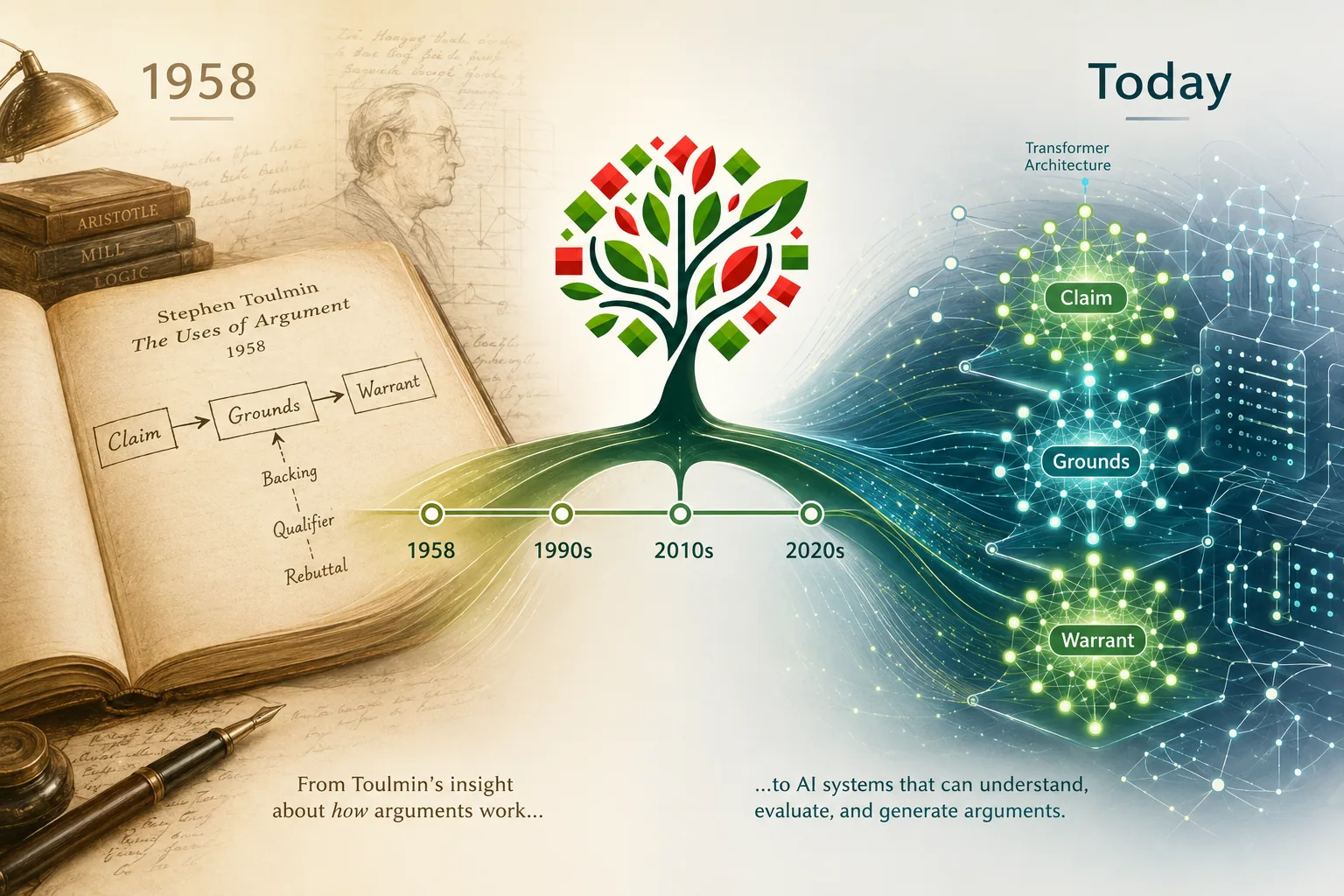
From Toulmin to Transformers: How Argument Mining Became a Technology
In 1958 a philosopher published a book about reasoning that declined to be about formal logic, and was told he had wandered off the map. Sixty years later every system that reads a transcript and tells you what was argued uses his vocabulary. The arc of argument mining: Toulmin's warrant, Walton's critical questions, Freeman's undercut, the corpora that made it measurable, and the one half that never got easier.
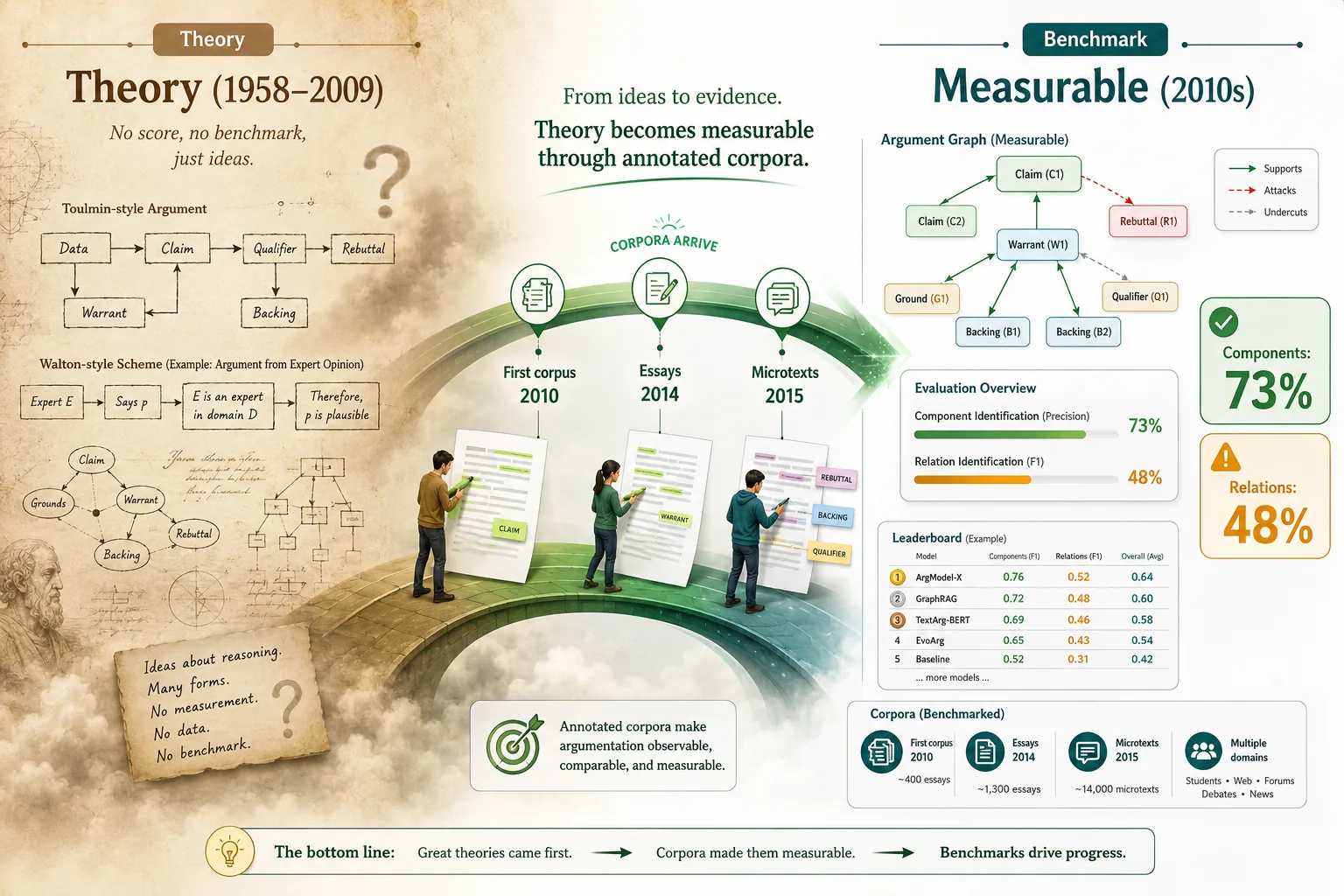
Teaching Machines to Read Arguments: The Decade of Annotated Corpora
Give two trained annotators the same paragraph and ask which sentence is the claim. They often disagree — and that single fact shaped the decade that turned argument mining from a theory into a measurable task. Why inter-annotator agreement is the real ceiling, why genre matters more than volume, and why more data never fixed relation detection.
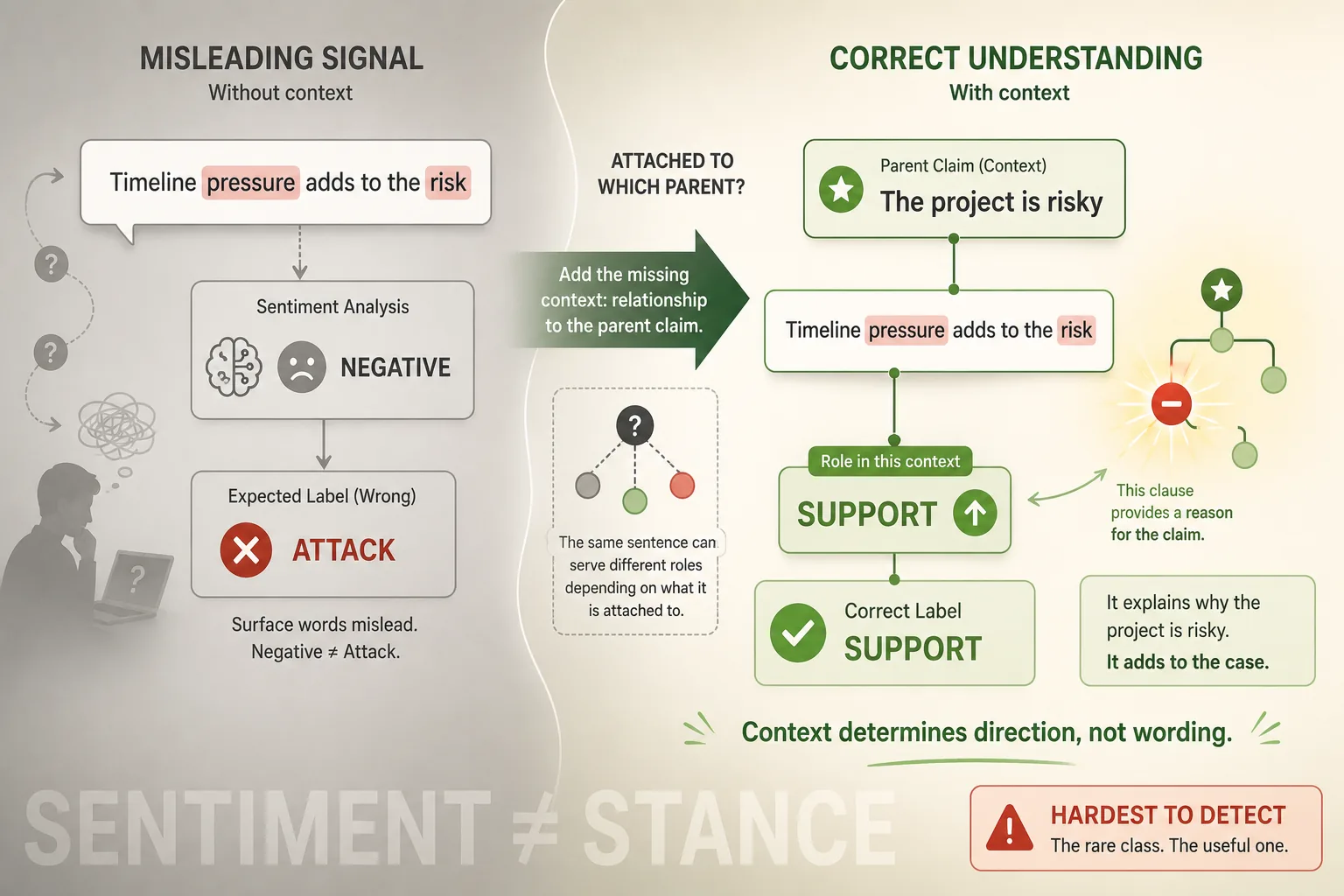
Why Attack Detection Is the Hardest Problem in Argument Mining
Disagreement is a small minority of the annotated data — in some corpora under a tenth of relations. So models learn that guessing agreement is usually safe, which is exactly backwards for the reason you would deploy one. Three structural reasons attack detection resists solution, and why the rare class is the one decisions turn on.
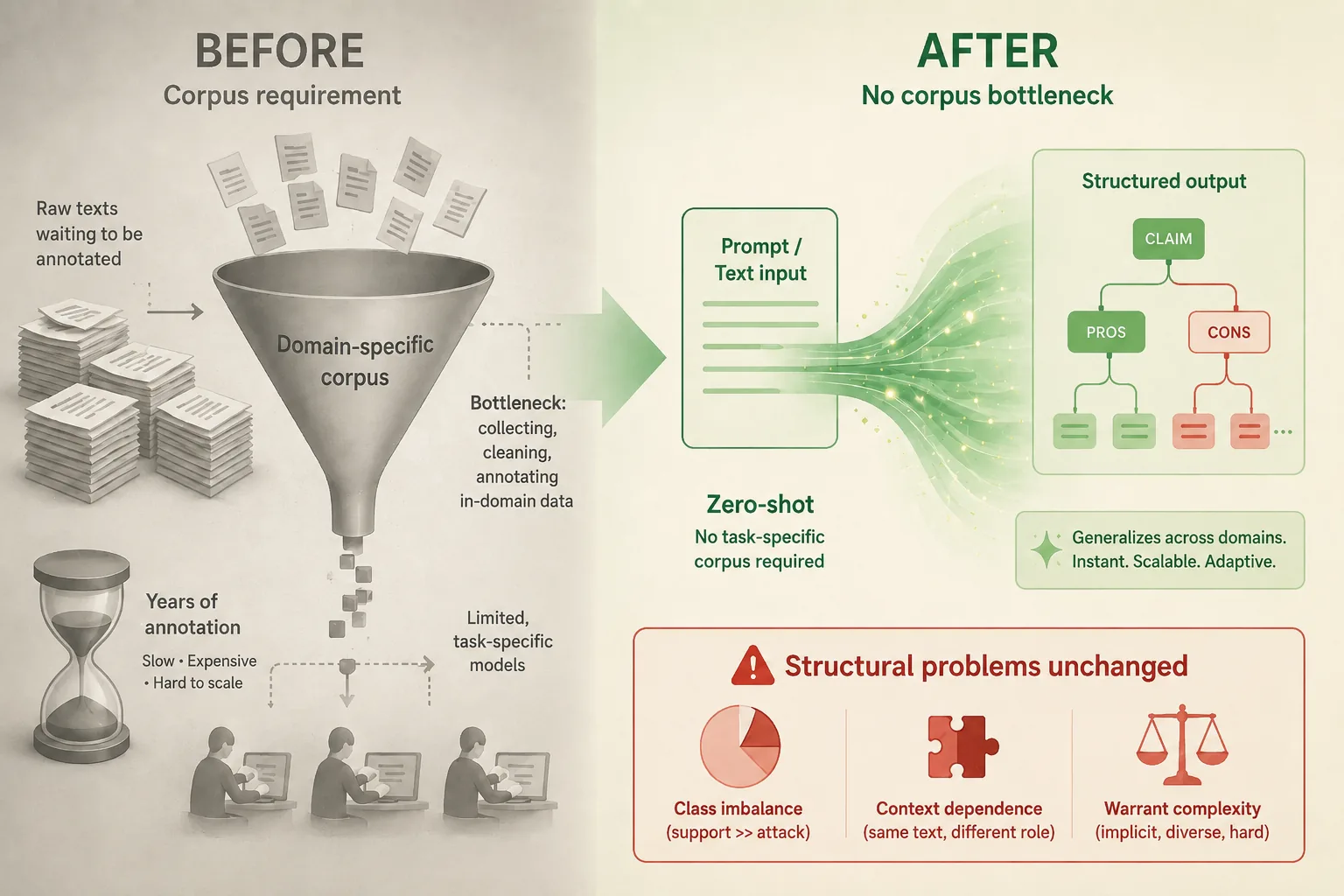
When LLMs Met Argument Mining: What Changed and What Didn't
For twenty years the answer to 'can we run argument mining on our data?' was another question: how many thousands of documents will you have annotated first? Large language models made that question stop being asked. What the corpus bottleneck's collapse actually changed, what it left exactly where it was, and the new trap that arrived wearing the costume of a solution.
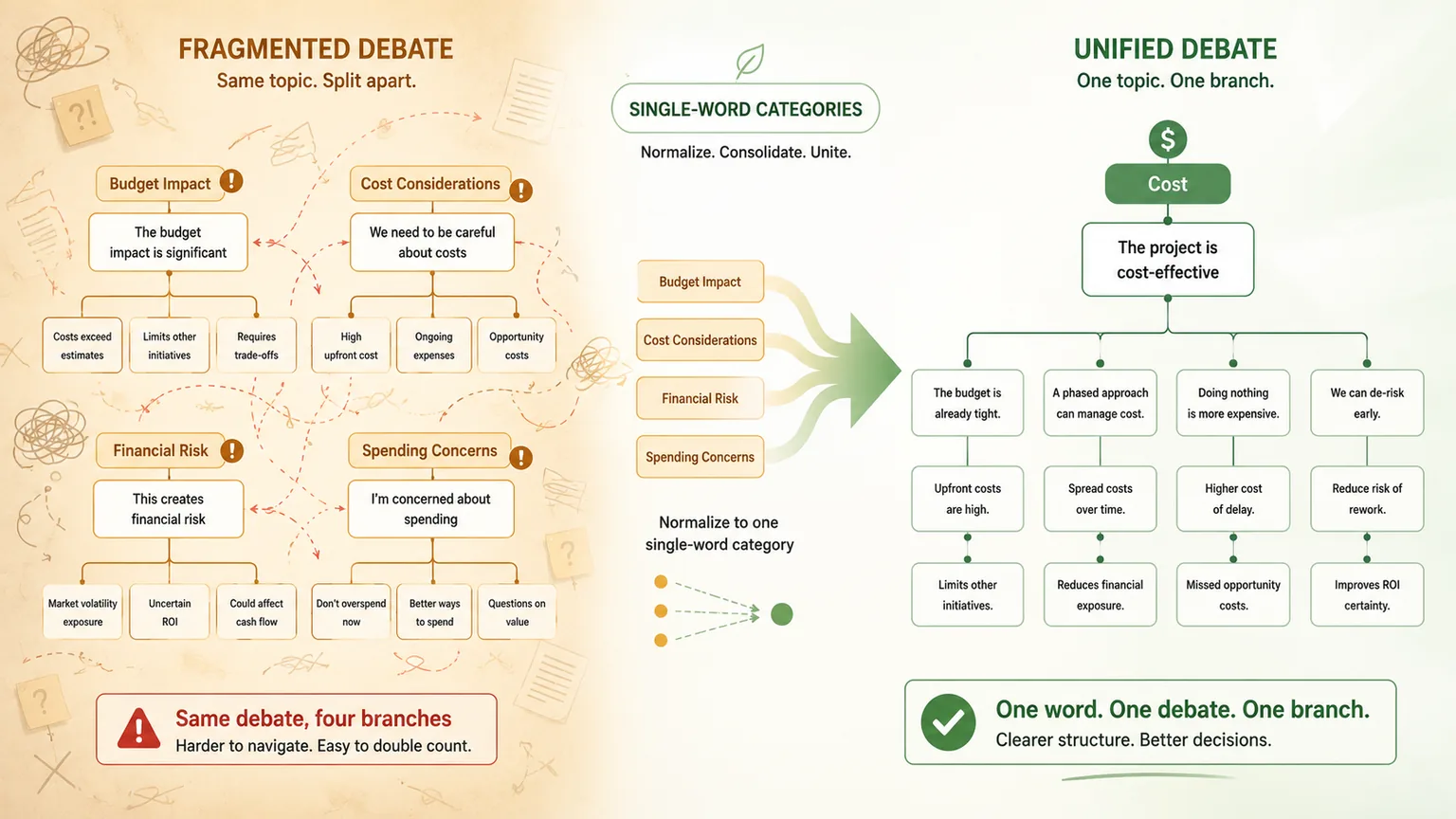
How Argumentree Turns a Transcript Into an Argument Tree
Feed a budget meeting into an extraction engine and ask which argument mattered most, and it hands you a statistic — which is exactly wrong. A high-level look at how we apply argument mining: why discussions get sorted into single-word categories, why exactly one argument per category becomes the main claim, why the model's own confidence is the wrong way to pick it, and why nothing survives that isn't quoted from your source.
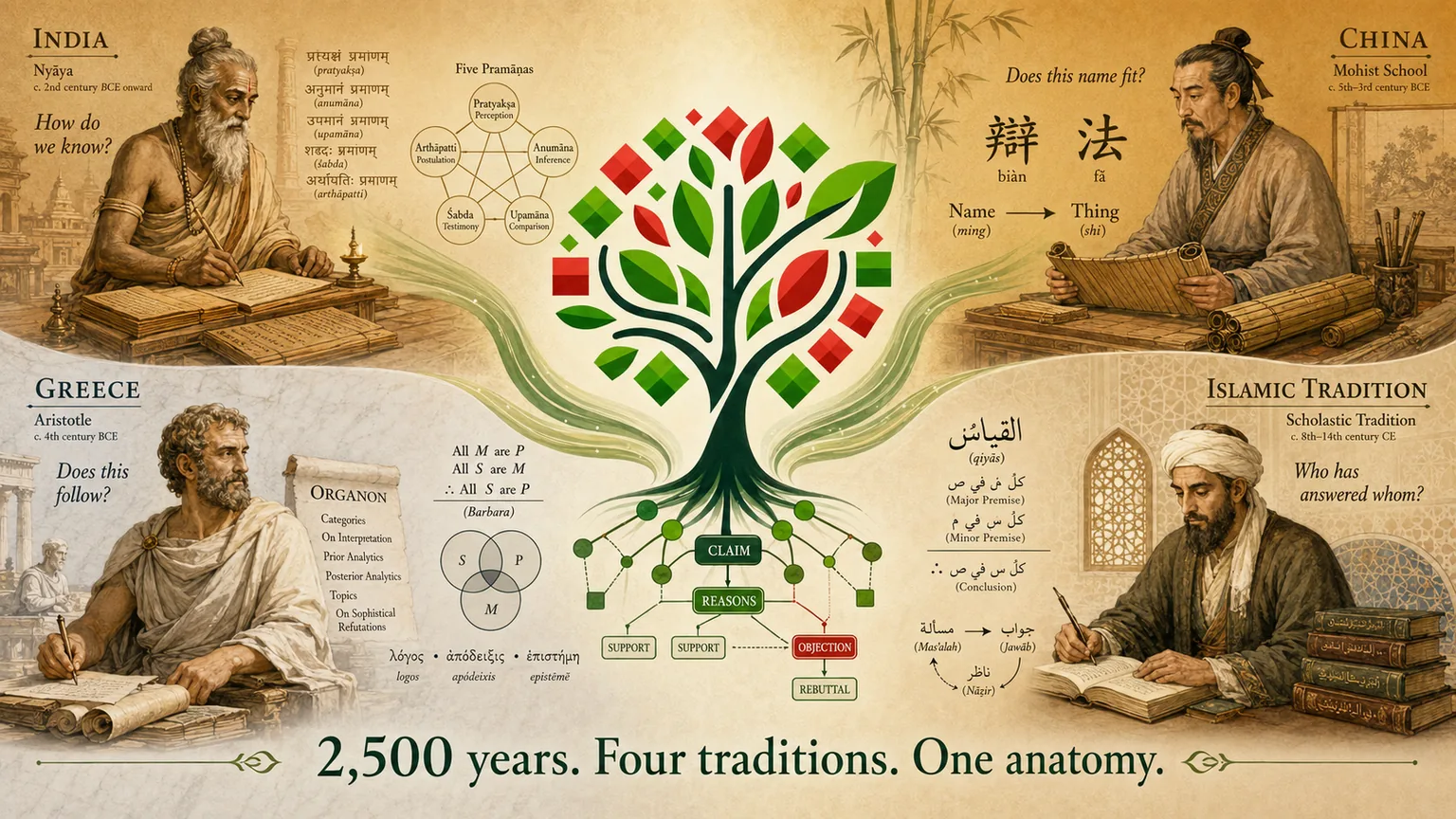
The Global Roots of Reasoned Argument: How Three Civilizations Invented Logic
Logic was not invented once. Between the 6th and 4th centuries BCE, India, China, and Greece independently developed sophisticated systems for structured argumentation — and later, Islamic scholars synthesized Greek logic with indigenous debate traditions. This is the hub of the Roots of Reasoning series: why the parallel emergence matters, what each tradition contributed, and what the global history teaches us about how to argue well.
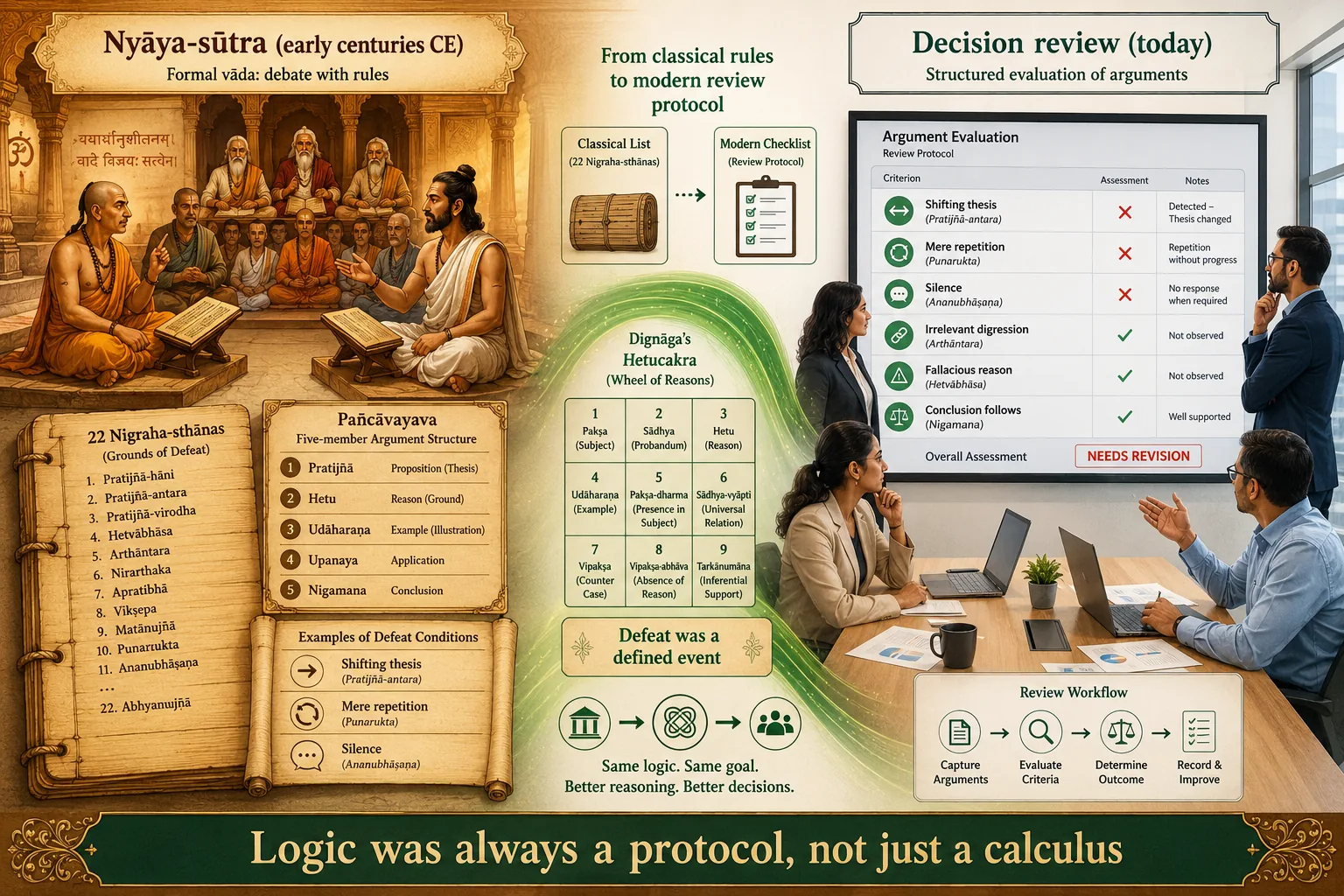
Indian Logic: The 2,500-Year Tradition from Nyāya to Buddhist Debate
Indian debate theory is old, institutional, and startlingly procedural: the Nyāya-sūtra lists 22 named ways to lose an argument. The five-member syllogism was built for public contest, not private proof. Dignāga's wheel of reasons is a nine-cell matrix that separates good evidence from bad. Buddhist prasaṅga, the tetralemma, and Jain seven-fold qualification round out a toolkit the West largely never built.
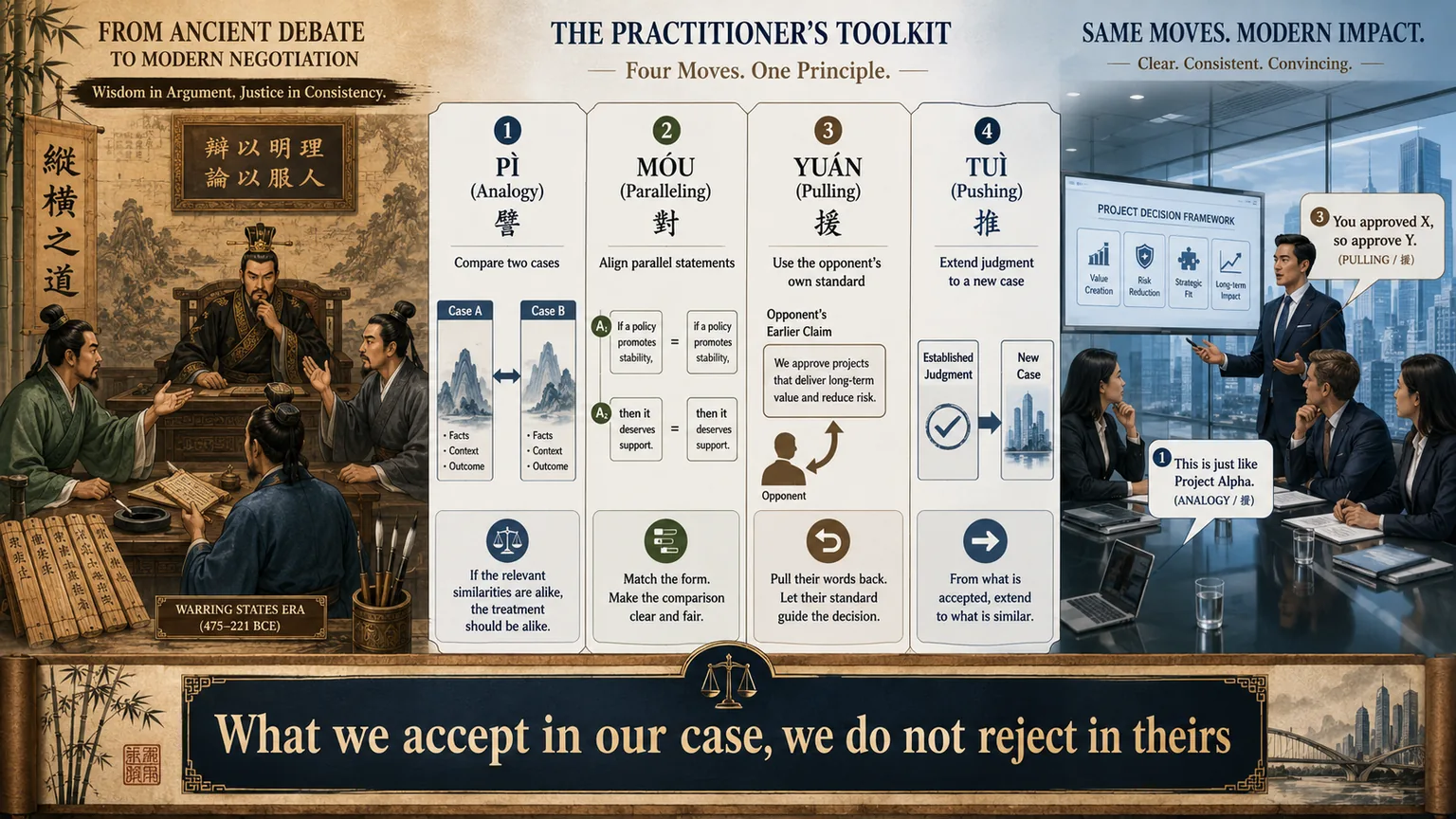
Mohist Logic: The Chinese Art of Drawing Distinctions
Classical Chinese thought developed argumentation without a formal syllogistic. The Mohist school analyzed disputation (biàn), analogy, and the correct application of names with precision the Western tradition largely lacks. Where Greek logic asked 'Does this follow?', Mohist logic asked 'Is this name correctly applied?' — a different question with different tools. Here's why Chinese logic took a different path, and what it offers today.
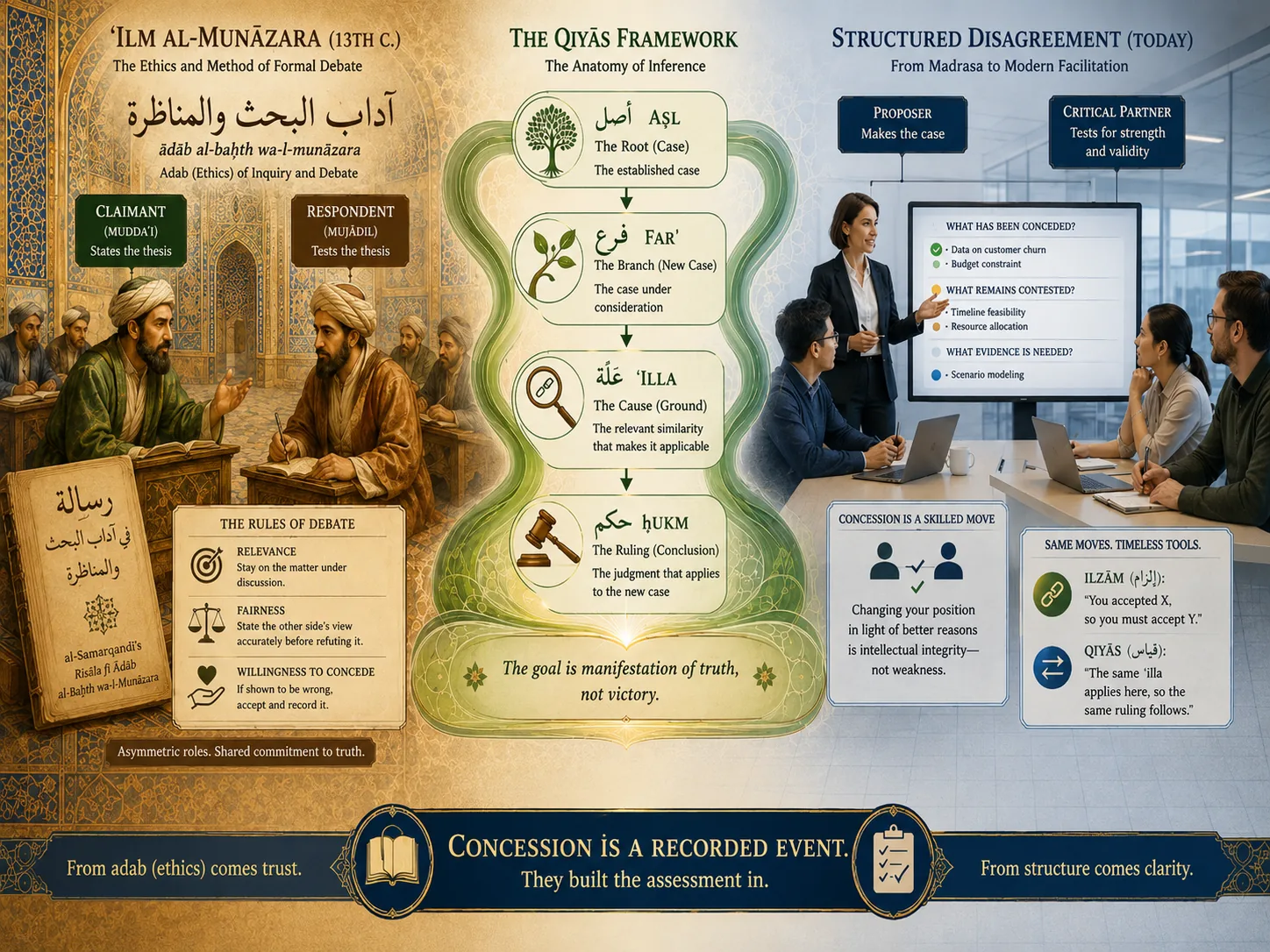
Islamic Dialectics: From Theological Debate to the Science of Disputation
Islamic philosophy did not just preserve Greek logic — it synthesized it with indigenous traditions of theological and legal debate to produce something new. Kalām (theology), qiyās (legal analogy), jadal (dialectic), and ultimately ʿilm al-munāẓara (the science of disputation): formalized rules for structured debate that anticipate modern argumentation protocols. Here's the tradition that transmitted Aristotle and transformed him.
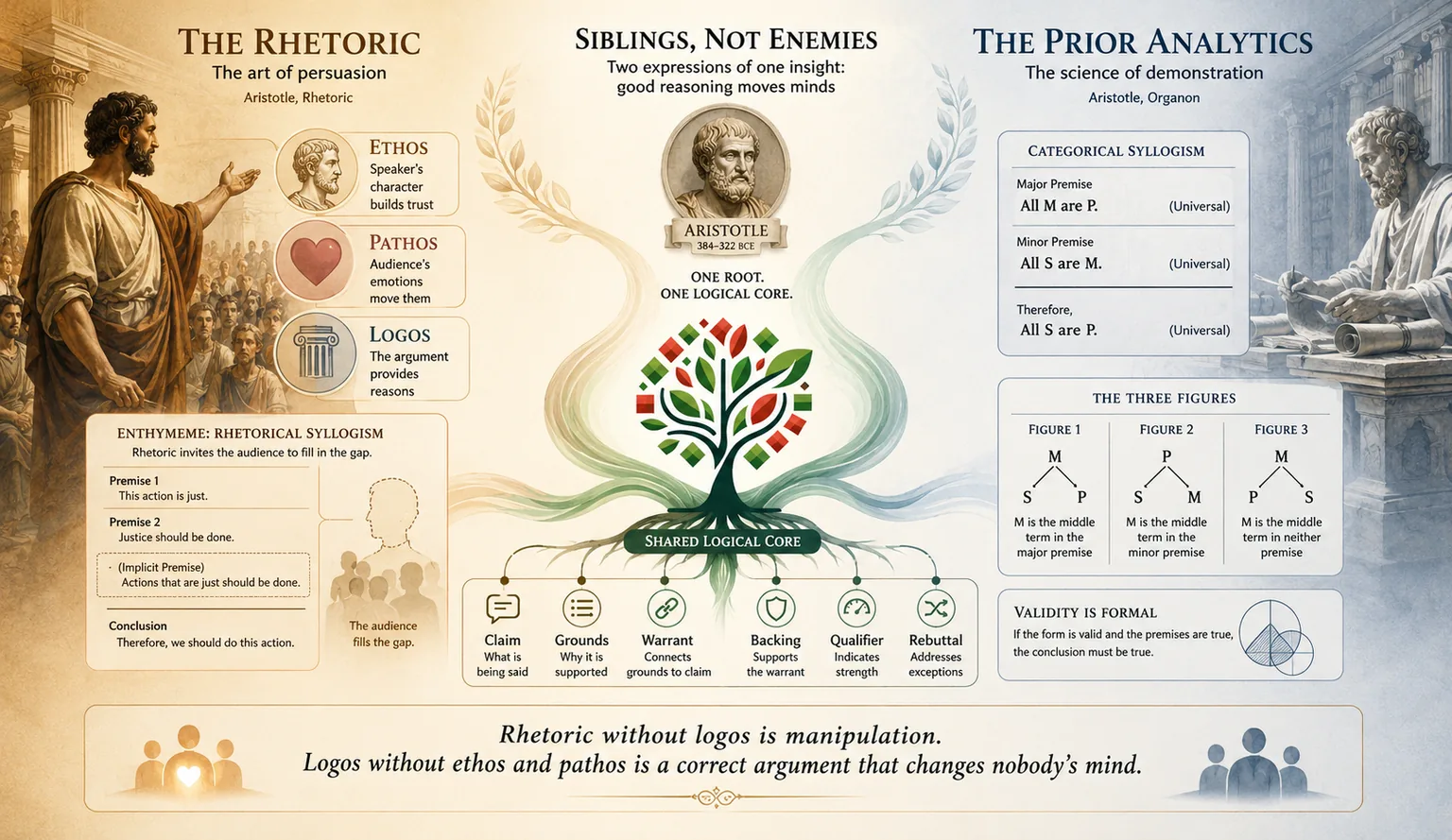
Aristotle's Logic: The Mediterranean Foundation of Western Argument
Aristotle created the formal study of logic in the Western tradition. His Organon — covering categories, syllogisms, demonstration, dialectic, and fallacies — remained the basis of logical education for two millennia. The Rhetoric added the three appeals (ethos, pathos, logos). But what did Aristotle actually build, what came before him, and what did he miss? Understanding the dominant framework is essential to seeing its limits.
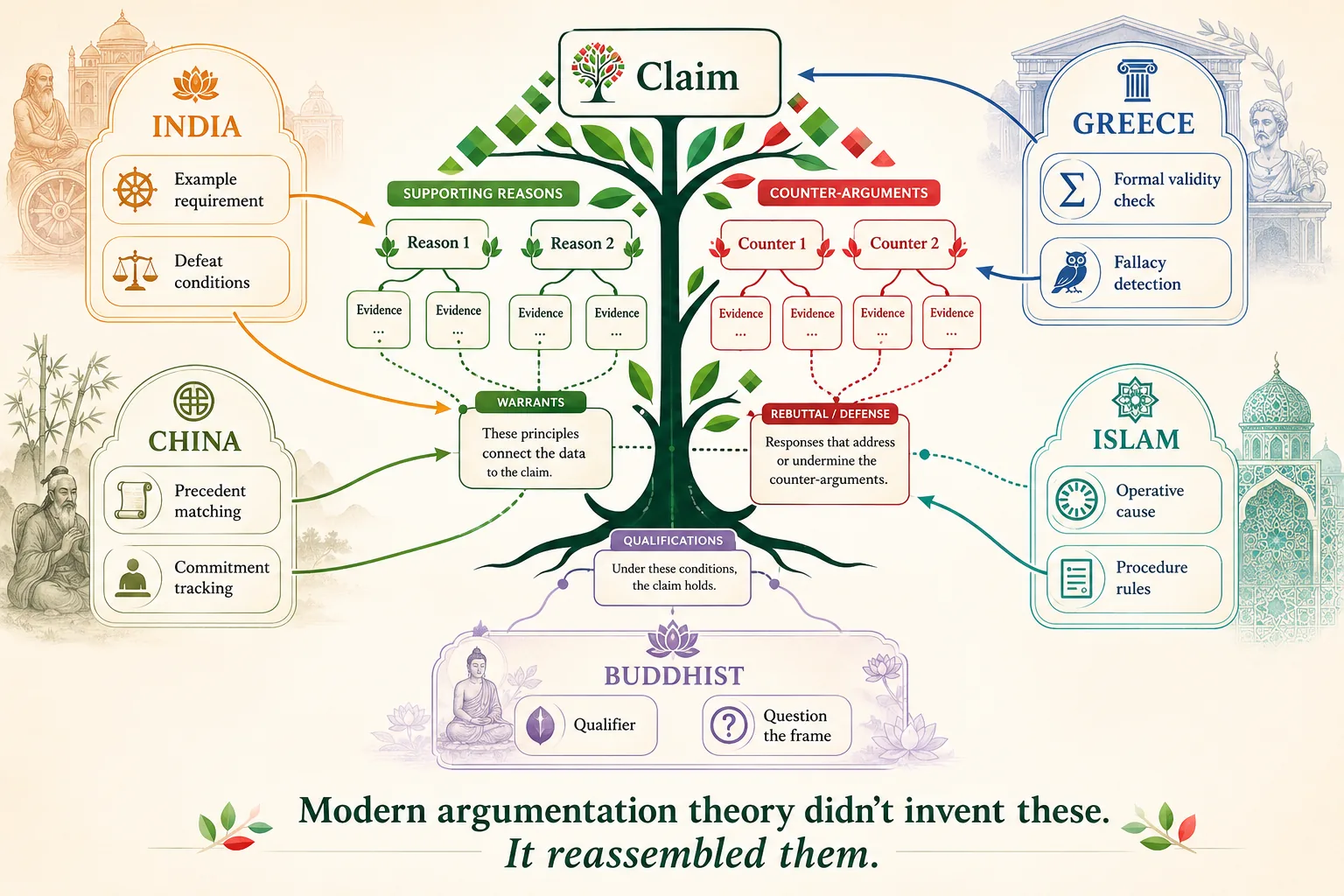
Five Syllogisms: Comparing Argument Structures Across Civilizations
The Indian five-member syllogism, the Greek three-member syllogism, Mohist argument from analogy, Islamic qiyās, and the Buddhist tetralemma — five civilizations developed five distinct structures for valid argument. Comparing them reveals that Aristotelian logic is powerful but incomplete, and that the global history of argumentation offers a fuller toolkit for reasoning than any single tradition provides.
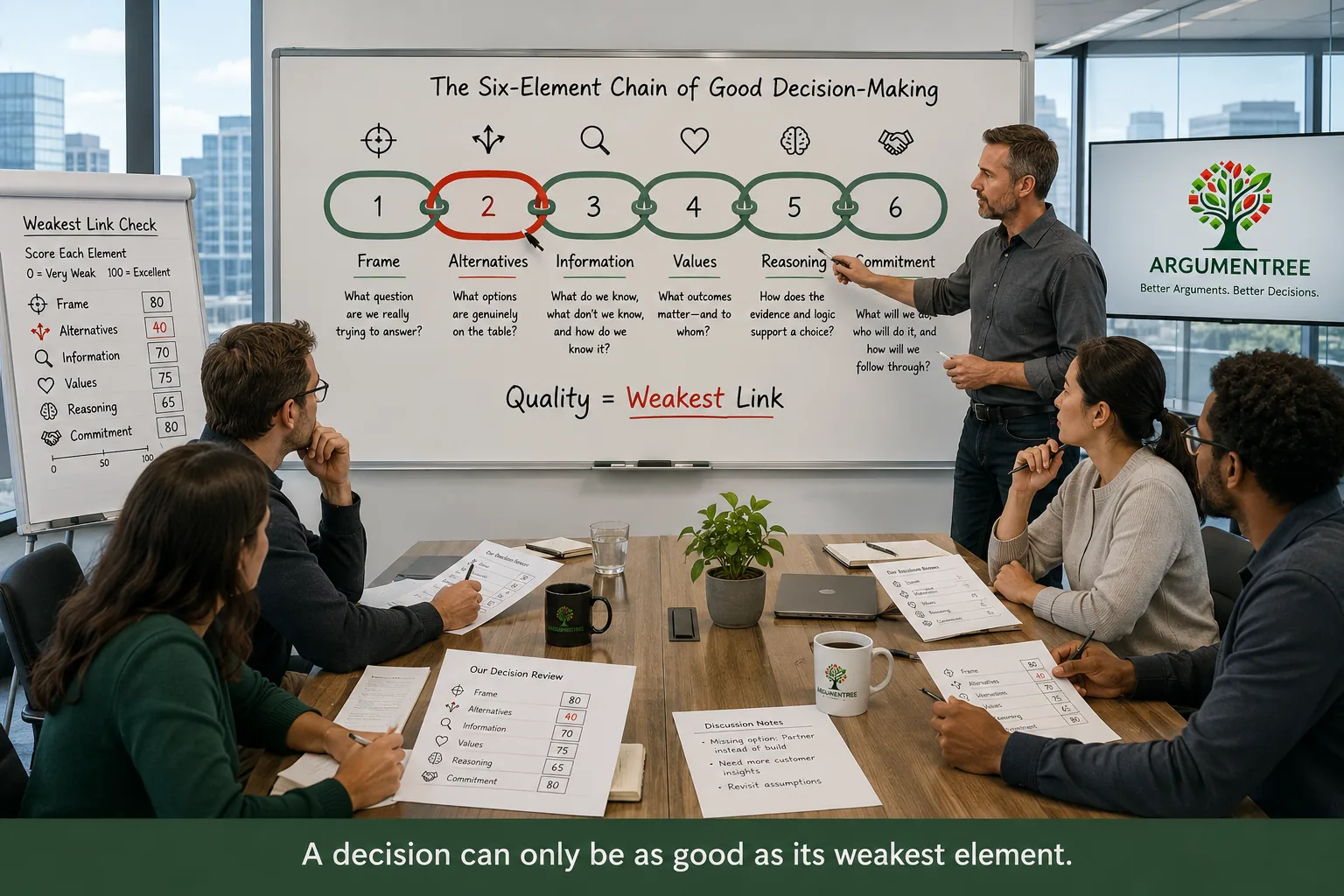
Decision Quality: The Six Elements of a Good Decision — Before You Know the Outcome
The worst play call in Super Bowl history was arguably a good decision — and that confusion has a name. Decision quality, the Stanford-lineage framework formalized by Carl Spetzler, judges decisions by six elements at the moment they're made: frame, alternatives, information, values, reasoning, commitment. The chain rule (quality = weakest link), the resulting trap, a 15-minute weakest-link check, and how improving the decision process mechanically improves the decision quality.
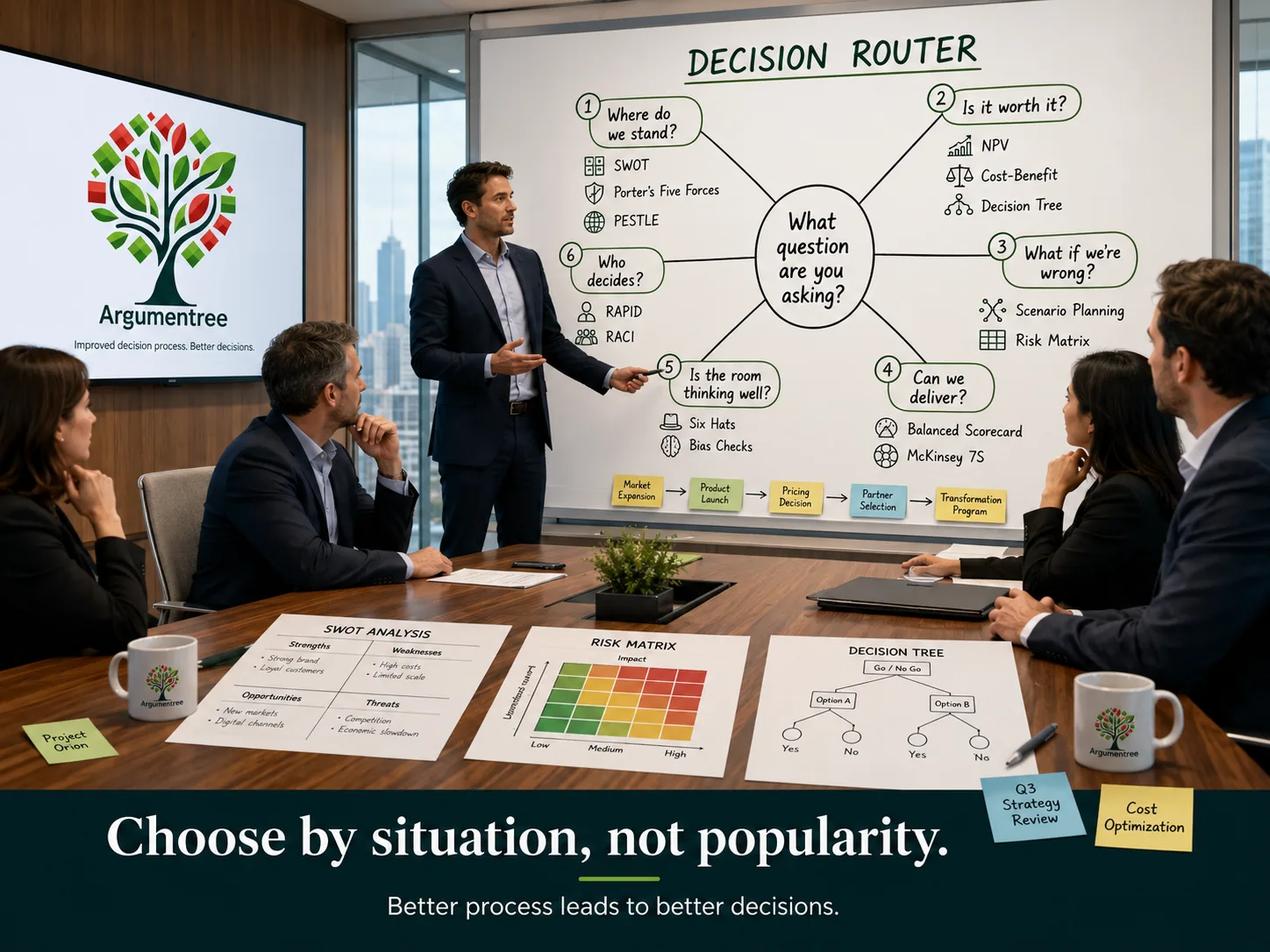
Business Decision Frameworks: Which One to Use, When — The Complete Chooser's Guide
The most-used framework in business — SWOT — has no verified inventor, and it never mattered: frameworks spread because they're useful containers. This chooser routes all of them by decision situation: strategic position (SWOT, PESTLE, Five Forces, BCG), money (CBA, NPV, decision trees, real options), uncertainty (scenario planning, ERM), execution (balanced scorecard, 7S, PDCA), group thinking (Six Hats, prospect theory), and roles (RAPID). Plus the master which-framework-when table — and the step every template skips.
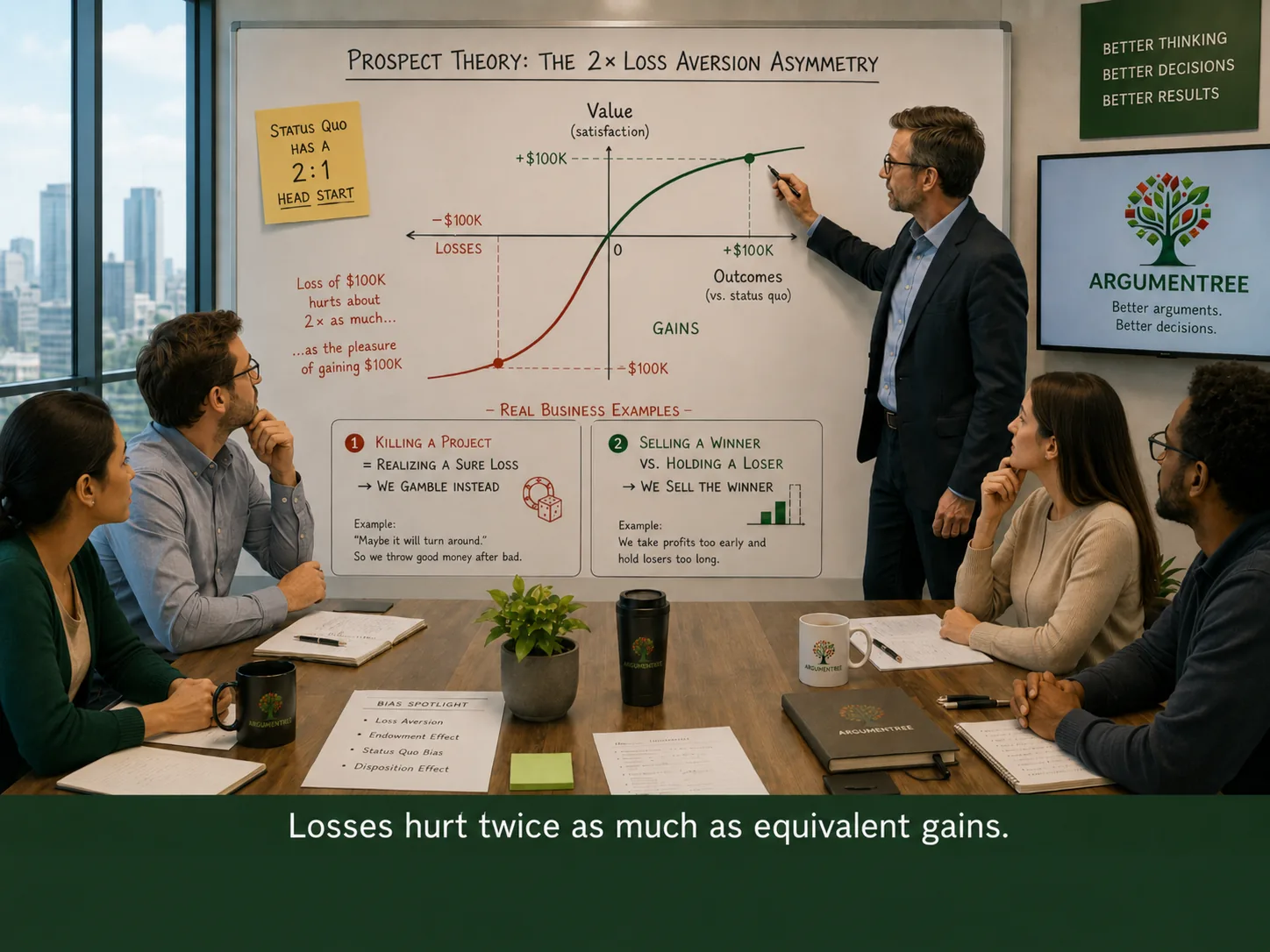
Prospect Theory: Why Your Team Fears Losses Twice as Much as It Values Wins
In Tversky and Kahneman's 1981 experiment, rewording a life-and-death choice from lives saved to lives lost flipped the majority — 72% chose safety in one frame, 78% chose the gamble in the other. Same outcomes, opposite decisions. The theory behind the flip, where it bites in business (doubling down, the disposition effect, the endowment effect), the honest state of the replication debate, and the frame-flip technique that defends your decisions.

Real Options: Why Keeping the Door Open Is a Decision Too
In 1994, Merck's CFO told Harvard Business Review the company priced its research pipeline with option mathematics — because a drug program is a chain of rights-to-continue, not one all-or-nothing bet. Real options thinking: the six option types hiding in your roadmap, why uncertainty flips from enemy to asset when downside is capped, the post-dotcom abuse that gave the method a bad name, and the kill-criteria discipline that keeps it honest.
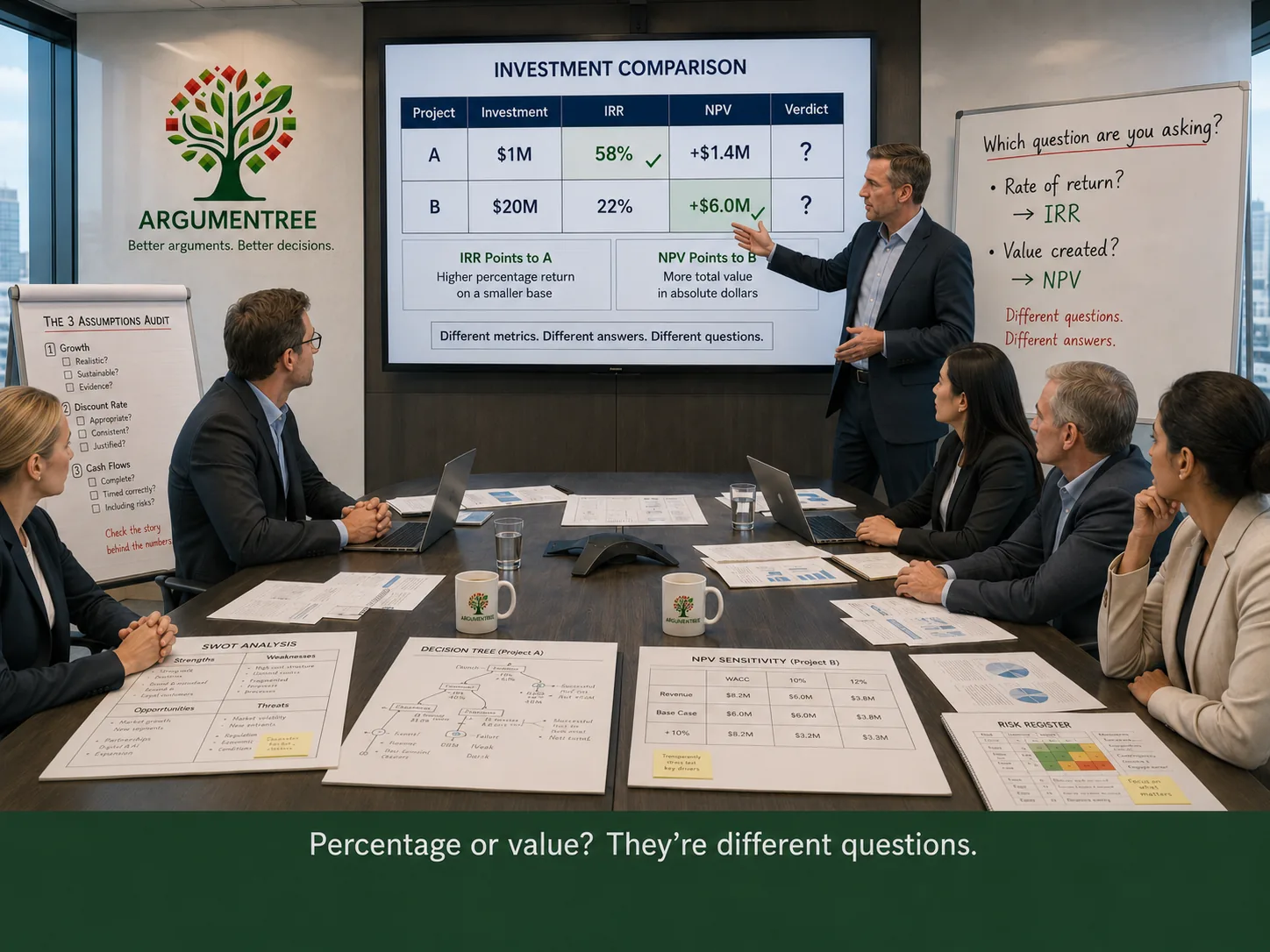
NPV Says Yes. Should You? What Discounted Cash Flow Can't Tell You
About three-quarters of CFOs run on NPV and IRR (Graham & Harvey, 2001) — and the two metrics can pick opposite winners from the same project list. IRR's reinvestment fantasy and scale blindness, NPV's hidden judgment calls (discount rate, terminal value, sponsor-authored base cases), why ditching DCF is the wrong lesson, and the three-assumption audit that turns any model into an arguable case in fifteen minutes.
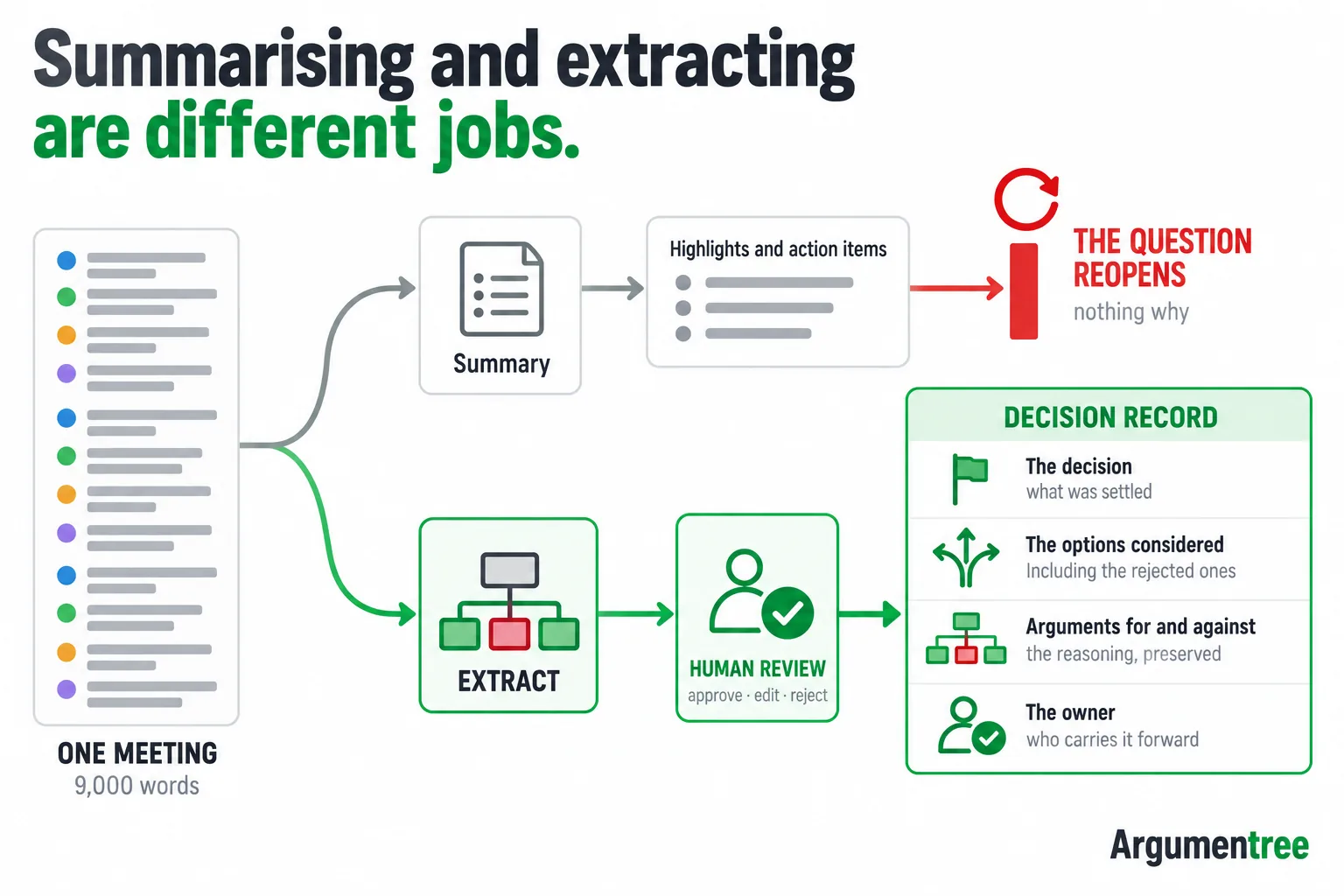
How to Extract Decisions From Meeting Transcripts (Not Just Summarize Them)
A transcript and an AI summary capture what was said — not what was settled and why. The four things to pull out of a transcript, twenty years of meeting-speech research on why that is hard, and how AI extraction with a human in the loop builds the record instead of another recap.

Sam Altman's WHAT vs HOW: The 5% of CEO Time That Actually Matters
Sam Altman splits the CEO job into 5% deciding WHAT and 95% making it happen — and runs OpenAI with, in his words, no master plan beyond great models and good products. The verified 2018 quote and its 2025 sequel, the Playground story that became ChatGPT, four practices for making the split work, and where Roger Martin and Mintzberg push back.

How to Document Decisions So They Actually Stick (and Stop Getting Re-Argued)
Roles are not records: RAPID, DACI and RACI assign who decides — none of them preserves what was decided and why. The definitive how-to: the seven-field decision record, the ADR practice it builds on, the habits that make it stick, and the mistakes that kill it.

Meeting Minutes vs a Decision Log: Why One Rots and the Other Is Your Institutional Memory
Minutes are organized by meeting; a decision log is organized by decision — and that difference decides which questions your organization can answer a year later. Where minutes genuinely win, where the log does, and how to run both without double bookkeeping.

Action Item vs. Decision: Why Your Meeting Notes Capture the Wrong Thing
An action item closes when the work is done; a decision stays load-bearing for years. Teams store the disposable artifact meticulously and lose the durable one — the task-level boundary, why the ticket thread is not a record, and the one-line fix.
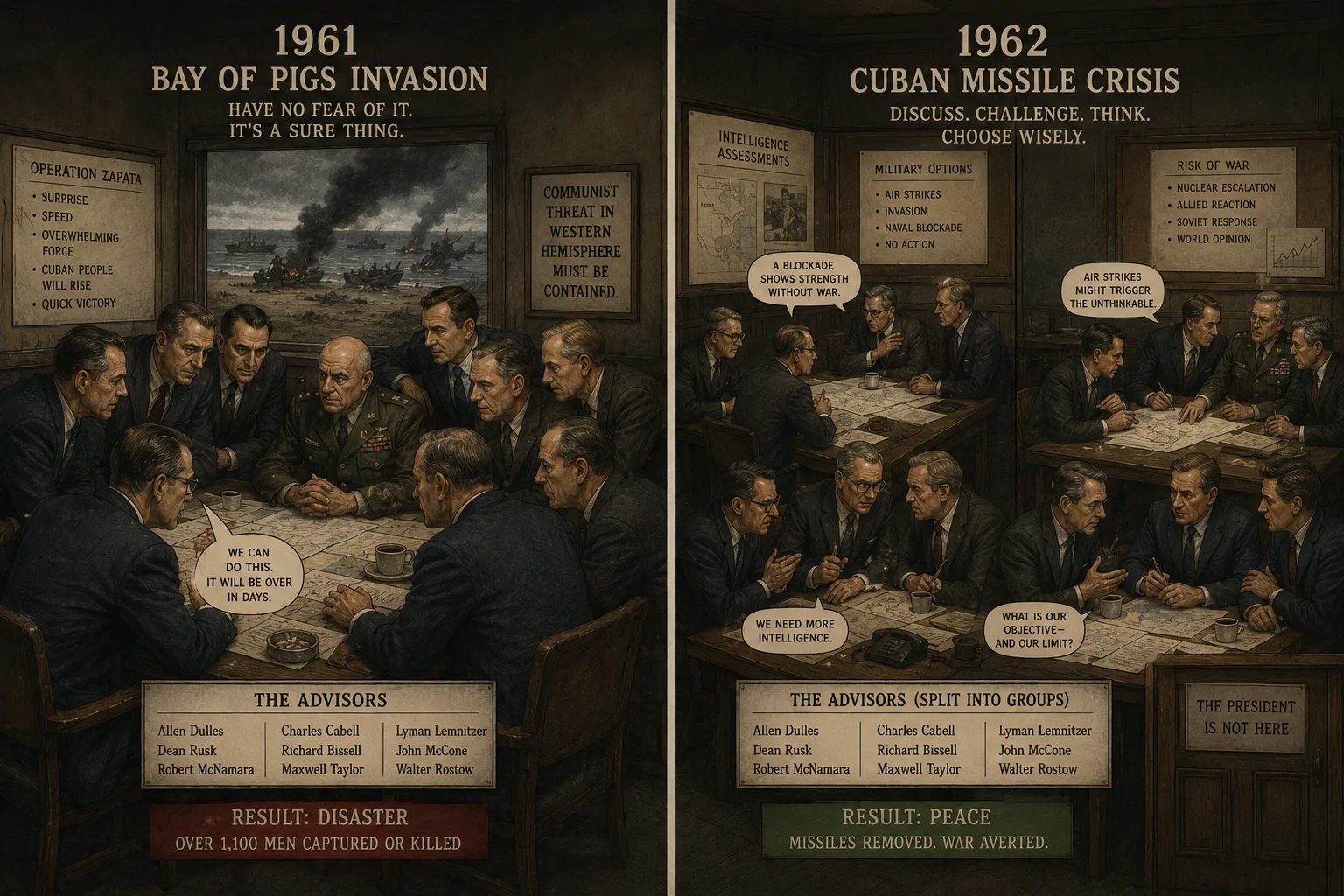
How to Avoid Groupthink: Build Structured Dissent Into Every Decision
The Bay of Pigs advisers weren't stupid — and eighteen months later the same men ran one of the century's best-deliberated decisions. Five structural countermeasures (leader speaks last, authentic dissent over assigned devil's advocates, red teams, pre-mortems, recorded dissent), plus what the research honestly supports.

Decision Fatigue in Teams: Why Your Last Decision of the Day Is Your Worst
Ego depletion failed its 23-lab replication and the hungry-judges study has a live methodological dispute — this post tells you honestly, then shows why the team fixes work anyway: big decisions first, trivial choices batched, and never a major call in an overrunning meeting's last five minutes.
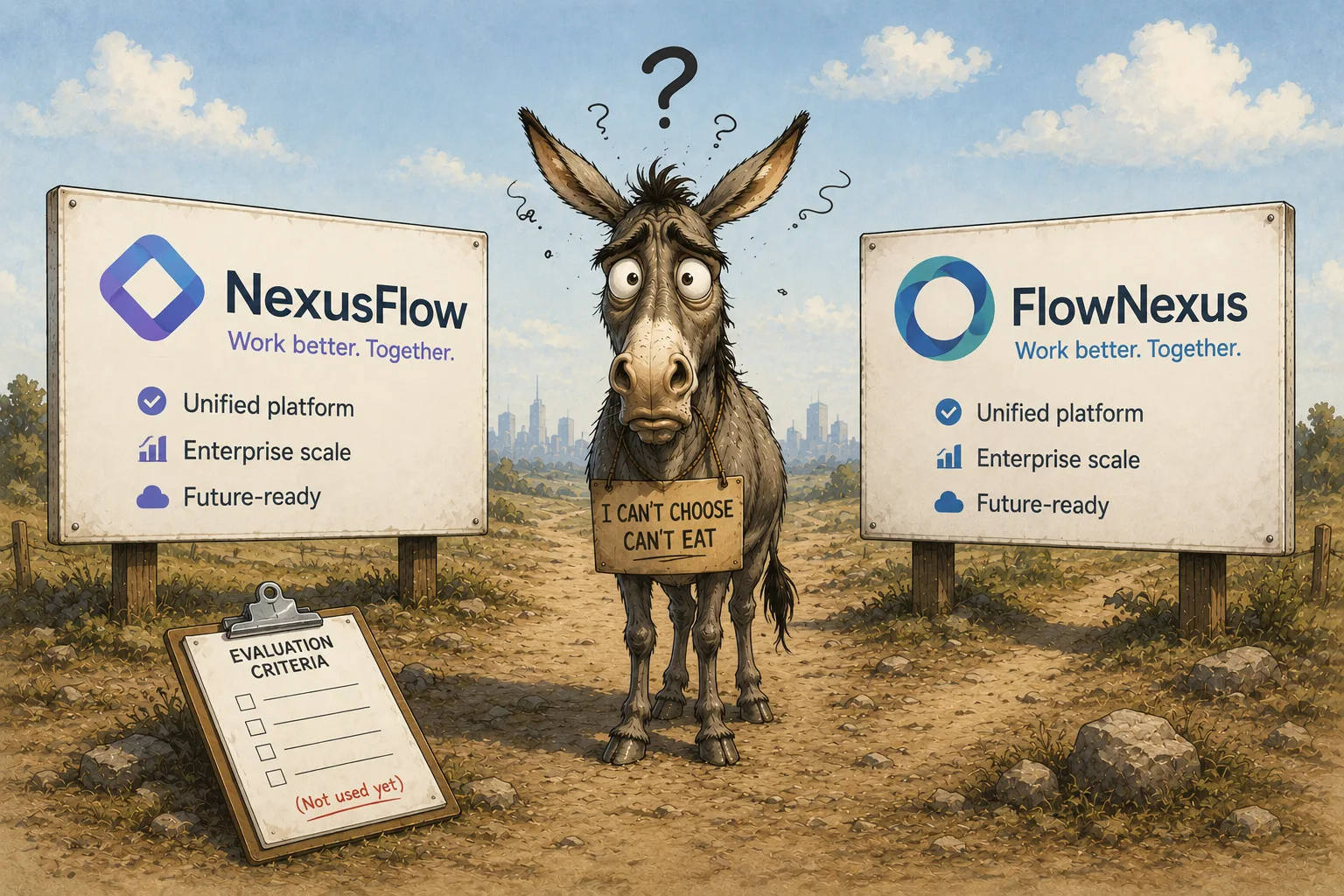
The Paradox of Choice: Why You Can't Make the Decision That Matters
The jam study made choice overload famous; a 50-experiment meta-analysis found the average effect near zero; a second meta-analysis found it real under four conditions — which describe your team's big decisions exactly. The honest research arc, a correctly attributed donkey, and the five fixes for deferral.

Consent vs. Consensus: The Objection Test That Changes How Groups Decide
Consensus asks if you agree; consent asks if you can argue against it — and the objection-vs-concern distinction is the mechanic that makes the difference work. Plus the awkward fact the frameworks skip: Sociocracy 3.0 and Holacracy define the objection test differently, so write yours down.

How to Make Better Decisions: Strategies, Biases, and Frameworks That Actually Work
Only 20% of executives say their organizations excel at decision making — while half spend a third of their time deciding. The gap is process, not intelligence: five moves — sort by reversibility, frame before options, structure the deliberation, decide by protocol, record and review — each with its deep-dive linked.

DAO Governance Best Practices: From Chaos to Consensus
Beanstalk lost $182M through governance that worked exactly as coded; Tornado Cash was captured by a proposal; Compound's whale vote passed 51/49 — and the empirical record says the quiet failures cost more. The five pillars the documented attacks wrote, with every claim sourced.

Herbert Simon Won a Nobel Prize for Proving You Can't Make Perfect Decisions. Here's What to Do Instead.
The 1978 economics Nobel went to the man who proved the rational decision-maker of the textbooks does not exist. The three constraints, organizations as cognitive architecture, and the 2025 studies showing LLMs are bounded too.
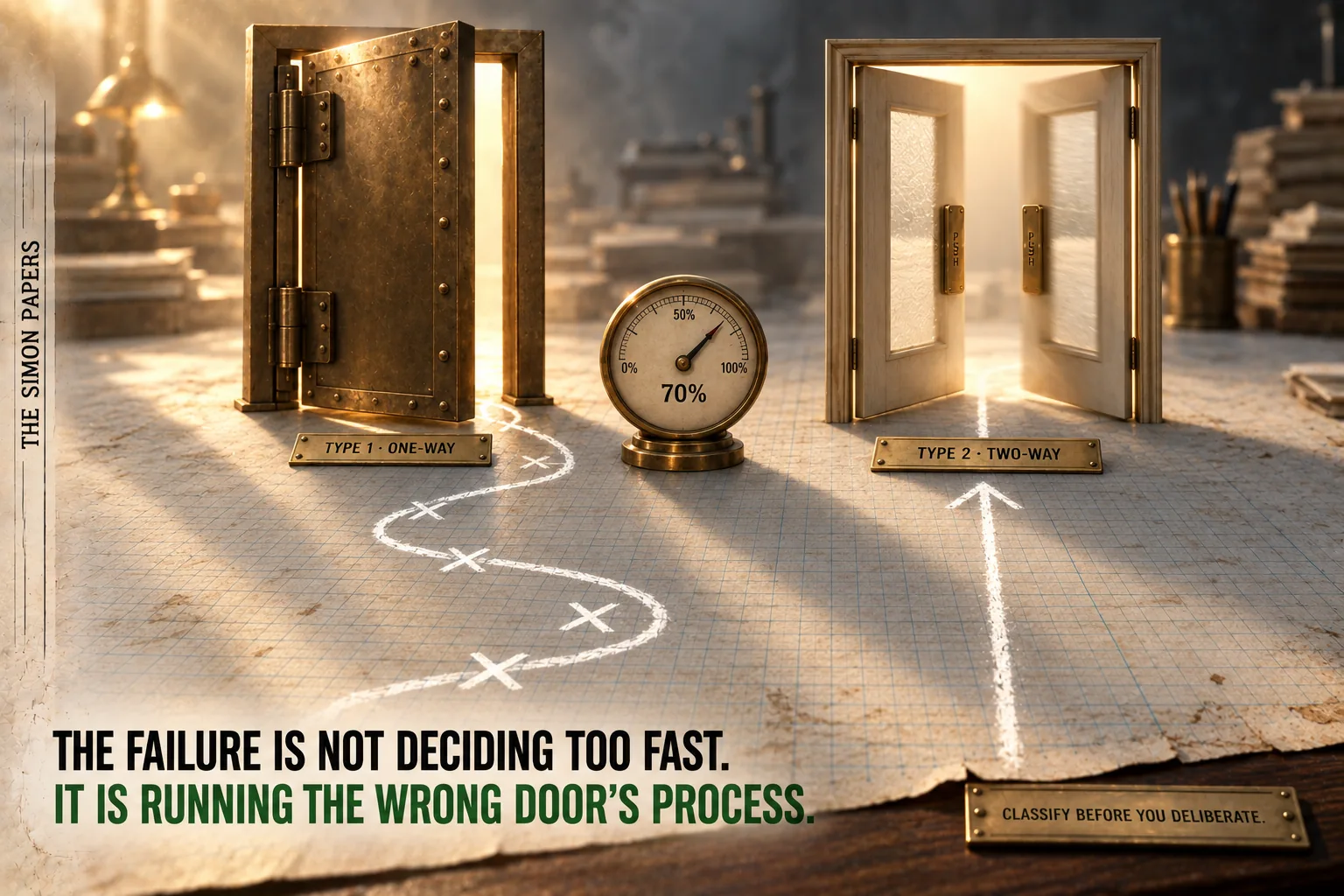
Stop Searching for the Perfect Decision. Nobel Prize Research Says "Good Enough" Wins.
Job-search maximizers earned 20% more and felt worse about it. How to satisfice deliberately: the five-step framework, the 37% optimal-stopping rule, and the one-way/two-way door test for when to maximize instead.
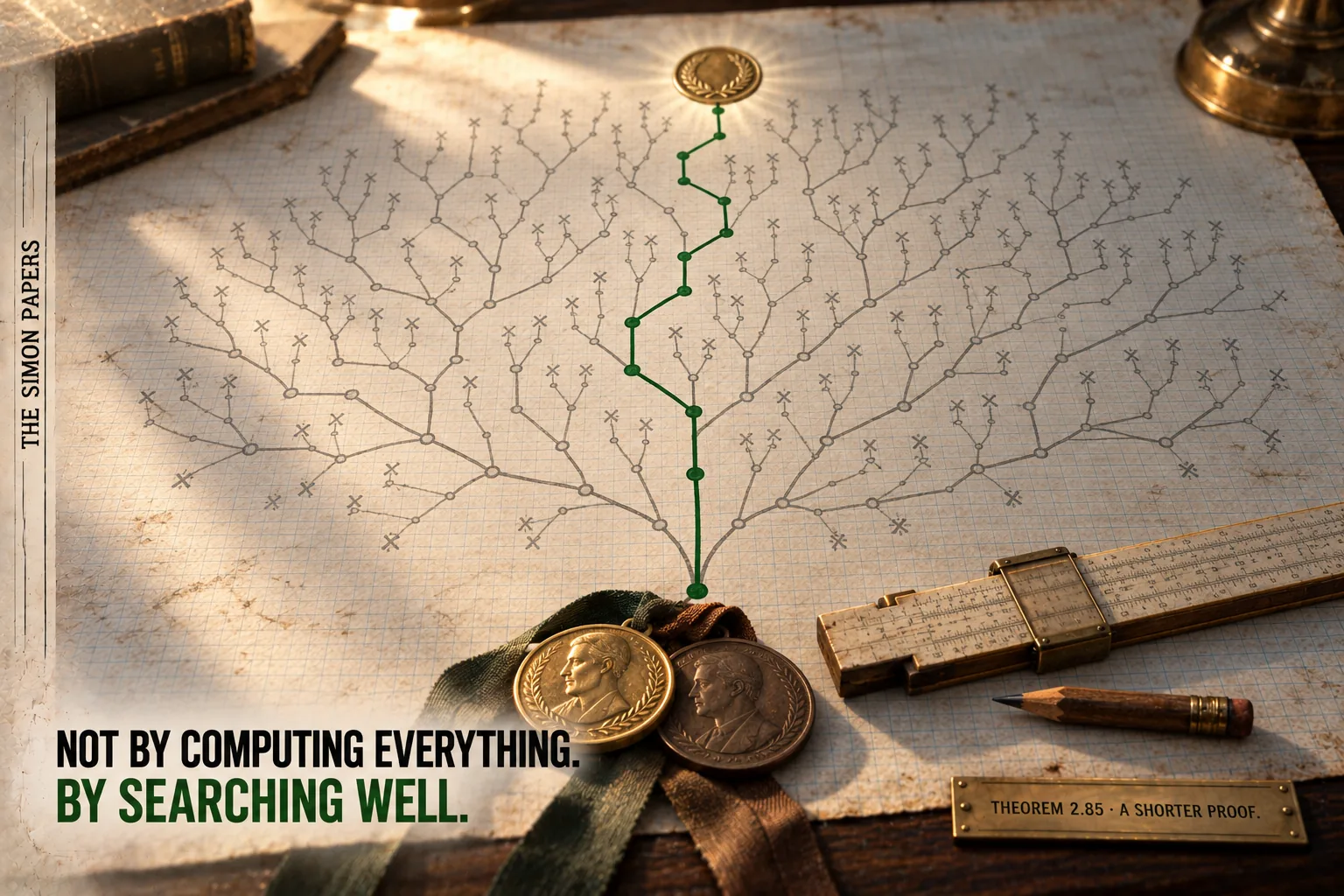
The Decision Theorist Who Co-Founded AI: How Herbert Simon's Christmas Thinking Machine Changed Everything
January 1956: an economist tells his class he invented a thinking machine over Christmas. The Logic Theorist, the proof that delighted Bertrand Russell — and the honest scorecard on whether deep learning proved Simon wrong.

12 Cognitive Biases Killing Your Strategy (Real Corporate Disasters Included)
The famous bias stories are mostly told wrong: the definitive Nokia study found fear, not blindness. The 12 biases, the process-beats-analysis-by-six study, the real premortem number — and why not to appoint a devil’s advocate.
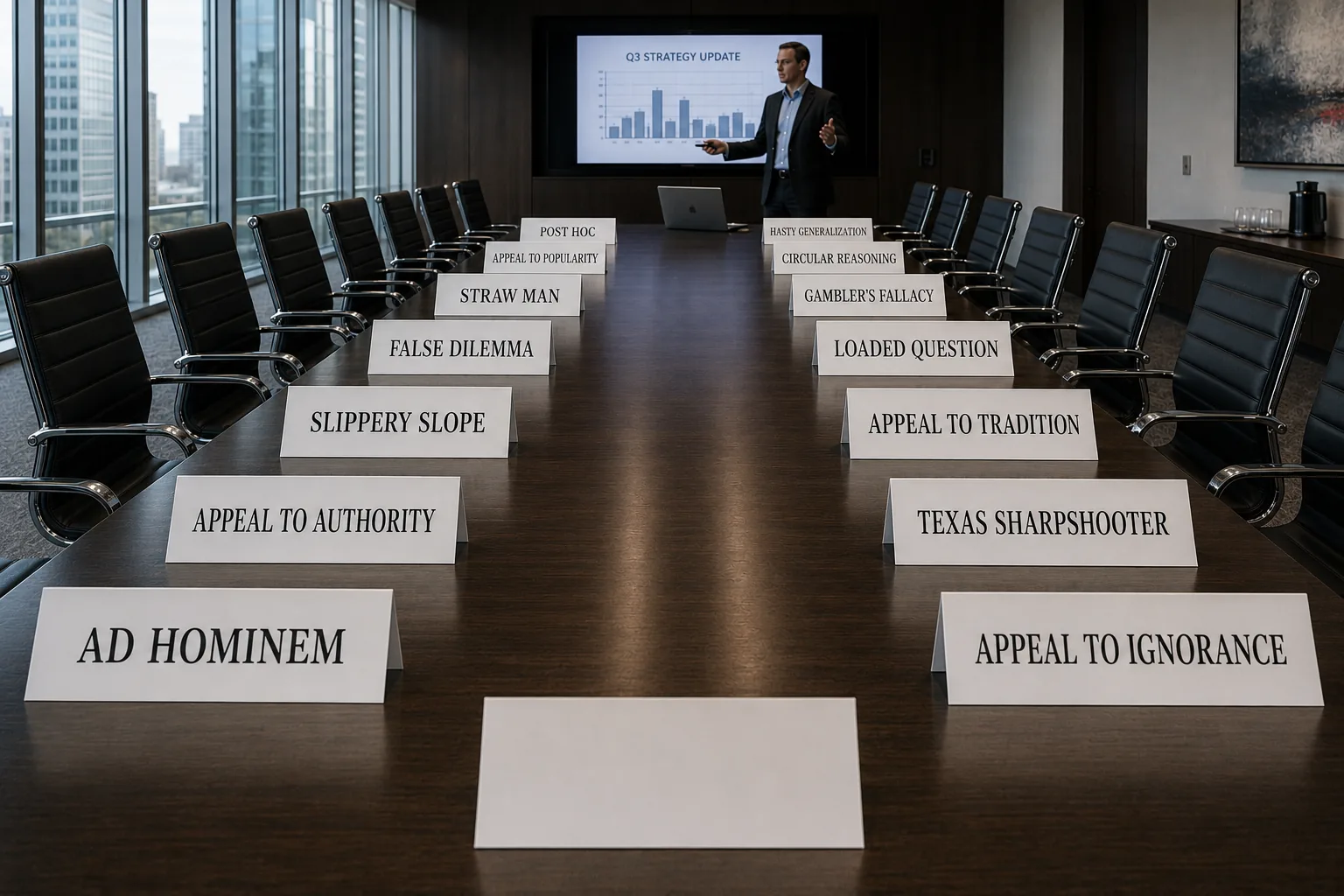
14 Logical Fallacies Hiding in Your Boardroom — and How to Counter Them Professionally
The 14-pattern field guide with counters you can say out loud, the fallacy-fallacy trap, Aristotle’s original catalog — and the 2025 finding that AI commits these patterns too.

Socrates' 2,400-Year-Old Meeting Technique: Six Questions That Beat Every Modern Framework
Athens executed a man for asking people to justify what they claimed to know — the method outlived the verdict. The six question types, Netflix’s farming for dissent, Munger’s inversion, and the two rules of a Socratic meeting.

Critical Thinking Tools: 8 Techniques That Build Sharper Reasoning
The 2025 offloading warning — heavy AI users scored lowest on critical thinking — and the counter-program: eight tools that make you reason better, led by argument mapping and its measured ~0.8 SD gains.
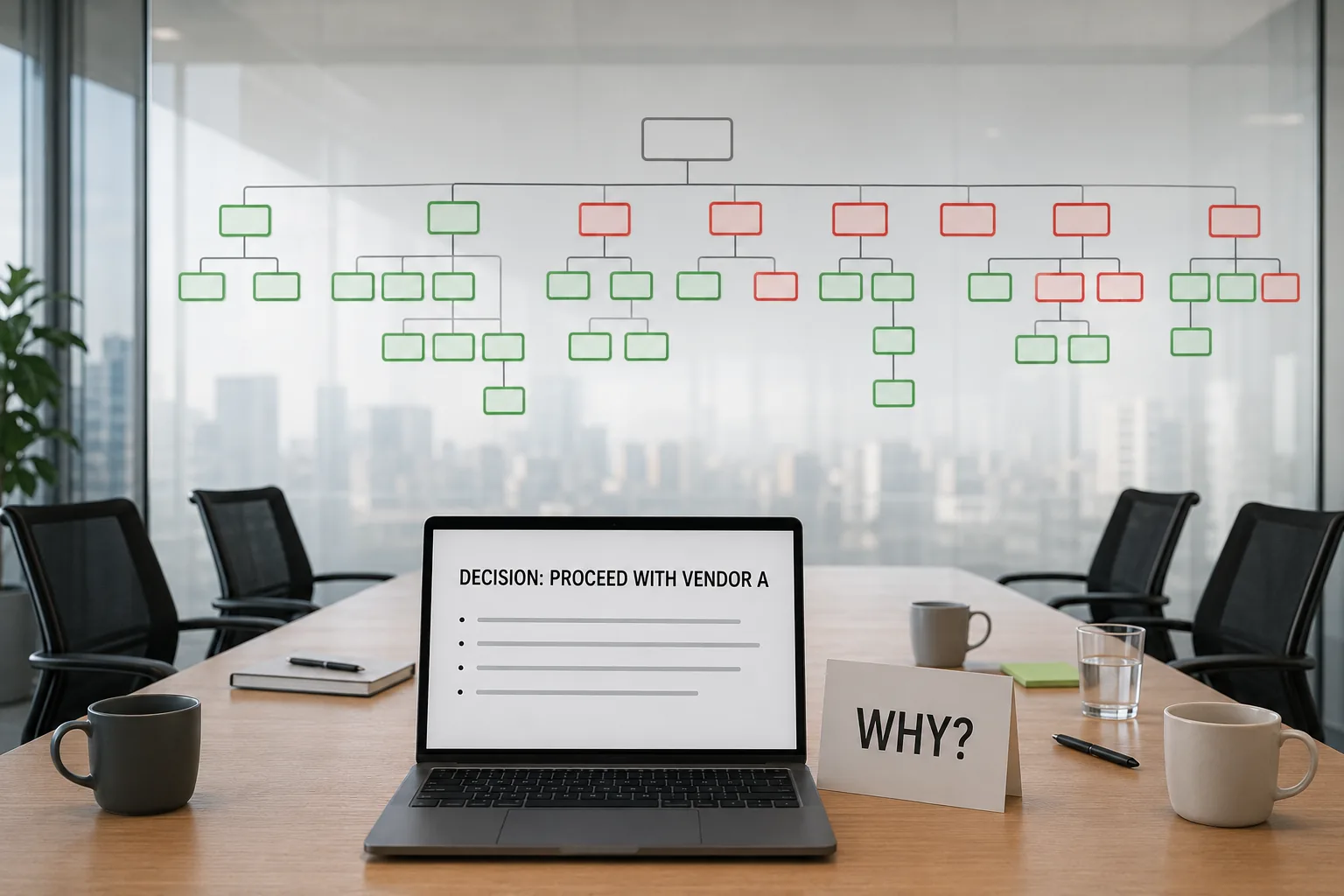
Argument Mapping: The Visual Tool That Makes Complex Decisions Obvious
The night before Challenger, the no-launch arguments existed — the structure didn’t. The 5-step process, the measured ~0.8 SD evidence, three famous decisions re-read as argument structures, and when not to map.
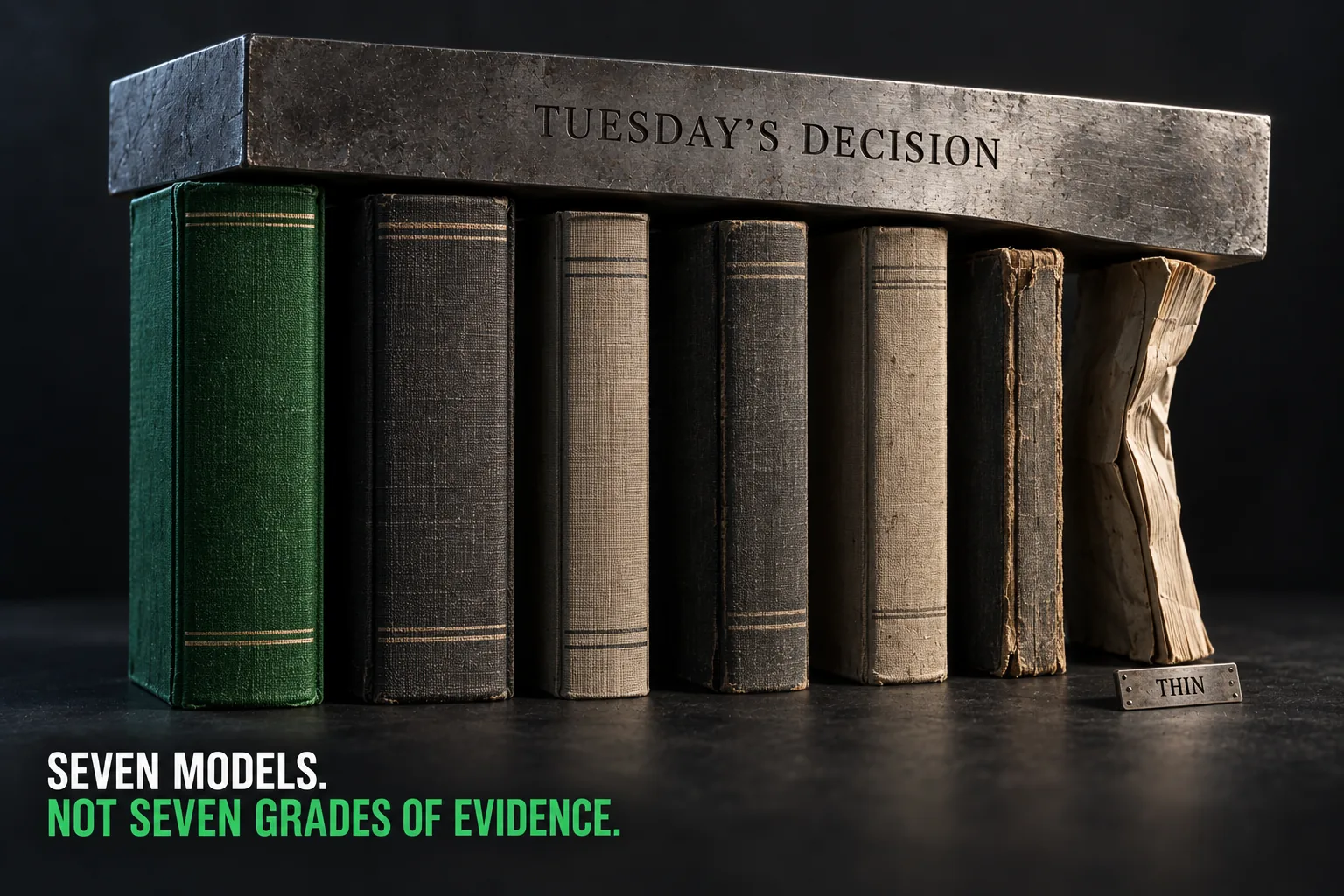
Mental Models for Decision-Making: The 7 Worth Knowing, Evidence-Graded
Seven models with their primary sources, their evidence status — only one has a measured effect size — and the honest finding about why knowing the list changes nothing. The sourced counter-listicle.

Meeting Culture: Which Meetings Should Be Async (A Four-Question Test)
Nothing happened in that meeting that needed everyone there at the same time — that is the actual complaint, and it has a test. The four questions, the five formats that almost always fail them, why email-able meetings get scheduled anyway, and the inverse error nobody notices.

The Amazon 6-Pager Has a Problem. Here's What Comes Next.
The principle was right; the format has problems. The verified Bezos quotes, the reading-speed science (238 wpm, Brysbaert 2019), the accessibility critique — and how to keep the rigor while fixing the exclusions.

IBM's Pattern of Dismissal: The Decisions That Created Trillion-Dollar Competitors
Xerography in 1944, the DOS deal in 1980, buybacks over cloud in the 2000s. Thirteen documented dismissals, the biases behind them, and the sourced deep-dive into the most expensive pattern in business history.

When Your Best Employee Quits, the Documents Stay — and the Reasoning Leaves
The checked numbers (Gallup, Panopto), the famous numbers that don’t survive checking, Polanyi’s tacit-knowledge line — and why the scalable fix is capturing decision reasoning at decision time.

Amazon Banned PowerPoint. Google Has a Memo Rule. What Does Your Company Do?
A year before Bezos banned PowerPoint, the Columbia accident board blamed a slide. The written-first meeting across Amazon, Google, Bridgewater and McKinsey — the real HBR numbers, and a 4-step version any team can run.

The 4 Phases of a Productive Debate (and the 10 Rules That Keep It Fair)
Confrontation, opening, argumentation, concluding — the pragma-dialectical model that turns disagreement into a recorded decision, the ten rules that keep it fair, and why a fallacy is just a broken rule. Plus what 2024 AI-mediation research in Science says about structured deliberation.

How to Get Stakeholder Buy-In: Stop Selling the Decision, Show the Reasoning
Fair process research has said it since 1997: people commit to decisions they disagree with when the process was visibly fair. What actually builds buy-in — early involvement, transparent reasoning, showing input was weighed — and the six-step sequence that operationalizes it.

Async Decision-Making for Remote Teams: Decide Without the Meeting
The five-step playbook for deciding in writing: proposal with context, a window and a named decider, structured arguments, explicit objection-handling, and a record. Plus the honest trade (async is slower per decision, faster per team) and which decisions to keep synchronous.

Do Remote Teams Make Worse Decisions? What the Research Actually Says (and the 3-Part Fix)
Hidden profiles (groups eight times less likely to surface the right answer), the computer-mediated communication meta-analysis, and Microsoft’s 61,182-employee network study — what the evidence really shows, why distance amplifies group failures, and the structural fix GitLab runs at scale.
The AI Accountability Gap: When Algorithms Make Million-Dollar Mistakes, Who's Responsible?
A government brought down by a risk-scoring algorithm, an unlawful automated welfare scheme, wrongful foreclosures from an unwatched calculation error. The real cases, the three failures inside the gap, the rules converging from Brussels to New York — and the structural fix.
The AI Decision Audit Trail: Recording What the AI Recommended and What a Human Decided
The model log is not the decision. The five fields of a defensible AI-assisted decision — inputs, AI output, human judgment, rationale, timestamps — why each one matters, and what the EU AI Act will demand of the highest-stakes systems from December 2027.

AI Decision Tracing: The Missing Link in Enterprise AI Compliance
A log lets you rerun the pipeline today; a trace lets you show what happened in March. The regulatory map with the real dates (Digital Omnibus included), the four pillars of decision tracing, and how to stay provable on third-party models.
The Boardroom in 2030: How AI Is Rewriting Corporate Governance
NBIM already publishes its voting reasoning for 10,000+ meetings a year, and Delaware has graded board process since Van Gorkom. What AI-augmented governance actually looks like, the honest regulatory picture — cancelled mandates included — and five moves for boards now.

The Best AI Decision-Making Tools for Teams (An Honest Roundup)
Five categories that don’t actually compete — meeting assistants, structured decision platforms, research assistants, decision matrices, and “let the AI decide” apps — judged on human-in-the-loop, reasoning capture, auditability, and fit. With the automation-bias research behind the criteria.
From Survey Results to a Decision: Closing the Gap Engagement Tools Leave Open
A survey gives you data, not a decision. The five-step method — read, theme, weigh, decide, record — plus the pseudo-voice research on why input you collect and don’t visibly weigh actively backfires.
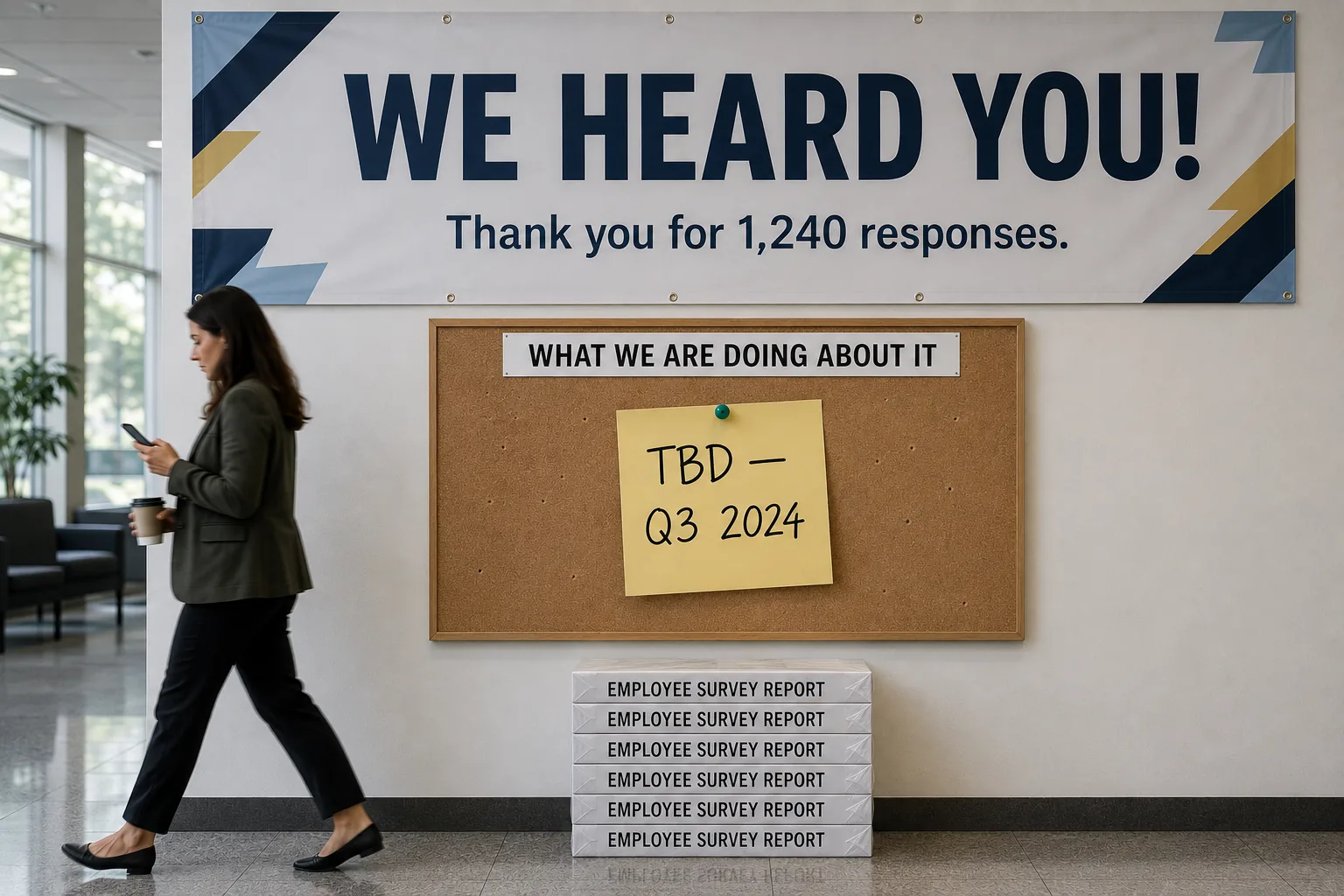
Engagement Survey Alternatives: 5 Ways to Actually Hear (and Act on) Your Team
The survey isn’t wrong — it’s not enough. Five alternative categories judged fairly on the counted→heard→weighed ladder, the Gallup engagement backdrop, and the pattern that works: keep the thermometer, add the treatment.
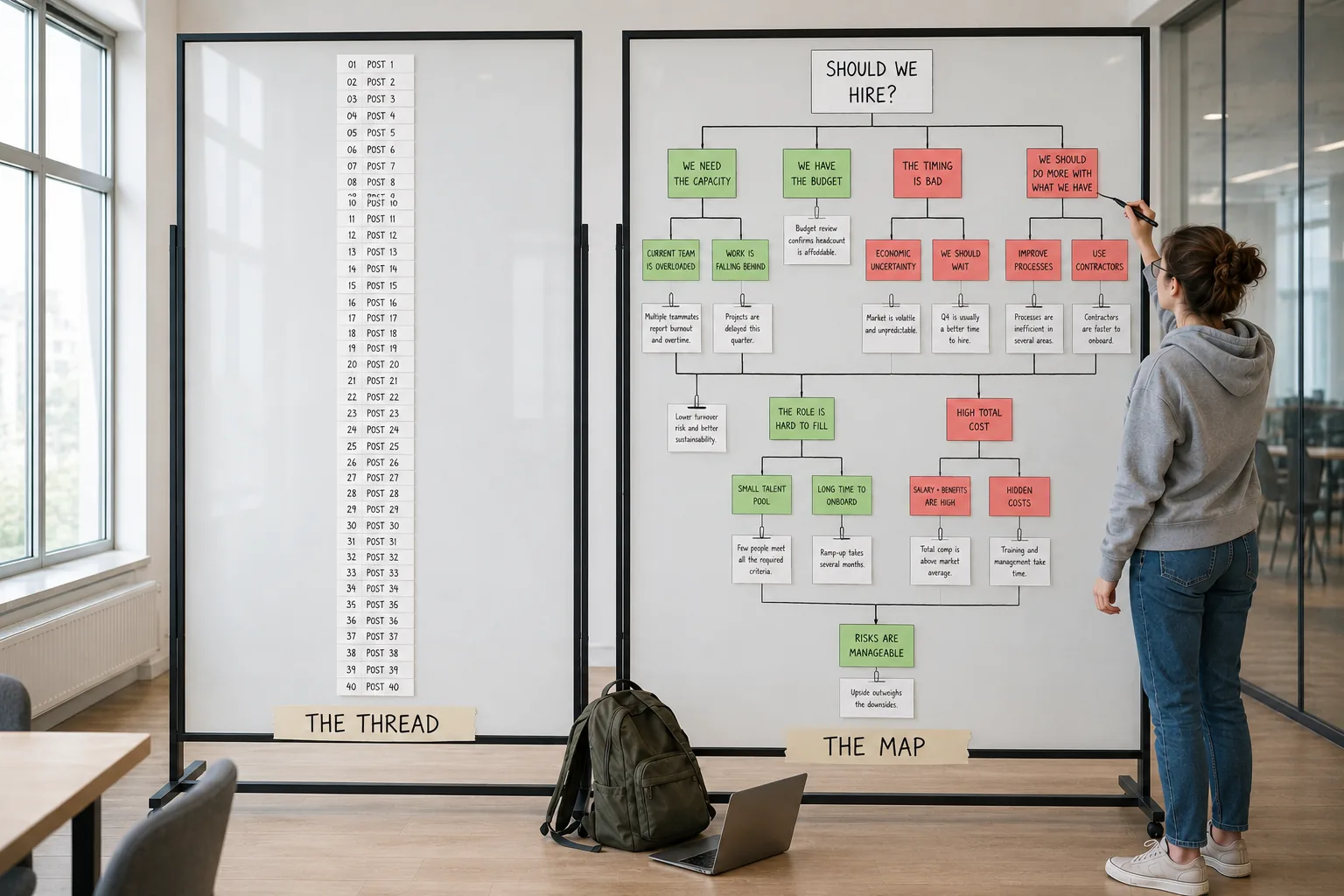
Discussion Board Alternatives: What to Use Instead in Online Courses
The threaded board fails structurally — no shape, box-ticking incentives, duplicate pileup, buried quiet students. The alternatives compared fairly, with the argument-mapping evidence (~0.7–0.8 SD critical-thinking gains) behind the strongest one.
The Vroom-Yetton Decision Model: When to Decide Alone, When to Consult, When to Let the Group Decide
Vroom and Yetton showed in 1973 that the right decision style is situational, not personal: five styles from autocratic to group consensus, seven diagnostic questions, one decision tree — with documented cases from the Tylenol recall to Apollo 13, and the model’s honest limitations.
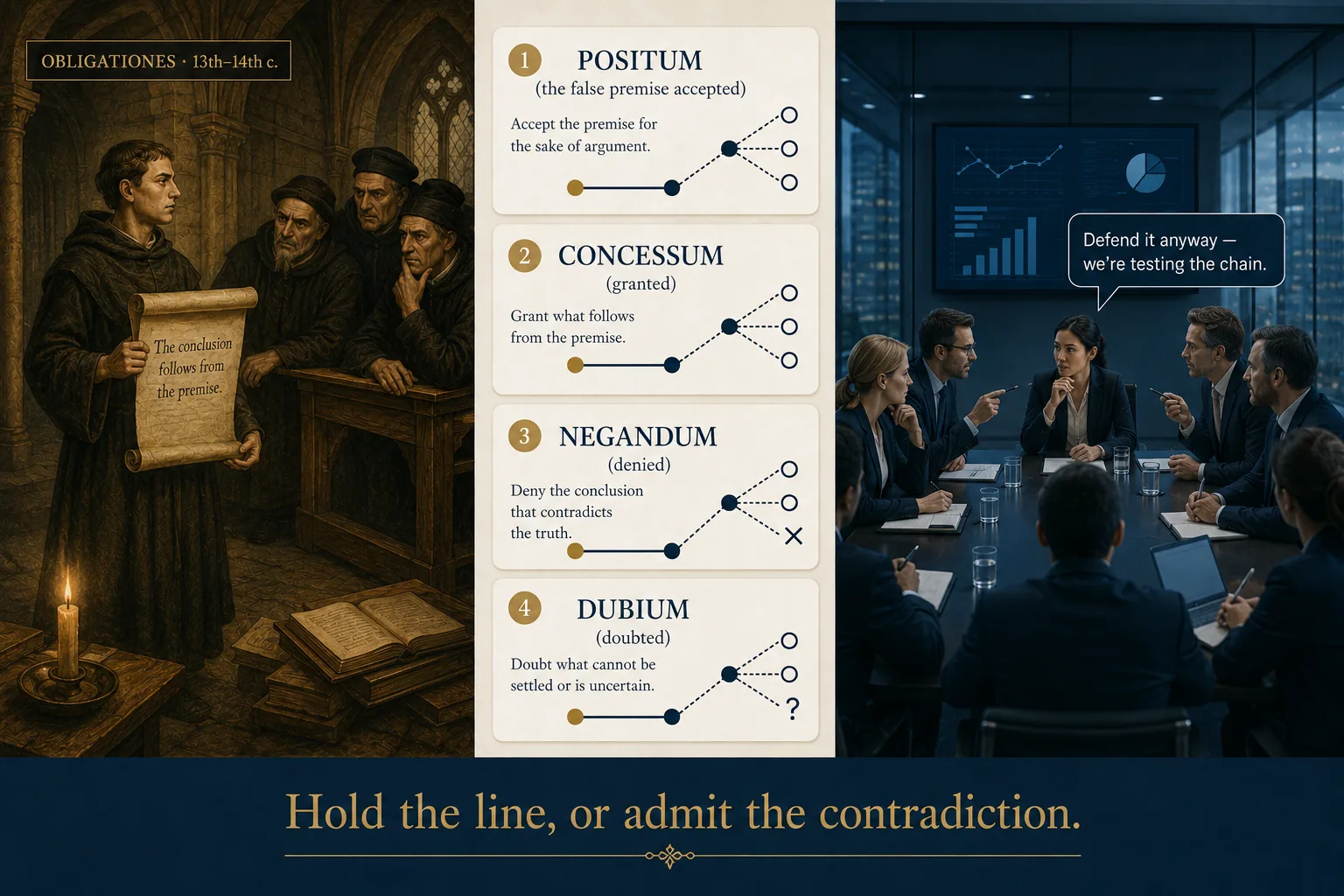
Medieval Scholastic Logic: How the University Invented the Structured Argument
Boethius transmitted Aristotle, Abelard turned contradiction into method, the university made disputation the curriculum, and obligationes — the consistency game with no Greek precedent — quietly became the thesis defence. The Latin tradition, 500 to 1662.

The Upvote Illusion — Why Popularity Kills Quality
Reddit's Boston-bombing 'investigation' proved the point at scale: upvotes measure agreement, timing and conformity — not argument quality. How downvote fear gamifies the spiral of silence, why the same physics run in Slack and meetings, and what rating arguments instead of people changes.

Wisdom or Madness? When Crowds Get It Right (and When They Don't)
Galton's ox and the 2008 bubble used the same statistical machinery with opposite results — because crowd wisdom is a property of conditions, not crowds. Independence, diversity, proper aggregation; how platforms break all three; and the Navajas finding that small structured debates beat huge crowds.
The Meritocracy Paradox — Why "Best Idea Wins" Fails Without Structure
Every company claims the best idea wins; almost none has a mechanism that makes it true. Why unstructured evaluation judges people wearing ideas (the HiPPO effect), why anonymous ideation isn't enough, and what merit-as-survival-under-challenge looks like as working machinery.
The Algorithm Trap — How Engagement Optimization Suppresses Quality
Meta's news-deprioritization cut reactions to news 78% across 5.2M posts — the cleanest demonstration that ranking manufactures information reality. Popularity bias, the filter-bubble loop, why 'just ignore the algorithm' fails, and the design fix: separate the momentum signal from the quality signal.
From Aristotle to Algorithms — Why Structured Debate Beats Free-Form Discussion
The Greeks made arguments visible structures; comment threads erased that. Toulmin's 1958 anatomy (claim, grounds, warrant, rebuttal), van Gelder's evidence that argument mapping measurably builds critical thinking, why threads fail structurally — and a discussion format where the map is the medium.

Cialdini's 7 Principles of Influence — and What They Do to a Group Decision
Three years undercover in the industries that sell for a living produced seven levers that get a yes. They are also the seven ways a meeting agrees without evaluating the argument — mapped onto the 7 Argument Traps, with the replication that failed.

Escalation of Commitment: Why Teams Keep Funding the Failing Project
The 1976 experiment that isolated the cause: not the failure, but who signed it. Expo 86, the 166-sample meta-analysis, and why 'ignore sunk costs' fixes the smaller half of the problem.
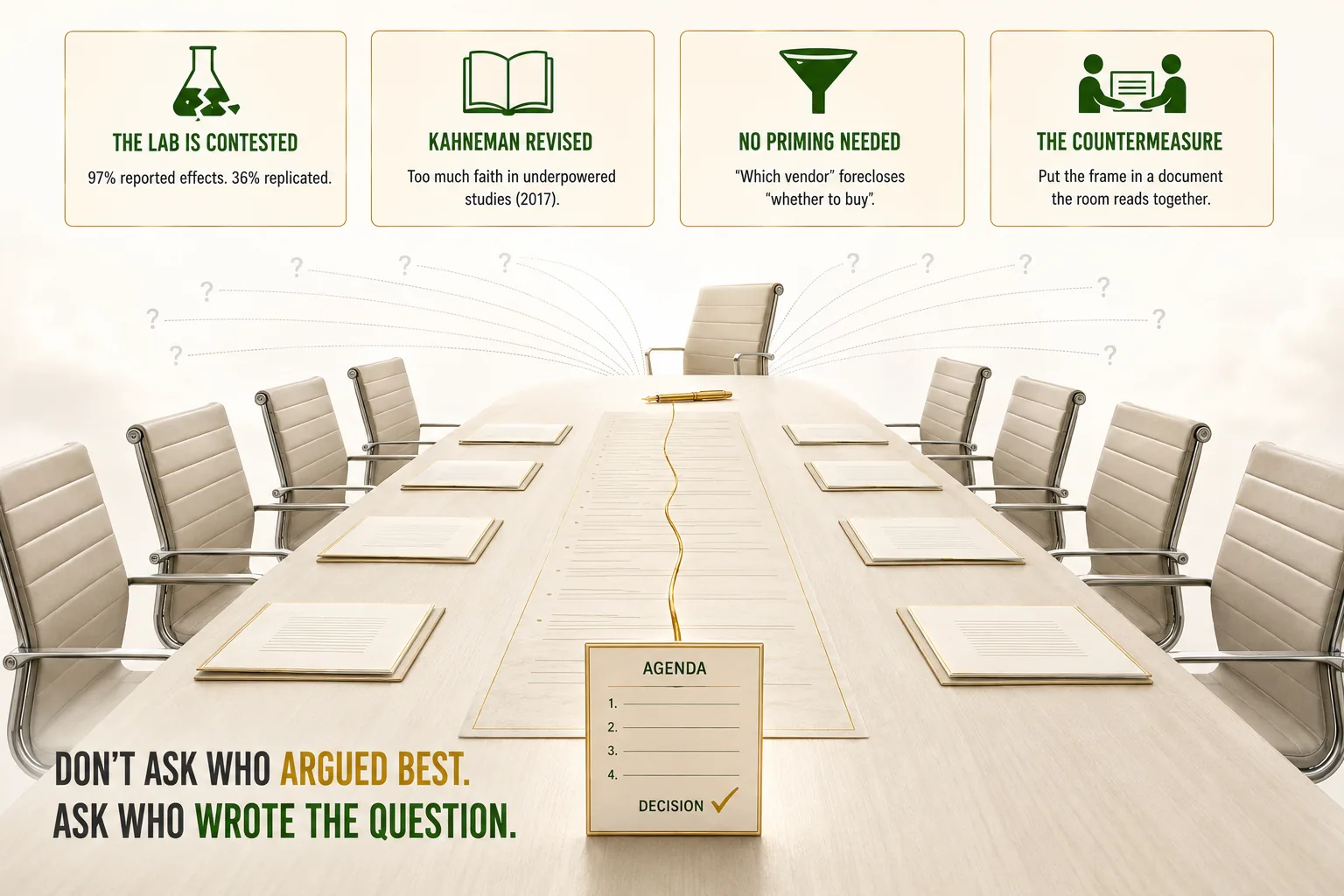
Pre-Suasion: Whoever Sets the Agenda Has Already Decided
Agenda control is the least governed power in any organisation. What survives priming's replication crisis, what doesn't, and the four moves that fix the frame before it fixes you.
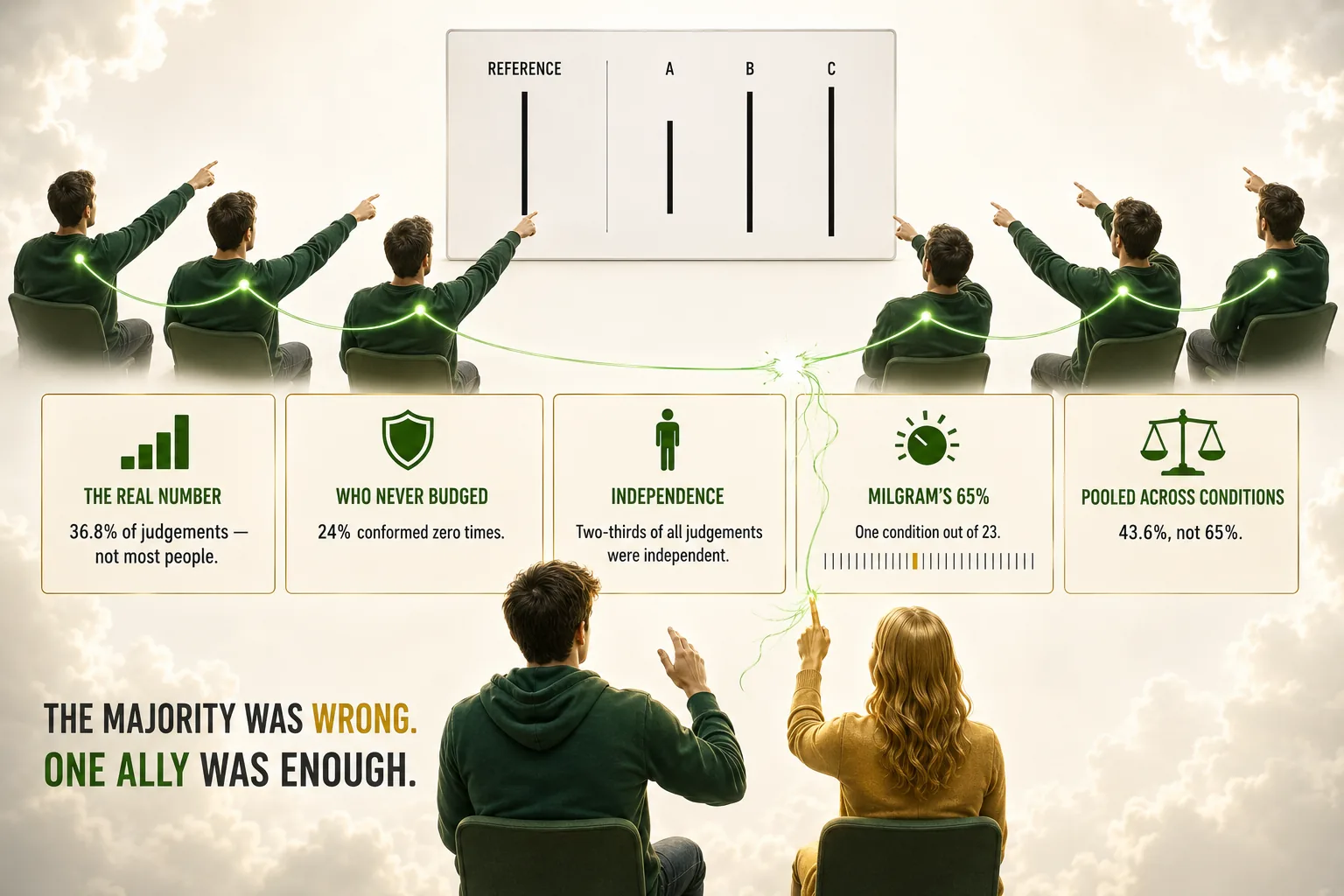
Asch, Milgram and the Meeting: What the Conformity Experiments Actually Found
The two experiments behind social proof and authority, quoted correctly for once — and the design parameter Asch found that collapses the effect: one ally.
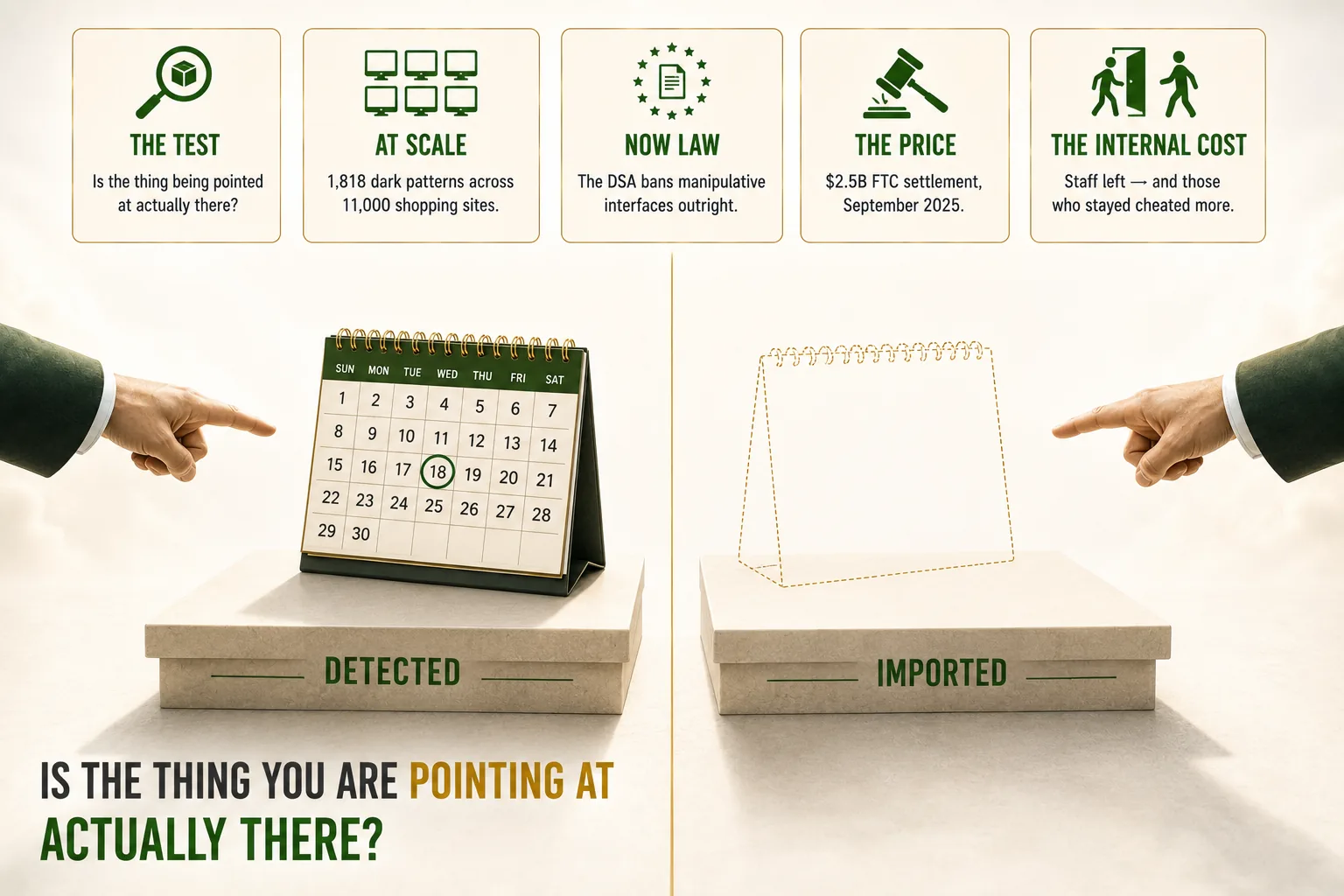
Influence or Manufactured Pressure? The Line Cialdini Draws, and What It Costs to Cross
Bunglers, sleuths and smugglers — plus the selective-attrition finding, the 11,000-site dark patterns crawl, DSA Article 25, and the $2.5bn Amazon settlement.
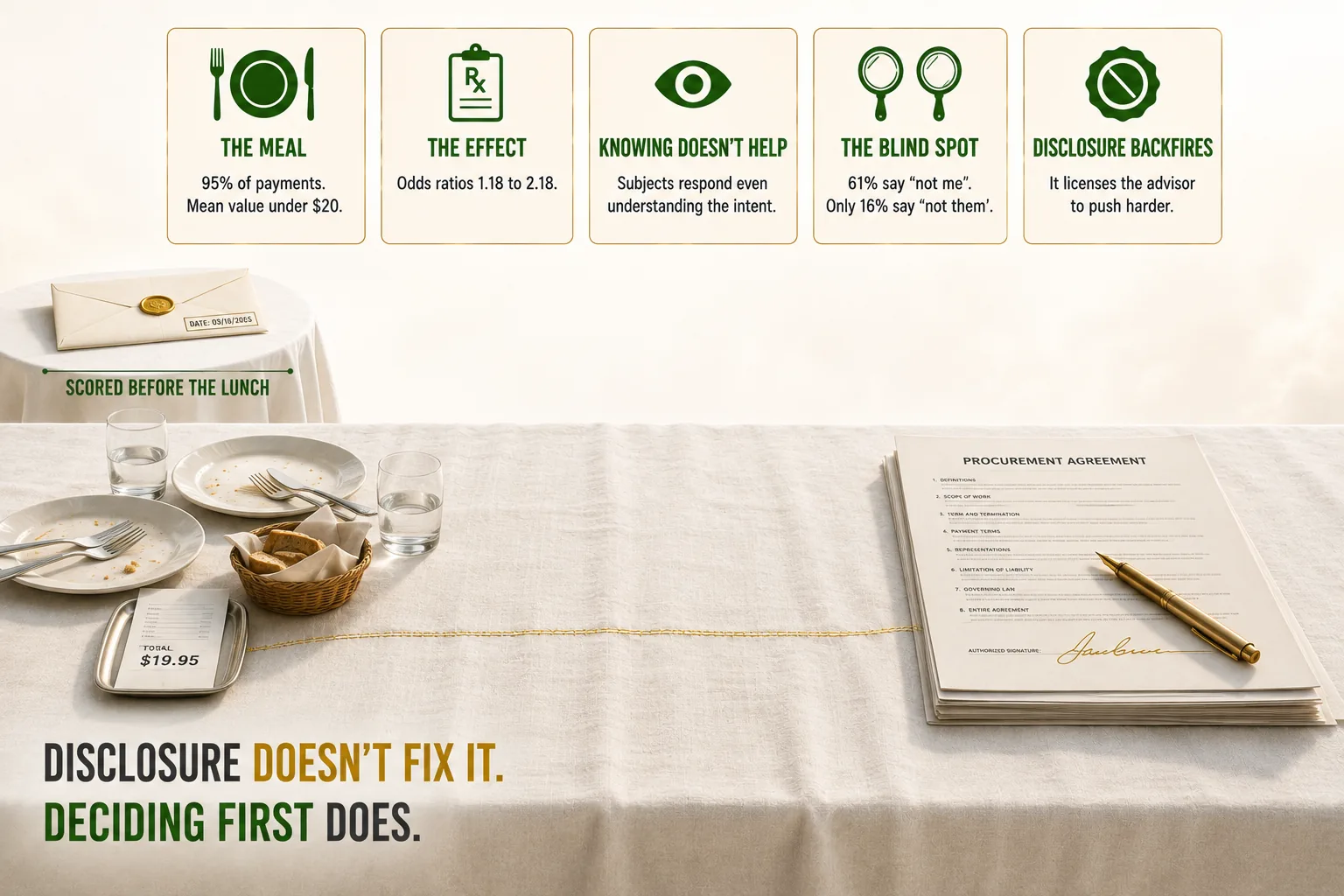
A Twenty-Dollar Lunch: Reciprocity in Vendor Selection — and Why Disclosure Doesn't Fix It
Reciprocity where money is at stake: the JAMA meals study, the AER experiment built like a procurement, the bias blind spot, and why disclosure can backfire.
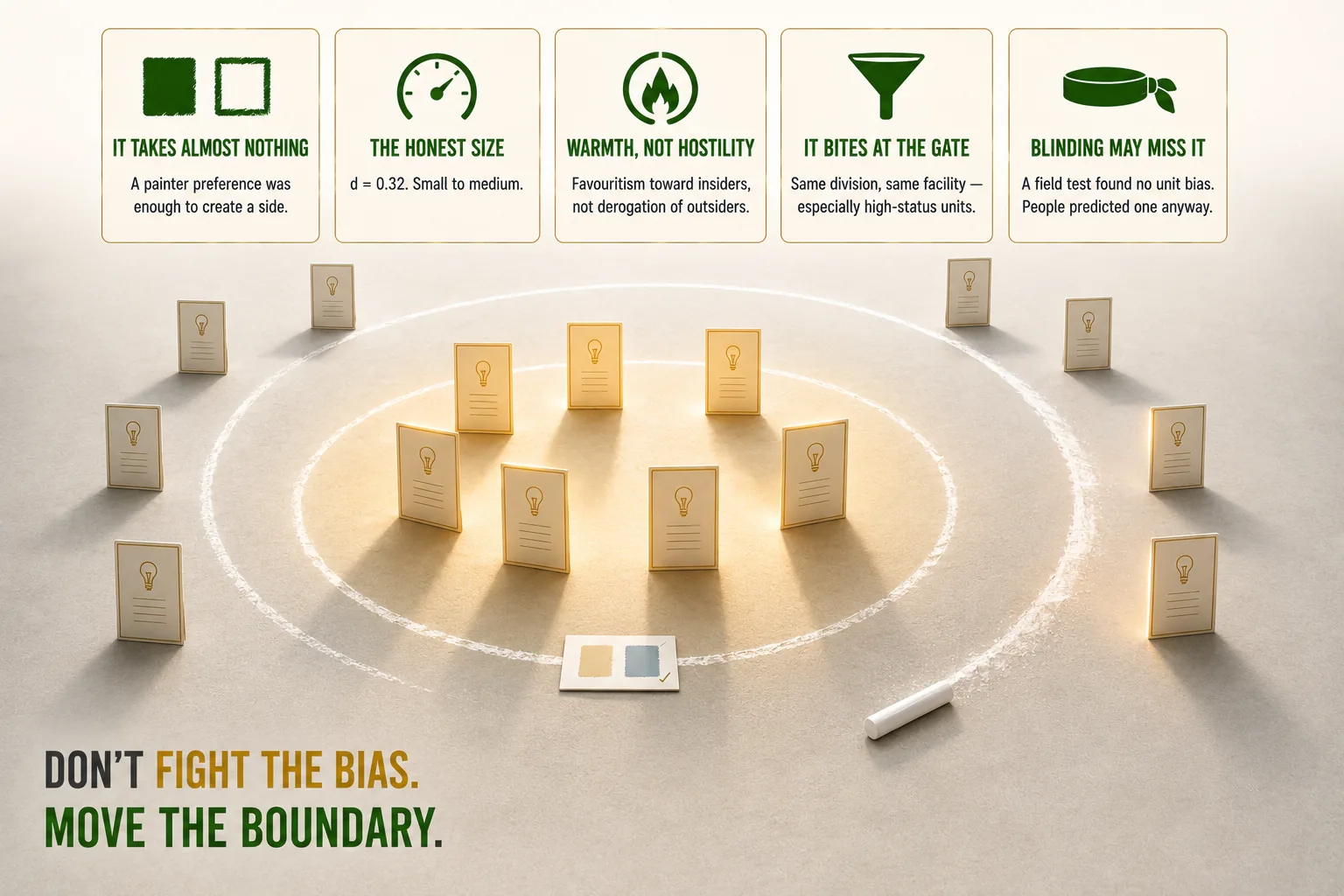
Not Invented Here: In-Group Bias in Idea Evaluation — and the Experiment That Complicates It
In-group favouritism is real (d=0.32), it's warmth toward insiders rather than hostility to outsiders, and the intervention everyone reaches for may be solving a smaller problem than they think.
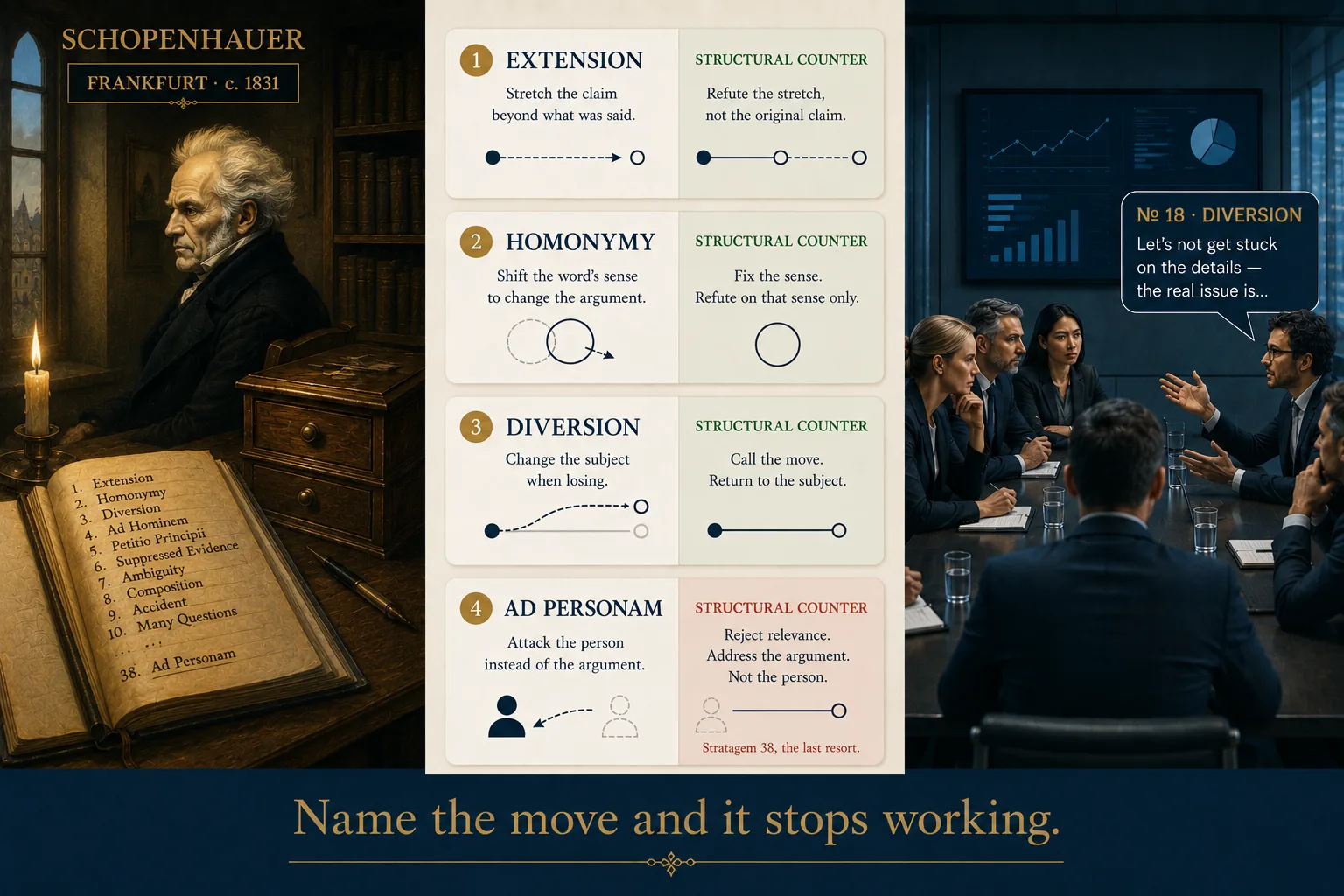
Schopenhauer's Art of Being Right: The First Field Guide to Bad-Faith Argument
The philosopher catalogued 38 stratagems for winning a dispute regardless of the truth — the extension, the diversion, and ad personam as the last resort — then shelved the manuscript. The 1831 treatise behind every modern field guide to debate foul play.
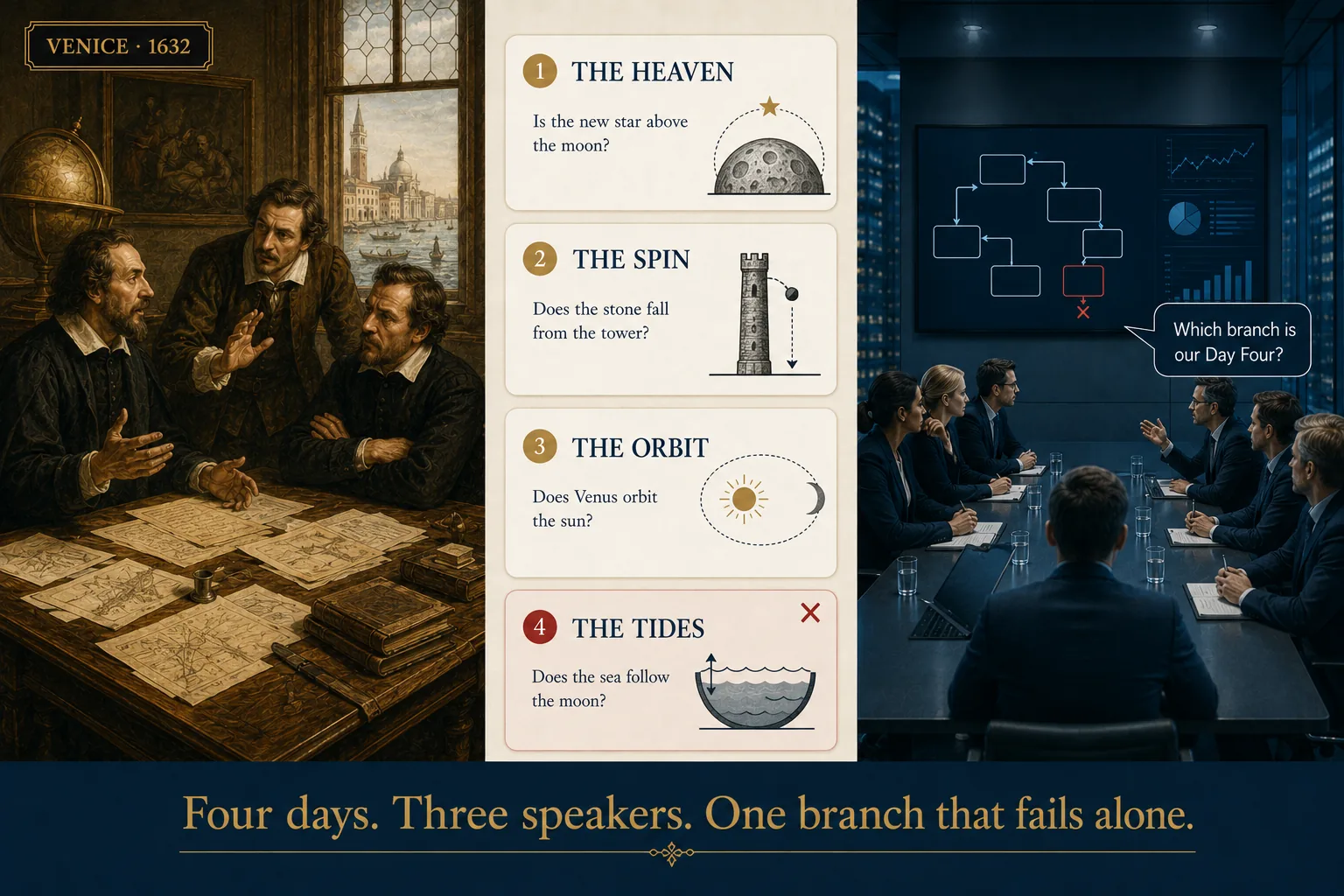
Galileo’s Dialogue: Four Days, Three Speakers, and the Argument He Got Wrong
In 1632 the Copernican debate was staged as four days of conversation between three speakers, working through nearly every argument then available — the tower, the ship’s mast, the cannon shots, the birds, the phases of Venus, the missing stellar parallax. Day by day, including the tide argument that is simply wrong, and the closing move that helped send its author to trial.
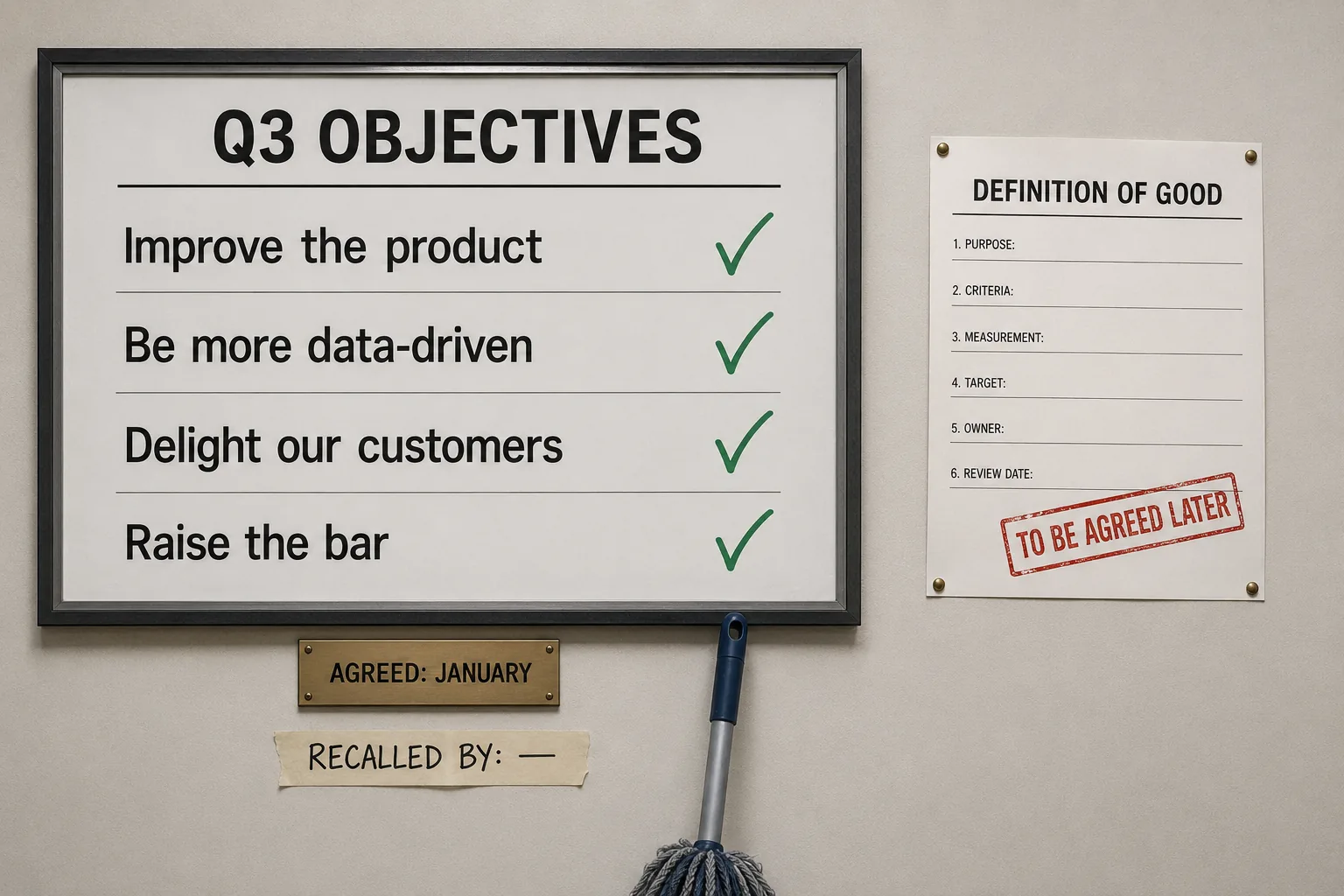
OKRs Are Not Goals. They're the Success Criteria You Wrote Down First.
Objectives and Key Results. Grove built them at Intel in 1971; critics say they are Drucker's MBO with a better implementation. The evidence sits with goal-setting theory, and the strongest paper against goals was rebutted by its own authors' opponents in the same volume. The reframe that survives: a Key Result is a record of what you agreed good would mean, before anyone did the work.
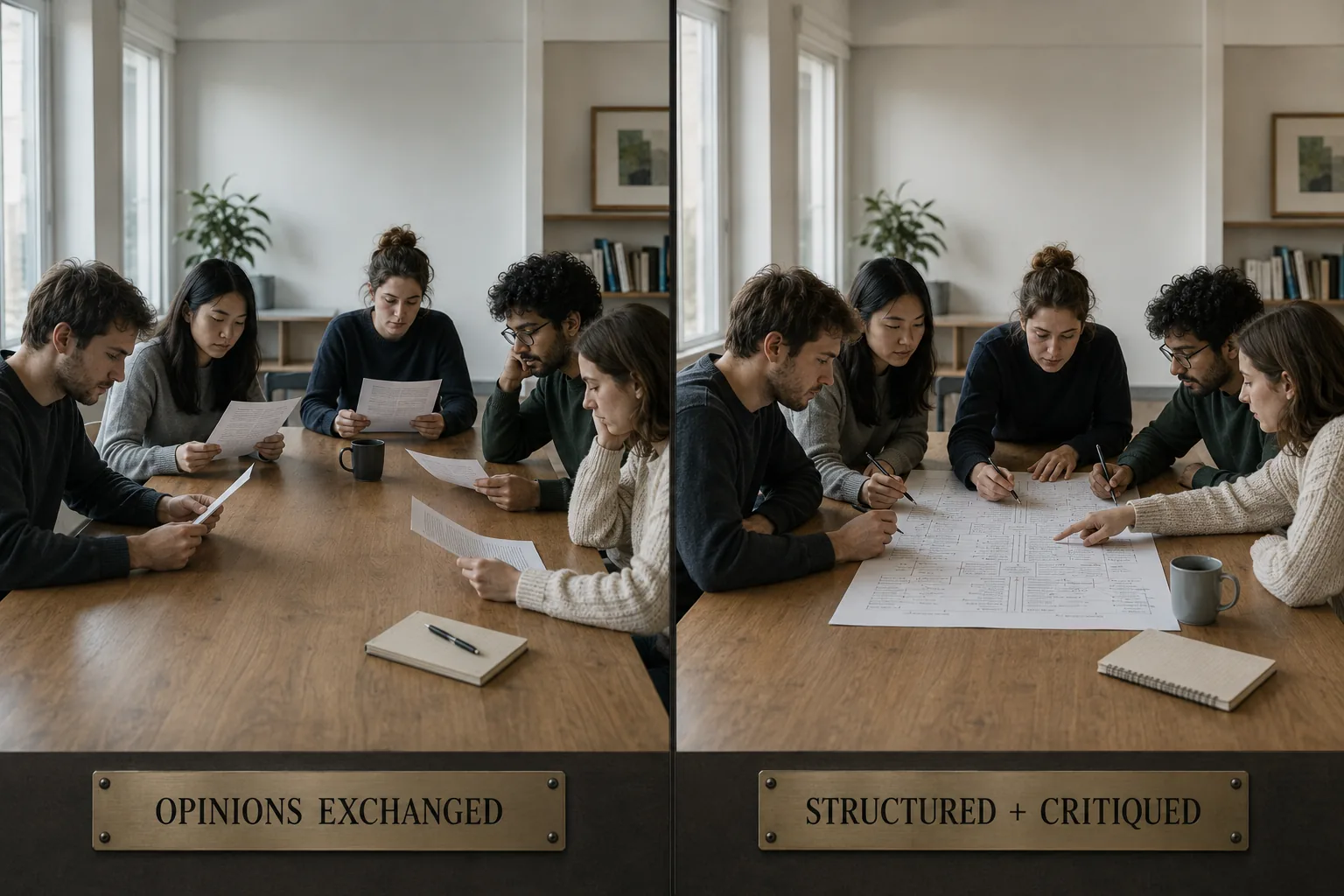
Sharing Opinions Changed Nothing: What a Science Study Found About Structured Deliberation
A preregistered Science experiment with 5,734 participants ran the control almost nobody reports: groups who just read each other’s opinions did not converge at all (P = 0.64). Structuring the same opinions moved them eight points. The findings, the limits, and where the critics are right.

Ready to Transform Your Decision-Making?
Join hundreds of organizations using Argumentree to structure arguments, track decisions, and build institutional knowledge.
Start Free 14-Day Trial