
How to Avoid Groupthink: Structural Countermeasures That Actually Work
How to avoid groupthink: use structural countermeasures, not appeals to speak up. The five that work: the leader states their preference last; make authentic dissent structurally safe (anonymous or written-first input — research finds assigned devil's advocates underperform genuine dissenters); commission a red team that reports outside the plan's authorship; run a pre-mortem (assume the decision failed, explain why); and record dissent in the decision record so minority views persist. Groupthink is Irving Janis's term for concurrence-seeking that overrides realistic appraisal in cohesive groups — a useful diagnostic lens, though its empirical support is mixed (Esser's 1998 review), and it is distinct from information cascades, which are an independence failure rather than a conformity failure.
Groupthink is not cured by telling people to speak up — the pressures that silence them are structural, so the countermeasures must be too. The working set:
- The leader speaks last. A stated preference at the top of the meeting converts deliberation into confirmation — withholding it is the cheapest fix that exists.
- Engineer authentic dissent, don't assign it. Research finds role-played devil's advocates underperform genuine dissenters — so make real disagreement safe (anonymous, written-first) instead of theatrical.
- Red-team the big calls and pre-mortem the plans — institutionalized challenge (UK MoD's handbook) and prospective hindsight (Klein) both legitimize doubt that politeness suppresses.
- Record the dissent. A minority view that enters the decision record survives the meeting — and makes disagree-and-commit honest rather than performative.
- Honesty note: groupthink is a useful lens, not settled law — its empirical support is mixed, and it is a different failure from information cascades. Different mechanism, different fixes.
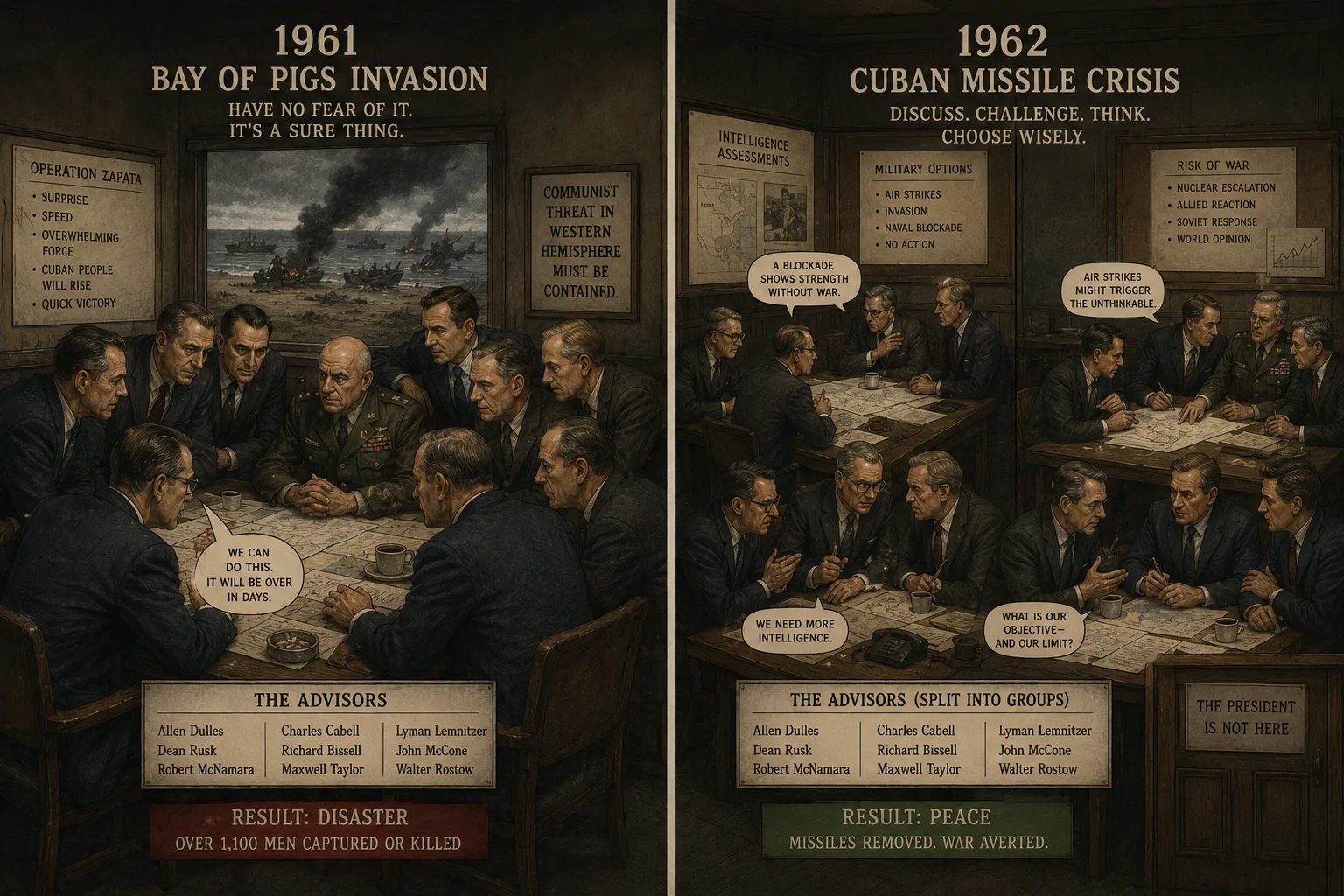
In April 1961, some of the most capable people ever assembled in an American administration — Rhodes scholars, decorated strategists, a future Nobel laureate among their advisers — unanimously endorsed a plan to land 1,400 exiles at Cuba's Bay of Pigs. The plan assumed a spontaneous uprising that no evidence supported, an escape route through eighty miles of swamp, and deniability that evaporated on day one. It failed in three days. President Kennedy reportedly asked afterward: "How could we have been so stupid?"
The interesting answer is: they weren't. Stupidity doesn't explain a room of brilliant people converging on a plan whose flaws were visible to outsiders almost immediately. Psychologist Irving Janis spent years on that puzzle and gave the answer a name — groupthink: the tendency of cohesive groups to seek concurrence so strongly that realistic appraisal of alternatives gets overridden. Doubters silenced themselves; doubts that surfaced were smoothed over; unanimity was mistaken for correctness.
Eighteen months later, the same men faced the Cuban Missile Crisis and produced one of the most carefully deliberated decisions of the century. Same people, same intelligence, same stakes — different process. That contrast, which Janis himself drew, is the whole thesis of this post: groupthink is not a character flaw to be exhorted away, it is a process failure with process fixes. Here are the five that work, what the research honestly supports, and how to install them without turning every meeting into a courtroom.
Nobody in the room disagreed.
That was the problem, not the achievement.
The lesson Janis drew from the Bay of Pigs
What Groupthink Is — and What It Isn't
Janis's definition, from his 1972 study of American foreign-policy fiascoes, is precise: groupthink is a mode of thinking people engage in when they are deeply involved in a cohesive in-group, when the members' strivings for unanimity override their motivation to realistically appraise alternative courses of action. The operative word is cohesive — groupthink is a disease of teams that like each other. The harmony is real; it just gets purchased with unexamined assumptions.
One boundary matters before the fixes, because two different failures get filed under "the group got it wrong." Groupthink is a conformity failure inside a deliberating group: people in a room, suppressing dissent to preserve unanimity. An information cascade — the failure we covered in When Crowds Go Wrong — is an independence failure across a crowd: individuals rationally copying earlier signals until private information stops entering the pool. No cohesion required, no meeting required.
The distinction is practical, not academic: cascade fixes protect independence (collect judgments before anyone sees anyone else's); groupthink fixes protect dissent (make disagreement inside the room safe and structural). Teams need both, and this post is about the second.
The Eight Symptoms — Janis's Diagnostic Lens
Janis catalogued eight symptoms, in three families. Read them as a checklist against your last big decision meeting — that is the use they've earned:
Illusion of invulnerability
Overestimating the group: "we've always pulled it off." Breeds extreme risk-taking on borrowed confidence.
Belief in inherent morality
Overestimating the group: because we are the good actors, our plan's ethics go unexamined.
Collective rationalization
Closed-mindedness: warnings get explained away collectively before they can force reconsideration.
Stereotyping outsiders
Closed-mindedness: rivals, critics and competitors are dismissed as too weak, biased or stupid to matter.
Self-censorship
Uniformity pressure: members with doubts conclude, privately, that this isn't the moment. The most common symptom — and invisible from the outside.
Illusion of unanimity
Uniformity pressure: silence gets read as agreement, so the room believes consensus exists that no one actually holds.
Direct pressure on dissenters
Uniformity pressure: the rare open doubter gets framed as disloyal — "are you with us on this or not?"
Self-appointed mindguards
Uniformity pressure: members shield the group and its leader from disturbing information before it reaches the table.
What the Research Honestly Supports
Content-integrity note, because this post would be easier to write without it: groupthink's empirical record is mixed. Esser's 1998 review of 25 years of research found laboratory support for the full model weak and inconsistent — cohesion, the theory's centerpiece, often fails to predict the symptoms — and the case-study method behind the famous examples has a built-in hindsight problem: failed decisions get diagnosed as groupthink because they failed.
A worked example of that caution: the Challenger launch decision is popularly cited as textbook groupthink, but the definitive study of it — Diane Vaughan's — frames the failure as normalization of deviance: acceptable-risk boundaries eroding gradually over years, not conformity pressure in one room. If you cite Challenger as groupthink in a meeting, someone who has read Vaughan is entitled to correct you.
So why keep the concept at all? Because as a lens it names real, individually well-documented pressures — self-censorship, silence-as-assent, pressure on dissenters are not in dispute — and because its prescriptions stand on their own evidence regardless of whether the eight-symptom syndrome hangs together. Use it as a checklist that provokes the right questions, not as a diagnosis that ends them. The countermeasures below are chosen on exactly that basis.
The Fix, Demonstrated: The Same Men, Eighteen Months Later
The Cuban Missile Crisis deliberations read like a deliberate inversion of the Bay of Pigs, because they were — Kennedy had absorbed the lesson. He absented himself from early ExComm sessions so his preference couldn't anchor the room. The group split into subgroups that developed rival options (blockade vs. air strike) and attacked each other's proposals. Outside experts were brought in and members were told to act as skeptical generalists rather than defend departmental turf.
Note what changed: nobody became braver, smarter or more honest. The structure changed — and the structure did the work the exhortation "speak up if you disagree" never does. That is the design principle behind all five countermeasures.
Assigned devil's advocates play a role.
Real dissenters change minds.
The Five Structural Countermeasures
Each targets a specific symptom family, and none of them requires anyone to be heroic: (Distributed teams have a head start here: written-first, independent input is remote work’s native mode — the evidence is in what the research says about remote team decisions.)
1. The leader speaks last
A stated preference from the senior person converts every subsequent contribution into agreement or defiance — which is why self-censorship follows it. Withhold the preference; open with the question; state your view after the room has committed to theirs. Kennedy's ExComm absence is the extreme form; "I'll share my take at the end" is the everyday one.
2. Engineer authentic dissent — don't assign it
The classic advice is a rotating devil's advocate. The research nuance matters: Charlan Nemeth's experiments found assigned devil's advocates underperform authentic dissenters — the room discounts a position it knows is role-played, and the role-player doesn't fight for it. What works is making real dissent structurally safe: collect written positions before discussion, take anonymous input on the risky calls, and treat the first expressed doubt as a contribution to examine rather than an objection to overcome.
3. Red-team the consequential calls
For decisions that warrant it, institutionalize the challenge: a group whose explicit mandate is to attack the plan, reporting outside the plan's authorship. The UK Ministry of Defence's Red Teaming Handbook is the citable public playbook — its core insight is that challenge must be commissioned and protected, because volunteered challenge gets socially taxed exactly as symptom 7 predicts.
4. Run a pre-mortem
Gary Klein's technique: before committing, the group assumes the decision has already failed, and each member independently writes the story of why. Prospective hindsight converts doubt from disloyalty into an assignment — the doubters were going to stay silent; now silence is the rule violation. It is the cheapest legitimizer of dissent ever designed, and it takes fifteen minutes.
5. Record the dissent
Dissent that lives only in the meeting dies with the meeting — and with it, the group's ability to learn whether the majority or the minority read the situation right. The decision record keeps the losing arguments alongside the winning ones, which also makes disagree-and-commit honest: you can commit fully to a decision precisely because your disagreement is on the record, not swallowed.
"Doesn't All This Dissent Machinery Just Slow Us Down?"
Steelmanned properly: cohesion is not a disease — it is why good teams move fast, trust each other's judgment, and don't relitigate everything. Most consensus is genuine agreement among people who know the domain. A team that red-teams the lunch order has built dissent theater, which taxes exactly the trust that makes teams work. And the hindsight critique above cuts here too: since failed decisions get labeled groupthink after the fact, the risk of over-correcting is real.
The answer is proportionality plus structure. The countermeasures are not a permanent adversarial culture — they are a protocol for consequential decisions, the ones where being wrong costs quarters. A pre-mortem is fifteen minutes; leader-speaks-last is free; the record is five. Against a Bay-of-Pigs-class error, the overhead is noise. And structure is precisely what separates earned consensus from unexamined consensus: if the plan survives a pre-mortem and a real dissenting argument, you haven't slowed the decision — you've upgraded your confidence in it.
The honest concession: on small, reversible calls, none of this applies — cohesion should win, speed should win, and "disagree and commit" without ceremony is the right culture. The five countermeasures are for the decisions your team will still be living with next year.
The Diagnostic
Two questions about your last consequential decision meeting: When did anyone last change the room's mind? And is there any written trace of what the doubters said? If the answers are "can't recall" and "no" — your consensus may be real, but you have no way to know.
How Argumentree Builds the Countermeasures In
Every countermeasure above fights the same enemy: dissent that is socially expensive and structurally optional. Argumentree inverts both defaults. A decision is deliberated as a pro/con argument tree — con arguments are a built-in branch, not an act of courage — and arguments are rated on their merits, independently of the seniority of whoever raised them, which is symptom 7's structural antidote.
And because the deliberation is the record, the minority view persists automatically: the losing arguments stay attached to the decision, reviewable when outcomes land. The pre-mortem's question — "why might this fail?" — has a permanent, rated home in every decision rather than a workshop slot once a quarter. If you want the countermeasures pre-built rather than facilitated by hand, start free and run your next contentious decision through them.
Same People, Different Structure
The Bay of Pigs advisers didn't become different men by October 1962. They got a different process — one where the leader's preference arrived last, rival options had institutional homes, and doubt was an assignment instead of a betrayal. The quality of the outcome followed the quality of the structure.
That is the encouraging version of the groupthink story: if the failure were stupidity or cowardice, you couldn't fix it by Tuesday. It's structure — so you can. Pick your next consequential decision, put the leader's view last on the agenda, run the fifteen-minute pre-mortem, and write the dissent into the record. Your team is already smart enough; give it a process that lets the intelligence out. And give the failure modes their names: a room that only hears agreement is in the Echo Chamber Trap, and one where assertiveness outruns evidence is in the Loudest Voice Trap — named patterns are catchable patterns.
Groupthink isn't cured by braver people. It's cured by structure that makes bravery unnecessary.
Make Dissent Structural, Not Heroic
Run your next big decision as an argument tree — con arguments invited by design, rated on merit, preserved in the record.
Sources & Further Reading
- Janis, I. L. (1972; 2nd ed. 1982). Victims of Groupthink / Groupthink: Psychological Studies of Policy Decisions and Fiascoes. Houghton Mifflin.The primary source: the definition, the eight symptoms, and the Bay of Pigs vs. Cuban Missile Crisis contrast used in this post.
- Esser, J. K. (1998). Alive and Well after 25 Years: A Review of Groupthink Research. Organizational Behavior and Human Decision Processes, 73(2–3), 116–141.The honesty section's backbone: laboratory support for the full model is mixed; the case-study method carries hindsight risk.
- Klein, G. (2007). Performing a Project Premortem. Harvard Business Review, September 2007.The pre-mortem technique: prospective hindsight that turns doubt into an assignment.
- UK Ministry of Defence (2021). Red Teaming Handbook, 3rd Edition.The public playbook for institutionalized challenge — commissioned, protected, reporting outside the plan's authorship.
- Nemeth, C. (2018). In Defense of Troublemakers: The Power of Dissent in Life and Business. Basic Books.The authentic-dissent finding behind countermeasure 2: assigned devil's advocates underperform genuine dissenters.
Frequently Asked Questions
What is groupthink?
Irving Janis's term for a failure mode of cohesive groups: the striving for unanimity overrides realistic appraisal of alternatives, so doubts are self-censored, silence is read as agreement, and dissenters feel pressure to conform. It was developed from case studies of policy fiascoes like the 1961 Bay of Pigs invasion.
What are the eight symptoms of groupthink?
In Janis's model, three families: overestimation of the group (illusion of invulnerability, belief in inherent morality), closed-mindedness (collective rationalization, stereotyping outsiders), and pressure toward uniformity (self-censorship, illusion of unanimity, direct pressure on dissenters, self-appointed mindguards).
Is groupthink scientifically proven?
Its empirical support is mixed. Esser's 1998 review found weak and inconsistent laboratory support for the full model, and the case-study evidence carries hindsight risk. The individual pressures it names — self-censorship, silence read as assent, pressure on dissenters — are well documented, which is why the concept remains useful as a diagnostic lens rather than settled law.
What is the difference between groupthink and an information cascade?
Groupthink is a conformity failure inside a deliberating group — dissent suppressed to preserve harmony. An information cascade is an independence failure across a crowd — individuals copying earlier signals until private information stops entering the pool. Cascade fixes protect independence; groupthink fixes protect dissent.
Does appointing a devil's advocate prevent groupthink?
Less than commonly believed. Charlan Nemeth's research found assigned devil's advocates underperform authentic dissenters — groups discount role-played opposition. The stronger move is making genuine dissent structurally safe: written-first positions, anonymous input on risky calls, and recording minority views in the decision record.
How do you prevent groupthink in remote or asynchronous teams?
Remote teams have a structural advantage: written-first, asynchronous input naturally collects positions before anyone anchors the group, and anonymity is easy to implement. The same five countermeasures apply — leader comments last in the thread, pre-mortem as an async exercise, dissent recorded in the decision log by default.
Your Team Is Smart Enough. Fix the Structure.
Structured pro/con deliberation with merit-based ratings — dissent by design, preserved in every decision record.
About Argumentree Team
Decision Science
The Argumentree team is building the collaborative decision-making platform Argumentree. Our mission is to transform how organizations make, document, and learn from decisions.
Related Articles
Think devil's advocates work fine?
Bring the counter-evidence — structured — to the Argumentree forum.
Join the Discussion