
How to Extract Decisions From Meeting Transcripts (Not Just Summarize Them)
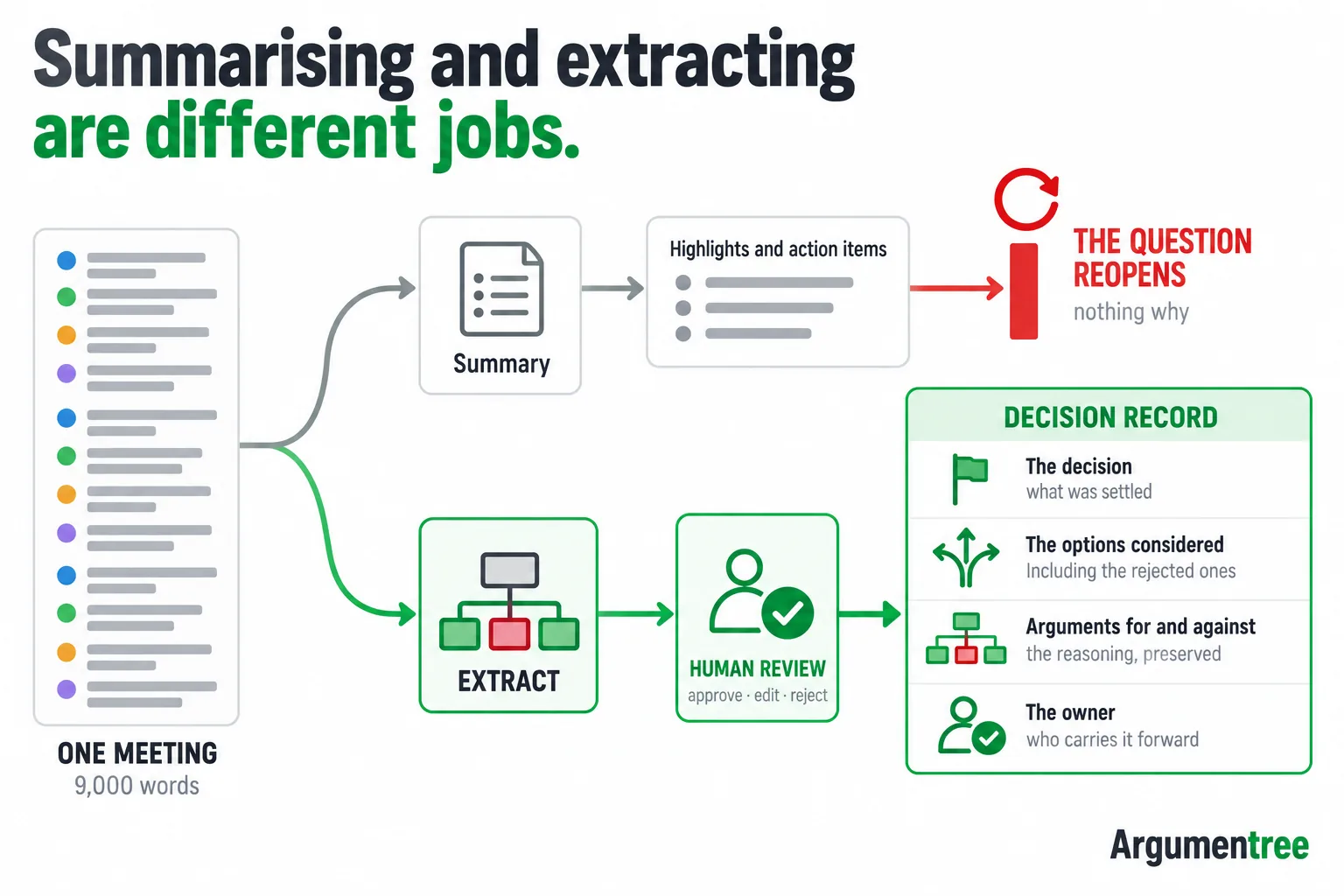
A meeting transcript and an AI meeting summary are not a decision record. A summary compresses what was said; a decision record captures what was decided and why. To extract decisions from a transcript, pull out four things: the decision itself stated as a resolution, the options that were considered and rejected, the arguments for and against each option with who raised them, and the owner accountable for the outcome. Research on meeting speech going back to the AMI corpus (2005) shows why this is hard: decisions in real meetings are negotiated across scattered turns and rarely stated cleanly in one place, and studies of machine-generated meeting summaries (the QMSum Mistake dataset, COLING 2025) list omission of significant decisions as a recurring error class. Software engineering institutionalized the fix in 2011 with Nygard's architecture decision records: context, decision, consequences. Argumentree AI reads a transcript for its decision structure instead of summarizing it, builds a pro/con argument map with a draft decision and owner, and keeps a human in the loop to review and confirm before anything becomes a record.
Your meeting tool already gives you a transcript and a tidy summary. Neither is a record of what you decided — and that gap is why settled questions quietly reopen. Extracting decisions is a different job from summarizing.
- A summary captures what was said; a decision record captures what was decided and why
- From a transcript, pull four things: the decision, the options considered, the arguments for and against, and the owner
- Twenty years of research on meeting speech — and 2025 error studies of AI summaries — show why decisions are exactly what gets scattered, buried and dropped
- Argumentree AI reads the transcript for its decision structure, builds a pro/con map, and keeps a human in the loop before it becomes a record
The migration meeting ended at 3:30 on a Tuesday in March. The recording bot was in the call, so there is a transcript — about 9,000 words of it, which is roughly what an hour of overlapping speech produces — and a tidy AI summary with highlights and action items. Everything about that meeting is, in some sense, on file.
Six months later a new engineering lead asks the obvious question: "Why didn't we just defer this to Q4?" And nobody can answer. The person who made the case against deferring has left. The argument was real — it was raised in three separate asides, forty minutes apart, and it carried the room — but it appears in no summary, because summaries keep highlights, and reasoning that arrives in fragments is never a highlight.
The transcript is the meeting. It is not the decision. This post is about the difference — what a decision record actually contains, why pulling one out of a transcript by hand eats an afternoon, and how AI extraction changes the economics when it targets the decision structure instead of the recap.
A summary compresses what was said.
A decision record preserves what was settled — and why.
The distinction that decides whether your meetings compound or evaporate
A transcript is the meeting. It is not the decision.
The transcript-and-summary problem is essentially solved. Half a dozen tools will sit in your call, produce a clean transcript, and hand you a summary with the highlights and the action items. That is genuinely useful, and you should keep using it. But notice what it gives you: a compressed retelling of what was said. That is a summary's job, and it does it well.
What it does not give you is a record of what you decided — the choice the group committed to, the alternatives you ruled out, and the reasons you ruled them out. No amount of better summarization produces that, because the two documents answer different questions. A summary answers "what happened in this meeting?" A decision record answers "what did we settle, and why did we reject the other options?"
The distinction matters most at the moment it is most expensive: months later, when the question reopens. A summary is silent on "why didn't we defer?" — the argument against deferring was said out loud, then compressed away. A decision record answers it in a sentence. (For the closely related trap of logging tasks instead of the choices behind them, see action items vs. decisions — and for what happens to all that uncaptured reasoning when people leave, see the institutional knowledge crisis.)
Researchers have been trying to pull decisions out of meetings for twenty years
This is not a problem AI notetakers discovered last year. In 2005, the AMI project recorded and annotated roughly 100 hours of meetings precisely so researchers could study what actually happens in them, and by 2007–2008 groups were building systems to detect decision points in that corpus — Hsueh and Moore's decision-detection work, and Fernández and colleagues' models of decision sub-dialogues among them.
The consistent, humbling finding from that line of research: decisions in real meetings are negotiated, scattered, and implicit. People rarely say "we have decided X for reasons Y and Z." They circle a topic, drop it, return to it, half-commit, and move on — which is exactly why decisions are what both hurried humans and summarization models lose. The reasoning you need is distributed across turns that no single highlight contains.
What to actually pull out of a transcript
Extracting decisions is not "summarize, but shorter." It is a targeted read for four specific things. Miss any one and you have a note, not a record.
The decision
The actual choice the group landed on, stated as a resolution — "We will ship the migration in Q3" — not the discussion that led up to it. One sentence a reader can act on without listening to the recording.
The options considered
The alternatives that were genuinely on the table and rejected — ship in Q2, defer to Q4, split the migration. A decision with no visible alternatives reads like a foregone conclusion, and nobody can tell later whether the trade-off was actually weighed.
The arguments for and against
The reasons each option was argued up or down — the pros and cons, and who raised them. This is the reasoning, and it is exactly what a summary drops. Six months on, "why did we not just defer?" is answerable only if the con survived in writing.
The owner
Who is accountable for the decision holding, and who the next action falls to. Not the same as an action item: the owner of a decision defends it if it is reopened; the owner of a task just does the task.
Software engineering institutionalized this exact shape in 2011, when Michael Nygard proposed architecture decision records: short documents capturing the context, the decision, and its consequences, kept with the code they explain. ADRs spread because they solved the same reopening problem — a new engineer asking "why is it built this way?" gets an answer instead of an archaeology project. Put the four items above together and you have the general-purpose version: the spine of a decision audit trail that survives the people who were in the room.
The manual method — and why it drains an afternoon
You can extract all of this by hand, and the method is straightforward:
- Read the transcript end to end, marking every turn where a choice, an objection, or an alternative appears.
- For each decision, write the resolution as a single sentence — the thing the group committed to.
- Scroll back through the discussion and collect the options that were floated and rejected, so the choice has visible alternatives.
- Reconstruct the arguments — quote or paraphrase who argued for and against each option, and attach the reasoning to the right side.
- Name the owner, and file the whole thing somewhere it can actually be found again.
It works. It is also the part everyone quietly skips, because a real transcript is thousands of words of overlapping speech, tangents, and half-finished thoughts — and as the meeting-speech research above predicts, the reasoning you need is scattered across it, often never stated cleanly in one place. Reassembling a con that was raised in three separate asides forty minutes apart is slow, careful work. Do it well and it eats an afternoon per meeting. Do it in a hurry and you get a summary again — which is exactly the thing that was not enough. The tedium is not a discipline problem; it is a structure problem, and structure is automatable.
"But my AI notetaker already lists the decisions"
Fair objection — most meeting tools now emit a "Decisions made" bullet list, and if all you need is topics plus action items, that summary is genuinely enough. But there are two problems with leaning on it as your decision record, and they are different kinds of problem. (For the wider landscape — which kind of AI tool fits which decision job — see our honest roundup of AI decision-making tools.)
The first is reliability. When researchers had humans annotate 200 machine-generated meeting summaries for the QMSum Mistake dataset, omission — significant decisions and actions missing outright, or mentioned without their substance — showed up as one of nine recurring error classes, alongside hallucinated specifics that were never said (Kirstein, Ruas & Gipp, COLING 2025). Summarization models are optimized for coverage of what was discussed, not for guaranteed capture of what was settled — and the scattered, implicit way real decisions are reached is precisely the hard case.
The second problem is there even when the bullet is correct. "Decided: ship the migration in Q3" is the resolution alone — the options considered and the arguments on both sides are still gone, and those are the parts you need when the decision is questioned later. A correct one-line bullet is a note. The record is the structure around it.
Omission of significant decisions is a named, recurring error class
in machine-generated meeting summaries.
— the QMSum Mistake finding, after Kirstein, Ruas & Gipp (COLING 2025)
How Argumentree extracts the decision, not the summary
Argumentree reads the transcript for a different target. Instead of compressing what was said into a narrative, its AI extraction looks for the decision structure: the question under discussion, the options weighed against each other, and the arguments raised for and against each one. It assembles those into a pro/con argument map — the same shape a good facilitator would build on a whiteboard — with a draft decision and a suggested owner attached.
And it is human-in-the-loop by design, which is the honest answer to the reliability problem above. Nothing is published on the model's say-so: the extraction produces a draft map you review — confirm the decision, correct anything the model misread, promote an implied argument that was never said out loud, drop noise. The AI does the tedious reassembly; you do the judgment. Only when you confirm does the draft become a record.
The output is not another summary living next to your transcript. It is a structured, queryable decision record with the reasoning still attached and a full audit trail — the choice, its alternatives, and the arguments on both sides one click away the next time the question comes back. If turning meetings into defensible decisions is a recurring job for your team, this is the heart of what Argumentree calls meeting intelligence.
The 30-second diagnostic
Open the summary of your last significant meeting. Can it answer two questions: what did we rule out, and why? If not, you have minutes — not a record.
The transcript is the source. The record is the asset.
Keep your notetaker — the transcript it produces is the raw material everything else depends on, and its summary is a fine convenience for people who missed the call. Just stop asking it to be something it is not. A compression of what was said cannot answer what was settled and why, and the moment you need that answer is precisely the moment the people who could reconstruct it from memory are gone.
Extraction — by hand on your highest-stakes meetings, or automated with a human in the loop everywhere else — is what turns a pile of recordings into an asset that compounds: decisions with visible alternatives, reasoning that survives departures, and reopened questions that get answered by a link instead of a rerun.
The transcript is the source. The summary is a convenience. The decision record is the asset.
Turn your next transcript into a decision, not a summary.
Argumentree extracts the choice, the options, and the arguments on both sides — then hands you a draft record to review, confirm, and defend.
Sources & further reading
- Carletta, J., et al. (2005). The AMI Meeting Corpus. University of Edinburgh / AMI Consortium.Roughly 100 hours of recorded, transcribed and annotated meetings — the dataset that made meeting speech a serious research subject.
- Hsueh, P.-Y., & Moore, J. D. (2007). Automatic Decision Detection in Meeting Speech. Springer LNCS (MLMI).Early work on detecting decision-related conversation automatically in the AMI corpus.
- Fernández, R., et al. (2008). Modelling and Detecting Decisions in Multi-party Dialogue. 9th SIGdial Workshop on Discourse and Dialogue.Models decision sub-dialogues in meetings — and documents how scattered and implicit real decisions are.
- Kirstein, F., Ruas, T., & Gipp, B. (2024). What's Wrong? Refining Meeting Summaries with LLM Feedback. arXiv:2407.11919 (COLING 2025).Introduces the QMSum Mistake dataset: 200 machine-generated meeting summaries human-annotated on nine error types, omission among them.
- Nygard, M. (2011). Documenting Architecture Decisions. Cognitect blog.The essay that popularized architecture decision records — context, decision, consequences — as a lightweight engineering practice.
Frequently Asked Questions
How do I extract decisions from a meeting transcript?
Read the transcript looking for four things, not one. First, the decision itself — the choice the group actually committed to, phrased as a resolution. Second, the options that were considered and rejected. Third, the arguments for and against each option, with who raised them. Fourth, the owner accountable for the outcome. A meeting summary captures roughly the first item and the topics discussed; a decision record captures all four. You can do this by hand — scrubbing the transcript, quoting the relevant turns, and reassembling them into a structured record — or use AI extraction that pulls the pro/con structure out automatically and lets a human review it.
Why is an AI meeting summary not a decision record?
A summary is a compression of what was said — it preserves the topics, the highlights, and often the action items. A decision record is a compression of what was decided and why — the choice, the alternatives, the reasoning for and against, and the owner. Those are different documents with different jobs. Error studies of machine-generated meeting summaries (the QMSum Mistake dataset, COLING 2025) also list omission of significant decisions as a recurring error class, so even the "decisions made" bullet is not guaranteed to be complete — and when it is correct, it still carries the resolution without the alternatives or the reasoning.
What is the difference between a transcript, a summary, and a decision record?
A transcript is the raw, verbatim record of everything said — complete but unusable as a reference; nobody re-reads a 9,000-word transcript. A summary is a shorter narrative of the same content — readable, but it captures what was said, not what was settled. A decision record is a structured artifact scoped to the outcomes: for each decision, the choice made, the options weighed, the arguments on both sides, and the owner. The transcript is the source, the summary is a convenience, and the decision record is the durable asset — the one you actually query months later.
Can I extract decisions from any meeting tool's transcript?
Yes — any tool that produces a text transcript gives you a usable source, whichever service recorded the call. What those tools add on top is a summary and action items, which is a different output from a decision record. To go from their transcript to a structured decision record you still need to pull out the decision, the options, the arguments for and against, and the owner. That is the extraction step, and it is where a pro/con-aware tool adds value beyond the recap you already have.
What is a decision record, and where does the idea come from?
A decision record is a short structured document capturing a decision, the context and alternatives around it, and the reasoning that carried it — so the "why" survives after the meeting ends and the people move on. Software engineering institutionalized the practice in 2011 as architecture decision records (ADRs), which Michael Nygard framed as context, decision, and consequences kept alongside the code. The general-purpose version adds the explicit pro and con arguments and an owner, which is the shape Argumentree builds automatically from a transcript.
How does Argumentree turn a transcript into a decision record?
You paste or upload the transcript, and Argumentree AI reads it for the decision structure rather than summarizing it: it identifies the question under discussion, the options that were weighed, and the arguments raised for and against each one, and it assembles them into a pro/con argument map with a draft decision and a suggested owner. Nothing is published automatically — the extraction is human-in-the-loop, so you review the map, correct anything the model misread, add reasoning that was implied but not spoken, and confirm the decision. The result is a structured, queryable decision record with a full audit trail, not another summary.
Stop archiving meetings. Start recording decisions.
Argumentree AI extracts the decision structure from your transcripts — options, pro and con arguments, owner — and keeps a human in the loop before anything becomes the record.
About Argumentree Team
Decision Science
The Argumentree team is building the collaborative decision-making platform Argumentree. Our mission is to transform how organizations make, document, and learn from decisions.
Related Articles
Join the discussion
Is an AI summary enough, or does your team need real decision records? Make your case in the community.
Discuss on the Argumentree Forum