
Discussion Board Alternatives: What to Use Instead in Online Courses
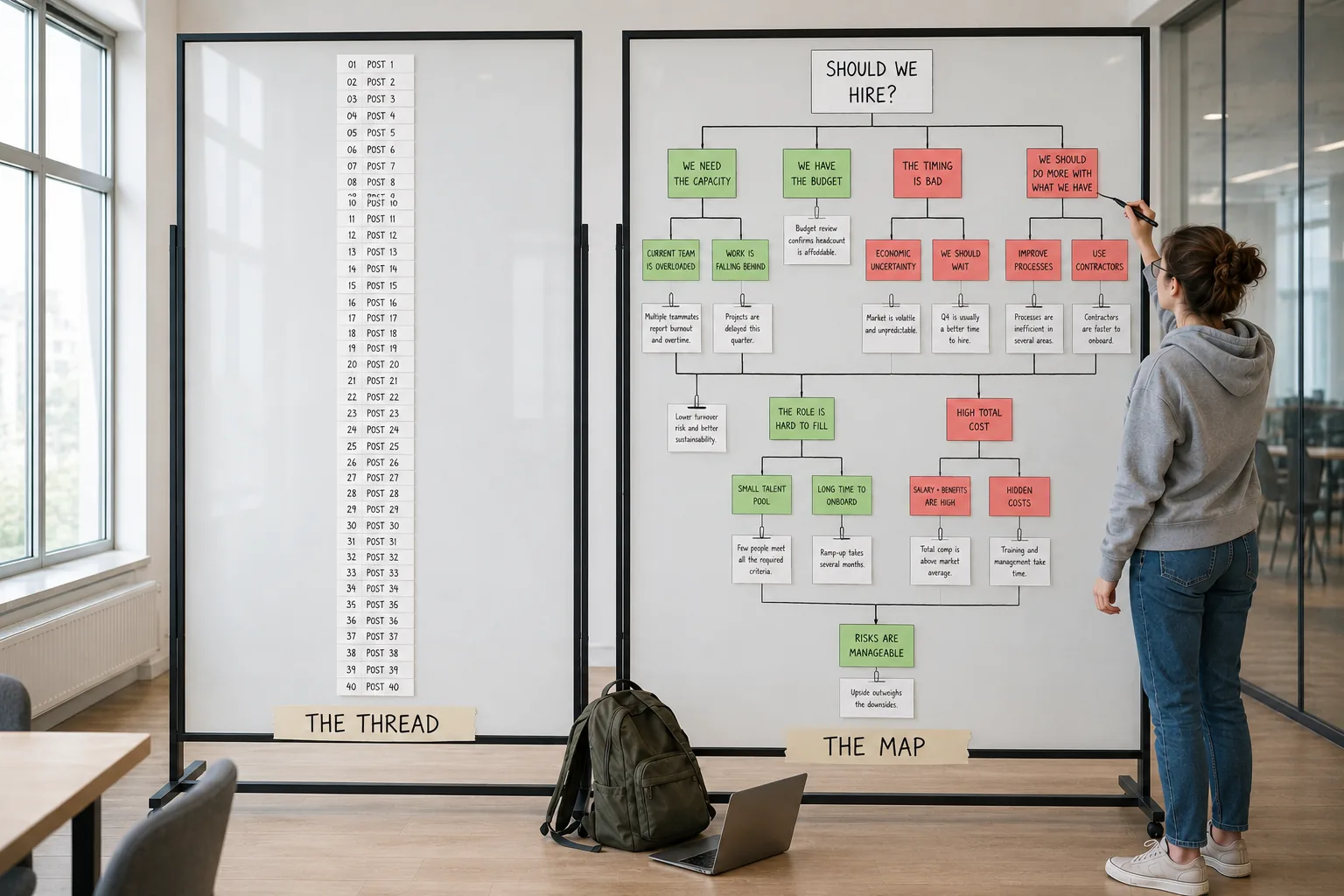
The threaded discussion board underperforms in online courses for structural reasons: it is linear, so the debate has no visible shape; the near-universal "post once, reply twice" grading rule optimizes for compliance rather than thinking; threads accumulate near-duplicate posts because nobody can hold 40 posts in their head; and quiet students get buried. The alternatives do different jobs: structured argument mapping (Kialo Edu, Argumentree) organizes the discussion as a pro/con map around a central question — and the mapping approach carries real evidence, with meta-analytic effect sizes around 0.7–0.8 standard deviations for critical-thinking gains from argument-mapping-based instruction (Alvarez-Ortiz 2007; van Gelder 2015); live polling and Q&A tools (Mentimeter, Slido, Poll Everywhere) excel at synchronous, anonymous participation but leave little durable record; social annotation (Hypothesis, Perusall) anchors discussion to the exact passage but fragments into local threads; and structured debate platforms teach claim-evidence-rebuttal directly. A better online discussion has shape (arguments attached to what they answer), de-duplication (a made point is a node to build on, not repeat), visible reasoning quality, and room for students who need time to think. Argumentree brings the same structure to course discussions, with anonymous participation possible and each argument ratable — useful for educational assessment of reasoning, not just participation counts. The same tool is called a discussion board in Blackboard Original, Discussions in Blackboard Ultra and Canvas, and a forum in Moodle; the structural analysis and the alternatives below apply to all of them equally. Three further structural failures compound these: a single post containing several arguments typically receives a reply to only one, so the rest go unexamined; replies arrive off-target and out of sequence, so rebuttals and misreadings are separated from the posts they concern; and a completed thread carries no record of which claims were challenged, which survived, or how they relate to each other.
The threaded discussion board was built for 1990s forums, not for graded academic reasoning. Its failures are structural — linearity, box-ticking incentives, duplication, buried quiet students, threads that orbit one point while five others go unexamined, replies answering posts twenty places back, and no record of which arguments survived — and the best alternatives fix the structure, not the prompt.
- Seven structural failures: no shape (a stack of posts), "post once, reply twice" compliance, near-duplicate pileup, quiet students buried, a six-argument post answered on one point, replies landing off-target and out of order, and no way to see what was actually settled
- The strongest-evidenced alternative is argument mapping: meta-analyses put critical-thinking gains from mapping-based instruction around 0.7–0.8 standard deviations
- The other categories do different jobs: live polling (synchronous energy), social annotation (close reading), debate platforms (claim–evidence–rebuttal)
- A better discussion has shape, de-duplication, visible reasoning, and room for slow thinkers — pick the tool that delivers those, not a prettier thread
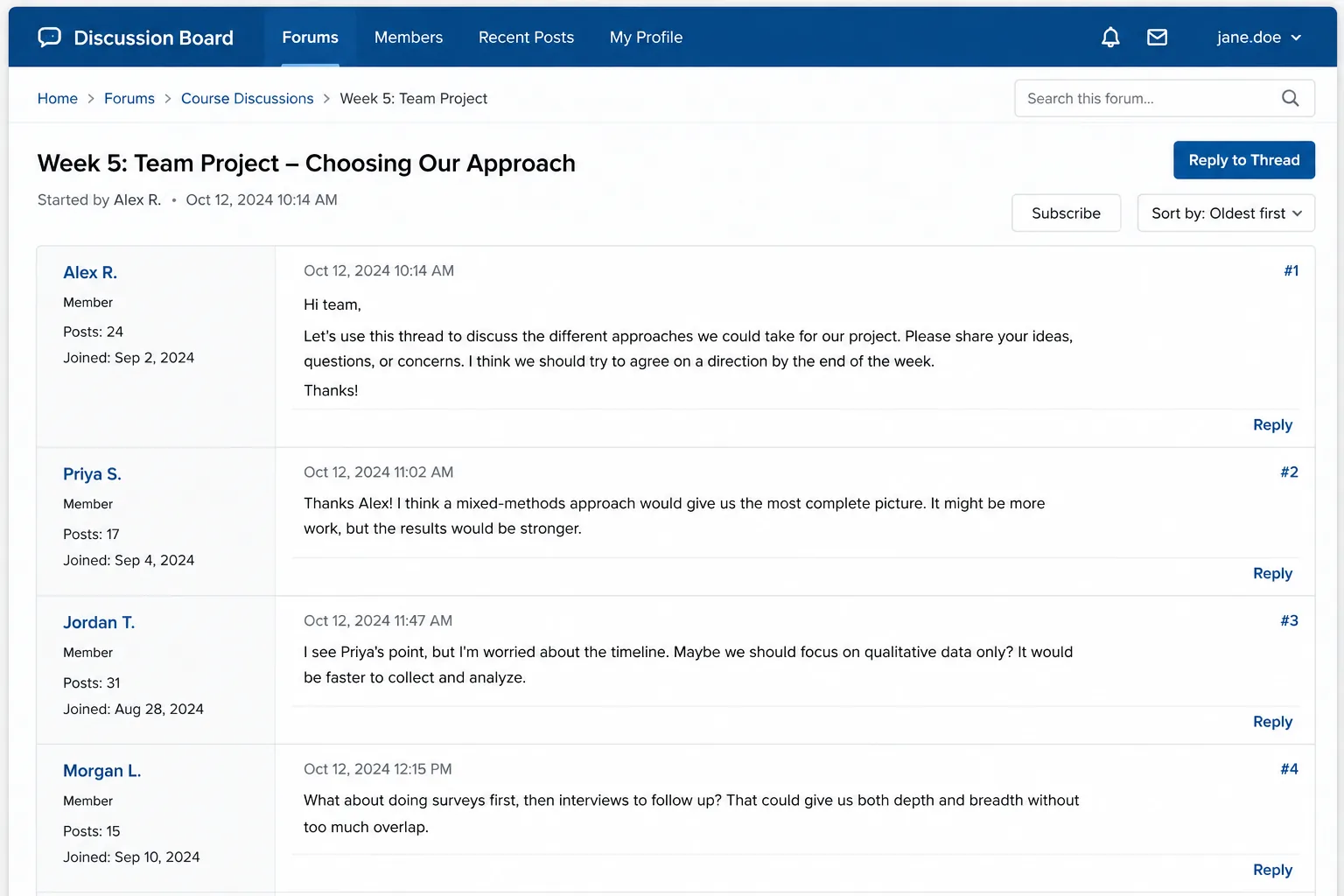
Open any online course in week six and find the discussion board. Forty-one posts under this week's prompt. The first five are thoughtful; the next twenty restate them with different anecdotes, because nobody read forty posts before writing their own. Every reply begins "Great point!" — the course's polite dialect for "I am fulfilling the reply requirement." The one genuinely sharp objection, posted Tuesday by a student who needed two days to think, sits at position 38, unread, beneath the fold of everyone's attention.
Nobody in this scene is failing. The students are doing exactly what the structure rewards; the instructor wrote a good prompt and a fair rubric. The board itself is the problem — a piece of 1990s forum architecture asked to host graded academic reasoning, a job it was never built for. Your LMS may file it under a different name — Blackboard Original calls it the discussion board, Blackboard Ultra and Canvas call it Discussions, and Moodle calls it a forum — but it is the same threaded architecture with the same failure modes, and everything below applies to all of them.
This post is the honest tour: why the threaded board structurally underperforms, what a better online discussion actually requires, a fair roundup of the alternative categories — including the one with real research behind it — and where our own tool fits and doesn't.
"Post once, reply twice" grades the posting.
Nobody is grading the thinking.
The compliance trap of the threaded board
Why the threaded board underperforms
It is linear, so it has no shape
A threaded board is a stack of posts in reply order. Two people can make the same point ten posts apart and nobody notices; a strong objection sits at the bottom where no one scrolls. The discussion has content but no visible structure — you cannot see the state of the argument, only its chronology.
"Post once, reply twice" turns it into box-ticking
The near-universal grading rule — one original post plus two replies — optimizes for compliance, not thinking. Students write to hit the word count and the deadline, drop a post the hour it is due, and never return to the thread. The rubric measures participation; the structure lets participation and reasoning come apart.
It is repetitive and low-signal
Because nobody can hold 40 posts in their head, the same few ideas get restated over and over. Later posters rarely read the earlier ones closely, so the thread accumulates near-duplicates instead of building on itself — the discussion gets longer without getting deeper.
Quiet students disappear
A board rewards whoever posts first, longest, and most confidently. Students who need time to think, who are anxious about writing in public, or who sit in a different time zone get buried — their best contribution arrives after the room has moved on, if it arrives at all.
One post carries six arguments; the thread discusses one
A student writes half a page containing six distinct claims. A classmate replies to the third one — usually the easiest to answer — and from there the whole thread orbits that single point. The other five are never examined, never rebutted, never even acknowledged. Nothing in the format makes their absence visible, so the discussion feels thorough while most of what was actually argued goes untouched.
Replies land off-target, and out of order
Post 34 answers post 7. Post 19 answers something post 11 never said. A reader working top to bottom meets a rebuttal twenty-seven posts after the claim it addresses, and a misreading two posts before the correction. Drift and misunderstanding carry no structural cost in a thread — nothing holds a reply to the point it answers — so both accumulate quietly until the conversation is running several different arguments at once without anyone noticing.
Nobody can say what was actually settled
Read all forty posts, assuming that is even possible, then try to answer three questions: which claims were genuinely challenged, which survived, and how any of them relate to each other. The thread cannot tell you. It preserves everything that was said and records nothing about what any of it did to the argument — which is exactly why the same discussion can be re-run next term from zero.
What a better online discussion actually looks like
Flip each failure and you get the requirements list. Shape: contributions attach to what they answer — an objection sits on the claim it objects to, visibly — so anyone can read the state of the debate at a glance. De-duplication: a point already made is a node to build on, rate, or rebut, not a post to unknowingly repeat. Visible reasoning: the unit of contribution is a claim with support, which lets an instructor assess the quality of thinking rather than the fact of posting. Room for slow thinkers: asynchronous by design, with a structure that makes a late, sharp contribution land where it matters instead of at position 38.
None of that is speculative pedagogy. Argument-mapping-based instruction is one of the few teaching techniques with meta-analytic receipts: Alvarez-Ortiz's 2007 meta-analysis of critical-thinking instruction found courses built on argument mapping improved standardized critical-thinking scores by roughly 0.7–0.8 standard deviations — several times typical gains — and van Gelder's 2015 review puts deliberate-practice mapping courses around 0.8 SD, the difference between the 50th and 79th percentile. (The technique itself is covered in our argument mapping guide.) The board's replacement isn't a nicer forum. It's structure.
Courses built on argument mapping improved critical thinking
by around three-quarters of a standard deviation.
— the mapping evidence, after Alvarez-Ortiz's 2007 meta-analysis and van Gelder's 2015 review
A fair roundup of the alternatives
Four categories, judged on what each actually does — with limits stated plainly, our own included.
Structured argument mapping
<strong>Kialo Edu</strong> and <strong>Argumentree</strong> both work this way, and they are built for different ends. Kialo Edu is purpose-built for the classroom — free, nonprofit-funded, with private class discussions and LMS integration — and for running the discussion itself in a course it is the more natural fit. Argumentree is built for the discussion to survive as a decision: the same pro/con structure, plus AI extraction of arguments from a document or transcript, question and review chains on individual claims, per-user merit ratings, and a durable record of what was decided and why. In week six of a course that extra machinery is overhead; for a department choosing a curriculum it is the point. <a href="/compare/kialo">The full comparison is here</a>.
Instead of a chronological thread, the discussion is organized as a map: a central question, then arguments branching off as explicit pro and con nodes, each attached to the specific claim it supports or challenges.
Strengths
- Shows the shape of the debate — every argument for and against in one view
- De-duplicates: a point already made is a node others build on, not a post they repeat
- Late, thoughtful contributions land on the claim they answer — quiet students stop being buried
- The one category with meta-analytic evidence for critical-thinking gains
Limits
- A bigger shift from the familiar forum than a drop-in replacement
- Works best when the discussion is genuinely a question with sides, less so for open-ended sharing
- Kialo Edu is education-only by design — no route to using the same map for an institutional decision
- Argumentree carries decision machinery a single seminar discussion does not need
Live polling and Q&A tools
Mentimeter, Slido, and Poll Everywhere are common choices.
Tools that collect responses, run live polls, and let students upvote questions in real time — usually inside a lecture or synchronous session.
Strengths
- Excellent for fast, anonymous, everyone-answers-at-once participation
- Upvoting surfaces the questions the room actually cares about
- Very low friction — students just scan a code and respond
Limits
- Built for synchronous moments, not sustained asynchronous reasoning
- Answers are usually ephemeral — little durable record to return to
- Polls capture where people stand, not why
Social annotation
Hypothesis and Perusall are widely used in courses.
Students discuss a shared text, video, or PDF by highlighting passages and commenting in the margin, so the conversation is anchored to the exact spot in the source it responds to.
Strengths
- Ties discussion tightly to evidence in the source material
- Great for close reading — comments sit exactly where they are relevant
- Naturally pulls quieter students into low-stakes, in-context replies
Limits
- Organized around a document, not around a question or decision
- Can fragment into many small local threads with no overall synthesis
- Less suited to weighing competing positions on an open question
Structured debate platforms
<strong>Kialo Edu</strong> is the best-known, and the education edition is the one to use in a course — it is free for educators and integrates with Canvas, Moodle and Google Classroom. General debate formats can be run in most tools with discipline.
Purpose-built debate tools assign or invite sides, structure claims and rebuttals, and often add voting or scoring so a position has to be defended rather than just asserted.
Strengths
- Directly teaches argumentation — claim, evidence, rebuttal
- The structure makes it hard to coast on box-ticking replies
- Positions are visible and contestable, not buried in a thread
Limits
- A formal debate frame can feel adversarial for collaborative topics
- Assigning sides is powerful pedagogy but not always the right fit
- Some tools lean more toward competition than shared understanding
"The board is fine — your prompts are the problem"
There is real truth here, and instructors who invest in prompt design deserve the credit: a genuinely arguable question beats "discuss the reading," and rubrics that grade engagement with peers beat raw post counts. Better prompts and better rubrics measurably improve threads, and if a tool change is off the table this term, that is where the effort should go.
But prompts hit a structural ceiling. The best question in the world still lands in a linear stack where duplicates accumulate, replies are box-ticked, and the argument has no visible shape — the rubric can demand engagement, but the medium cannot show whether a student's point is new, answered, or contested. That is why the classroom evidence favors changing the structure: the studies collected on Kialo Edu's research page — small classroom investigations, vendor-collected, worth reading with that in mind — consistently report students preferring mapped discussion to the forum and engaging more deeply with each other's reasoning, which is the mechanism the meta-analytic mapping numbers would predict. Fix the prompt and the structure; only one of them has a ceiling.
How Argumentree improves course discussion
Argumentree is the argument-mapping category, built so a course discussion has shape from the first contribution: the prompt becomes a central question, and every student contribution is a pro or con argument attached to the claim it addresses. Duplicates become ratings or rebuttals on an existing node instead of post #23; a late, sharp objection lands directly on the argument it challenges; and anonymous participation is possible for students unwilling to dissent in public. Because each argument can be rated and rebutted, the instructor sees the reasoning itself — which arguments students found strong, which survived challenge — a far better basis for assessing student reasoning than counting posts.
Where it isn't the tool: open-ended sharing ("introduce yourself," "post your project update") doesn't need an argument tree — keep the forum or a channel for that, and spend the structure on the discussions that are actually debates. The full classroom setup — roles, moderation, grading views — is covered under class discussion, and the pedagogy of running a proper debate lives in how to structure a debate.
The week-six test
Open your current course's board and read the last ten posts. How many make a point the thread hadn't already made? If the answer is two, the problem isn't your students — it's that the structure can't show them what has already been said.
Grade the thinking, not the posting
Go back to the week-six thread. The student at position 38 — the two-days-later objection nobody read — is the whole case in one post. In a threaded board, her contribution was late; in a mapped discussion, it would have been the most valuable node on the tree, attached to the claim it challenged, visible to everyone who rated that claim, and impossible for the instructor to miss.
That is the choice the alternatives actually offer. Not a prettier forum, but a structure where reasoning is the unit of work: where making a point requires placing it, where answering one requires engaging it, and where the instructor grades the quality of an argument rather than the presence of a post. The evidence says structure teaches thinking. The board never could.
Forty-one posts is participation. One well-placed objection is thinking.
Give your course discussions a shape.
A central question, pro and con arguments, ratings and rebuttals — discussion your students build together and you can actually assess.
Sources & further reading
- Alvarez-Ortiz, C. (2007). Does Philosophy Improve Critical Thinking Skills? (Master's thesis, University of Melbourne) — meta-analysis of critical-thinking instruction.Argument-mapping-based courses improved standardized critical-thinking scores by roughly 0.7–0.8 SD — several times typical instruction gains.
- van Gelder, T. (2015). Using argument mapping to improve critical thinking skills. In The Palgrave Handbook of Critical Thinking in Higher Education.Deliberate-practice mapping courses around 0.8 SD — the 50th-to-79th-percentile jump behind the pull quote.
- Kialo Edu — Research page (classroom studies collected by the vendor, e.g. Mahoney 2022, Rikkyo University).Small classroom studies — vendor-collected, read accordingly — consistently reporting students preferring mapped discussion to threaded forums.
- Lu, L., Yuan, Y. C., & McLeod, P. L. (2012). Twenty-Five Years of Hidden Profiles in Group Decision Making. Personality and Social Psychology Review, 16(1).Why unstructured discussion circles what everyone already knows — the duplication failure, measured in the group-decision literature.
Frequently Asked Questions
What is the best alternative to a discussion board for online courses?
It depends on the job. For discussions that are genuinely debates — a question with sides — structured argument mapping (Kialo Edu, Argumentree) is the strongest-evidenced alternative: the discussion becomes a pro/con map with visible shape, and meta-analyses of argument-mapping instruction report critical-thinking gains around 0.7–0.8 standard deviations. For synchronous energy and anonymous quick input, live polling tools (Mentimeter, Slido, Poll Everywhere) excel. For close reading, social annotation (Hypothesis, Perusall) anchors discussion to the exact passage. For explicit argumentation training, structured debate formats work. The common thread: fix the structure, not just the prompt.
Why do traditional discussion boards fail to drive engagement?
Seven structural reasons. The board is linear, so the discussion has no visible shape — duplicate points pile up and strong objections sink unread. The standard 'post once, reply twice' rubric optimizes for compliance, so students write to the requirement rather than to each other. Threads get longer without getting deeper, because nobody can hold forty posts in their head. And the format rewards fast, confident posters, burying students who need time to think or sit in other time zones. None of this is fixed by better prompts alone — the failures live in the medium. Three more compound them: a post carrying six arguments gets a reply on one of them and the thread orbits that point alone; replies land off-target and out of order, so a rebuttal can appear twenty posts after the claim it answers; and when the thread ends nobody can say which arguments were genuinely challenged, which survived, or how any of them relate.
Is there evidence that argument mapping improves student thinking?
Yes — it is one of the few instructional techniques with meta-analytic support. Alvarez-Ortiz's 2007 meta-analysis of critical-thinking instruction found that courses built around argument mapping improved standardized critical-thinking scores by roughly 0.7–0.8 standard deviations, several times the typical gain of a semester's instruction, and van Gelder's 2015 review of deliberate-practice mapping courses reports effects around 0.8 SD — moving a median student to roughly the 79th percentile. Classroom studies of mapped discussion tools (collected on Kialo Edu's research page, with the vendor-collected caveat) add that students prefer the format to threaded forums and engage more with each other's reasoning.
Is Kialo Edu a good discussion board alternative?
Yes, for its job. Kialo Edu is the best-known argument-mapping tool in education: free for classrooms, built around pro/con trees on a central thesis, and well-suited to teaching argumentation and running structured class debates. Its focus is the discussion itself. Argumentree shares the mapped-discussion structure and adds the decision layer — AI extraction of arguments from source material, per-argument rating with net support, anonymous participation, and a recorded outcome — which matters when the discussion is meant to reach and document a conclusion, or when you want to assess the reasoning rather than host the debate.
How does Argumentree improve course discussions?
The prompt becomes a central question and every contribution is a pro or con argument attached to the claim it addresses — so the discussion has shape, duplicates become ratings or rebuttals on existing points, and a late, thoughtful objection lands where it matters instead of at the bottom of a thread. Anonymous participation is possible for students unwilling to dissent publicly. And because arguments are rated and rebutted individually, instructors can assess the quality of reasoning — which arguments were strong, which survived challenge — rather than counting posts. Open-ended sharing still belongs in a forum; the argument tree is for the discussions that are actually debates.
Retire the thread. Keep the discussion.
Mapped arguments, visible reasoning, room for every student — course discussion that builds instead of piling up.
About Argumentree Team
Deliberation & Decision Science
The Argumentree team is building the collaborative decision-making platform Argumentree. Our mission is to transform how organizations make, document, and learn from decisions.
Related Articles
Join the discussion
Threaded boards: fixable with better prompts, or structurally past saving? Make your case in the community.
Discuss on the Argumentree Forum