
The Best AI Decision-Making Tools for Teams: An Honest Roundup
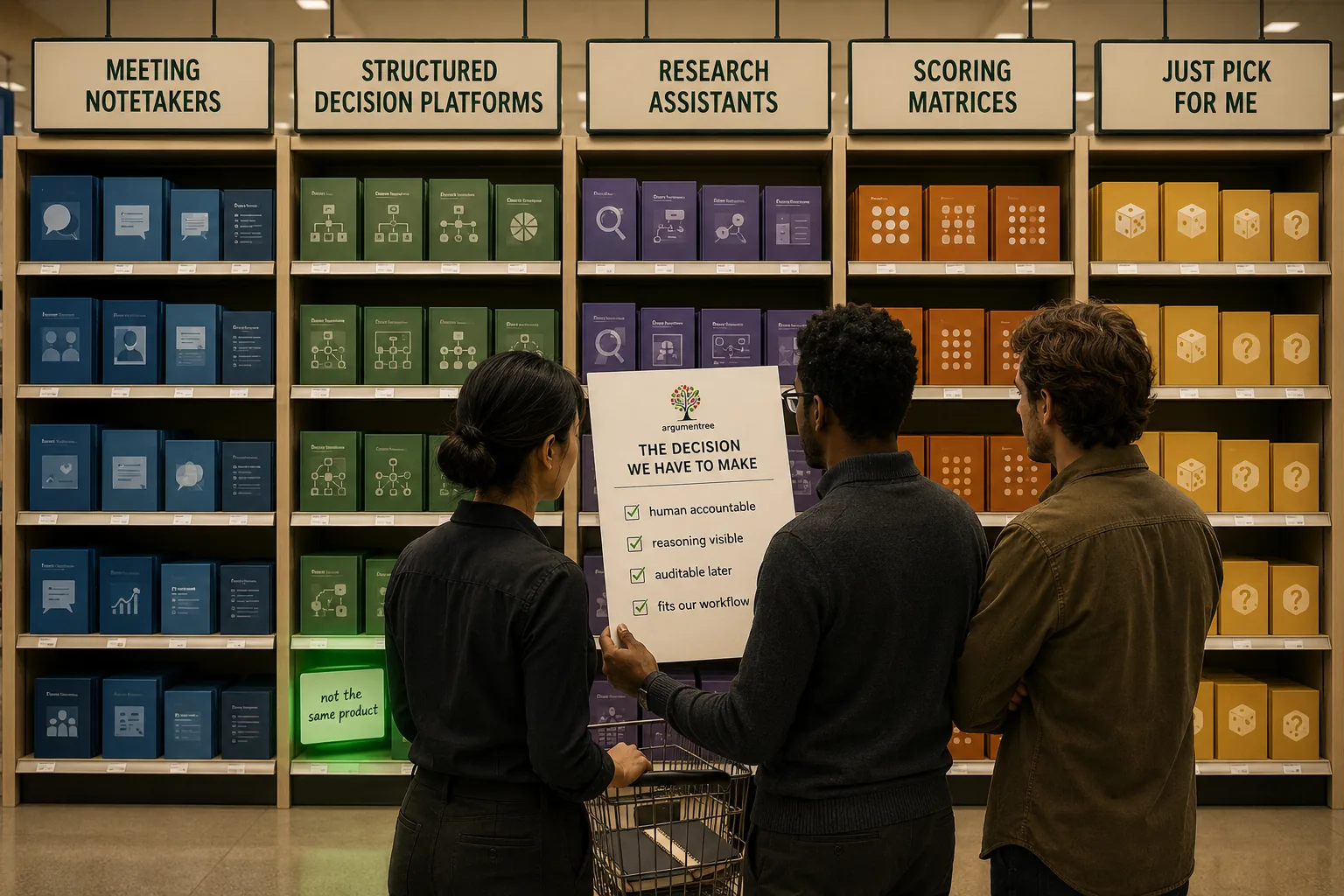
"AI decision-making tool" is a category label covering five very different things. AI meeting and decision assistants (Otter.ai, Fireflies and similar notetakers) capture what was said but not the reasoning — and error studies of machine-generated meeting summaries list omission of significant decisions as a recurring failure class. Structured decision platforms such as Argumentree organize a decision as arguments for and against, let a group weigh them, and record the outcome with its rationale. General AI research assistants (ChatGPT, Claude, Gemini) are fast at surfacing considerations and pressure-testing arguments but should inform decisions, not make them. Decision-matrix and prioritization tools (weighted criteria, RICE) make trade-offs explicit but can lend false precision. And consumer "let the AI decide" apps automate low-stakes choices with no reasoning trail. Judge any of them on four criteria: human-in-the-loop accountability, reasoning capture, auditability, and workflow integration. The caution is research-backed: the human-factors literature on automation (Parasuraman and Riley's use-misuse-disuse framework; Skitka and colleagues' automation-bias experiments) shows people over-rely on automated recommendations, and the EU AI Act's Article 14 makes meaningful human oversight a legal requirement for high-risk uses. The responsible pattern across all five categories: AI assists, humans decide, and the decision plus its rationale is recorded.
"AI decision-making tool" covers everything from a meeting notetaker to an app that picks your lunch. This is the honest map: five categories, what each is genuinely good at, where each fails — and the four criteria that matter for decisions a team has to stand behind.
- Judge any tool on four things: human-in-the-loop accountability, reasoning capture, auditability, and integration
- The five categories: meeting assistants (capture words, drop reasoning), structured decision platforms, research assistants, decision matrices, and "let the AI decide" apps
- The caution is research-backed: automation-bias studies show people over-trust automated recommendations — which is why the accountable human and the recorded why are the real differentiators
- The responsible pattern everywhere: AI assists, humans decide, decisions are recorded
Type "AI decision-making tool" into a search box and the results will include: a bot that sits in your meetings and writes summaries, a platform that maps arguments for and against a strategic choice, a chat assistant that will happily argue either side of anything, a weighted-scoring spreadsheet with an AI autofill, and an app that will simply tell you what to have for dinner. All five answer to the same phrase. They have almost nothing else in common.
That is the real problem with "best AI decision tools" listicles: they rank across categories that don't compete. A meeting notetaker is not an alternative to an argument-mapping platform, and neither is an alternative to asking a chatbot — they do different jobs at different stakes, and the honest question is never "which is best?" but "which job is my decision, and what does that job require?"
So this roundup is organized the honest way: first the four criteria that matter when a team has to stand behind a decision, then the five categories — including where our own product sits and, just as plainly, where it isn't the right tool — and finally the research on why the "human in the loop" criterion is not a slogan but a documented failure mode waiting for the teams that skip it.
The best AI decision tool is not the one with the best answers.
It's the one that leaves you owning the decision — with the reasoning on record.
The selection principle this roundup applies
How to judge an AI decision-making tool
For consequential team decisions — the ones someone will later ask about — four properties separate tools that help from tools that just feel helpful:
Human-in-the-loop
Does the tool keep a person accountable for the final call, or does it quietly decide for you? For anything consequential, you want AI that assists — not one that outputs a verdict you are tempted to rubber-stamp.
Reasoning capture
A good answer is worth little if you cannot see why. Look for tools that surface the arguments, evidence, and trade-offs — not just a score or a recommendation with the workings hidden.
Auditability
Can you reconstruct, months later, what was decided and on what basis? A durable record of the decision and its rationale is what stops a settled question from reopening from scratch.
Integration
Where does the decision actually happen — in a meeting, a doc, a chat thread? A tool that fits that workflow gets used; one that demands a separate ritual usually does not.
The roundup: five categories of AI decision tool
Five categories, each judged on what it is actually for — with the strengths stated fairly and the limits stated plainly, our own included.
AI meeting and decision assistants
Meeting notetakers and transcription copilots — Otter.ai, Fireflies, and the recorder built into your video platform — plus the "decision summary" bots layered on top.
Strengths: Excellent at capturing what was said and drafting summaries and action items with almost no extra effort. They lower the cost of writing anything down at all — which for many teams is the binding constraint.
Limits: They record the conversation, not the reasoning. Error studies of machine-generated meeting summaries list omission of significant decisions as a recurring failure class, and even a correct "decisions made" bullet carries the resolution without the alternatives or the why. Great as an input; weak as the decision record itself. (The full argument is in our piece on extracting decisions from transcripts.)
Structured decision platforms
Argumentree — and, in the adjacent education/debate space, argument-mapping tools like Kialo — organizing a decision as explicit arguments for and against.
Strengths: Built around the reasoning, not just the conclusion. Argumentree, for example, can extract the arguments from a discussion or document, let a group weigh and rebut them, and keep the decision plus its rationale on the record — AI assists, people decide, and the "why" survives. Strong on all four criteria, and the only category designed for auditability.
Limits: More deliberate than a one-click answer — the value shows up when a decision matters enough to be worth structuring, less so for trivial or purely mechanical choices. It organizes human judgment; it does not replace it. If you want a machine to just pick, this is the wrong category.
AI research and analysis assistants
General LLM assistants — ChatGPT, Claude, Gemini — used to gather evidence, summarize options, and pressure-test an argument.
Strengths: Fast, broad, and genuinely useful for surfacing considerations you hadn't thought of, drafting pro/con lists, and playing devil's advocate against your own reasoning on demand.
Limits: They are assistants, not deciders: output quality depends on the prompt and sources, a fluent answer can be confidently wrong, and a private chat leaves no team-visible record. Treat them as a way to inform a decision — then move the surviving arguments somewhere the team can weigh and record them.
Decision-matrix and prioritization tools
Weighted scoring matrices, prioritization frameworks (RICE, weighted-criteria grids), and the spreadsheets and PM tools that implement them — increasingly with AI filling in the grid.
Strengths: Make trade-offs explicit and comparable: you can see which criteria drove the ranking and adjust the weights. A genuine antidote to deciding by vibe.
Limits: Only as good as the criteria and weights you choose, and a tidy number can lend false precision to a subjective call. Best paired with an explicit discussion of the reasoning behind the weights — the matrix is an input to deliberation, not a verdict.
Dedicated "AI decision maker" apps
Consumer "let the AI decide" apps and spinner-plus-LLM tools that take your options and return a pick.
Strengths: Genuinely handy for low-stakes, reversible choices — where to eat, which of two roughly equal options to try first — where the cost of deliberating exceeds the cost of a wrong answer.
Limits: By design they automate the choice rather than support judgment, and they leave no reasoning trail. Fine for trivia; the wrong pattern for anything a team must stand behind, explain, or revisit.
"Why not just ask ChatGPT?"
For many decisions — honestly — you can, and the research-assistant category above is that answer used well. The trouble starts with how humans behave around automated advice, and it is one of the best-documented effects in human-factors research. Parasuraman and Riley's classic framework describes how automation gets misused — relied on when it shouldn't be — and Skitka, Mosier and Burdick's automation-bias experiments showed people following automated recommendations into errors they would have caught unaided, both missing problems the automation didn't flag and accepting wrong flags it did. A fluent, confident answer invites exactly this over-reliance — and a chat window offers no structural resistance to it.
The second problem is organizational: a private chat is invisible to the team. The considerations it surfaced, the counter-arguments it raised, the option it talked you out of — none of it enters the record, so the group inherits your conclusion without your reasoning. That's why the four criteria put accountability and auditability ahead of answer quality, and why regulation is converging on the same instinct: the EU AI Act's Article 14 makes meaningful human oversight — a person able to understand, question, and override the output — a legal requirement for high-risk uses. The pattern that survives both the psychology and the regulation is the same one this roundup keeps landing on: AI assists, a human decides, and the decision is recorded with its why. Use the chat assistant to generate; use a structured platform to weigh, decide, and remember.
People over-rely on automated recommendations —
even when their own judgment would have been better.
— the automation-bias finding, after Skitka, Mosier & Burdick (1999) and Parasuraman & Riley (1997)
Where Argumentree fits — and where it doesn't
Argumentree is the structured-platform category, built for the decisions where the reasoning has to be visible and durable: AI extracts and structures the arguments from your discussion or documents, the team weighs and rebuts them in the open, and the outcome is recorded with its rationale — a decision you can defend in six months, not a chat you'd have to scroll for. It pairs naturally with the other categories rather than replacing them: the notetaker's transcript is excellent input for extraction, and the research assistant's generated considerations are excellent candidate arguments for the tree. This is the working core of decision intelligence in practice — and for how it plays out in a team setting specifically, see decision intelligence for teams.
And where it doesn't fit: trivial, reversible, low-stakes choices don't need an argument tree — let an app pick, or just decide. If your need is primarily non-AI group voting and facilitation, dedicated group-decision tools may serve; our group decision-making tools comparison covers that adjacent landscape honestly. Plan details, including the free tier this roundup would be dishonest not to mention, are on pricing.
The category test
Take the last decision your team got wrong. Which failed: the information (research assistant's job), the trade-off visibility (matrix's job), the record (notetaker can't help you), or the weighing of arguments nobody surfaced? Pick the tool for the failure you actually have.
Assist, decide, record
The five categories aren't rivals; they are stations along one pipeline. Research assistants generate considerations. Notetakers capture what was said. Matrices make trade-offs comparable. Structured platforms turn all of it into weighed arguments and a recorded decision. And the "AI decides" apps mark the boundary — the class of choices small enough that none of this machinery is worth it.
What separates teams that get real value from AI decision tools from teams that accumulate subscriptions is not picking the hottest product in each category. It is enforcing the one pattern the psychology, the regulation, and the post-mortems all point to: the AI assists, a named human decides, and the decision — with its reasoning — goes on the record. Any tool that strengthens that pattern is worth having. Any tool that erodes it is expensive at any price.
AI assists. Humans decide. The decision gets recorded. Everything else is feature comparison.
The structured half of your AI decision stack.
Feed it transcripts and research; get weighed arguments, a named decision, and a record that survives — with your team in the loop the whole way.
Sources & further reading
- Parasuraman, R., & Riley, V. (1997). Humans and Automation: Use, Misuse, Disuse, Abuse. Human Factors, 39(2).The classic framework for how people actually behave around automation — including relying on it when they shouldn't.
- Skitka, L. J., Mosier, K. L., & Burdick, M. (1999). Does automation bias decision-making? International Journal of Human-Computer Studies, 51(5).The automation-bias experiments: people follow automated recommendations into errors they would otherwise have caught.
- Kirstein, F., Ruas, T., & Gipp, B. (2024). What's Wrong? Refining Meeting Summaries with LLM Feedback. arXiv:2407.11919 (COLING 2025).The QMSum Mistake error taxonomy behind the meeting-assistant caveat: omission of significant decisions is a recurring failure class.
- Regulation (EU) 2024/1689 (AI Act) — Article 14, human oversight.Meaningful human oversight as a legal requirement for high-risk AI uses — the regulatory version of the human-in-the-loop criterion.
Frequently Asked Questions
What are the best AI decision-making tools for teams?
There is no single best tool — it depends on the job. For capturing what was said, AI meeting assistants like Otter.ai or Fireflies are strong. For research and pressure-testing options, general assistants like ChatGPT, Claude, or Gemini help. For making trade-offs explicit, decision-matrix and prioritization tools work well. And for consequential group decisions where the reasoning has to be visible and recorded, structured decision platforms such as Argumentree are designed around arguments, weighing, and an auditable outcome. The responsible pattern across all of them is the same: AI assists, humans decide, and the decision plus its rationale is recorded.
What is the difference between AI-assisted and automated decision-making?
AI-assisted decision-making keeps a person accountable for the final call: the AI gathers evidence, surfaces arguments, summarizes, or scores options, but a human weighs and decides. Automated decision-making has the system output the choice directly. Automation is appropriate for high-volume, low-stakes, reversible decisions; for consequential choices — especially ones a team must explain or stand behind later — the assisted pattern with a human in the loop is safer, more transparent, and easier to audit. The EU AI Act draws a version of this same line, making meaningful human oversight a requirement for high-risk uses.
Should you let an AI make decisions for you?
For trivial, low-stakes, easily reversible choices — sure, and it can save real time. For anything consequential, the research says be careful with more than the AI's accuracy: automation-bias studies (Skitka, Mosier and Burdick, 1999) show people follow automated recommendations into errors they would have caught unaided, and Parasuraman and Riley's classic analysis documents systematic over-reliance on automation. The better approach for consequential choices is to use AI to inform the decision — research, argument capture, structured weighing — while a named human makes the call and the reasoning goes on the record.
What should you look for in an AI decision-making tool?
Four things. Human-in-the-loop: does it keep a person accountable, or decide for you? Reasoning capture: can you see the arguments, evidence, and trade-offs, not just a score? Auditability: can you reconstruct later what was decided and why? Integration: does it fit where the decision actually happens? A tool that surfaces the reasoning and records the outcome is far more valuable for team decisions than one that just returns an answer — a confident answer with hidden workings is precisely the shape automation bias feeds on.
Are AI meeting notetakers enough to document decisions?
They are a genuinely useful start and a poor finish. Notetakers capture what was said and draft summaries and action items at near-zero effort — but they record the conversation, not the reasoning, and error studies of machine-generated meeting summaries (the QMSum Mistake dataset, COLING 2025) list omission of significant decisions as a recurring failure class. Even a correct 'decided: X' bullet drops the alternatives and the why. Use the transcript as input, and put the decision itself — options, arguments, rationale, owner — into a structured record.
How is Argumentree different from an AI decision maker app?
AI decision maker apps automate the choice and return a pick, usually with no reasoning trail — useful for low-stakes decisions. Argumentree does the opposite: it is a structured decision platform where AI assists but people decide. It can extract the arguments from a discussion, let a group weigh the points for and against, and keep the decision together with its rationale as an auditable record. The goal is not to hand you an answer, but to make group reasoning explicit and durable so a settled decision does not quietly reopen later.
Add the category your stack is missing.
You have the notetaker and the chatbot. Argumentree is the layer that weighs the arguments, names the decider, and keeps the why.
About Argumentree Team
Decision Science
The Argumentree team is building the collaborative decision-making platform Argumentree. Our mission is to transform how organizations make, document, and learn from decisions.
Related Articles
Join the discussion
Which AI tools have actually improved your team's decisions — and which just produced more text? Make your case in the community.
Discuss on the Argumentree Forum