
Three ways to use a principle, and only one of them is legitimate
Every article about influence eventually reaches the ethics paragraph, and almost all of them fudge it, because "use these techniques responsibly" is not a test anyone can apply on a Tuesday. Cialdini's own framing is far more usable, because it puts the question on the world rather than on the intent.
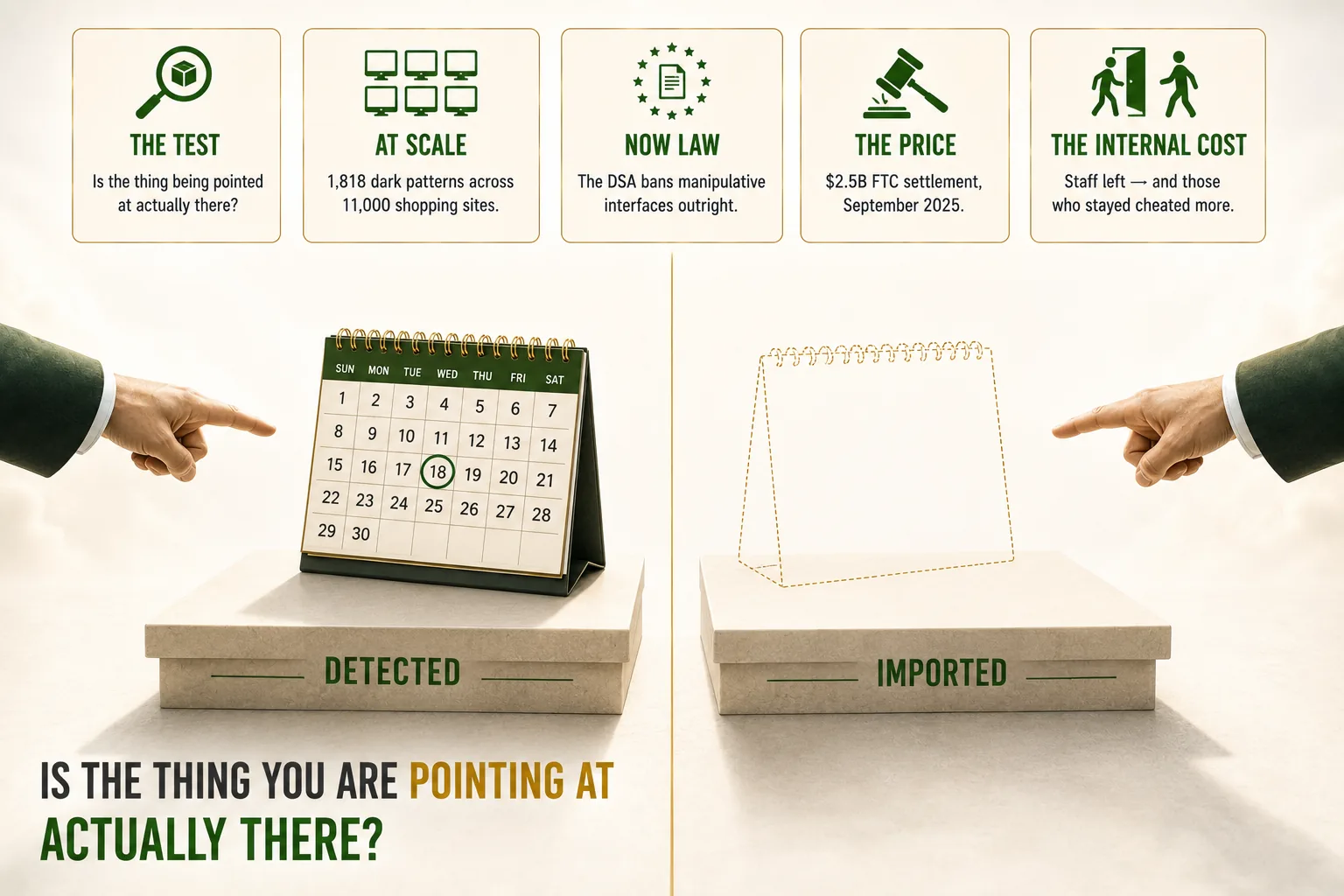
That is a test you can run in a meeting. Not did that feel manipulative, which nobody agrees on, but: is the thing being pointed at actually there? A real deadline stated plainly and an invented one sound identical in the room. They differ only in whether the calendar backs them up.
- 1The bungler fumbles away an opportunity to tap a legitimate source of influence — the person who has genuine expertise and never mentions it, or a real deadline nobody communicates.
- 2The sleuth detects what is genuinely present in the situation and surfaces it: the actual constraint, the actual track record, the actual majority.
- 3The smuggler illicitly imports a principle into a situation where it does not naturally belong — the deadline that exists to force the decision, the authority borrowed from an unrelated domain, the consensus asserted rather than counted.
The cost lands inside your own building first
The usual objection to influence ethics is that it is a customer problem — a matter of external reputation, priced accordingly. Cialdini's argument, made with Petrova and Goldstein in MIT Sloan Management Review in 2004, is that this gets the accounting backwards. Dishonest external practice generates internal costs that arrive sooner and compound quietly: reputational degradation, a values mismatch between the organisation and the people in it, and a growing need for surveillance because trust has stopped doing that work.
The empirical follow-up is the part worth putting on a slide. In the Journal of Business Ethics in 2021, Cialdini, Li, Samper and Wellman reported that exposure to unethical leader behaviour raised group members' likelihood of leaving — and that those who remained became more likely to cheat the group afterwards.
Unethical influence does not merely cost you customers. It sorts your workforce — the people most uncomfortable with it leave first, and the ones who stay are more willing to do it again. That is a culture change you did not vote on.
The same line, now with a price attached
What used to be a professional-ethics discussion is now enforcement. In 2018 Gray and colleagues named dark patterns in the HCI literature, describing designs in which user value is supplanted in favour of shareholder value. A year later Mathur and colleagues measured the scale: a crawl of roughly 53,000 product pages across 11,000 shopping websites turned up 1,818 dark pattern instances spanning 15 types — and 22 third-party entities selling them as a turnkey service. Their definition is the one a business audience should use:
Dark patterns are user interface design choices that benefit an online service by coercing, steering, or deceiving users into making unintended and potentially harmful decisions.
— Mathur et al., Dark Patterns at Scale, Proceedings of the ACM on Human-Computer Interaction (2019)
Then the law arrived. The EU's Digital Services Act, applicable across the Union since 17 February 2024, states in Article 25(1) that providers of online platforms "shall not design, organise or operate their online interfaces in a way that deceives or manipulates the recipients of their service or in a way that otherwise materially distorts or impairs the ability of the recipients of their service to make free and informed decisions." Recital 67 supplies the first definition of dark patterns in EU law, and Article 25(3) names three familiar mechanics: giving one option visual prominence, repeatedly asking someone to reconsider a choice they have already made, and making cancellation harder than sign-up.
- ✗FTC, 2022. Bringing Dark Patterns to Light — a staff report describing design practices that trick or manipulate users into choices they would not otherwise have made, across e-commerce, cookie banners, children's apps and subscriptions.
- ✗FTC v. Amazon, September 2025. A $2.5 billion settlement — $1bn civil penalty plus $1.5bn in consumer redress — over allegations that dark patterns enrolled consumers in Prime without consent and obstructed cancellation. The largest civil penalty ever obtained by the FTC in a rule-violation case.
- ✗Coming in the EU. A Digital Fairness Act, slated as a Commission initiative for late 2026, explicitly targets dark patterns, addictive design and unfair personalisation — a signal that the interface, not just the claim, is now regulated territory.
But every meeting uses pressure — isn't this unavoidable?
Yes, and that objection is right enough to take seriously. Deadlines are real. Expertise is real. Momentum is sometimes exactly what a stalled decision needs, and a leader who refuses to ever use urgency will preside over a lot of unmade decisions. Cialdini's position has never been that influence is suspect; it is that these shortcuts are usually adaptive, which is why they work at all.
The line holds anyway, because it is not drawn at intensity. It is drawn at correspondence with reality. Push hard on a genuine constraint and you are informing the room. Manufacture the constraint and you have removed the room's ability to weigh the case — which is the same harm the DSA describes as materially distorting the ability to make free and informed decisions. Regulators arrived at Cialdini's test independently, which is a decent sign that it is the right one.
There is also a self-interested reason to hold the line, and it is the one that persuades executives who are unmoved by the ethical case: smuggled pressure destroys your own information. A room that agreed because of an invented deadline has told you nothing about whether the proposal was good — so you cannot learn from the outcome either way. You have spent your team's judgement and received no signal in return.
The test: would this reason survive the decision record?
One question, applied to the reason a proposal actually won.
- ✓Write down why it won, in the language used in the room. "Because the CFO backed it" and "because we had to decide by Friday" look very different in a decision record than they sound in the moment.
- ✓Check each pressure against reality. Is the deadline in a contract or in a slide? Does the expert's expertise cover this question? Was the consensus counted, or asserted by whoever spoke first?
- ✓Separate the constraint from the recommendation. Real constraints belong in the framing, visible to everyone, not deployed mid-discussion by whoever benefits from them.
- ✓Apply it to your own product, too. If your interface uses countdowns that reset, prominence to steer a choice, or a cancellation path longer than the sign-up path, you are running the mechanics the DSA names — the ethics question and the compliance question have converged.
- ✓Score the argument, not the pressure. When claims are rated on evidence in the tree, a manufactured urgency has nowhere to attach itself: it is not a claim, so it cannot be supported.
Is the thing you are pointing at actually there?
Cialdini spent three years learning how professionals get a yes, and the ethical conclusion he drew from it was not squeamish. He kept using the principles. He just insisted that a practitioner detect what is genuinely in the situation rather than import what is not — and warned that importing it corrodes the importer, not only the audience.
Forty years on, that test has been written into European law and priced at two and a half billion dollars in an American courtroom. It still fits in one question, and it is worth asking out loud the next time a decision starts moving faster than the evidence: is the thing we are pointing at actually there?
Sources & further reading
Every named source in this post, with a link where one exists.
- •Kenrick, D. T. (2018). The Influence Smugglers. Psychology Today. — the bungler / sleuth / smuggler typology, as set out by Cialdini and quoted here in Kenrick's wording.
- •Cialdini, R. B. (1999). Of tricks and tumors: Some little-recognized costs of dishonest use of effective social influence. Psychology & Marketing, 16(2), 91–98. — the original argument that dishonest influence carries internal costs.
- •Cialdini, R. B., Petrova, P. K., & Goldstein, N. J. (2004). The Hidden Costs of Organizational Dishonesty. MIT Sloan Management Review, 45(3), 67–73. — reputational damage, values mismatch, and the surveillance burden.
- •Cialdini, R., Li, Y. J., Samper, A., & Wellman, N. (2021). How Bad Apples Promote Bad Barrels: Unethical Leader Behavior and the Selective Attrition Effect. Journal of Business Ethics, 168(4), 861–880. — the selective-attrition finding.
- •Gray, C. M., Kou, Y., Battles, B., Hoggatt, J., & Toombs, A. L. (2018). The Dark (Patterns) Side of UX Design. CHI '18. — the naming paper in HCI.
- •Mathur, A., et al. (2019). Dark Patterns at Scale: Findings from a Crawl of 11K Shopping Websites. PACM HCI, 3(CSCW), Article 81. — 1,818 instances, 15 types, 22 third-party providers.
- •Regulation (EU) 2022/2065 (Digital Services Act), Article 25 and Recital 67. — the prohibition on deceptive or manipulative interfaces; applicable from 17 February 2024.
- •FTC Bureau of Consumer Protection (2022). Bringing Dark Patterns to Light. Staff Report P214800.
- •FTC (2025). FTC Secures Historic $2.5 Billion Settlement Against Amazon. Press release, 25 September 2025.
- •European Parliament, Legislative Train Schedule: Digital Fairness Act. — the Commission initiative slated for late 2026.