
Schopenhauer's Eristic Dialectic: The First Field Guide to Bad-Faith Argument
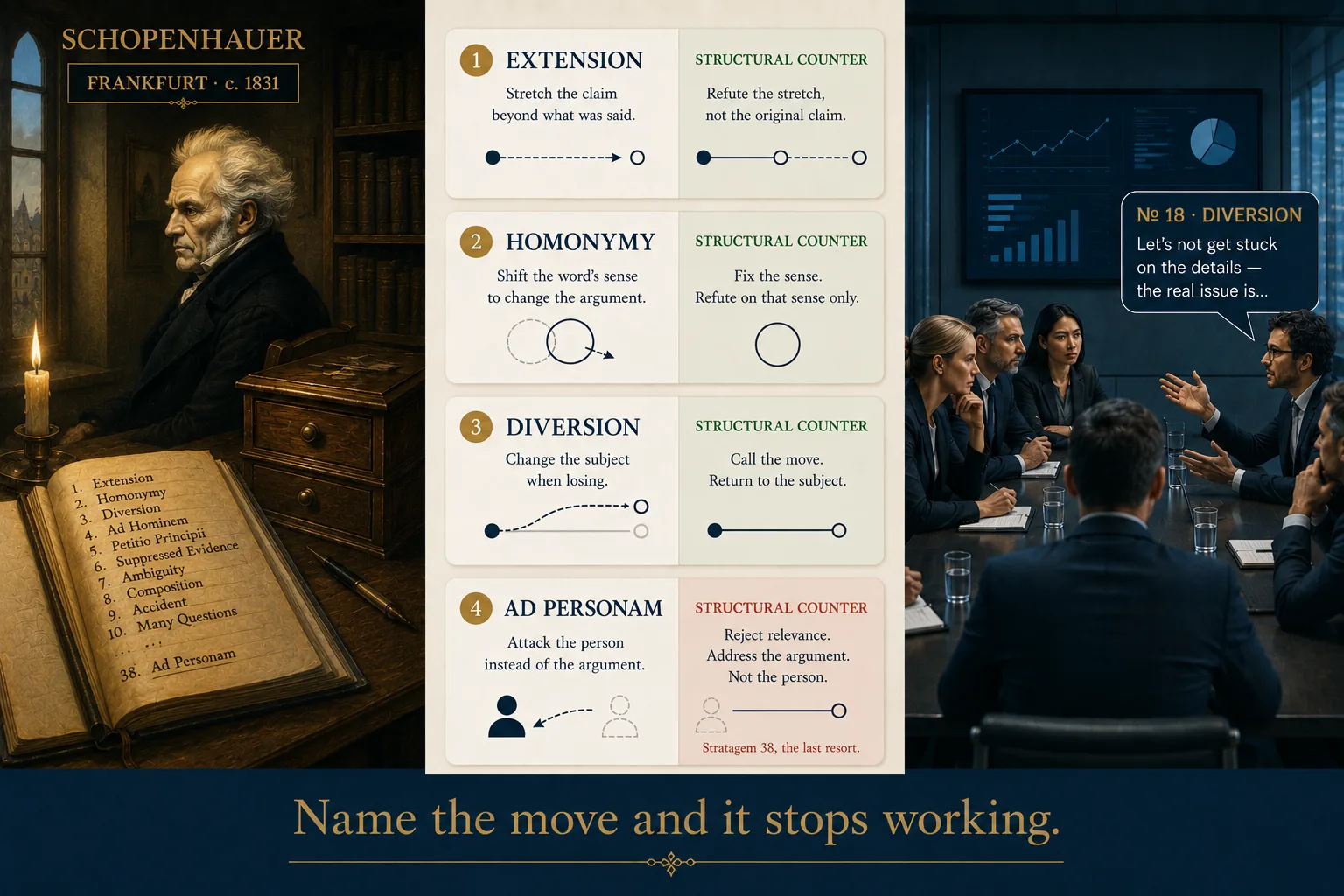
Around 1830–31, Arthur Schopenhauer drafted Eristische Dialektik: Die Kunst, Recht zu behalten — 'Eristic Dialectic: The Art of Being Right' — a catalogue of 38 stratagems for winning a dispute regardless of the truth. It is the first systematic field guide to bad-faith argument: the extension that stretches an opponent's claim past its limits, equivocation on a word's two senses, postulating what has to be proved, diverting the dispute, appealing to authority rather than reason, claiming victory despite defeat — and, as the final stratagem when all else fails, becoming personal, insulting and rude (ad personam). Schopenhauer never published it. He abandoned the project, writing that so minute a consideration of 'the crooked ways and tricks that are used by common human nature to cover up its shortcomings' no longer suited his temperament; the full text surfaced only in his posthumous manuscripts, and English readers know it through T. Bailey Saunders' 'The Art of Controversy' and E.F.J. Payne's translation of the Manuscript Remains. Read descriptively, it remains startlingly current: nearly two centuries later, the same moves run through meetings and public debate under newer names — the straw man, the motte-and-bailey, the red herring, tone policing. The durable lesson is structural: eristic thrives where argument is a live performance judged by the room; it starves where claims are written, framed against a fixed question, and rated on merit.
Around 1830–31 Schopenhauer catalogued 38 stratagems for being right without being correct — then refused to publish the catalogue. It is the founding document of what we now call debate foul play.
- Eristische Dialektik: Die Kunst, Recht zu behalten — drafted around 1830–31, published only after his death; English readers know it as The Art of Being Right or The Art of Controversy
- 38 numbered stratagems: the extension, equivocation, generalizing specific statements, postulating what has to be proved, appeals to authority, claiming victory despite defeat
- The final stratagem, when every other trick has failed: become personal, insulting, rude — ad personam, the ancestor of every comment-section meltdown
- Schopenhauer abandoned the project — dissecting 'the crooked ways and tricks' of human nature no longer suited his temperament — which is why the first field guide to bad faith reached print posthumously
- Nearly two centuries on, the same moves carry newer names — red herring, motte-and-bailey, tone policing — and the counter is still structural, not rhetorical
Aristotle was neither the first nor the only thinker to systematize argument. Eight connected pieces on the traditions that built the anatomy of reasoned disagreement — and what each one saw that the others missed.
- 1.The Global Roots of Reasoned Argument: How Three Civilizations Invented Logic
- 2.Indian Logic: The 2,500-Year Tradition from Nyāya to Buddhist Debate
- 3.Mohist Logic: The Chinese Art of Drawing Distinctions
- 4.Aristotle's Logic: The Mediterranean Foundation of Western Argument
- 5.Islamic Dialectics: From Theological Debate to the Science of Disputation
- 6.Medieval Scholastic Logic: How the University Invented the Structured Argument
- 7.Five Syllogisms: Comparing Argument Structures Across Civilizations
- 8.Schopenhauer's Art of Being Right: The First Field Guide to Bad-Faith ArgumentYou are here
- 9.Galileo's Dialogue: Four Days, Three Speakers, and the Argument He Got Wrong
The philosopher who catalogued the dirty tricks
Sometime around 1830, one of the most formidable minds in Europe sat down to write a manual on how to win arguments dishonestly. Arthur Schopenhauer — the philosopher of The World as Will and Representation, a man who prized truth so highly he built a metaphysics around the difficulty of reaching it — drafted a short, acid treatise he called Eristische Dialektik: Die Kunst, Recht zu behalten: Eristic Dialectic, the art of being right.
The premise is delivered deadpan. Set truth aside — this is not a book about being correct. It is a book about prevailing: thirty-eight numbered stratagems for coming out of a dispute victorious whether your position deserves it or not. Stretch your opponent's claim until it becomes indefensible. Slide between two meanings of the same word. Smuggle your conclusion into your premises. Change the subject. Appeal to authority rather than reason. And if you are losing on every front, deploy the final stratagem: abandon the argument and attack the person.
Readers have argued ever since about what the treatise is. A cynic's confession? A satire on how people actually argue, wearing the form of an instruction manual? The most defensible reading is the one the text itself supports: it is a diagnosis. Schopenhauer had watched enough disputation — in seminar rooms, in print, in the philosophical feuds of his age — to see that most of it was not a search for truth at all, and he did what a systematic mind does with a recurring phenomenon: he classified it.
That makes this the natural eighth chapter of a series about the traditions that built reasoned argument. The Indians catalogued the ways a debater could lose; the scholastics built institutions to keep disputation honest. Schopenhauer inverted the lens and catalogued the ways a debater could cheat — and in doing so wrote the first systematic field guide to what we now call bad-faith argument.
Eristic: arguing to win, not to know
The word comes from Eris, the Greek goddess of strife, and Schopenhauer used it with precision. Eristic dialectic is disputation with the sole intention of winning — rather than seeking the truth. It is the shadow discipline of everything this series has covered: where Aristotle's dialectic tests claims to find out what holds, eristic manipulates the test itself so that one side prevails regardless.
What gives the treatise its bite is Schopenhauer's account of why eristic exists. The root, he argued, is vanity. Almost no one can bear to be publicly wrong; when a position starts to collapse, 'common human nature' reaches for tricks, dodges and chicanery to be right in the end — not because people are stupid, but because the wound of conceding is sharper than the reward of learning. The tricks are not a fringe pathology of bad people. They are what ordinary people do under argumentative pressure, which is exactly why they repay systematic study.
Note what this framing quietly concedes: the stratagems work. Every one of the thirty-eight succeeds often enough in live disputation to be worth naming. That is the uncomfortable insight a modern reader should carry through the catalogue — these are not logical errors that collapse on inspection, like a formal fallacy. They are performance moves, and they beat honest reasoners in real time precisely because honest reasoning is slower than trickery.
Inside the catalogue: the moves you will recognize
The thirty-eight stratagems are uneven — some are technical points of classical dialectic, others are timeless. What is striking, reading them today, is how many carry a modern name. Schopenhauer got there first, without the vocabulary:
- The extension. Stretch the opponent's claim beyond its natural limits — make it more general, more absolute, more extreme than intended — then refute the inflated version. The modern name is the straw man; run in reverse, retreating from a bold claim to a trivially safe one, it becomes the motte-and-bailey.
- Homonymy. Slide between two senses of the same word and treat an argument against one as an argument against the other — equivocation, the trick a written definition kills instantly.
- Generalize the specific. Take a claim your opponent made about one case and answer it as if it were a universal — a targeted cousin of the extension, and a reliable way to make a careful speaker sound careless.
- Postulate what has to be proved. Smuggle the disputed conclusion into your premises or definitions — begging the question, the ancestor of the loaded question that convicts whatever you answer.
- Divert the dispute. When the argument turns against you, change what is being argued about — the move the field now calls the red herring, and the reason the framed question is the single strongest piece of debate hygiene.
- Appeal to authority rather than reason. Substitute a respected name for an argument, tuned to the audience's reverences rather than the question's merits.
- Claim victory despite defeat. When the exchange ends unresolved — or lost — declare it won with confidence; the audience remembers the confidence, not the logic. Every unrecorded meeting rewards this one.
Two things distinguish the catalogue from a mere list of fallacies. First, these are tactics, not errors — each is deployed with intent, which is why Schopenhauer organized them by when to use them, not by what logical form they violate. Second, they are audience-facing: many stratagems explicitly target what the listeners will believe rather than what the opponent can refute. Eristic, Schopenhauer understood, is a spectator sport.
Diagnose your last contested meeting
Replay the most consequential disagreement your team has had this quarter and audit it against the catalogue: was anyone's claim stretched before it was attacked? Did the question quietly change mid-dispute? Did someone declare victory with confidence the record would not support — if there had been a record? If you can name two stratagems from memory, the meeting was part eristic. The fix is not sharper rhetoric; it is a written record that makes the moves visible.
Stratagem 38: the last resort
The catalogue ends with its most famous entry. When you notice that your opponent is superior and you are going to lose, Schopenhauer advises with lethal irony, there remains one move that cannot fail: become personal, insulting, rude. Leave the subject altogether and attack the person — ad personam.
The placement is the point. Attacking the person is not stratagem one; it is stratagem thirty-eight — the move you reach for when every argumentative resource is exhausted. An insult in a dispute is therefore not merely unpleasant. It is information: a signal that the insulter has run out of arguments and knows it.
Schopenhauer distinguished this from the classical argumentum ad hominem of his dialectical tradition — arguing from the opponent's own concessions, a perfectly legitimate move. Ad personam abandons the argument entirely for the arguer. Modern discourse has largely collapsed the two under one Latin label, which is a loss: one is a way of reasoning, the other the end of reasoning.
Anyone who has watched a thread melt down — or a meeting turn from the proposal to the proposer — has seen stratagem 38 executed exactly as described, one hundred and ninety-five years after it was written down.
The book he refused to finish
Here the story takes its strangest turn: Schopenhauer never published the treatise. He drafted it around 1830–31 and set it aside; the manuscript stayed in his papers for the rest of his life. When he revisited the subject in his late collection Parerga and Paralipomena (1851), he explained the abandonment — and recorded only 'a few stratagems as specimens' of the old project.
Such a detailed and minute consideration of the crooked ways and tricks that are used by common human nature to cover up its shortcomings is no longer suited to my temperament.
The full text reached readers only posthumously, through his manuscript remains — a 46-page section on eristic dialectic in what English readers now access through E.F.J. Payne's translation of the Manuscript Remains. T. Bailey Saunders' looser rendering, The Art of Controversy, carried it into English in the nineteenth century, and A.C. Grayling's 2004 edition retitled it with the name that stuck: The Art of Being Right: 38 Ways to Win an Argument.
The abandonment is itself the best evidence for how to read the book. A cynic marketing a manual of tricks does not shelve it out of distaste for the material. Schopenhauer catalogued the crooked ways, found the catalogue accurate, and found sustained intimacy with it corrosive — a diagnostician who could no longer stand the disease.
Satire, manual, or mirror?
The treatise is routinely mislabeled as sincere advice — stripped of context, '38 ways to win an argument' sells as a self-help title, which is partly why the Grayling-era editions found a mass audience. Read whole, the acid is unmissable: a thinker who spent his career on the difficulty of knowing anything did not sincerely believe you should equivocate your way past an opponent.
But 'satire' undersells it too. The stratagems are described too precisely, with too much tactical detail about when each works, to be mere mockery. The most useful frame is the one modern security people use for attack catalogues: you document the exploits to defend against them. Whether Schopenhauer intended it or not, that is what the book became — an inoculation text. Name the move, and it loses most of its power over you.
That framing also sets the ethical line for a modern reader. Studied descriptively, the catalogue sharpens your defenses; studied prescriptively, it makes you the problem it describes. The same line runs through every page of our own field guide to debate foul play — recognition and counters, never coaching.
195 years later: the same moves, structural counters
Put the 1831 catalogue beside a modern inventory of bad-faith tactics and the continuity is uncanny. The extension lives on as the straw man and its motte-and-bailey inversion. Diversion is the red herring and the whataboutist pivot. Postulating what has to be proved survives inside loaded questions. Claiming victory despite defeat is the unrecorded meeting's favorite closer. And stratagem 38 has an entire modern family — from tone policing's genteel version to the open personal attack.
What has changed is not the moves but the possible counters. Schopenhauer's own conclusion was pessimistic: dispute only with the few capable of honest argument, and let the rest be. That was the best available answer when every dispute was a live, unrecorded performance in which the quickest tongue held the advantage.
Structure changes the terms. Nearly every stratagem in the catalogue depends on properties of live oral disputation: claims that exist only in contestable memory, a question that can drift unnoticed, an audience scoring confidence instead of content, tempo that punishes careful thinkers. In an argument-level discussion, claims are written nodes with authors and history — the extension fails against the claim's own recorded wording; the framed question makes diversion a visible act instead of a smooth one; merit ratings are attached to arguments, not to the volume or status of whoever made them; and 'claiming victory despite defeat' collides with a decision record that shows exactly what withstood scrutiny.
That is the arc of this whole series compressed into one contrast. Traditions from Nyāya to the scholastics kept inventing procedure to keep disagreement honest, because they knew unstructured argument defaults to eristic. Schopenhauer documented the default with unmatched clarity. The modern answer is the same as the ancient one, with better tooling: do not out-trick the trickster — change the game so the tricks stop paying.
What the catalogue still teaches
Five takeaways survive the 195 years intact:
- Bad faith is systematic, so defense can be too. The tricks are a finite, learnable catalogue — inoculation beats improvisation.
- Tactics are not fallacies. Eristic moves are deployed with intent and timed for effect; countering them is a matter of structure and procedure, not just logic.
- The insult is a signal. Stratagem 38 is the last resort — personal attack in a dispute reliably marks the moment its user ran out of arguments.
- Vanity, not stupidity, drives it. People cheat in arguments because conceding hurts; any process that lowers the cost of being wrong lowers the temptation to cheat.
- Description is not endorsement. Schopenhauer shelved his own catalogue rather than live in it — the moves are studied to be recognized, never to be used.
The treatise Schopenhauer refused to finish became, by accident, the founding document of a genuinely useful genre: the field guide to argumentative foul play. Its modern descendants — including ours — inherit both the method and the obligation that comes with it: name every trick, and coach none.
The Roots of Reasoning Series
This article is part of a series exploring the world's argumentation traditions:
How three civilizations independently invented logic — and what each saw that the others missed.
The 22 grounds of defeat, the five-membered syllogism, and monastic debate as epistemology.
China asked whether the name fits the thing, and built four argument moves around it.
The syllogism, the fallacies, and the system that trained Western argument for two millennia.
Theological debate matured into a formal science of disputation with rules of engagement.
The university institutionalized structured disagreement — quaestio, disputation, obligationes.
The Indian, Greek, Chinese, Islamic, and Buddhist argument forms side by side.
Sources & Further Reading
The scholarly overview of Schopenhauer's life and work, situating the eristic manuscript within his philosophy.
Accessible summary of the treatise's history, the 38 stratagems, and the publication trail from manuscript to the Grayling edition.
The posthumous papers, including the 46-page section on eristic dialectic — the scholarly English text of the full treatise.
The classic English rendering that carried the treatise to a general audience, retitled The Art of Being Right in the 2004 edition.
Frequently Asked Questions
What is Schopenhauer's Eristic Dialectic?
A short treatise Arthur Schopenhauer drafted around 1830–31 — Eristische Dialektik: Die Kunst, Recht zu behalten ('The Art of Being Right') — cataloguing 38 stratagems for winning a dispute regardless of the truth. Eristic dialectic means disputing with the sole intention of winning rather than seeking truth. It is the first systematic field guide to bad-faith argument.
Did Schopenhauer seriously recommend the 38 stratagems?
No — the treatise is diagnostic, written with heavy irony, and he refused to publish it: he abandoned the project, writing that so minute a study of 'the crooked ways and tricks' of human nature no longer suited his temperament. The full text appeared only posthumously in his manuscript remains. Modern readers use it the way security researchers use attack catalogues: document the exploits to defend against them.
What is the last of the 38 stratagems?
When defeat is otherwise certain: become personal, insulting, rude — ad personam. Its placement as the final stratagem is the enduring insight: a personal attack in a dispute signals that its user has run out of arguments. Schopenhauer kept it distinct from the classical argumentum ad hominem (arguing from an opponent's own concessions), which is a legitimate move.
How does the treatise relate to modern debate tactics?
Almost every stratagem survives under a modern name — the extension became the straw man and motte-and-bailey, diversion the red herring, postulating-the-proved the loaded question, and ad personam anchors the family that includes tone policing. The moves exploit properties of live, unrecorded argument; written, argument-level discussion with framed questions and merit ratings removes most of what they depend on.
Argumentree Team
Decision Science
The Argumentree team explores the science of better decisions—from ancient philosophy to modern AI.
Keep reading the series
Seven more traditions and toolkits — the constructive side of the story Schopenhauer told from the shadows.
Change the game the tricks depend on
Argumentree turns disputes into written argument trees — framed questions, claims with authors and history, merit ratings blind to volume and status. Eristic starves in structure.
Start Free 14-Day Trial →