Galileo's Dialogue Concerning the Two Chief World Systems (1632): the four-day argument structure, day by day
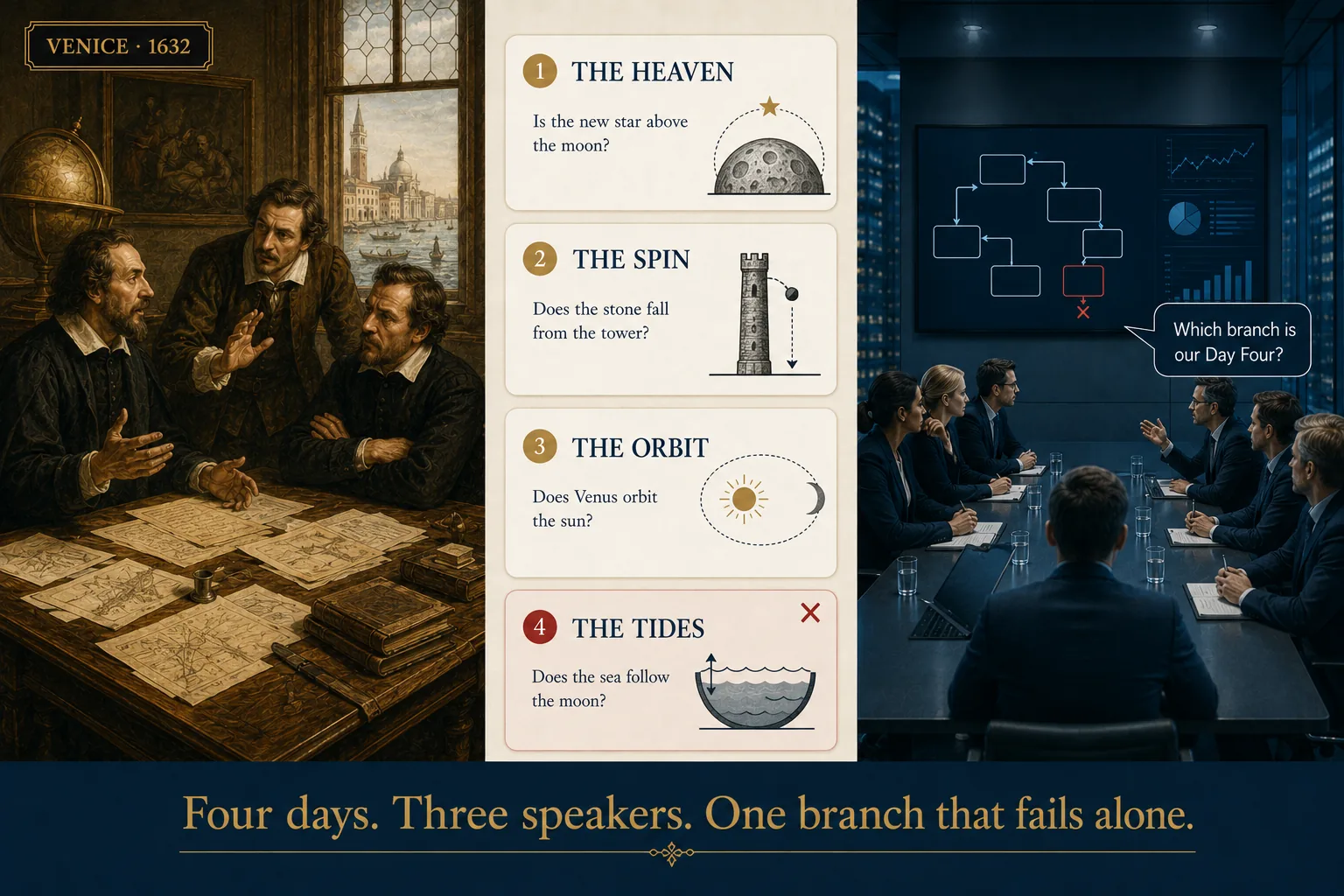
Galileo's Dialogue Concerning the Two Chief World Systems (1632) stages the Copernican–Ptolemaic debate as four days of conversation between three speakers: Salviati, who argues the Copernican position; Simplicio, who argues the Aristotelian–Ptolemaic position; and Sagredo, an intelligent neutral who presses both. Day 1 attacks Aristotle's division of the cosmos into an incorruptible heaven and a corruptible earth, using the new stars of 1572 and 1604, comets, sunspots and the rough surface of the Moon. Day 2 defends the Earth's daily rotation against the physical objections of the time: the tower argument, the stone dropped from a ship's mast, cannon shots fired east and west, point-blank shots north and south, birds that should be left behind, and the claim that rotation would fling objects off the Earth — answered by what is now called Galilean relativity, that shared motion is undetectable from inside the system. Day 3 argues the Earth's annual orbit, using the phases of Venus and the retrograde motion of the planets, and confronts the absence of observable stellar parallax. Day 4 argues that the tides are caused by the Earth's combined daily and annual motions — Galileo's own favourite argument, and the one that is simply wrong; he rejected lunar influence, which is the actual cause. The book closes with Simplicio's argument that God could have produced the tides by means beyond human understanding, a position Pope Urban VIII had asked Galileo to include; placing it in Simplicio's mouth contributed to Galileo's trial in 1633. A crucial limitation the book never addresses: Tycho Brahe’s hybrid system, in which the Earth is stationary while the other planets orbit a Sun that orbits the Earth, accommodates every telescopic observation offered — so the phases of Venus refute simple Ptolemy without proving Copernicus. Read as an argument map, the Dialogue shows a structure that survives one badly wrong branch, because the branches are separable.
Four days, three speakers, roughly forty distinct arguments — and the one Galileo thought was his strongest is the one that is wrong. Read as a map instead of a wall of text, the Dialogue shows exactly what a good argument structure buys you: the bad branch fails on its own without taking the rest down with it.
- Four days, one question each — is the heaven changeable (Day 1), does the Earth spin (Day 2), does it orbit (Day 3), and do the tides prove it (Day 4).
- Three speakers, not two — Salviati argues Copernicus, Simplicio argues Aristotle and Ptolemy, and Sagredo is the intelligent neutral whose job is to press whoever is currently winning.
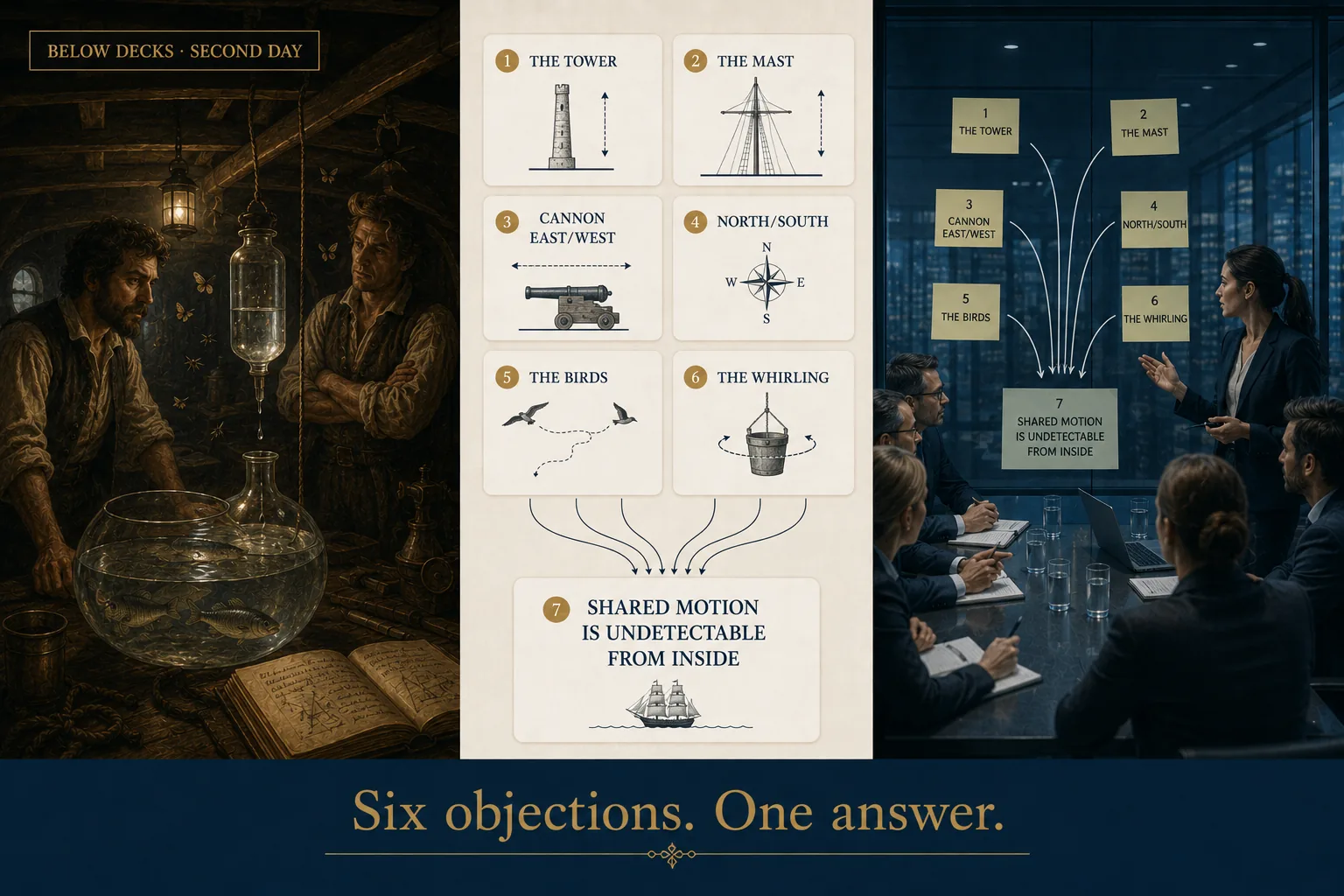
- Day 2 is the masterpiece — every objection to a spinning Earth is answered by one idea: motion shared by the observer and the observed is undetectable from inside the system.
- The gap nobody mentions — Tycho’s hybrid accommodates every telescopic result in the book, so Day 3 refutes Ptolemy without establishing Copernicus. The two chief world systems of the title leave out the third.
- Day 4 is wrong — Galileo argued the tides prove the Earth's double motion and explicitly rejected the Moon. He was more wrong to reject lunar influence than his opponents were to accept it.
- The last argument got him tried — Simplicio's closing appeal to divine omnipotence was Urban VIII's own, and putting it in that character's mouth is part of why 1632 led to 1633.
Aristotle was neither the first nor the only thinker to systematize argument. Connected pieces on the traditions that built the anatomy of reasoned disagreement — and what each one saw that the others missed.
- 1.The Global Roots of Reasoned Argument: How Three Civilizations Invented Logic
- 2.Indian Logic: The 2,500-Year Tradition from Nyāya to Buddhist Debate
- 3.Mohist Logic: The Chinese Art of Drawing Distinctions
- 4.Aristotle's Logic: The Mediterranean Foundation of Western Argument
- 5.Islamic Dialectics: From Theological Debate to the Science of Disputation
- 6.Medieval Scholastic Logic: How the University Invented the Structured Argument
- 7.Five Syllogisms: Comparing Argument Structures Across Civilizations
- 8.Schopenhauer's Art of Being Right: The First Field Guide to Bad-Faith Argument
- 9.Galileo's Dialogue: Four Days, Three Speakers, and the Argument He Got WrongYou are here
The book that argues with itself
In 1632 Galileo published a book that does not tell you what to think. It stages a conversation. Three men meet in a Venetian palace for four days, and across those four days they work through nearly every argument then available for and against the proposition that the Earth moves.
That format was not decoration and it was not cowardice. A dialogue lets an author put the strongest version of the opposing case on the page, in its own voice, and then answer it — which is exactly what a structured argument is supposed to do and exactly what a treatise makes easy to avoid. The Dialogue Concerning the Two Chief World Systems is one of the most sustained pieces of argument mapping ever written, several centuries before anyone drew one.
It is also the book that got its author tried. Within a year the Dialogue was before the Inquisition, and the reason is partly structural — a fact about where one particular argument was placed, which we will come to on Day 4.
What follows is the whole argument, day by day: what is claimed, who claims it, what it answers, and how it is met. Page references are to the Stillman Drake translation (Modern Library), the edition quoted throughout.
Three speakers, three jobs
The cast is the first piece of argumentative design, and the third speaker is the one people forget.
| Speaker | Position | Function in the argument |
|---|---|---|
| Salviati | Copernican | Advances the moving-Earth case and answers objections. Galileo's own voice, in practice. |
| Simplicio | Aristotelian / Ptolemaic | Raises the objections — and they are the real objections of the period, not strawmen. The book is only worth reading because he is given good material. |
| Sagredo | Neither | The intelligent neutral. Presses both sides, concedes when convinced, and asks the question the reader is forming. |
Sagredo is the load-bearing character. Without him the book is a debate with a predetermined winner; with him it is an inquiry, because someone on the page is permitted to be persuaded. The modern equivalent is the reviewer who is not the author and not the critic — the person whose changing mind is the actual evidence.
Simplicio's name is a problem we will return to. It derives from Simplicius of Cilicia, a genuine sixth-century commentator on Aristotle, and Galileo says so. It also reads, in Italian, as simpleton. Both facts are true at once, and the second one mattered enormously.
How to read the argument labels
One consequence runs through everything below. The arguments in this post are attributed to the speakers who make them, not to Galileo. "Galileo says the Earth moves" is the reading the book's own form is built to resist: Salviati argues, Simplicio objects, Sagredo weighs. Salviati is in practice the author's voice, but treating the two as identical throws away the thing that makes the Dialogue worth mapping — that every position has an owner, and the owner can be pressed.
Two numbers make the point better than the description does. Across the whole book the speech turns divide Salviati 562 (54%), Sagredo 343 (33%), Simplicio 142 (14%). The character everyone remembers as “the opposition” speaks least, by a wide margin — and the supposedly minor neutral is the second largest voice in the book. Any retelling that reduces this to a duel between two men has lost a third of it.
Each argument below is labelled with the speaker who owns it. Where the text shows someone else actually speaking the words, that is marked too — and in every case it is Salviati, reciting an objection at length in order to answer it. Five of the Day 2 objections are like this: the falling stone, the cannon shots east and west, the birds, and the extruding power of whirling are all delivered in Salviati’s own voice before he dismantles them. That is what steelmanning looks like in a primary source, and flattening it into “Simplicio said X” would erase it.
Each argument below carries its side and its fate. The colours are the same ones an argument map uses.
- CON — supports the Aristotelian / Ptolemaic geostatic position (the Earth is at rest).
- PRO — supports the Copernican geokinetic position (the Earth moves).
- Counter — a reply to the argument immediately above it, whichever side made it.
- Modern verdict — what later physics and astronomy actually settled, which is not always in favour of the side that won the exchange.
How deep does the argument actually nest?
A common assumption about pre-modern argument is that it is flat: a claim, an objection, done. Two levels. That is not what this book does, and it is not what its author was trained to do.
Measured across the four days, the longest chain is in Day 3 and runs four levels of counter-argument below the day’s thesis — five levels in all:
THE CLAIM — the Earth travels once a year around the Sun.
If it does, the fixed stars must show annual parallax. None is observable.
The stars are far enough away that the shift falls below what any instrument can register.
Then the universe contains an absurd empty gulf — and the stars, still showing discs at that distance, must be preposterously larger than the Sun.
The discs are an optical artefact of irradiation, not resolved surfaces; a telescope or a restricted aperture shrinks them.
That is a claim, an objection, an answer to the objection, an attack on the answer, and a rebuttal of the attack. Each level operates on the level above it, not on the original claim: L4 does not dispute that the Earth orbits the Sun, it disputes the explanation offered for the missing parallax. Collapse the levels into a flat pro/con list and the argument stops being followable.
And it branches as well as descends. The same L3 answer — the stars are simply very distant — is attacked twice, independently: once on the size of the resulting universe and the implied size of the stars, and once on the philosophical implausibility of a cosmos that large. Two siblings, each with its own reply. A chain cannot represent that; a tree can. The other days are shallower but never flat: Day 2 fans ten separate objections off a single thesis and answers the whole class with two general principles, which is why the diagram above shows six arrows converging on one card.
And no, this was not an innovation
Multi-level argument structure was not something the seventeenth century stumbled into. It was the institutional teaching format of the European university for four centuries beforehand, and it was more formally hierarchical than anything in this book.
The scholastic quaestio has a fixed shape with named levels: videtur quod — a numbered list of objections to the position; sed contra — the authority on the other side; respondeo — the determination; and then ad primum, ad secundum — a separate reply addressed to each numbered objection in turn. That last move is the important one. It is not a single rebuttal aimed at a pile of objections; it is a reply per branch, tracked by number, which is precisely what an argument map does with edges.
Galileo was educated in that tradition, and the Dialogue inherits its habits even while attacking its conclusions: objections are stated in their strongest form before they are answered, and answers are addressed to particular objections rather than to the general position. The medieval scholastic post in this series covers the machinery in detail — including obligationes, a formal game of nested commitments where a respondent must maintain consistency with everything already granted, which is hierarchy tracking as a competitive sport.
So the honest answer to “was this one level or many?” is that the book is shallower than the tradition it came from. Four levels in its deepest chain, against a teaching format built to track an unbounded stack of granted, denied and doubted commitments. What the Dialogue adds is not depth; it is that the branches are attached to observations rather than to authorities.
Four days, four increasingly ambitious questions
The whole book is one escalating argument, and the escalation is the design. Each day asks a harder question than the last, and the burden of proof shifts as it goes.
| Day | Central question | What Salviati has to achieve |
|---|---|---|
| I | Is the Earth fundamentally unlike the celestial bodies? | Destroy the Aristotelian Earth/heaven distinction |
| II | Could the Earth rotate once a day? | Show that terrestrial experiments do not disprove rotation |
| III | Could the Earth orbit the Sun annually? | Show that astronomical phenomena favour a heliocentric organisation |
| IV | Can the Earth's motion be physically demonstrated? | Explain the tides as an effect of the Earth's motions |
There is a methodological progression underneath that, and it is easy to miss. Days I and II are defensive — the claim is only that you cannot prove the Earth is stationary. Day III turns positive — the astronomical phenomena make far better sense with the planets moving around the Sun. Day IV attempts the knockout — here is a physical phenomenon actually caused by the Earth's movement.
The irony is exact: the case is strongest in Days II and III, and weakest precisely where Salviati claims a decisive proof — the tides.
Day 1 — Is the heaven a different kind of place?
Before anyone can argue about whether the Earth moves, a prior commitment has to be dislodged: that the heavens and the Earth are made of different stuff and obey different rules. Aristotle's cosmos divides at the Moon — below it things are generated, altered and corrupted; above it nothing changes. Copernicus creates an immediate problem for that, because the Earth would have to become one of the celestial bodies. So Day 1 attacks the distinction itself. Finocchiaro's breakdown counts roughly eleven distinct argumentative topics here.
Simplicio opens with the framework rather than with geocentrism. A line has one dimension, a surface two, a body three; there are no further spatial dimensions; therefore a three-dimensional body is complete, completeness is perfection, and the cosmos is a perfect body — “a body having length, breadth, and depth. Since there are only these three dimensions, the world, having these, has them all, and, having the Whole, is perfect” (Day 1, p. 10).
Salviati does not dispute that bodies have three dimensions. He asks why three dimensions → completeness → perfection should follow necessarily. The weakness is the transition, not the conclusion. This is the move he repeats all book: Aristotle defined nature this way, therefore nature must behave this way is not an argument. The world has to be investigated, not deduced from definitions.
Natural bodies have characteristic natural motions. Heavy terrestrial matter moves down toward the centre; light matter moves up; celestial matter moves in circles. Therefore terrestrial matter is not celestial matter — and the Earth, being made of the former, should not behave like a planet.
Salviati challenges the classification rather than the observation. Straight downward movement is matter moving toward an equilibrium arrangement; once that arrangement is reached, continued straight motion makes no sense. Circular motion can continue indefinitely without carrying a body away from its ordered position. The categories become straight movement establishes an arrangement, circular movement can preserve one — which no longer marks a difference in kind between heaven and Earth.
From everywhere on Earth, “down” points toward approximately the same centre. Heavy matter moves toward that centre. Therefore the Earth occupies the natural centre toward which heavy matter tends — and so belongs at the centre of the universe.
The argument hides an enormous assumption. That bodies fall toward the Earth demonstrates a tendency toward the Earth. It does not demonstrate that the Earth’s centre is the centre of everything. A stone could fall toward the Earth wherever the Earth happened to be.
Salviati is right, and the distinction turned out to be foundational. Local gravitational “down” says nothing about the Earth’s cosmological position.
Things here grow, decay, break, transform, are born and die. Celestial objects appear eternal and unaltered. Therefore celestial matter is fundamentally different in kind, and the Earth cannot simply be another planet.
Salviati attacks the observational premise directly: “the two new stars of 1572 and 1604, which were indisputably beyond all the planets”, plus “many comets generated and dissipated in places above the lunar orbit” (Day 1, p. 58), plus sunspots appearing and decaying on the Sun itself. Then the clever turn: Aristotle himself holds that sensory evidence should be preferred where experience contradicts reasoning, so accepting observed celestial change is the more Aristotelian position. The complaint is against blind Aristotelianism, not against Aristotle.
The defence has real escape routes: comets may be atmospheric; new stars may be nearer than the astronomers think; sunspots may be small bodies passing in front of the Sun rather than alterations of it; and telescopes may simply be producing optical artefacts. Each preserves celestial incorruptibility, and none of them is stupid.
The reply is that parallax measurement, repeated telescopic observation and consistency between independent observers make the dismissal progressively harder to sustain. Day 3 returns to this with the 1572 nova in detail.
The cosmos is arranged hierarchically; the celestial bodies serve terrestrial purposes — light, seasons, influence. The Earth and humanity occupy the privileged position, and therefore appropriately the central one.
Salviati attacks the anthropocentrism. How could anyone know that enormous celestial bodies exist primarily for us? The argument confuses usefulness to humans with the purpose of the cosmos, and it argues from presumed purpose rather than from observation.
Now the offensive. If the Moon is unquestionably celestial and the Earth resembles it, the absolute division weakens. The resemblances are specific: both spherical, both opaque bodies lit by the Sun, both showing light and shadow, both with uneven surfaces, mountains and valleys, and comparable illumination patterns. The Moon starts to look less like a perfect celestial sphere and more like another world.
Telescopic light and shadow show irregularities, and the shadows near the terminator change exactly as they would if mountains rose above valleys (Day 1, p. 55). The reasoning is geometrical rather than merely visual: sunlight plus relief predicts a shadow pattern, and the predicted pattern is what appears. That breaks the equation celestial = perfectly smooth.
The ingenious rescue: the visible roughness might lie inside or beneath a perfectly spherical transparent outer surface, so apparent mountains need not mean a rough exterior.
The illumination changes as the Sun’s angle changes, in exactly the way real relief would produce. Preserving a smooth exterior requires an increasingly artificial auxiliary hypothesis to explain shadows that a rough exterior explains directly.
When the bright crescent is visible, the dark portion is sometimes faintly visible too (Day 1, pp. 80, 103). The explanation is a chain: Sun to Earth to Moon — the Earth reflects sunlight onto the Moon. If that is right, the Earth behaves optically exactly like another celestial body, which is the conclusion the whole day has been building toward.
Day 1 — bottom line
The Aristotelian chain is: different motions → different substances → the Earth is corruptible and the heavens are not → the Earth cannot be a planet. Salviati reverses it: the heavens are observed to change, the Moon resembles the Earth, and the motion categories are not demonstrated — so there is no established essential divide. Notice what has not been proven. Nothing here shows that the Earth moves. What has been removed is a major philosophical reason why it could not. That distinction matters, and the book is careful about it.
Day 2 — Does the Earth turn on its axis?
The most argument-dense part of the book, and the passage to map if you only map one. Finocchiaro's units here cover simplicity, violent motion, multiple motions, vertical fall, the ship experiment, conservation and composition of motion, several cannon experiments, birds, centrifugal effects, sensory deception, natural motions and luminosity. The question throughout: do ordinary terrestrial experiences prove the Earth is not rotating?
Everything in this day hangs off this one proposition. Every objection below attacks it, and the two general principles answer the whole class of objections rather than any single one. The claim itself is never demonstrated here — Day 2 is defensive, and its achievement is to show that the terrestrial evidence does not refute it.
Every day the Sun, Moon, planets and stars appear to travel east to west. Two explanations produce an identical appearance: the Earth stands still and the whole celestial sphere revolves around it every twenty-four hours, or the Earth rotates west to east and the heavens need no daily revolution at all. Salviati argues that moving one relatively small body is simpler than moving the entire universe daily.
Simplicio’s reply is far more sophisticated than his name suggests, and it is the best single line he gets. For humans, moving one small object is easier than moving trillions. But for a power “which is infinite, it is just as easy to move the universe as” to move the Earth (Day 2, p. 142). Mechanical economy therefore proves nothing about what an infinite power would do.
Salviati concedes it outright: simplicity is not a demonstration. It establishes probability and elegance, not necessity. The concession matters because it shows the book distinguishing plausibility arguments from conclusive demonstrations — a distinction most of the objections on both sides ignore.
The known motions show a pattern: smaller orbit, shorter period; larger orbit, longer period. The Moon takes a month; Jupiter’s satellites lengthen outward; the planets lengthen outward. But on the traditional account the largest sphere of all, the stellar sphere, must whip round in twenty-four hours. That is disorderly. If the Earth rotates instead, the anomaly disappears.
Again: elegance is a human preference, not a constraint on the world. And again the reply concedes the form of the objection — this is probable reasoning, not proof.
Drop a stone from a tower. If the Earth turns eastward during the fall, the tower moves out from under it and the stone should land well to the west. Simplicio reports the scale of the expected effect: a rock “being carried by the whirling of the earth, would travel many hundreds of yards to the east in the time the rock would consume in its” fall (Day 2, p. 146). It lands at the foot of the tower. Aristotle and Ptolemy both treated this as powerful evidence, and on their physics it is.
The central conceptual move of the book. Before release the stone is already moving with the Earth — as are the tower, the observer and the air. On release it does not lose that horizontal motion; it combines the shared horizontal motion with the new vertical fall, and relative to the tower it comes down essentially straight. The observation everyone agrees on is preserved, and the inference from it collapses.
The same argument at human scale. A stone dropped from the masthead of a moving ship should land behind the mast, because the ship advances while the stone falls straight down. Simplicio takes the outcome as agreed: it “falls to the foot of the mast when the ship is standing still, but falls as far from that same point” when the ship moves (Day 2, p. 164).
The stone already shares the ship’s forward motion, so it lands at the foot in both cases — which makes the ship an argument for the possibility of the Earth’s motion. Salviati also dismantles the mechanics: if the rock followed the ship, the effect “would have to be attributed to the air, and not to the impressed force” (Day 2, p. 174), which is not what the objector believes. The objection is inconsistent with its own physics.
The passage the whole day exists for. “Shut yourself up with some friend in the main cabin below decks on some large” ship, with “some flies, butterflies, and other small flying animals”, a bowl of fish, a bottle dripping into a vessel beneath (Day 2, p. 215). Observe everything at rest. Then have the ship move uniformly. Nothing changes: the flies do not pile against the rear wall, the fish swim as easily in every direction, the drops still fall into the vessel, jumping is no easier one way than the other. Experiments performed entirely inside a uniformly moving system cannot reveal that motion. The stipulation is exact and flagged in the text — you must be below decks, “for if this took place above in the open air”, the air would not follow the ship (Day 2, p. 218).
Fire a cannon straight up. If the Earth turns while the ball is in the air, the cannon should be carried away and the ball should land far from it. “Projectiles thrown vertically upward come” back to the same place (Day 2, p. 145). Therefore the Earth does not turn.
The same answer: the ball, the cannon and the air all share the eastward motion before firing, and the vertical motion is superimposed on it. No large displacement should be expected.
“Shooting a cannon ball point-blank to the east, and then another one with equal charge at the same elevation” west (Day 2, p. 147). On a rotating Earth the target runs away from one shot and toward the other, so the ranges should differ enormously. Artillery shows no such asymmetry.
Salviati identifies the recurring error precisely: the opponents imagine the Earth moving but forget to give the Earth’s motion to the things standing on it. Gun, ball, target and air all share it, and the ball does not begin from cosmic rest.
Different latitudes travel at different speeds, so a shot fired due north or south should be carried sideways off its mark. No such deviation is observed.
The expected deviation is nothing like the gross displacement the naive version predicts.
There is a systematic deflection from the Earth’s rotation: the Coriolis effect, real and measurable, and unavailable to either speaker without a mathematical framework a century away. So the central claim — projectiles are not catastrophically left behind — is correct, while the stronger claim that trajectories are perfectly unaffected is not.
A refined version: eastward and westward horizontal shots should strike at detectably different points.
The calculated difference is far too small for contemporary artillery to reveal, and the gun and target share the motion in any case. Embedded here is a methodological rule the book uses repeatedly: failure to observe an effect is evidence only if the predicted effect is large enough for your instrument to detect. That principle does more work in Day 3 than anything else on this list.
The most intuitive objection of all. If the surface runs “at least sixteen thousand miles” in twenty-four hours, “how could the birds keep up on such a course? Whereas we see them fly east just as much as west” (Day 2, p. 153). Why is there not a permanent easterly gale? Why are the clouds not left behind?
The atmosphere shares the Earth’s motion, and the bird begins with that motion already in it, so flying relative to the surrounding air requires no catching up. The bird’s own self-generated motion is distinguished from the shared terrestrial motion it possesses before it takes off.
The most basic sensory argument: we perceive no movement, therefore there is none.
A smoothly moving ship feels like a stationary one, and looking out makes the shore appear to move instead. Perception alone cannot distinguish the observer moving relative to the environment from the environment moving relative to the observer.
The centrifugal objection, and the best of the physical ones. A spinning wheel throws off mud; a spinning Earth should fling loose stones, water, buildings and people off its surface — the “extrusion of stones, animals, etc. should be very violent” (Day 2, p. 244; the mechanism is introduced at p. 218). It does not happen.
The supposed effect is given a mathematical treatment: it is not enough to say rotation is rapid, because whether material is extruded depends on the rotational radius, the speed, and the strength of the competing tendency toward the Earth. The inference from “rapid rotation” to “catastrophic ejection” does not follow.
Rotation does produce a centrifugal effect: you weigh very slightly less at the equator, partly because of it. So the Aristotelians were right that rotation should have a physical consequence, and Salviati was right that the consequence does not imply objects fly off. Gravity is simply much stronger. This is the argument handled least conclusively in the book, and it cannot be closed without a theory of gravitation.
On the Copernican account the Earth has several — daily rotation, annual revolution, and participation in others. A single body with several natural motions is unnatural.
Why should one body have only one natural motion? The Moon moves around the Earth while the Earth–Moon system could move around the Sun. What counts as a body’s motion depends on the system being considered.
A suggestive classification rather than a proof, and presented as such. The bodies that unquestionably move are those that do not shine with their own light; the Sun and fixed stars are luminous and are the ones held fixed. The Earth is dark and opaque like the planets. Assigning motion by physical resemblance puts the Earth with the planets, not with the Sun. Analogical, probabilistic, and offered at that weight.
Day 2 — bottom line
The classical argument is: if the Earth moved, terrestrial experiments would reveal it. The answer is: not if the observer, the experiment, the air and the projectile all share the motion — in which case local experiments behave almost exactly as they would on a stationary Earth. This is why the first two days are best read as establishing that terrestrial experiment is insufficient to decide between rest and uniform shared motion. That is a profound result, and it is not the same as proving the Earth moves. What has been demolished is the supposed proof that it cannot.
Day 3 — Does the Earth orbit the Sun?
Now the argument turns to astronomy, and the evidential situation changes. For the first time there is genuinely strong positive evidence — and also the single best objection anyone made against Copernicus, which is not answered in this book or for two centuries after it. Finocchiaro's principal units here: the 1572 nova, Mars, Venus and the Moon, heliocentric planetary revolutions, retrograde motion, sunspot paths, stellar distances and sizes, apparent stellar positions, and magnetism.
Day 3 turns positive: instead of deflecting objections it offers evidence. Each observation below supports this claim, and the parallax objection attacks it directly — the only objection in the book that is never answered.
A new star appeared in Cassiopeia (Day 3, p. 326). If the heavens are incorruptible it should not have, so defenders tried to place it below the Moon. Parallax measurements put it enormously far away — in the celestial region. What is methodologically interesting is how the argument is conducted: rather than simply asserting better numbers, Salviati works through how the anti-nova calculations selected and rejected observations, arguing that Chiaramonti’s preferred measurements were internally less consistent than those supporting a distant nova. The target is selective use of evidence, not merely a rival result. The same opponent’s Anti-Tycho is picked over in Day 2 as well (pp. 287, 311).
The strongest observational argument in the book. Mercury and Venus never wander far from the Sun in angle, and Venus runs a full cycle of phases, appearing “horned when beneath the sun” and changing shape as the Moon does (Day 3, p. 389). It is “certain that Venus and Mercury must revolve” about the Sun (Day 3, p. 373). Simplicio is walked through the geometry himself: Venus cannot have an orbit enclosing the Earth, or it would reach opposition; cannot always sit between Earth and Sun, or the phases would not work; cannot always lie beyond the Sun, or it would never show a crescent. Therefore it circles the Sun.
The phases of Venus kill the simple Ptolemaic arrangement. They do not establish that the Earth moves. Tycho Brahe’s hybrid reproduces them perfectly: the Earth stands still, the Sun orbits the Earth, and the other planets orbit the Sun. Every telescopic result in this day is compatible with it. This is the strongest structural objection to the whole book, and the Dialogue does not seriously engage it — the “two chief world systems” of the title are Ptolemy and Copernicus, and the third live option, held by most astronomically literate opponents, is largely absent.
It “cannot be comprehended that Mars does increase sixty”-fold on the traditional account (Day 3, p. 433). If Mars orbits the Sun on a larger orbit than the Earth’s, it is sometimes near and sometimes far, and a large variation follows directly. The same reasoning applies in weaker form to Jupiter and Saturn, whose proportional distance variation is smaller.
Mercury, Venus, Mars, Jupiter and Saturn all revolve about the Sun, which becomes the natural centre of the planetary revolutions. The question then reverses: why should the Earth be the one bizarre exception? This is a unification argument — Copernicus makes the Earth one member of a system, rather than a unique object requiring its own physics.
Planets sometimes appear to reverse against the stars. Geocentric astronomy reproduces this with deferents and epicycles — dedicated geometrical machinery. On a moving Earth it is simply what overtaking looks like: the Earth on a faster inner orbit catches and passes an outer planet, which appears to slide backwards, exactly as a slower train appears to when you pass it. The planet does not literally reverse. Retrograde motion stops being a special construction and becomes a consequence.
Worth stating plainly, because it is true: Ptolemaic astronomy was not incapable of predicting planetary positions. Sufficiently sophisticated combinations of circles reproduce the appearances. So a simpler physical explanation is not thereby a deductive proof. The Copernican case here rests on explanatory unity, not on predictive capability that the rival lacks.
They establish that the Sun is not unchanging, that the Sun itself rotates, and — through the changing tilt of their tracks across the disc over a year — carry geometrical information about the relation between the Sun, the Earth and the orbital planes. Finocchiaro gives this an unusually large subsection, and it is the argument in Day 3 that most nearly bears on the Earth’s annual motion specifically.
If the Earth swings from one side of a vast orbit to the other, nearby stars should shift against distant ones across the year. No such shift could be detected. This is not dogma or stupidity; it is the correct prediction, correctly tested, with a negative result. It was the strongest scientific objection to Copernicus and it stood.
If the stars are distant enough, the Earth’s orbital diameter is negligible against that distance and the shift falls below what any contemporary instrument could register. So no detectable parallax is not no parallax.
Two objections in one, and both were fair on the physics available. First, Copernicanism now requires an enormous empty gulf between Saturn and the fixed stars, apparently for no reason. Second, stars appear to have measurable discs; if they are that far away and still show a disc, their physical sizes must be preposterous — vastly larger than the Sun. This was among the best technical anti-Copernican arguments in existence.
Bright objects acquire halos and rays that enlarge their apparent size, so naked-eye stellar discs are not measurements of physical diameter. Observing through a telescope, or through a restricted aperture, shrinks the apparent disc — which is what you would expect from irradiation rather than from a resolved surface.
Correct on the discs: they were not resolved stellar surfaces. Correct on the distances, and then some — the stars are far further away than anyone in 1632 imagined. Annual stellar parallax was not measured until Bessel in 1838. So the negative result was entirely understandable, and the reply to it was right — but in 1632 it was a promissory note, and the objection was left standing for two centuries.
Why would God create such vast and apparently useless distances merely so that the Earth’s parallax becomes invisible?
The reply is that human imagination cannot set an upper limit on what God may create; calling the universe “too large” assumes human intuition constrains divine scale. The symmetry is exact and worth pausing on: Simplicio deployed divine power against the simplicity argument in Day 2 (p. 142), and here the same move is turned around against the objection from cosmic vastness. The same argumentative form serves both sides, which is a good sign it is settling nothing.
Gilbert’s magnetic philosophy is discussed near the end (Day 3, p. 464). Its relevance is indirect: it makes the Earth look like a physically organised body with real properties capable of maintaining orientation and motion, rather than a passive heap at the centre. It is a supportive analogy about what kind of thing the Earth is.
And it is not offered as though it does. Supportive physical analogy, not proof.
Day 3 — bottom line
The Copernican case here is cumulative: the phases of Venus, the planetary size changes, Mercury and Venus staying near the Sun, retrograde motion, the sunspot paths, celestial change, and the organisation of the planets around the Sun. Together they make a moving planetary Earth increasingly plausible. But the honest summary is the caveat: there is still no single decisive observation proving the Earth’s annual motion, and a Tychonic hybrid accommodates almost everything on the list. That is precisely why Day 4 matters so much — what is wanted is a physical effect that could not exist unless the Earth moved.
Day 4 — The tides, and the argument that is simply wrong
The attempted knockout. The title Galileo wanted was On the Flux and Reflux of the Tides; the censor refused it. Finocchiaro divides the day into the clarification and criticism of alternatives, the daily tidal cycle, the atmospheric and trade-wind consequences, and the monthly and annual variations. It is short, confident, and wrong — and it is the reason this book belongs in a series about reasoning rather than a series about heroes.
The attempted knockout. If the tides are produced by the compound of the daily and annual motions, then a terrestrial phenomenon requires a moving Earth — the physical demonstration Copernicanism had never had, and the one thing a Tychonic system could not accommodate.
Sea level rises and falls regularly; water also moves horizontally; and different places differ in both the strength and the timing of the effect. Something causes this.
Influence of the Moon; lunar heating and rarefaction of the water; properties of the sea’s depth; occult celestial influence; and supernatural causes. Salviati dislikes all the varieties that invoke mysterious action at a distance, and wants a mechanical cause — which is a methodological commitment, not an observation.
The Earth has a daily rotation and an annual revolution. Because these combine differently through the daily cycle, a point on the surface undergoes a continually varying effective speed. Water in a moved container sloshes when the container changes speed — put “a floating ball” into “a basin of water” and move the basin (the analogy is set up at Day 3, p. 462 and applied at Day 4, p. 487). The ocean basins are the container; the compound motion is the change in speed; the tides are the slosh.
It reverses the whole book. Day 2 showed terrestrial phenomena do not disprove the Earth’s motion. Day 3 made it astronomically plausible. Day 4 would show a terrestrial phenomenon that requires it — the physical demonstration Copernicanism had never had, and the one thing a Tychonic system could not accommodate.
Kepler and others suspected the connection, and the evidence for it is the plainest fact in the whole subject: tidal behaviour tracks the lunar cycle closely.
The rejection is explicit and it is a rejection on principle: there is no rope, no contact, no mechanical connection, and to Salviati the proposal resembles astrology and occult sympathy. Kepler’s lunar explanation is dismissed largely for that reason.
Gravity is exactly the kind of long-range interaction being ruled out on principle. The Moon and the Sun produce differential gravitational forces across the Earth, and those generate the tides. The prior methodological commitment — only contact-like mechanisms are respectable — is what steered the argument away from the correct answer. The strongest observational clue in the field was rejected because it looked like magic.
Devastating and simple. The mechanism ties the tides primarily to the Earth’s daily motion relative to the Sun. Real tides shift from day to day in step with the Moon, not the Sun.
A straightforward sloshing mechanism does not generate the observed semi-diurnal pattern. The actual structure follows naturally from tidal bulges produced by differential gravity, and secondary explanations have to be introduced here to reconcile theory with observation.
Tides differ enormously by location because oceans are not identical containers: depth, shape, length, orientation, coastlines, channels and the communication between seas all matter. This is physically sensible and modern tidal science agrees — basin geometry, resonance and bathymetry strongly modify local tides. The error is in the primary forcing, not in the recognition that geography shapes the outcome.
If any discrepancy between prediction and observation can be attributed to basin configuration, the theory loses predictive grip unless the basin effects can be calculated independently. Some seas have almost no tides at all, and the auxiliary explanation absorbs that too. This is the unfalsifiability worry, and it is a fair one.
The reasoning is extended to air: if the Earth’s motions move water, they should have atmospheric consequences too, and there are “strong winds blowing continuously from the east” to point at (Day 4, p. 503), with a contrast drawn against occasional winds that “blow indifferently toward all” quarters (p. 510). Consistent extension of the mechanism — and wrong for the same reason.
Real tides vary over longer periods, and these are derived from combinations and changing geometry of the Earth’s motions. But the strong monthly lunar correlation is exactly what a Moon-based theory predicts immediately, while this theory must reach it indirectly. A theory that has to work to reproduce the most obvious pattern in the data is telling you something.
Day 4 — bottom line
The strongest objection to Day 4 can be put in four lines. The tides correlate strongly with the Moon. Salviati says the Moon is not the cause. Kepler’s direction says it is. Modern physics says the Moon’s gravitational gradient is the dominant forcing, with an important solar contribution. The best observational clue available was rejected because a prior commitment made action at a distance unacceptable. And a map that quietly omitted this would be an advertisement — included, it is the most useful thing in the book, because Days 1 to 3 do not depend on it. The bad branch is separable, it fails locally, and the conclusion survives on the other three. You cannot demonstrate that with an argument that was right.
The last argument in the book, and the trial
The Dialogue ends with Simplicio making a general argument rather than a physical one: God, in "His infinite power and wisdom", could have produced the tides "in many ways which are unthinkable to our minds", and therefore "it would be excessive boldness for anyone to limit and restrict the Divine power and wisdom" to one particular explanation (Fourth Day, p. 538).
As an epistemic move this is serious: it says that a mechanism sufficient to produce an effect is not thereby the actual cause. That is a real limit on inference to the best explanation, and it is still a live objection in any field where several models fit the same data.
It was also Pope Urban VIII's own argument, which Galileo had been asked to include. It appears in the mouth of the character who has been wrong for four hundred pages, and it is placed last. Whatever the intention, the effect was catastrophic: Galileo was tried in 1633 and spent the rest of his life under house arrest.
The popular retellings of this are heavily embroidered, and the standard documentary account is Finocchiaro's edition of the trial records rather than any of them. What matters for our purposes is narrower and better attested: where you place an argument, and whose mouth you put it in, is itself an argumentative act. Structure carries meaning that content alone does not.
The seven levels the argument actually runs on
The Dialogue becomes far easier to hold in your head once the arguments are sorted by kind rather than by day. Seven levels, and they are not interchangeable — an objection at one level cannot be answered with evidence from another, which is the single most common failure in the exchanges below.
Level 1 — Metaphysical
Heaven and Earth are different substances; natural place determines motion; circular motion belongs to the heavens; the Earth belongs at the centre; celestial perfection requires incorruptibility. Attacked as insufficiently demonstrated — not as false, which is a different and weaker charge.
Level 2 — Common sense
We do not feel the Earth move; birds and clouds are not left behind; stones fall vertically; cannonballs return; nothing flies off. Answered as a class by shared motion, relativity and the composition of motions.
Level 3 — Experimental / mechanical
Tower drops, the ship’s mast, vertical projectiles, east–west and north–south cannon fire, point-blank shots, rotational extrusion, the below-decks cabin. These test whether local mechanics can distinguish a moving Earth from a stationary one. The answer arrived at is: not at this precision.
Level 4 — Astronomical observation
Novae, sunspots, lunar mountains, earthshine, the phases of Venus, Mercury’s elongation, Mars’s size variation, Jupiter and Saturn, retrograde motion, stellar parallax, apparent stellar diameters. These test the architecture of the cosmos rather than local physics.
Level 5 — Explanatory / unification
Which system explains more with fewer independent assumptions? Ptolemy needs a uniquely stationary Earth, geometrical machinery for retrogrades, a daily celestial revolution and two physics. Copernicus makes the Earth a planet, and daily motion, retrogrades, brightness changes and phases all become consequences. This is inference to the best explanation, and it is decisive for neither side on its own.
Level 6 — Theological
Deployed by both sides, which is the tell. Simplicio: an infinite power can move the universe as easily as the Earth (p. 142), so simplicity proves nothing. Salviati: an infinite power is not constrained by what humans find absurdly large, so the vastness objection proves nothing either. A form of argument that serves whoever needs it is not adjudicating anything.
Level 7 — Epistemological
The deepest layer, and probably the real subject of the book. The Aristotelian pattern: start from established principles and authority, then interpret phenomena within them. The alternative: observe, reason mathematically, form a hypothesis, deduce consequences, compare with observation, attack the alternative explanations, revise the assumptions. The target is never Aristotle — who is to be read and studied — but the treatment of Aristotle’s words as decrees rather than as claims about a world that can be checked.
The debate in its strongest form, on both sides
Reconstructed as fairly as possible — that is, without letting the rhetoric make Simplicio look foolish, which the text does not always resist. For each issue, the best available argument on each side in 1632.
| Issue | Strongest PRO Earth-motion | Strongest CON |
|---|---|---|
| Earth as planet | Earth/Moon and planetary similarities | terrestrial matter behaves differently |
| Daily rotation | relativity and shared motion | rotational effects ought to exist |
| Falling bodies | conservation and composition of motion | precise deflections should occur |
| Projectiles | inherited terrestrial velocity | latitude and direction should create deviations |
| Birds and clouds | the atmosphere shares the rotation | requires the atmosphere to participate |
| Centrifugal effect | too small to eject bodies | rotation should produce measurable effects |
| Planetary system | the planets organise around the Sun | Tycho preserves a stationary Earth |
| Venus | the phases prove a solar orbit | they do not prove the Earth’s orbit |
| Mars | size variation fits changing distance | compatible with the Tychonic model |
| Retrograde motion | emerges from relative motion | geocentric models reproduce it mathematically |
| Sunspots | celestial change and solar rotation | do not directly prove the Earth moves |
| Stellar parallax | the stars may be extremely distant | none observed, at all |
| Stellar size | apparent discs are optical | the required distances looked extreme |
| Tides | a terrestrial effect seemingly caused by motion | timing and lunar correlation contradict it |
| Moon and tides | rejects occult action at a distance | the lunar correlation strongly favours the Moon |
| Simplicity | the Copernican system unifies the phenomena | nature need not maximise human simplicity |
Scoring it with modern physics — the interesting result
The result is not “Salviati was right and Simplicio was stupid.” It is considerably more interesting than that, and it is the reason the book survives as a study in reasoning rather than as a historical curiosity.
Spectacularly right
- The relativity of uniform motion.
- The composition of motion.
- Objects retaining shared terrestrial motion.
- The Earth being physically comparable to celestial bodies.
- Celestial bodies being changeable.
- The Moon having mountains.
- Venus orbiting the Sun.
- The Sun rotating.
- Naked-eye stellar diameters being misleading.
- The absence of visible parallax not proving the Earth immobile.
- The Earth rotating.
- The Earth orbiting the Sun.
The opponents had legitimate points
- A rotating Earth should produce detectable physical effects. It does — Coriolis and centrifugal effects are real.
- An orbiting Earth should produce stellar parallax. It does. Their instruments could not measure it, and would not for two hundred years.
- Copernicanism required enormous stellar distances. Correct — and the universe is vastly larger than even Salviati proposed.
- The telescopic observations did not uniquely eliminate Tycho’s system. Correct, and the book never really engages it.
- The tidal theory did not match the observations. Correct, and decisively so.
Outright wrong
The physical cause of the tides — and it was the argument regarded as among the strongest evidence for the Earth’s movement. The one place a decisive proof was claimed is the one place the reasoning fails.
What the best 1632 case against Copernicus actually sounded like
Not “Aristotle says the Earth does not move.” This:
If the Earth rotates, there should be physical rotational effects. If it travels a vast orbit around the Sun, the stars should shift apparently. No stellar parallax has been detected. Telescopic discoveries prove that Venus circles the Sun, but they do not prove that the Earth does, because Tycho’s model accommodates them while leaving the Earth at rest. And the supposed physical proof from the tides does not predict their connection with the Moon.
That is a formidable scientific argument, and it was not defeated in this book. The reply — that terrestrial objections fail because bodies conserve shared motion, that the celestial observations destroy the Earth/heaven distinction, that the planetary phenomena acquire a coherent organisation around the Sun, that retrogrades and distance variations arise from relative motion, and that the missing parallax follows from immense distance — eventually wins. But it wins because later science supplied what the book lacked: Newtonian mechanics and universal gravitation explained why the Earth could move and why the tides follow the Moon; Coriolis and Foucault-type effects supplied terrestrial evidence of rotation; stellar aberration and eventually parallax supplied observational evidence of the annual motion.
So the importance of the Dialogue is not that it contained the right answer. It is that it reorganised the standards of argument: authority against observation, appearance against relative motion, possibility against proof, mathematical consequence against intuition, and isolated explanation against explanatory unification. That is why the serious scholarly treatment of it — Finocchiaro’s — reads it as an extended study in critical reasoning and balanced judgement rather than as a book about astronomy.
What the shape shows
Read as a map rather than as prose, the Dialogue has a particular and instructive geometry.
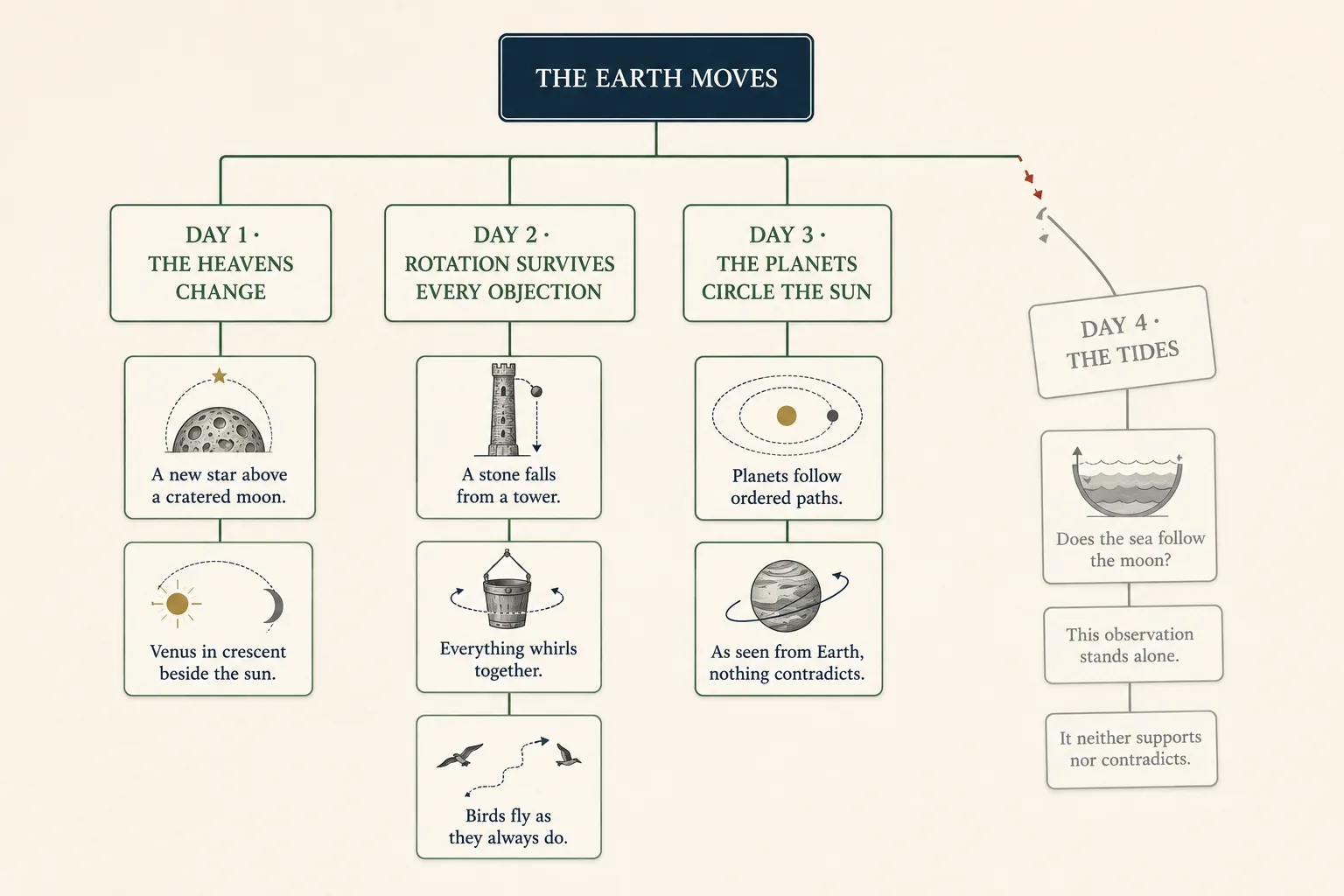
- Day 1 is a premise attack — it does not dispute Aristotle's logic, it removes an assumption. One node, many children.
- Day 2 is a fan of objections into a single rebuttal — six apparently independent attacks, one answer. The map makes the redundancy visible in a way the text does not.
- Day 3 is a genuine unresolved branch — a strong positive case and a strong objection, with the objection left open by an appeal to scale. Marking it unresolved rather than refuted is the honest reading.
- Day 4 is a detached limb — load-bearing for nothing above it. Its failure is contained.
- The closing argument attaches to everything — it is not an objection to any one branch but a challenge to the inference method itself, which is why it cannot be answered by more evidence.
That last distinction — an objection to a branch versus an objection to the whole method of inference — is the one most commonly lost in unstructured discussion, and it is exactly what a typed argument structure preserves. A comment thread flattens both into "someone disagreed".
Four things the Dialogue still teaches
Give the opposition its best material
Simplicio's objections are the real ones and they are strong. The book is persuasive because of that, not despite it. A review that only records the weak version of the counter-case has not been reviewed.
Keep a neutral in the room
Sagredo's function is to be persuadable. Someone whose position can visibly change is the only evidence a discussion is doing anything. If everyone in your meeting entered with a side, the meeting is a ratification.
Separate the observation from the inference
Every Day 2 objection reports something true. What fails is the step from the observation to the conclusion. Most durable disagreements have this shape and are mislabelled as factual disputes.
Let the bad branch fail alone
Day 4 is wrong and the book survives it, because the argument was built so that it could. A structure where every claim depends on every other is not rigorous, it is brittle.
Questions worth taking to your own arguments
- Which of your current arguments would still stand if its weakest branch were removed — and do you know which branch that is?
- Who in your process plays Sagredo, and are they actually free to be convinced?
- Where are you explaining away a missing piece of evidence by appealing to scale, cost or timing — the parallax move — and is that promissory note ever going to be paid?
- Which objections in your last contested decision were genuinely independent, and which were one objection wearing six hats?
- Is anyone raising the Urban VIII objection — that your mechanism is sufficient but not shown to be actual — and is it being answered or dismissed?
Sources & Further Reading
The pinned edition. Every page citation in this post is to this translation — section and page references differ between translations, so an unpinned cite cannot be checked.
The scanned text used for extraction, so every quotation here can be checked against the same copy.
The scholarly precedent for everything in this post: a 478-page logical and rhetorical analysis of this Dialogue, sympathetic to Toulmin and Perelman. If you want the argument structure done rigorously rather than journalistically, start here.
A day-by-day reconstruction that keeps the book’s structure while making the hidden assumptions explicit — which is what an argument map does. The day/topic divisions used in this post follow its breakdown.
Scholarly overview of the science, the method and the condemnation; the corrective to popular retellings.
The standard collection of the trial documents in translation — the source to use for anything about 1633, in place of the embroidered popular account.
Frequently Asked Questions
What are the two chief world systems in Galileo's Dialogue?
The Ptolemaic system, in which the Earth is stationary at the centre and everything else revolves around it, and the Copernican system, in which the Earth spins daily on its axis and orbits the Sun annually. Salviati argues the Copernican case, Simplicio the Ptolemaic and Aristotelian one, and Sagredo presses both. Notably the book does not seriously treat the Tychonic system, a third live option at the time in which the planets orbit the Sun while the Sun orbits a stationary Earth — an omission critics have noted, since it was the compromise most of Galileo's astronomically literate opponents actually held.
What happens on each of the four days?
Day 1 attacks Aristotle's division of the cosmos into an unchanging heaven and a changeable Earth, using the new stars of 1572 and 1604, comets, sunspots and the Moon's rough surface. Day 2 defends the Earth's daily rotation against the physical objections — the tower, the ship's mast, cannon shots east and west, the birds, and the extruding force of spin — by way of what is now called Galilean relativity. Day 3 argues the annual orbit from the phases of Venus and retrograde motion, and confronts the absence of stellar parallax. Day 4 argues that the tides are caused by the Earth's combined motions, which is wrong.
Was Galileo's tide argument correct?
No. Galileo held that the Earth's daily and annual motions combine to accelerate and decelerate the ocean basins, sloshing the water like a carried bowl, and he explicitly rejected lunar influence as occult. The mechanism predicts one high tide a day where there are two, and cannot explain why tides track the Moon — which is the actual cause. It was the argument he considered his strongest and wanted in the title. Including it in any honest map of the book matters: the other three days do not depend on it, so it fails without bringing down the conclusion.
Why did the Dialogue lead to Galileo's trial?
Several reasons compound, but one is structural. The book closes with Simplicio arguing that God could have produced the tides by means beyond human understanding, so no single explanation should be treated as established. That argument was Pope Urban VIII's own, and Galileo had been asked to include it. It appears last, in the mouth of the character who has been refuted for four hundred pages. Galileo was tried in 1633 and lived the rest of his life under house arrest. For the documents rather than the legend, see Finocchiaro's documentary history.
Is Simplicio meant to be an insult?
Galileo said the name came from Simplicius of Cilicia, a real sixth-century commentator on Aristotle, and that is a genuine derivation. It also reads in Italian as simpleton. Both are true simultaneously, and the second is inseparable from how the book was received. The character is not, however, a strawman: the objections he raises are the strong contemporary ones, which is exactly why the book works as an argument.
Why was the absence of stellar parallax such a strong objection?
If the Earth orbits the Sun, nearby stars should appear to shift against more distant ones over the year. No such shift could be detected. Salviati answers that the stars are far enough away to make the shift unobservable — which is correct, but in 1632 it explains away the missing evidence by postulating exactly the distance required to hide it. Stellar parallax was not measured until Bessel did it in 1838, so the best objection to Copernicanism stood unanswered for two centuries after the Dialogue.
What can a modern team actually take from the Dialogue?
Four things: give the opposing case its strongest material, as Simplicio is given; keep someone in the room who is genuinely free to change position, as Sagredo is; separate what was observed from what was inferred, since every Day 2 objection reports something true and fails only at the inference; and build the argument so a weak branch can fail alone, as Day 4 does without taking Days 1 to 3 with it.
Argumentree Team
Decision Science
The Argumentree team explores the science of better decisions—from ancient philosophy to modern AI.
Where this connects
The <em>Dialogue</em> is a four-hundred-page argument map written before anyone drew one. The rest of this series traces the traditions that built the same anatomy elsewhere.
The system Simplicio is defending, and why it was strong enough to hold for two thousand years
The disputation format that trained everyone in this book, Galileo included
What changes when you map the same claim five different ways
Map an argument that has four days in it
Argumentree turns a long, contested discussion into a typed structure — claims, objections, rebuttals and the links between them — so a weak branch fails where it stands instead of taking the decision with it.
Start Free 14-Day Trial →