
Engagement Survey Alternatives: 5 Ways to Actually Hear (and Act on) Your Team
The annual engagement survey is not wrong — it is just not enough: it looks backward, its closed scales miss the "why," and the real problem is the action rate, not the measurement. The stakes are documented: Gallup's State of the Global Workplace puts global engagement at roughly a fifth of employees (23% in the 2024 report, 21% a year later), and pseudo-voice research (de Vries, Jehn and Terwel, 2012) shows that soliciting input without visibly weighing it makes people stop speaking up and raises conflict. A fair roundup of the alternatives: open-ended exchange platforms such as Thoughtexchange surface what a large group cares about in its own words but stop short of a decision; continuous listening and pulse tools give a near-real-time trend but are thin on reasoning; structured deliberation and argument mapping (Argumentree) organizes open input into weighed pro/con arguments around a real question and ends in a recorded decision; town halls and AMAs are high-trust but dominated by confident voices and rarely recorded; focus groups go deep but small. The honest pattern: keep the survey as the thermometer, and add a deliberation loop as the treatment — because engagement follows from being weighed, not just counted.
The engagement survey isn't wrong — it's just not enough. It measures how people felt weeks ago on scales that miss the why, and the real crisis is the action rate: feedback that visibly goes nowhere makes things worse, not better.
- The backdrop is measured: Gallup puts global engagement at roughly a fifth of employees — and pseudo-voice research shows unweighed input actively backfires
- The alternatives do different jobs: open-ended exchanges surface themes, pulse tools trend a signal, structured deliberation reaches a recorded decision, town halls build trust, focus groups go deep
- None of the listening tools decides — the gap between "we heard you" and "here is what we're doing, and why" is where engagement is actually won
- Keep the survey as the thermometer; add deliberation as the treatment
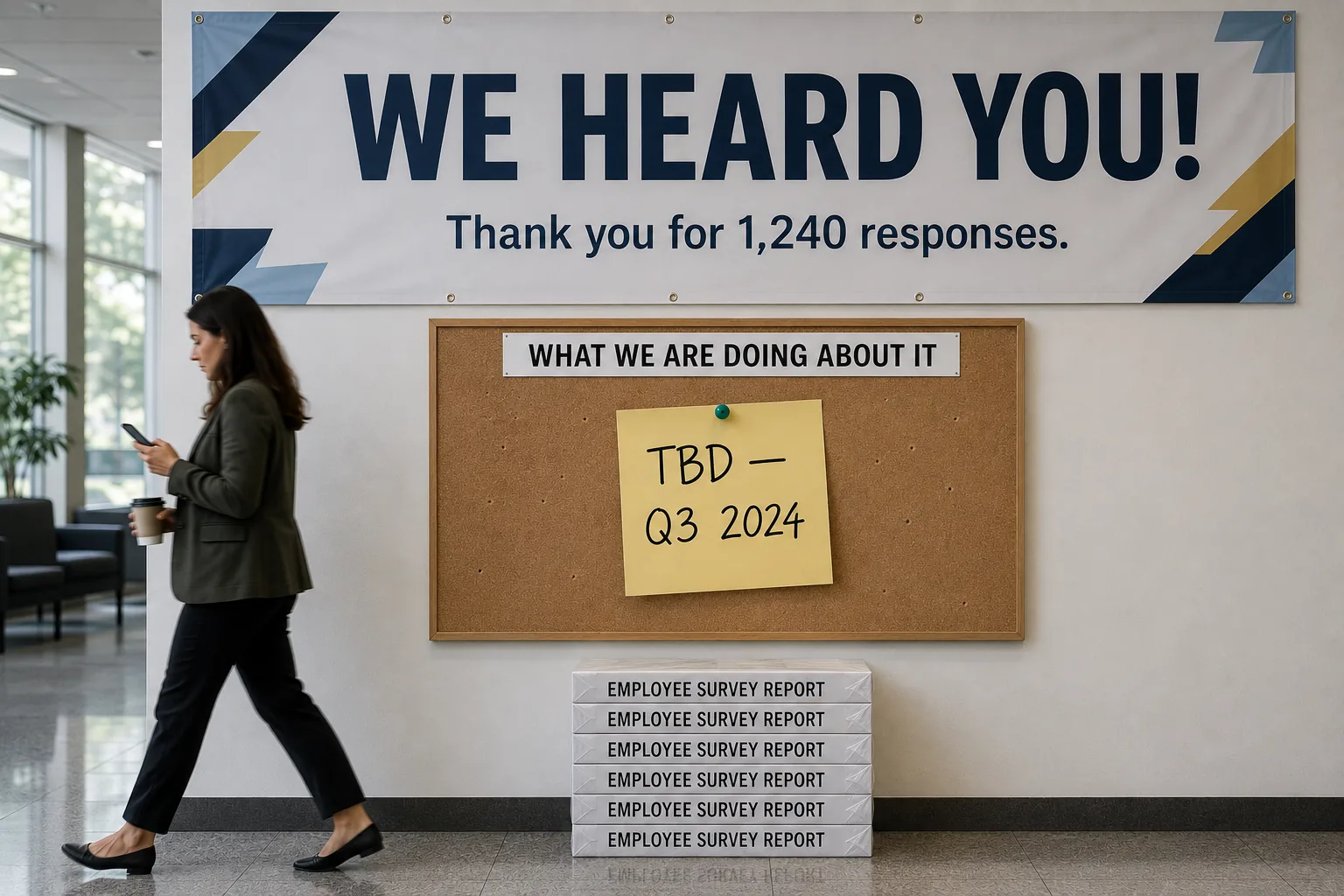
The engagement survey lands in every inbox in October, as it does every October. Response rate: respectable. Results: engagement dipped 0.3, "communication" and "career development" flagged again, sentiment on the open comments "mixed." The deck is presented in November, the action-planning workshops are scheduled for January, and by the time anything changes — if anything changes — the feelings being acted on are eight months old. Everyone involved is behaving professionally. And everyone, on both sides of the survey, quietly suspects the exercise changes nothing.
That suspicion has numbers behind it. Gallup's State of the Global Workplace has measured engagement for years at roughly a fifth of employees worldwide — 23% in its 2024 report, slipping to 21% a year later — while organizations have never collected more feedback. Measurement is not the bottleneck. The bottleneck is what happens after: input that visibly goes nowhere doesn't just fail to help — the pseudo-voice research says it actively corrodes the willingness to speak up at all.
So this is a roundup with a thesis: the interesting alternatives to the engagement survey are not better questionnaires. They are tools that move further along the ladder from counting people's answers, to hearing their reasoning, to weighing it in a decision they can see. Here is where the survey genuinely falls short, the five alternative categories judged fairly, and the pattern that makes any of them work.
People don't disengage because they were asked too often.
They disengage because answering never changed anything.
The action-rate problem, which no amount of measuring fixes
Where the annual survey falls short
It looks backward, not forward
An annual or quarterly survey measures how people felt weeks ago. By the time results are cleaned, benchmarked, and presented, the moment that caused the score has passed. You are steering by the wake.
Closed questions miss the "why"
A 1–5 scale tells you engagement dropped from 3.8 to 3.4. It does not tell you what changed, who is affected, or what would fix it. The number is the symptom; the reasoning is exactly what the format strips out.
The action rate is the real problem
Most organisations collect far more feedback than they ever act on. When people watch a survey disappear into a slide deck and nothing changes, they learn the exercise is theatre — the pseudo-voice studies show they respond by going quiet, and conflict rises.
Survey fatigue is self-inflicted
The common cure for a lagging signal is to survey more often. But shorter pulses asked more frequently, with the same lack of follow-through, just accelerate the cynicism. Frequency without follow-through is fatigue by design.
What people actually want from feedback
The procedural-justice literature has been precise about this for decades: voice matters to people not only instrumentally — the chance to change the outcome — but because being genuinely heard signals that you count (Lind and Tyler's group-value model). That sets up a ladder the feedback stack has to climb. A scale question counts you. An open-ended prompt hears you. But only a process that visibly weighs your reasoning against the alternatives — and shows you where it landed — delivers the thing engagement is made of. De Vries and colleagues' pseudo-voice finding is the same ladder read downward: input solicited and not weighed is experienced as an insult, not a courtesy.
Judge every tool below by that ladder: how far does it climb from counting, through hearing, to weighing — and does anyone ever see a decision at the top?
Being counted is not the same as being heard —
and being heard is not the same as being weighed.
— the ladder engagement actually climbs, after the procedural-justice literature
A fair roundup of the alternatives
Five categories, each judged on what it actually does — with the limits stated plainly, our own included.
Open-ended exchanges
e.g. Thoughtexchange
Participants share short open-ended thoughts and rate each other's in waves, surfacing what the group collectively cares about rather than what a survey author thought to ask.
Strengths
- Captures the "why" in people's own words
- Crowd-rating reveals shared priorities fast
- Scales to very large groups without losing the qualitative signal
Limits
- Surfaces sentiment and themes, but stops short of a decision
- Ranking ≠ resolving — competing thoughts aren't weighed against each other as arguments
- You still need a separate step to turn themes into a committed choice
Continuous listening tools
always-on pulse / eNPS platforms
Lightweight, frequent check-ins (a question a week, sentiment from chat and HR systems) that trend a signal over time instead of one big annual event.
Strengths
- Near-real-time trend line
- Low per-response burden
- Good early-warning system for morale
Limits
- Still mostly closed-scale — thin on the reasoning
- Trend without action just makes fatigue continuous
- Rarely produces anything a leader can decide from directly
Structured deliberation / argument mapping
e.g. Argumentree
Open input is organised into a pro/con structure around a specific question, the arguments are weighed by the group, and the outcome is written down as a decision with its reasoning attached.
Strengths
- Moves from listening all the way to a recorded decision
- Keeps the reasoning, not just the sentiment
- Everyone can see why the group landed where it did — the anti-pseudo-voice mechanism, structural
Limits
- Needs a real question to organise around — not a fit for pure mood-tracking
- More deliberate than a one-click pulse
- Best used after listening has surfaced the theme, to resolve it
Town halls / AMAs
live all-hands with Q&A
Leadership takes questions live, often with upvoting on submitted questions to prioritise what gets answered.
Strengths
- High-trust, visible two-way signal
- Great for context and tone
- Upvoting surfaces the room's real questions
Limits
- The loudest and most senior voices dominate
- Hard to be candid in public
- Answers are said, not recorded or acted on systematically
Focus groups / interviews
facilitated small-group sessions
A facilitator explores a topic in depth with a small, often hand-picked group.
Strengths
- Deepest qualitative insight
- Room to probe and follow up
- Good for sensitive or complex topics
Limits
- Tiny, unrepresentative sample
- Expensive and slow to run at scale
- Findings depend heavily on the facilitator and who was in the room
"So should we kill the engagement survey?"
No — and the honest version of this post says so plainly. The annual survey does one job well that nothing above replaces: a periodic, comparable, quantitative baseline you can trend year over year and benchmark against peers. That is a thermometer, and organizations need one. The mistake is asking the thermometer to be the treatment — expecting a measurement instrument to produce the understanding and the decisions that change what it measures.
The workable pattern is a division of labor. Keep the survey (or a lighter pulse) as the detector: it tells you where something is wrong. Then, for the two or three themes that matter this cycle, run a real deliberation loop: an open question, the reasoning gathered and structured, the arguments weighed in view of the people who raised them, and a decision published with its why — the same close-the-loop discipline covered in from survey results to a decision. Measurement detects; deliberation treats. Confusing the two is how organizations end up surveying more and changing less.
Where Argumentree fits: from listening to deciding
Argumentree is the third category above, built for the top of the ladder. Take a theme the survey flagged — "communication is broken" — and turn it into a real question: which of these three changes to how we communicate should we make? Open input flows in asynchronously; AI extraction structures it into distinct pro and con arguments; rating shows where support genuinely stands on each point; and the outcome is a recorded decision — what was chosen, what was argued, what was overruled and why — that every participant can inspect.
That last clause is the engagement mechanism, not a compliance feature. The pseudo-voice spiral runs on invisibility: people speak, nothing visibly happens, they stop speaking. A published decision record with their arguments in it — weighed, answered, sometimes overruled with reasons — is the visible proof that speaking up did something. For structured programs of this kind, see stakeholder engagement; for how the exchange-style tools compare directly, see Argumentree vs Thoughtexchange.
The action-rate audit
Take your last engagement survey. Count the themes it flagged — then count the decisions your organization published in response, with reasoning people could read. If the second number is zero, the survey isn't your problem.
Measure less, weigh more
Go back to the October ritual. Nothing in it needs to be abolished — it needs to be completed. The survey found the themes; what was missing was everything the ladder demands above counting: the open question, the reasoning heard in people's own words, the arguments weighed where people could watch, and a decision they could find their input inside.
That completion is cheaper than the next measurement tool and more effective than the next reminder email about response rates. Pick one flagged theme this cycle. Run it to a real, published decision. The most reliable way to raise next year's engagement score is to give people evidence that this year's answers moved something.
The survey tells you the temperature. Only a decision changes the weather.
Close the loop your survey opens.
From flagged theme to structured arguments to a published decision — the deliberation layer that makes listening mean something.
Sources & further reading
- Gallup — State of the Global Workplace (2024/2025 reports).The engagement baseline: 23% of employees globally engaged in the 2024 report, 21% a year later — against record volumes of collected feedback.
- de Vries, G., Jehn, K. A., & Terwel, B. W. (2012). When Employees Stop Talking and Start Fighting: The Detrimental Effects of Pseudo Voice in Organizations. Journal of Business Ethics, 105(2).Input solicited without intent to weigh it reduced voice behavior and increased conflict — why the action rate, not the measurement, is the crisis.
- Lind, E. A., & Tyler, T. R. (1988). The Social Psychology of Procedural Justice. Plenum Press.The group-value model: being genuinely heard signals that you count — the rung above being counted.
- Kim, W. C., & Mauborgne, R. (1997). Fair Process: Managing in the Knowledge Economy. Harvard Business Review.Engagement, explanation, expectation clarity — the fair-process principles a deliberation loop operationalizes.
Frequently Asked Questions
What are the best alternatives to an employee engagement survey?
There is no single replacement — different tools do different jobs. Open-ended exchanges (like Thoughtexchange) are strong at surfacing what a large group cares about in its own words. Continuous listening and pulse tools give a near-real-time trend line at low burden. Town halls and AMAs build trust and context live. Focus groups go deepest on a narrow topic. And structured deliberation platforms (like Argumentree) are the only category that runs all the way to a recorded decision — organizing open input into weighed pro and con arguments around a real question. The honest pattern combines them: keep a measurement baseline as the thermometer, and add a deliberation loop as the treatment.
Are engagement surveys still useful at all?
Yes, for what they are good at: a periodic, comparable, quantitative baseline you can trend year over year and benchmark against peers. The problem is not the survey itself — it is expecting a measurement instrument to produce understanding and change. A scale score tells you where something is wrong, not what to do about it, and acting on it requires a separate synthesis-and-decide step. Keep the thermometer; stop asking it to be the treatment.
What is survey fatigue and how do you avoid it?
Survey fatigue is the falling response rate and rising cynicism that set in when people are asked for input repeatedly but rarely see it lead to anything. The usual mistake is to fight it with frequency — shorter pulses, asked more often — which just makes the fatigue continuous if the follow-through doesn't change. The research points at the real lever: pseudo-voice studies show people stop contributing when input is visibly unweighed. The fix is raising the action rate, not the ask rate: fewer questions, and a published, reasoned decision for the themes you do pursue.
How is Thoughtexchange different from a survey?
A traditional survey asks fixed, mostly closed questions the author chose in advance. Thoughtexchange instead invites open-ended thoughts and has participants rate each other's contributions in waves, so the group's own priorities surface rather than the survey designer's guesses. That makes it genuinely better at hearing the "why" at scale. Where it stops — like all listening tools — is at the decision: ranked themes still are not weighed arguments, and someone still has to resolve competing thoughts into a committed, explained choice. Our direct comparison covers where each tool fits.
What does research say about collecting feedback and not acting on it?
That it backfires. De Vries, Jehn and Terwel's pseudo-voice study (Journal of Business Ethics, 2012) found that when employees perceive voice opportunities as sham — input solicited without intent to weigh it — they reduce their voice behavior and intragroup conflict rises. Procedural-justice research (Lind and Tyler) explains why: genuine voice signals that you count, so fake voice signals the opposite. Every unactioned survey is a small deposit into that account, which is why the action rate matters more than the measurement cadence.
How does Argumentree turn engagement feedback into a decision?
Argumentree takes open input on a specific question and organizes it into a pro/con argument tree: AI extraction turns free-text contributions into distinct arguments, each point can be supported, challenged, and rated, and net support shows where the group genuinely stands on the merits. The outcome is a recorded decision — what was chosen, which arguments carried it, which were overruled and why — that every participant can inspect. That visible weighing is the anti-pseudo-voice mechanism: people can see their input was not just counted but engaged with.
Your people already told you what's wrong. Decide something.
Take one flagged theme to a real, published decision — arguments weighed in the open, reasoning on the record.
About Argumentree Team
Decision Science
The Argumentree team is building the collaborative decision-making platform Argumentree. Our mission is to transform how organizations make, document, and learn from decisions.
Related Articles
Join the discussion
Thermometer, treatment, or theater — what has your organization's feedback stack actually been? Make your case in the community.
Discuss on the Argumentree Forum