
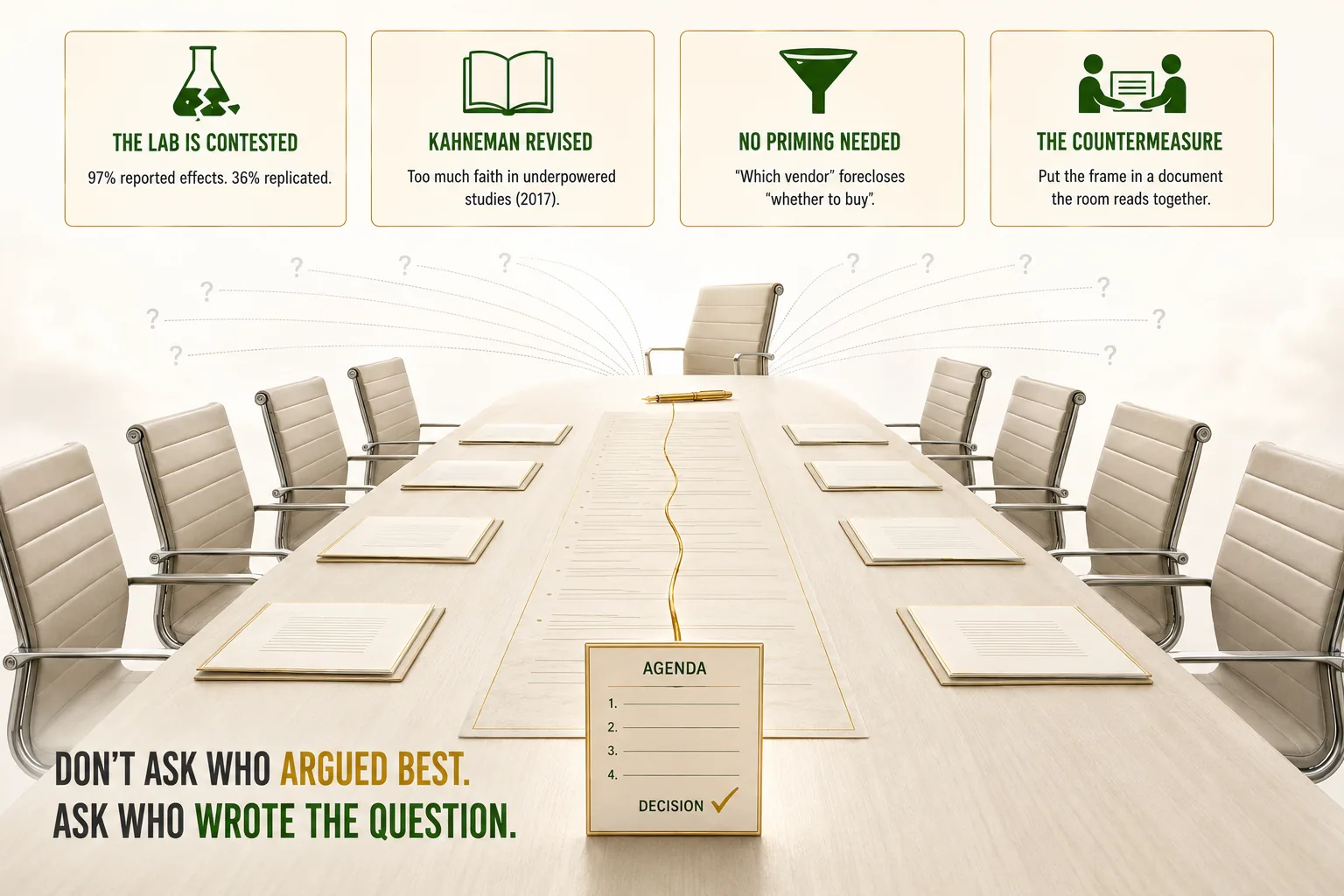
The most consequential decision in a meeting is made before it starts
Someone chose what goes on the agenda. Someone chose the order. Someone wrote the pre-read that frames the problem, and picked which option appears as the recommendation and which appear as alternatives. By the time eight people sit down to weigh a decision, a substantial part of the outcome has already been set by a person who may not even be in the room.
Robert Cialdini gave this its name. In Pre-Suasion (2016) he argues that persuasion does not begin with the message; it begins with what the audience is attending to when the message lands. Talking to PBS NewsHour when the book appeared, he described it in plain terms:
The practice of getting people sympathetic to your message before they experience it… the ability to cause people to have something at the top of their consciousness that makes them receptive to your message that's yet to come.Chapter two of the book calls these privileged moments — identifiable points in time when someone is unusually receptive to a communicator's message. In a company, the privileged moment is not a mystery: it is the pre-read.
— Robert Cialdini, PBS NewsHour (22 September 2016)
Now the part the business summaries leave out
You will meet three studies in almost every article about pre-suasion, and all three deserve caveats that rarely travel with them.
- ✗The wine-and-music study. Alternating French and German background music in a supermarket shifted purchases toward the matching country's wine — real, published first in Nature (1997) and in full in the Journal of Applied Psychology (1999) by North, Hargreaves and McKendrick. But the entire effect rests on 82 bottles sold across two weeks. That is a field study worth knowing, not a law of nature.
- ✗It is also routinely misattributed. The music-and-wine result is frequently credited to Areni and Kim. That is a different study — 1993, classical versus Top Forty, and it affected how much shoppers spent per bottle rather than which country they chose — and it was published in conference proceedings rather than a peer-reviewed journal.
- ✗The "are you adventurous?" study is not Cialdini's. The finding that asking that question first sharply raises acceptance of a free sample belongs to Bolkan and Andersen (Basic and Applied Social Psychology, 2009). Cialdini cites it; the popular retelling has quietly reassigned it to him.
And priming itself is contested — properly contested
The deeper problem is that pre-suasion's laboratory backbone is social priming, which has had the roughest decade in psychology. The Open Science Collaboration's 2015 replication project found that while 97 per cent of 100 original studies reported significant effects, only 36 per cent of the replications did, with effect sizes roughly halved. Doyen and colleagues failed to reproduce a landmark priming demonstration in 2012 and found the effect appeared mainly when experimenters expected it. Many Labs 2, in 2018, replicated 15 of 28 findings across 15,305 participants, with median effect sizes falling from 0.60 to 0.15.
Daniel Kahneman, who had presented priming work confidently in Thinking, Fast and Slow, publicly revised his position in 2017, writing that he had placed too much faith in underpowered studies and that the effects could not be as large or as robust as his chapter had suggested.
Here is where an honest post has to stop short of the satisfying conclusion. "Priming is debunked" would be wrong. Sherman and Rivers argued in Psychological Inquiry (2021) that "social priming" was never a coherent category to begin with, and a 2023 meta-analysis in Psychological Bulletin by Dai, Albarracín and colleagues — 351 studies, 862 effect sizes — reported a moderate overall priming effect of d = 0.37 that survived adjustment for publication bias. The defensible reading: the mechanism is real and moderate; the headline demonstrations in popular books are fragile and their effect sizes inflated.
A post that sold you the wine study without the 82 bottles would be more persuasive and less true — which is precisely the failure mode this whole cluster is about. If a claim only works when the caveats are removed, it is not the claim you should build a meeting on.
The meeting-level version needs no priming literature
Strip out the contested lab work and something obvious remains: agenda control is real, uncontroversial, and almost never governed. Nobody disputes that discussing the budget before the strategy produces a different conversation than the reverse, or that a pre-read framing a decision as "which vendor" forecloses "whether to buy". You do not need priming research to accept that whoever writes the frame has moved the outcome — you need only to have attended meetings.
This is also where pre-suasion meets the Anchoring Trap. The first number spoken — a budget, a timeline, a valuation — sets the range everyone argues within, and the pre-read chooses that number. Amazon's written-narrative meetings are, read this way, a pre-suasion countermeasure: the six-pager forces the framing into a document the room reads together, rather than leaving it to whoever speaks first.
The technique: govern the frame, not just the discussion
Four moves, none of which require anyone to be less human.
- ✓Write the decision criteria before the options. Agree what would make an answer good — cost ceiling, must-haves, reversibility — while the choices are still abstract. Criteria written after the options are visible are criteria written to fit a preference.
- ✓Rotate who sets the agenda. If the same person frames every decision, that person is making more of them than the org chart says. Rotation costs nothing and redistributes a real power.
- ✓Collect positions before the pre-read is discussed. Independent written input, gathered before the framing has done its work, is the cheapest counter-pre-suasion move available — and the same one that defuses social proof and authority.
- ✓Put the frame on the record. When the decision record keeps the original question, a reviewer a year later can ask the question that matters most: was this the right thing to be deciding at all?
Who wrote the question?
Cialdini's insight, stripped of the fragile experiments, is that attention is a resource that gets allocated before anyone starts reasoning — and that whoever allocates it holds an advantage no counterargument in the meeting can fully undo.
So the next time a decision feels foreordained, do not start by asking who argued best. Ask who wrote the question — because in most meetings, that is the person who already decided.
Sources & further reading
Every named source in this post, with a link where one exists. Where a claim could not be traced to a primary source, the post says so in the body rather than in a footnote.
- •Cialdini, R. B., interviewed by Paul Solman. "What's 'pre-suasion?' How marketers make us receptive to an ad." PBS NewsHour, 22 September 2016. — Cialdini defining pre-suasion in his own voice; the quotation used above.
- •Cialdini, R. B. (2016). Pre-Suasion: A Revolutionary Way to Influence and Persuade. — chapter 2, "Privileged Moments".
- •North, A. C., Hargreaves, D. J., & McKendrick, J. (1997). In-store music affects product choice. Nature, 390, 132. — the wine-and-music field study; reported in full as North, Hargreaves & McKendrick (1999), Journal of Applied Psychology, 84(2), 271–276.
- •Areni, C. S., & Kim, D. (1993). The Influence of Background Music on Shopping Behavior. Advances in Consumer Research, 20, 336–340. — the study the wine-and-music result is often confused with.
- •Bolkan, S., & Andersen, P. A. (2009). Image Induction and Social Influence. Basic and Applied Social Psychology, 31(4), 317–324. — the question-framing studies usually misattributed to Cialdini.
- •Mandel, N., & Johnson, E. J. (2002). When Web Pages Influence Choice: Effects of Visual Primes on Experts and Novices. Journal of Consumer Research, 29(2), 235–245. — background imagery shifting product choice online.
- •Open Science Collaboration (2015). Estimating the reproducibility of psychological science. Science, 349(6251). — the 36 per cent replication figure.
- •Doyen, S., Klein, O., Pichon, C.-L., & Cleeremans, A. (2012). Behavioral Priming: It's All in the Mind, but Whose Mind? PLoS ONE, 7(1), e29081. — the failed replication and the experimenter-expectancy finding.
- •Klein, R. A., et al. (2018). Many Labs 2. Advances in Methods and Practices in Psychological Science, 1(4), 443–490. — 15 of 28 findings replicated; median d from 0.60 to 0.15.
- •Sherman, J. W., & Rivers, A. M. (2021). There's Nothing Social about Social Priming. Psychological Inquiry, 32(1), 1–11. — the argument that the category itself is incoherent.
- •Dai, W., et al. (2023). Priming Behavior: A Meta-Analysis. Psychological Bulletin, 149(1–2), 67–98. — d = 0.37 across 351 studies, robust to publication-bias adjustment.