
Nineteen dollars and ninety-five cents
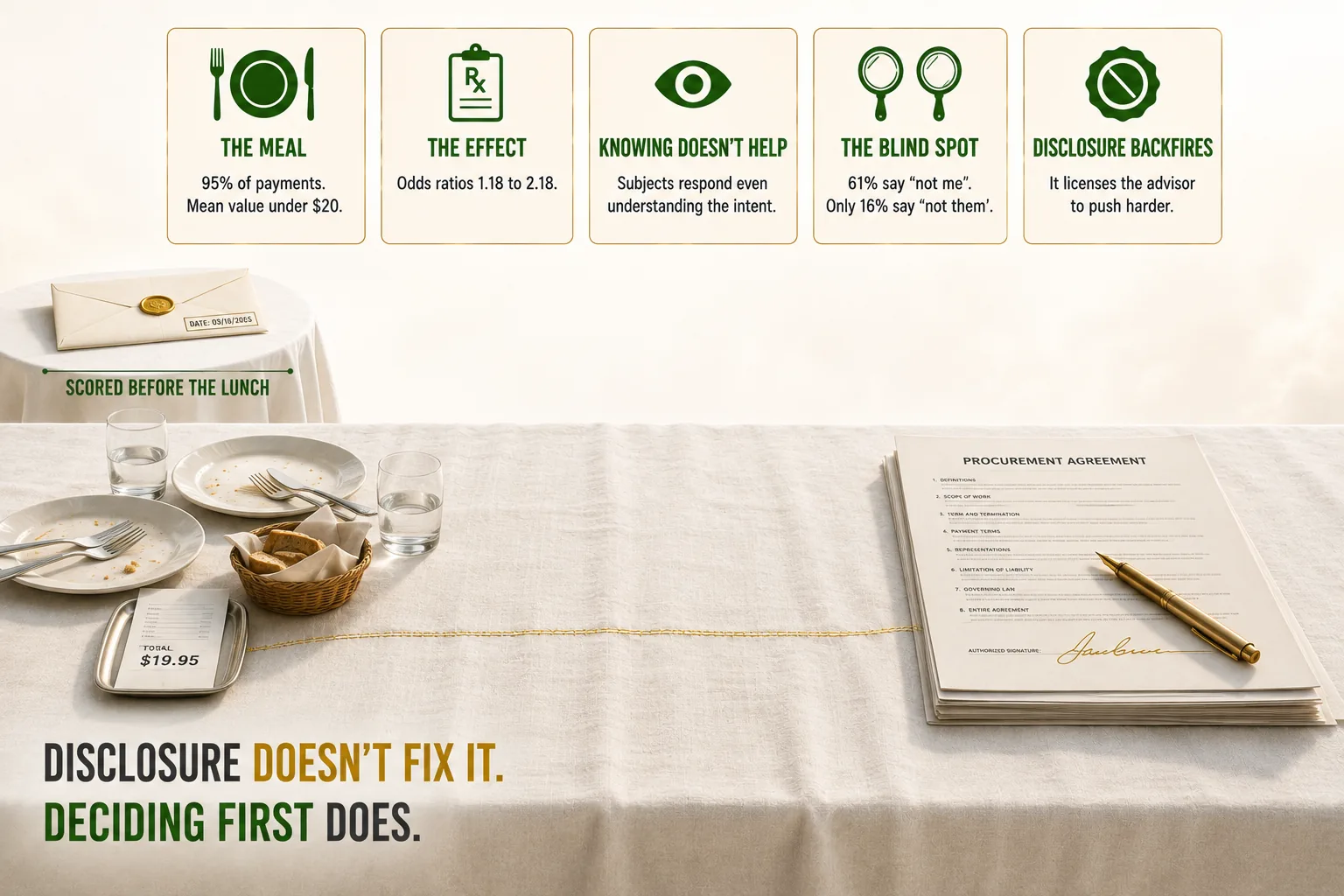
In 2016 a team led by Colette DeJong published something uncomfortable in JAMA Internal Medicine. They linked 63,524 industry payments to the Medicare prescribing records of 279,669 physicians across four drug classes. Ninety-five per cent of those payments were not consulting fees or speaking engagements. They were meals, with a mean value below twenty dollars.
Receipt of a single sponsored meal was associated with a higher rate of prescribing the promoted brand-name drug: an odds ratio of 1.18 for rosuvastatin, 1.52 for olmesartan, 1.70 for nebivolol, 2.18 for desvenlafaxine. More meals, and costlier meals, were associated with larger increases. The authors' conclusion is one sentence long:
Receipt of industry-sponsored meals was associated with an increased rate of prescribing the brand-name medication that was being promoted.These are associations, not a randomised trial, and the authors present them as such. But the pattern is a dose–response across a quarter of a million professionals whose entire training is in evidence-based judgement — and the input is lunch.
— DeJong et al., JAMA Internal Medicine (2016)
You are not a doctor. Unfortunately, that is not the escape hatch
The natural objection is that medicine is a special case. So consider the experiment built to look exactly like procurement. In You Owe Me, published in the American Economic Review in 2017, Ulrike Malmendier and Klaus Schmidt had participants choose between two products on behalf of a client — an agency relationship, the way a buyer chooses for their employer — after one seller offered a small gift.
In business and politics, gifts are often aimed at influencing the recipient at the expense of third parties. In an experimental study, which removes informational and incentive confounds, subjects strongly respond to small gifts even though they understand the gift giver's intention.
— Malmendier & Schmidt, You Owe Me, American Economic Review (2017)
Read the second half of that sentence again. Even though they understand the gift giver's intention. The participants were not fooled about why the gift arrived. Knowing did not protect them — which is precisely why "our people are too experienced to be swayed by a dinner" is not a control. And the cost landed on the client, who was not in the room and did not receive a dinner.
Everyone else is influenced
There is a reliable pattern in how professionals assess their own exposure. Steinman, Shlipak and McPhee asked medical housestaff about pharmaceutical promotion and published the result in the American Journal of Medicine in 2001:
Most respondents (61%) stated that industry promotions and contacts did not influence their own prescribing, but only 16% believed other physicians were similarly unaffected (P<.0001).
— Steinman, Shlipak & McPhee, American Journal of Medicine (2001)
Sixty-one per cent immune; sixteen per cent think their colleagues are. Both numbers cannot be right, and the gap is the whole problem: reciprocity does not feel like being bought. It feels like liking someone, or like fairness, or like simply having had a good conversation with a vendor who gets your business. That is what makes it the most under-managed influence risk in most buying processes.
If a mechanism only works on people who do not notice it, then a policy that relies on people noticing it will not work either. That is the finding behind everything in the next section.
But surely disclosure fixes it — and a spending cap?
This is where most gift policies live, and where the evidence is least comfortable. Cain, Loewenstein and Moore tested disclosure directly in the Journal of Legal Studies in 2005 and found it could backfire:
Disclosure can increase the bias in advice because it leads advisors to feel morally licensed and strategically encouraged to exaggerate their advice even further. As a result, disclosure may fail to solve the problems created by conflicts of interest and may sometimes even make matters worse.
— Cain, Loewenstein & Moore, The Dirt on Coming Clean, Journal of Legal Studies (2005)
Two honest caveats, because this finding is frequently over-claimed. First, Sah's 2019 direct replication in the Journal of Economic Psychology confirmed the advisor-side effect — disclosure does license more biased advice — but found little support for several advisee-side effects, though the meta-analytic bottom line still left advisees financially worse off with disclosure. Second, this is a reason to design disclosure better, not to abandon transparency. What it is not is evidence that a disclosure line in a procurement policy has solved anything. And on the other common remedy, Malmendier and Schmidt are blunt: common policy responses (disclosure, size limits) may be ineffective.
What the law actually asks of you
Worth knowing precisely, because the legal test is more sensible than most internal policies. Under section 7 of the UK Bribery Act 2010, a commercial organisation is guilty of an offence if an associated person bribes another to obtain or retain business or a business advantage for it — with a defence that the organisation had adequate procedures in place. Hospitality itself is not the target. The joint prosecution guidance from the SFO and DPP is explicit:
Hospitality or promotional expenditure which is reasonable, proportionate and made in good faith is an established and important part of doing business.
The more lavish the hospitality or expenditure (beyond what may be reasonable standards in the particular circumstances) the greater the inference that it is intended to encourage or reward improper performance.
— Joint Prosecution Guidance of the Director of the SFO and the DPP, Bribery Act 2010
Notice the shape of that test: not a number, but proportionality and intent, evidenced by procedure. Which is exactly the gap the research exposes — the legal standard asks whether you had adequate procedures, while the psychology says the influence lands well below the threshold any value-based policy would flag. In the United States the transparency route is statutory: the Physician Payments Sunshine Act (42 U.S.C. §1320a-7h) requires manufacturers to report transfers of value to covered recipients, published annually in a searchable public database. In the EU there is no equivalent statute; the EFPIA Disclosure Code is self-regulatory, with France's 2011 loi Bertrand as the notable binding national regime.
The technique: decide before you are hosted
Everything above says the same thing — the defence cannot be individual resistance, because the mechanism does not announce itself. It has to be procedural, and cheap enough that people actually do it.
- ✓Write and weight the scoring criteria before any vendor contact. This is the single highest-leverage move, and it is the same one that defeats agenda-setting: criteria fixed while the field is abstract cannot be quietly reshaped around whoever hosted the best dinner.
- ✓Separate the relationship from the evaluation. The person who owns the vendor relationship should not be the person who scores the vendor. Reciprocity needs a recipient — remove the recipient from the scoring seat and the mechanism has nowhere to land.
- ✓Record contact, not just conclusions. Who met whom, and what was received, logged alongside the decision. Not to accuse anyone: to make the pattern visible in the decision record if the winning vendor turns out to be the one that hosted the most meetings.
- ✓Score against the criteria in writing, independently, before discussion. Same move as everywhere else in this cluster — it removes the audience that social proof and authority need, and it timestamps the judgement.
- ✓Treat disclosure as a signal, not a solution. Log it, because the pattern is useful evidence. But do not let a disclosed conflict substitute for a structural one — the research says the disclosing party may argue harder afterwards.
It was never about the lunch
Nobody sells a seven-figure contract with a sandwich. The gift is not payment; it is the opening of an account that the recipient will feel a quiet pull to settle later — in a meeting where the decision will be described, entirely sincerely, as being about capability and fit.
So the question for your next vendor decision is not whether your team can be bought. Almost certainly they cannot. It is narrower and much more awkward: were the criteria written before the hospitality started? Because the research is consistent on this point — by the time anyone is scoring, the account is already open.
Sources & further reading
Every named source in this post, with a link where one exists. Two widely repeated figures were deliberately left out because they could not be traced to a primary source: an often-quoted per-physician industry marketing spend, and a claim about larger gifts producing weaker effects.
- •DeJong, C., et al. (2016). Pharmaceutical Industry–Sponsored Meals and Physician Prescribing Patterns for Medicare Beneficiaries. JAMA Internal Medicine, 176(8), 1114–1122. — 279,669 physicians; 95% of payments were meals under $20; odds ratios 1.18 to 2.18 with a dose–response.
- •Malmendier, U., & Schmidt, K. M. (2017). You Owe Me. American Economic Review, 107(2), 493–526. — choices made on behalf of a client, small gifts, understood intent; disclosure and size limits found potentially ineffective.
- •Steinman, M. A., Shlipak, M. G., & McPhee, S. J. (2001). Of principles and pens. American Journal of Medicine, 110(7), 551–557. — 61% versus 16%: the bias blind spot in its natural habitat.
- •Wazana, A. (2000). Physicians and the Pharmaceutical Industry: Is a Gift Ever Just a Gift? JAMA, 283(3), 373–380. — the systematic review of 29 studies that opened the field.
- •Cain, D. M., Loewenstein, G., & Moore, D. A. (2005). The Dirt on Coming Clean: Perverse Effects of Disclosing Conflicts of Interest. Journal of Legal Studies, 34(1), 1–25. — moral licensing and insufficient discounting.
- •Sah, S. (2019). Understanding the (perverse) effects of disclosing conflicts of interest: A direct replication study. Journal of Economic Psychology. — advisor-side effect replicated; several advisee-side effects not; advisees still worse off overall.
- •Loewenstein, G., Cain, D. M., & Sah, S. (2011). The Limits of Transparency. American Economic Review, 101(3), 423–428. — why disclosure can increase pressure to comply.
- •Bribery Act 2010, section 7 (failure of commercial organisations to prevent bribery). — the offence and the adequate-procedures defence.
- •Joint Prosecution Guidance of the Director of the SFO and the DPP, Bribery Act 2010. — proportionate hospitality is legitimate; lavishness raises the inference.
- •Physician Payments Sunshine Act, 42 U.S.C. §1320a-7h. — mandatory reporting of transfers of value, published in a searchable public database.