
Herbert Simon and Artificial Intelligence: How a Decision Theorist Co-Created the First AI Program
Herbert Simon (1916–2001) co-created the Logic Theorist — widely considered the first artificial intelligence program — with Allen Newell and Cliff Shaw. In January 1956 Simon told his class: 'Over Christmas, Al Newell and I invented a thinking machine.' The Logic Theorist proved 38 of the first 52 theorems in chapter two of Whitehead and Russell's Principia Mathematica and found a more elegant proof of Theorem 2.85; Bertrand Russell responded with delight, but the Journal of Symbolic Logic rejected the write-up, judging a new proof of an elementary theorem unworthy of publication. Simon and Newell went on to build the General Problem Solver (first version 1957, report published 1959), introducing means-ends analysis, and stated the Physical Symbol System Hypothesis in their 1976 Turing lecture: 'A physical symbol system has the necessary and sufficient means for general intelligent action.' Simon is one of the few people to win both the ACM Turing Award (1975, with Newell) and the Nobel Memorial Prize in Economics (1978). The through-line from his decision research: intelligence is heuristic search under constraints — bounded rationality implemented in code. Deep learning overturned the symbolic program's strong claim, but the bounded-rationality core survives: modern systems still rely on heuristic search, approximate good-enough solutions, and Simon's definition of intuition as recognition.
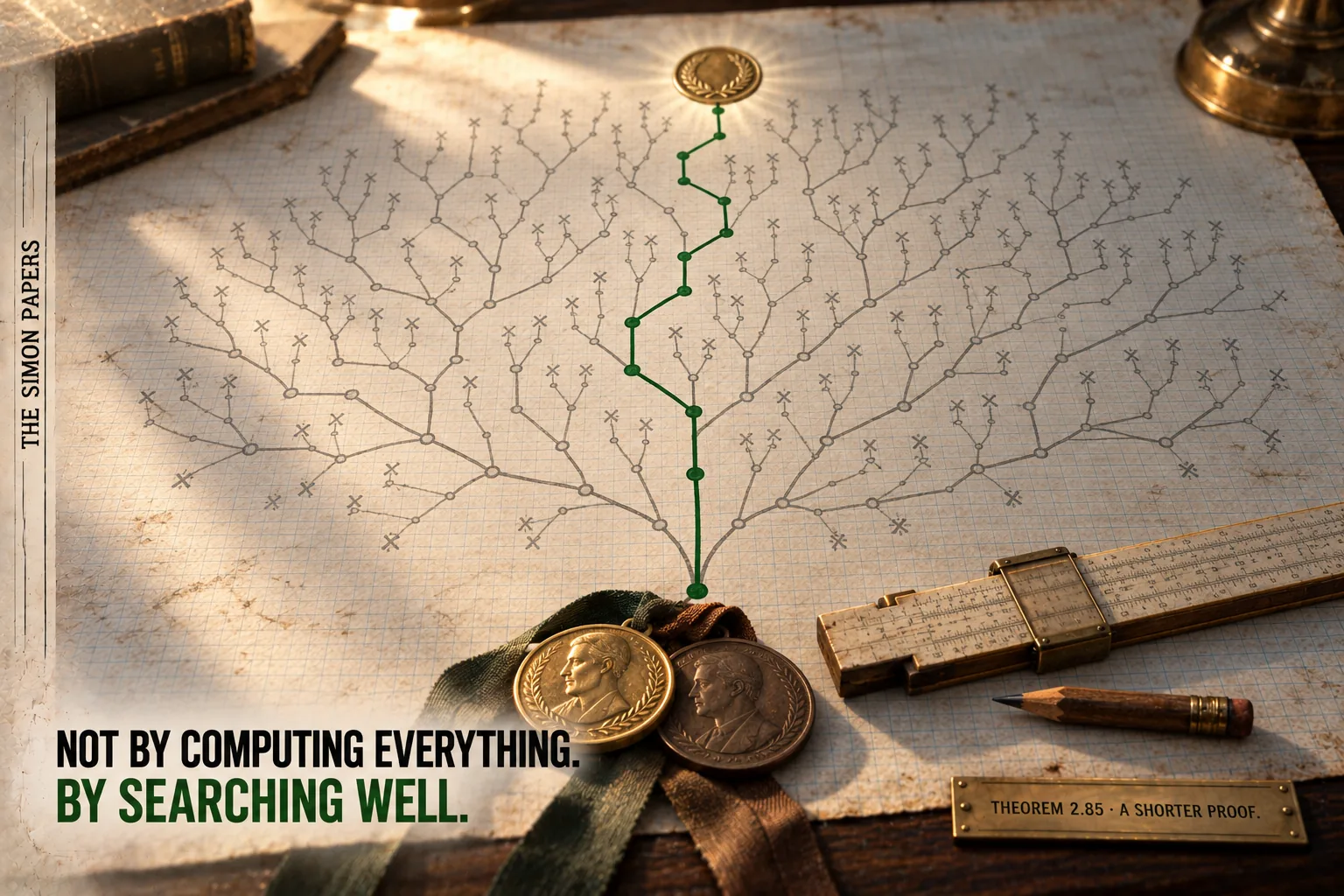
In January 1956, an economist walked into a Carnegie Tech classroom and announced: Over Christmas, Al Newell and I invented a thinking machine. It was barely an exaggeration — the Logic Theorist, hand-simulated with index cards before it ever ran on hardware, became the first AI program. Its design principle was Simon's decision science turned into code: intelligence is smart search under constraints, not exhaustive computation.
- Logic Theorist (1956) — proved 38 of Principia Mathematica's first 52 theorems by heuristic search; its improved proof of Theorem 2.85 delighted Bertrand Russell and was rejected by the Journal of Symbolic Logic.
- General Problem Solver (1957–59) — introduced means-ends analysis, still recognizable in AI planning.
- The 1976 hypothesis — a physical symbol system has the necessary and sufficient means for general intelligent action: the founding claim of symbolic AI.
- Nobel + Turing — Simon remains one of the only people to hold both.
- The honest scorecard: deep learning broke the symbolic program's strong claim — and vindicated the deeper one, that intelligence is bounded, heuristic and recognition-based.
One man proved you can't make perfect decisions, told you what to do instead, and then built the first artificial intelligence on the same principle. Three connected pieces on Herbert Simon: the theory, the practice, and the machines.
- 1.Herbert Simon Won a Nobel Prize for Proving You Can't Make Perfect Decisions. Here's What to Do Instead.
- 2.Stop Searching for the Perfect Decision. Nobel Prize Research Says "Good Enough" Wins.
- 3.The Decision Theorist Who Co-Founded AI: How Herbert Simon's Christmas Thinking Machine Changed EverythingYou are here
January 1956. Carnegie Institute of Technology. A 39-year-old professor — a political scientist by training, already famous among economists for arguing that nobody optimizes anything — opens his mathematical modeling class with a sentence that had no business being true: Over Christmas, Al Newell and I invented a thinking machine.
The machine barely existed as a machine. Over the holiday break, Simon, Allen Newell and programmer Cliff Shaw had worked out the Logic Theorist — and before it ever ran on a computer, they hand-simulated it: the program's subroutines written on 3×5 index cards, dealt to Simon's family and students, each human executing one component's rules. A thinking machine, first run on people. By that summer it ran on hardware and was presented at the Dartmouth workshop — the meeting that gave artificial intelligence its name.
The story usually gets filed under computing history. It belongs equally to decision science — because the Logic Theorist was not a faster calculator. It was Simon's theory of bounded rationality implemented in code: if human intelligence works through shortcuts and selective search rather than exhaustive computation, then a machine using shortcuts and selective search can be intelligent too. Everything Simon built in AI follows from that one move.
Over Christmas,
Al Newell and I invented a thinking machine.
— Herbert A. Simon, to his class at Carnegie Tech, January 1956 (Models of My Life, 1991)
The Resume That Shouldn't Exist
Herbert Alexander Simon (1916–2001) took a PhD in political science (Chicago, 1943), wrote Administrative Behavior (1947) on how organizations actually decide, and spent five decades at Carnegie Mellon working across economics, psychology, computer science and philosophy of science. The awards tell the range: the 1975 ACM Turing Award with Allen Newell, for basic contributions to artificial intelligence and the psychology of human cognition; the 1978 Nobel Memorial Prize in Economics, for pioneering research into decision-making in economic organizations; the 1986 U.S. National Medal of Science. He remains one of the only people ever to hold both the Turing and the Nobel — for what he insisted was a single research program.
That program: understand intelligence as it actually operates — in people, in organizations, in machines — under real limits of information, computation and time. The theory half retired the perfectly rational economic man. The engineering half asked the obvious next question: if intelligence is bounded search, can we build it?
The Logic Theorist: Proof by Shortcut
The Logic Theorist attacked the theorems of Whitehead and Russell's Principia Mathematica — the early-century monument of formal logic — and proved 38 of the first 52 in chapter two. The method was the message: instead of grinding through every derivation (brute force that the era's hardware could not have survived), it used heuristics to select promising paths, worked backwards from goals, and stopped when it had a valid proof rather than the best one. Heuristic search and satisficing — Simon's decision science, running at machine speed.
For Theorem 2.85 it found a proof more elegant than the original. Bertrand Russell, then in his eighties, responded with delight when Simon wrote to him about it. The Journal of Symbolic Logic was harder to charm: it declined to publish the result, judging a new proof of an elementary theorem unworthy of publication — apparently without registering the detail that one of the authors was a computer program.
The General Problem Solver: Strategy Without Subject Matter
The successor program was more ambitious in exactly the direction you'd expect from the author of Administrative Behavior. The General Problem Solver — first version running in 1957, the report published in 1959 by Newell, Shaw and Simon — introduced means-ends analysis: measure the difference between the current state and the goal state, find an operator that reduces that difference, apply it, repeat. Navigation by gap-closing.
GPS's real innovation was architectural: it separated the problem-solving strategy from the problem's content. The same engine could attack puzzles, proofs or plans, given a description of states and operators. That separation — general method, pluggable domain — became a founding design principle of AI, and means-ends analysis is still recognizable inside modern planning systems.
The Big Claim: Symbols and Search
In their 1976 Turing Award lecture, Computer Science as Empirical Inquiry, Newell and Simon distilled two decades of work into the field's most famous hypothesis: a physical symbol system has the necessary and sufficient means for general intelligent action. Minds manipulate symbols; computers manipulate symbols; therefore, suitably programmed, computers can act intelligently — and nothing beyond symbol manipulation is required. This became the charter of what is now called symbolic AI, or GOFAI.
They also made predictions with dates on them, and the dates were wrong. In their 1958 Operations Research paper, Simon and Newell predicted that within ten years a digital computer would be the world's chess champion, unless the rules barred it from competition. The world champion fell to a computer in 1997 — 39 years after the prediction, not ten. Worth noting what kind of wrong that is: the mechanism (heuristic search over a space no machine could exhaust) was exactly right; the timeline was off by a generation. Both facts belong in the record.
Didn't Deep Learning Prove Simon Wrong?
Here is the objection a 2026 reader arrives with: modern AI is not symbolic. Neural networks learn patterns from data; nobody hand-writes the heuristics; and Richard Sutton's influential 2019 essay The Bitter Lesson reads like a verdict against Simon's whole approach — seventy years of AI history showing that general methods which scale with computation beat systems built on human-crafted domain knowledge.
The objection lands — partially. The strong symbolic claim did not survive: sufficient, it turned out, symbols were not, and the hand-built knowledge programs of the 1970s and 80s plateaued exactly as Sutton describes. An honest account of Simon says so plainly. But read The Bitter Lesson's own conclusion: the two method families that scale are search and learning. Heuristic search is Simon and Newell's contribution to the field, alive today from game-tree search to the deliberate reasoning loops of current AI systems. And what deep networks do — recognize patterns accumulated from massive experience — is uncannily close to Simon's definition of expertise. Reinforcement learning, whose founders Andrew Barto and Richard Sutton received the 2024 Turing Award (announced March 2025), is selective trial-and-error search under computational bounds — a research program Simon's would have recognized as kin.
So the scorecard is split, and the split is instructive: the architecture he bet on lost; the theory of intelligence underneath it won. Machines did not become intelligent by computing exhaustively. They became intelligent by bounded, heuristic, recognition-driven search — which is the claim Simon staked his career on. Recent work closes the loop from the other side: 2025 studies find large language models exhibiting bounded rationality themselves, deviating from game-theoretic optimality in human-like ways, while satisficing has been engineered into model alignment as aspiration-level constraints.
Intuition is nothing more
and nothing less than recognition.
— Herbert A. Simon (1992), as quoted in Kahneman & Klein, American Psychologist (2009)
Simon's Fingerprints on Modern AI
Heuristic search
From A* pathfinding to game-tree search to modern deliberate-reasoning loops: no serious system searches exhaustively. Selective search under a budget is the Logic Theorist's method, industrialized.
Satisficing
Training stops at acceptable loss, not provable optimum; real-time systems act on the best answer available by the deadline. Good enough under constraints is an engineering principle now.
Intuition as recognition
Simon defined expert intuition as recognition — the situation provides a cue, the cue retrieves stored patterns. It is hard to write a better one-line description of what a trained neural network does.
Bounded machines, measured
2025 research treats LLMs as boundedly rational agents outright — measuring their human-like heuristics (arXiv:2506.09390) and aligning them via satisficing thresholds (arXiv:2505.23729).
Timeline: A Polymath's Life
What to Take From Simon Into the AI Decade
Four working principles for anyone building with, or deciding alongside, bounded machines:
1. Budget the computation, don't deny it
Neither your team nor your model optimizes. Design for reliable good-enough under an explicit budget rather than occasional perfect — for prompts and processes alike.
2. Make the reasoning inspectable
The Logic Theorist's proofs could be read and checked. Hold modern workflows to the founder's standard: a conclusion whose reasoning can't be examined can't be trusted or improved.
3. Split the labor by strength
Machines search broadly and fast; humans judge stakes, values and reversibility. Design the handoff explicitly instead of letting whoever answered last decide.
4. Archive decisions as training data for the organization
Simon called organizational memory an extension of bounded minds. A searchable record of past decisions and their reasoning is exactly that — for the humans and for the tools.
The diagnostic question
When your team uses AI in a decision, can anyone show the reasoning afterwards — or only the answer?
Where Argumentree Fits
Simon treated human and machine intelligence as one subject: bounded agents searching under constraints. Argumentree is built on the same premise. Human arguments and AI-extracted arguments land in one inspectable structure — the tree — where reasoning is visible, ratings direct scarce attention to the strongest points, and the record persists as organizational memory.
For teams whose AI use must be auditable, the sister product AIAgentree extends the same idea to machine reasoning itself — tracing how an AI system reached its conclusion, in the structure Simon would have asked to see.
The Long Bet
Simon's chess clock ran four times over, the symbolic architecture gave way, and the field he co-founded now runs on methods he didn't build. Judged as prophecy, a mixed record. Judged as science, something rarer: the core claim — that intelligence, wherever it occurs, is bounded search guided by recognition — has outlived every architecture used to test it, his own included.
Which is why the classroom sentence still lands seventy years later. He wasn't announcing a gadget. He was announcing that thinking had become an engineering subject — for minds, for organizations, and now for machines.
Intelligence was never perfect computation. It is smart search under constraints — in minds, in organizations, and in machines.
Reasoning You Can Inspect
Human and AI arguments in one visible structure, with a permanent record — Simon's standard, applied to your decisions.
Sources & Further Reading
- Simon, H. A. (1991). Models of My Life. New York: Basic BooksSimon's autobiography — source of the January 1956 classroom announcement and the Logic Theorist's origins.
- Newell, A. & Simon, H. A. (1976). Computer Science as Empirical Inquiry: Symbols and Search. Communications of the ACM, 19(3), 113–126The Turing Award lecture; source of the Physical Symbol System Hypothesis, quoted verbatim.
- Simon, H. A. & Newell, A. (1958). Heuristic Problem Solving: The Next Advance in Operations Research. Operations Research, 6(1), 1–10The ten-years predictions, including the chess-champion claim discussed in the text.
- Kahneman, D. & Klein, G. (2009). Conditions for Intuitive Expertise: A Failure to Disagree. American Psychologist, 64(6), 515–526Quotes Simon (1992) on intuition as recognition (p. 155) — the passage used in the pull quote.
- A. M. Turing Award 1975 — Allen Newell and Herbert A. Simon, ACMThe award record for the basic contributions to artificial intelligence and the psychology of human cognition.
- Sutton, R. S. (2019). The Bitter LessonThe essay behind the counterargument section: general methods that scale — search and learning — beat built-in knowledge.
- ACM Announces 2024 A.M. Turing Award: Andrew G. Barto and Richard S. Sutton (March 2025)The reinforcement-learning Turing Award referenced in the counterargument resolution.
- Beyond Nash Equilibrium: Bounded Rationality of LLMs and Humans in Strategic Decision-Making (2025). arXiv:2506.093902025 evidence that large language models exhibit human-like bounded rationality.
Frequently Asked Questions
What was Herbert Simon's contribution to artificial intelligence?
With Allen Newell and Cliff Shaw, Simon created the Logic Theorist (1956) — widely considered the first AI program — which proved theorems from Principia Mathematica using heuristic search rather than brute force. He and Newell then built the General Problem Solver (first version 1957, report 1959), introducing means-ends analysis, and stated the Physical Symbol System Hypothesis in their 1976 Turing lecture. He received the 1975 ACM Turing Award, with Newell, for these contributions.
What is the Logic Theorist and why does it matter?
The Logic Theorist was the first program designed to perform humanlike reasoning. It proved 38 of the first 52 theorems in chapter two of Whitehead and Russell's Principia Mathematica and found a more elegant proof of Theorem 2.85 — which delighted Bertrand Russell, though the Journal of Symbolic Logic declined to publish it, judging a new proof of an elementary theorem unworthy. It mattered because it demonstrated machine intelligence via heuristic search — shortcuts, not exhaustive computation.
How did bounded rationality shape early AI?
Directly. Simon's decision research showed humans reason through heuristics and satisficing — selective search that stops at good enough. That meant machine intelligence did not require infinite computing power: a program using well-chosen shortcuts could behave intelligently on 1950s hardware. Heuristic search became the founding method of AI, and it descends straight from Simon's theory of how bounded minds decide.
What is the Physical Symbol System Hypothesis?
Stated by Newell and Simon in their 1976 Turing Award lecture: a physical symbol system has the necessary and sufficient means for general intelligent action. It claims intelligence consists in the manipulation of symbol structures — the founding thesis of symbolic AI. Modern machine learning has overturned the sufficiency claim in practice, though hybrid neurosymbolic approaches keep parts of the program alive.
Did deep learning prove Simon wrong?
It broke his architecture and vindicated his theory. Hand-built symbolic knowledge systems plateaued, as Richard Sutton's Bitter Lesson (2019) recounts — but the methods that won, search and learning, implement Simon's deeper claim that intelligence is bounded, heuristic and recognition-based. His 1992 definition — intuition is nothing more and nothing less than recognition — describes trained neural networks remarkably well, and 2025 research finds LLMs exhibiting bounded rationality themselves.
Did Herbert Simon really win both the Nobel Prize and the Turing Award?
Yes — the 1975 ACM Turing Award (jointly with Allen Newell) for contributions to artificial intelligence and the psychology of human cognition, and the 1978 Nobel Memorial Prize in Economic Sciences for his research on decision-making in economic organizations. He also received the U.S. National Medal of Science in 1986. He treated all of it as one research program: intelligence under constraints.
What did Simon predict about computer chess?
In a 1958 Operations Research paper, Simon and Newell predicted that within ten years a digital computer would be the world's chess champion, unless barred from competition. It took 39 years — the world champion lost a match to a computer in 1997. The mechanism they predicted, heuristic search over an inexhaustible game tree, is essentially how it happened; the timeline was off by a generation.
Put the Reasoning Where Everyone Can See It
Argument trees for human and AI reasoning alike — inspectable, rated, and permanently on the record.
About Argumentree Team
Decision Science
The Argumentree team is building the collaborative decision-making platform Argumentree. Our mission is to transform how organizations make, document, and learn from decisions.
Related Articles
Was the Physical Symbol System Hypothesis wrong — or early?
Stake out a position and defend it, argument by argument, on the Argumentree forum.
Join the Discussion