
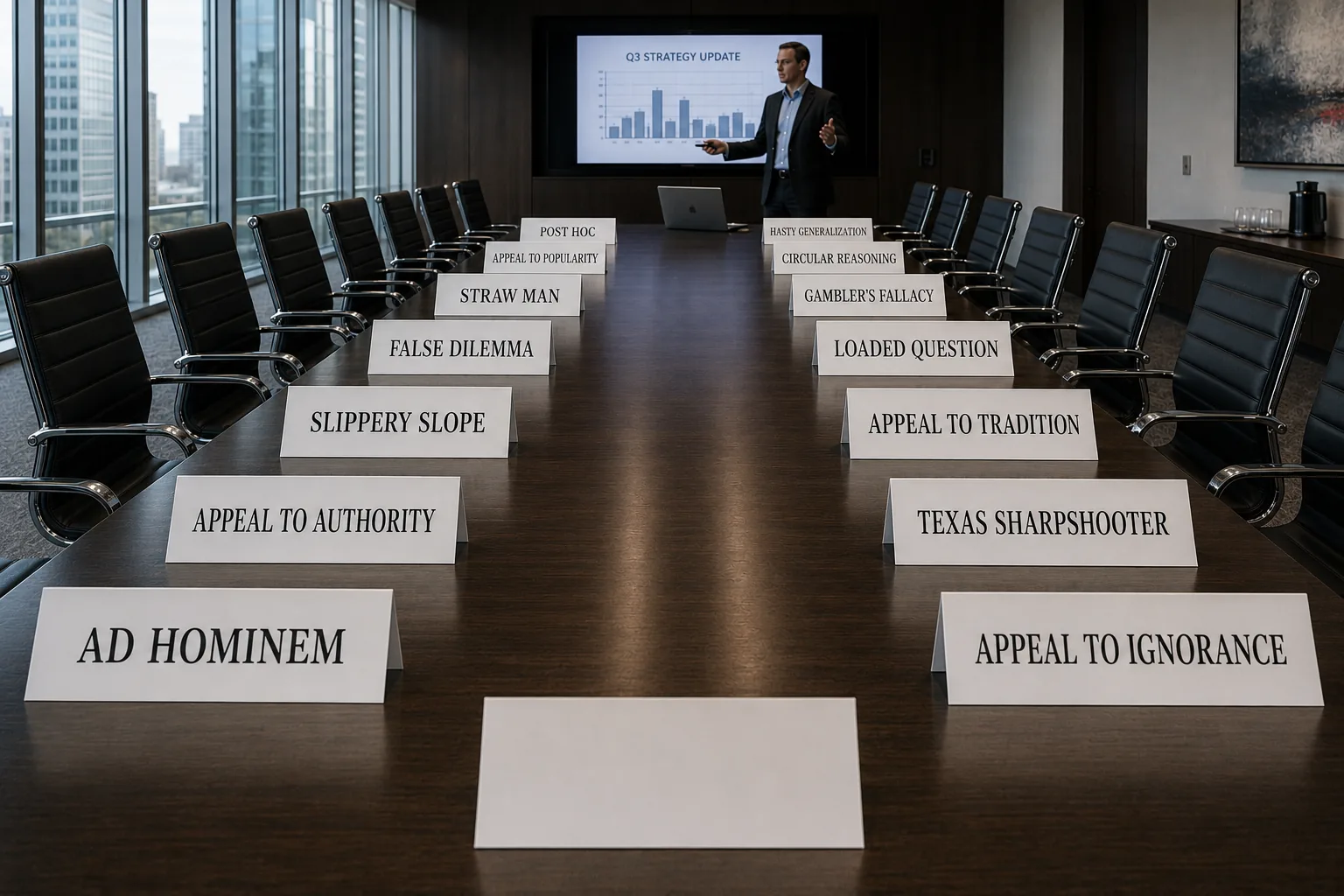
Logical Fallacies in the Boardroom: The 14-Pattern Field Guide, How to Counter Them Professionally, and Why Fallacy-Spotting Can Backfire
A logical fallacy is a reasoning pattern that appears valid but is structurally unreliable — the conclusion may happen to be true, but the reasoning that produced it will regularly fail. The fourteen most common in business settings: ad hominem (attacking the person), appeal to authority (prestige substituting for evidence), slippery slope (unjustified causal chains), false dilemma (artificial binaries), straw man (attacking a distorted version of the claim), appeal to popularity, post hoc (sequence mistaken for causation), hasty generalization (unrepresentative samples), circular reasoning, bandwagon, gambler's fallacy, and loaded question. The professional counter-technique is to name the pattern, never the person, and redirect to evidence with a question. Fallacies differ from cognitive biases: biases are psychological tendencies of the thinker; fallacies are structural defects of the argument. The catalog goes back to Aristotle's Sophistical Refutations, the first systematic list of fallacious argument forms. One caution has its own name — the fallacy fallacy: a fallaciously argued conclusion is not thereby false, so fallacy-spotting must open examination, not end it. Current AI research (NAACL Findings 2025) finds that large language models both commit logical fallacies and struggle to detect them reliably, and that detection improves with counterargument- and explanation-aware prompting — the same structural move that argument mapping enforces for human discussions: every claim carries evidence, and the counter-case is required.
Last quarter, someone in one of your meetings argued fallaciously — a reasoning pattern that sounds valid and isn't — and it probably went unchallenged, because the patterns exploit the same shortcuts that usually serve us well. This is the field guide: fourteen patterns, what each sounds like, and the professional counter that names the reasoning instead of attacking the person.
- Fallacy ≠ bias: biases are tendencies in the thinker; fallacies are structural defects in the argument. Different problem, different fix — the bias playbook is in the companion piece.
- The counter-technique is a question, not a verdict: restate the claim, name the gap, ask for the missing evidence — pattern, never person.
- Mind the fallacy fallacy: a badly argued conclusion isn't automatically false. Spotting a fallacy opens the examination; it doesn't win it.
- The lineage is 2,300 years old — Aristotle's Sophistical Refutations was the first catalog — and the 2025 twist is that LLMs both commit these patterns and struggle to detect them.
- The systematic prevention is structural: when every argument must carry evidence and face its counter-case, most fallacies fail to compile.
Last quarter, someone in one of your meetings committed a logical fallacy. It shaped the decision. Nobody called it out — and there is a decent chance you agreed with it, because the conclusion happened to sound right.
That is no indictment of anyone's intelligence. Fallacies persuade precisely because they ride the shortcuts that usually work: credentials usually do track expertise, which is why the appeal to authority lands; deterioration sometimes is gradual, which is why the slippery slope resonates. The problem is not that these patterns are always wrong — it is that they are systematically unreliable. Accept them at face value and you have accepted a reasoning process that will keep producing wrong conclusions, even if today's happened to be true.
This is the working field guide: what each of the fourteen most common boardroom fallacies sounds like, how to counter it without becoming the office pedant, where fallacy-spotting itself goes wrong — and why the 2,300-year-old catalog is suddenly current again now that AI systems are writing first drafts of business arguments.
The conclusion might be right.
The reasoning will still fail you next time.
Why fallacies matter even when they land on the truth
Fallacy vs. Bias — and Why the Difference Matters
This guide's companion piece covers the cognitive biases that damage strategy, and the two lists are often blurred together. Keep them apart, because the fixes differ. A bias is a tendency in the thinker — confirmation bias will quietly select your evidence whether or not any argument is ever spoken aloud. A fallacy is a defect in the argument itself — a structure that doesn't support its conclusion regardless of who utters it or why. Biases call for process design; fallacies can be caught in the moment, by anyone who knows the patterns, because they are visible in the words.
The catalog is old. Aristotle's Sophistical Refutations — the closing work of the Organon — was the first systematic inventory of argument forms that appear sound and are not, and most of its entries map straight onto modern meeting behavior. (His logic's whole origin story is told in our Roots of Reasoning series.) What is new is the volume: decisions move faster, documents are increasingly machine-drafted, and a confident paragraph with a broken inference inside it has never been cheaper to produce.
The Fourteen Patterns: A Boardroom Reference Guide
Each entry: what the pattern sounds like in a meeting, the shape of the error, and a counter you can actually say out loud. The quotes are illustrative dialogue, not transcripts.
Ad hominem
“He has no finance background, so his numbers are suspect.”
The error
The person is attacked; the argument goes unexamined.
The counter
“Let's evaluate the claim on its evidence, separately from who made it.”
Appeal to authority
“The CEO thinks we should do this, so we should.”
The error
Prestige substitutes for evidence.
The counter
“What supports this position, independent of who endorses it?”
Slippery slope
“If we allow flexible hours, soon nobody will keep any schedule.”
The error
A causal chain is asserted without evidence for its links.
The counter
“What actually links these steps — and what would stop the slide at step one?”
False dilemma
“Either we cut marketing or we miss our targets.”
The error
Two options presented as if they were the only ones.
The counter
“What other options exist that this framing leaves out?”
Straw man
“So you're saying we should abandon quality control entirely?”
The error
A distorted version of the claim is attacked instead of the claim.
The counter
“Is that what was proposed? Let's return to the exact claim that was made.”
Appeal to popularity (bandwagon)
“All our competitors are doing it. Everyone is integrating AI right now — we need to move immediately.”
The error
One fallacy in two business dresses: consensus substitutes for analysis, or momentum does. Both are argumentum ad populum — the first appeals to who agrees, the second to how fast they are arriving.
The counter
“What do our own economics show, independent of what everyone else is doing — and which specific problem does this solve for us?”
Post hoc
“Sales rose after the redesign, so the redesign drove growth.”
The error
Sequence mistaken for causation.
The counter
“What else changed in the same period — and what would isolate this variable?”
Hasty generalization
“Three customers complained, so the feature is broken.”
The error
An unrepresentative sample generalized to the whole.
The counter
“What does the full dataset show? How representative is this sample?”
Circular reasoning
“We need this investment because it's a necessary investment.”
The error
The conclusion restated as its own premise.
The counter
“What is the underlying reason that doesn't restate the conclusion?”
Gambler's fallacy
“Three bad quarters — we're overdue for a good one.”
The error
Independent outcomes treated as self-correcting.
The counter
“What evidence says the underlying conditions have changed?”
Loaded question
“When did you stop caring about product quality?”
The error
An assumption smuggled inside the question itself.
The counter
“Let's separate the assumption from the question — is the assumption accurate?”
Appeal to tradition
“We've always done it this way.”
The error
Longevity is treated as evidence. That a practice survived says nothing about whether the conditions that justified it still hold.
The counter
“What made this the right call originally — and which of those conditions are still true today?”
Texas sharpshooter
“Look at the pattern — every one of our wins came after a Q3 launch.”
The error
The target is drawn around the data after the fact. The cases that miss sit outside the circle and go uncounted.
The counter
“What did we predict before we looked? And how many launches do not fit this pattern?”
Appeal to ignorance
“Nobody has shown that it will not work.”
The error
Absence of disproof is treated as proof, which quietly reverses who owes the evidence.
The counter
“What would we expect to see if this did work — and have we actually looked for it?”
Two habits make the guide usable. First, listen for the signature phrases — pattern recognition beats definition recall in a live meeting. Second, deliver every counter as a genuine question, because sometimes the answer exists: the authority does have evidence, the slope does have a documented mechanism. The counter's job is to ask the argument to show its work. Four of these have a full page of their own elsewhere on the site, because they show up as group failures and as deliberate tactics too, not only as reasoning errors: the false dichotomy, the appeal to authority, the straw man and the loaded question.
Name the pattern.
Never the person.
The professional counter-technique, compressed
The Trap in the Toolkit: Fallacy-Spotting as a Weapon
Before you deploy any of this, the honest caution: fallacy-naming has its own failure mode, common enough to have a name of its own. The fallacy fallacy is concluding that because an argument is fallacious, its conclusion is false. It isn't — a true claim can be argued badly, and dismissing it on style hands you a wrong decision with extra self-satisfaction.
There is also a social version: wielded as a gotcha vocabulary, fallacy-spotting becomes a status game that shuts down exactly the open argumentation it was meant to protect — and calling out that's ad hominem! in a dismissive tone is, itself, adjacent to the pattern it names. The test for whether you are using the toolkit well is simple: does your intervention reopen the examination of evidence, or end it? Name the pattern, never the person, and always in the form of a request for the missing support.
The 2025 Twist: Machines Commit Them Too
Fallacy detection has become an active AI research problem, for a self-referential reason: language models frequently generate fallacious reasoning, and they are unreliable at catching it. Work presented at NAACL Findings 2025 shows detection remains genuinely hard for state-of-the-art models — and improves substantially when models are prompted to generate counterarguments, explanations and goals for a claim before judging it.
Read that finding twice, because it is this article's thesis wearing a lab coat: the reliable way to expose a broken argument — for humans and machines alike — is to force the counter-case and the evidence into the open, rather than trusting anyone's gut verdict on how convincing the argument sounds. As machine-drafted proposals become normal, the meeting that requires arguments to show their structure is the meeting that catches what the drafting model missed.
The Systematic Prevention: Make Evidence Structural
Spot-checking fallacies one meeting at a time is vigilance work, and vigilance fatigues. The durable fix mirrors the one for biases: change the format decisions travel in. When a proposal must be laid out as a structured argument — claims, evidence attached to each, counterarguments given standing — most of the fourteen patterns simply fail to compile. An appeal to authority collapses into what evidence supports this, beyond who said it? A false dilemma is exposed by the visible absence of the third option. Circular reasoning has nowhere to hide when the premise and conclusion occupy separate, labeled nodes. The procedure behind that format is older than it looks: in a properly structured debate, argumentation theory says, a fallacy is simply a broken rule of the discussion.
That is also where the fallacy fallacy gets handled correctly: a badly supported claim in an argument map isn't deleted — it sits there, visibly under-evidenced, waiting for better support that may yet arrive. The structure separates the argument was weak from the claim is false, which is exactly the distinction the toolkit's misusers blur.
The diagnostic question
In your last contested decision, was the winning argument the one with the best evidence — or the one with the best-positioned advocate?
Where Argumentree Fits
Argumentree turns the prevention section into the default. Every argument in a tree carries its evidence; every claim can be attacked or supported on its logical merits; and the AI argument check screens each submission for duplication, toxicity and — precisely to the point — whether it logically relates to the parent it claims to address. Rank has no field in the data model: the CEO's argument and the analyst's render identically and are rated on substance.
The result is a discussion in which the fourteen patterns are not policed by the bravest person in the room — they are filtered by the format itself.
The Skill Worth Practicing
You will not memorize fourteen definitions, and you don't need to. Practice two moves: hear the signature phrase, and answer it with a question that requests the missing evidence. That pair covers most of the catalog, keeps you on the right side of the fallacy fallacy, and — unlike the gotcha vocabulary — makes meetings better instead of quieter.
Aristotle built the catalog because sophists were winning arguments they should have lost. Twenty-three centuries later, the sophists include software. The counter has not changed: ask the argument to show its work. Two of these fallacies are common enough in decision meetings to have earned trap pages of their own: the False Dichotomy Trap and the Appeal to Authority Trap.
The conclusion might be right. The reasoning will still fail you next time.
Ask Every Argument to Show Its Work
Evidence-carrying arguments, required counter-cases, and an AI check on logical relation — the format that filters fallacies by default.
Sources & Further Reading
- Aristotle. Sophistical Refutations (De Sophisticis Elenchis)The first systematic catalog of fallacious argument forms — the lineage behind the modern list.
- Hansen, H. (2020). Fallacies. The Stanford Encyclopedia of PhilosophyThe scholarly reference on fallacy theory, from Aristotle to modern argumentation theory — including the fallacy fallacy caution.
- Hamblin, C. L. (1970). Fallacies. MethuenThe classic modern treatment that rebuilt fallacy theory as part of dialectic — arguments as moves in a dialogue.
- Large Language Models Are Better Logical Fallacy Reasoners with Counterargument, Explanation, and Goal-Aware Prompt Formulation. Findings of NAACL 2025The 2025 finding used in the AI section: fallacy detection is hard for LLMs and improves with counterargument- and explanation-aware prompting.
- Nemeth, C., Brown, K. & Rogers, J. (2001). Devil's advocate versus authentic dissent. European Journal of Social Psychology, 31(6), 707–720Why staged disagreement underperforms genuine dissent — context for the counter-technique's emphasis on real questions.
Frequently Asked Questions
What is a logical fallacy in a business context?
A logical fallacy is a reasoning pattern that appears valid but is structurally unreliable: the conclusion may happen to be true, but the structure connecting premises to conclusion doesn't actually support it. In business, fallacies are dangerous because they produce confident, persuasive-sounding arguments — an appeal to authority or a false dilemma can carry a meeting — while the underlying reasoning would fail on any comparable question.
How is a logical fallacy different from a cognitive bias?
A bias is a psychological tendency in the thinker — confirmation bias shapes what evidence you notice before any argument is voiced. A fallacy is a structural defect in an argument — visible in the words, catchable by anyone who knows the pattern. Biases are addressed with process design (premortems, protected dissent); fallacies can be countered in the moment by asking the argument for its missing support.
How do you politely call out a logical fallacy in a meeting?
Name the pattern, never the person, and phrase the counter as a genuine question. Restate the claim, identify the gap, and ask for the missing evidence: for an appeal to authority, ask what supports the position independent of who endorses it; for a false dilemma, ask which options the framing leaves out. Avoid the word fallacy in the room — the question form does the work without turning the exchange adversarial.
What is the fallacy fallacy?
The fallacy fallacy is concluding that a claim is false because it was argued fallaciously. A true conclusion can be badly defended, so spotting a fallacy licenses you to ask for better support — not to dismiss the claim. Practically: treat a detected fallacy as an under-evidenced argument awaiting support, not as a refutation.
What is the most common logical fallacy in corporate settings?
Appeal to authority — the leader thinks X, the famous firm recommends Y — because hierarchies price challenges to authority-backed claims. Close behind is the false dilemma, which compresses a rich option space into a binary that makes the preferred choice look inevitable. Both are countered the same way: ask what evidence supports the position on its own, and what options the framing omitted.
Can AI detect logical fallacies?
Imperfectly — and it also commits them. Research presented at NAACL Findings 2025 shows fallacy detection remains difficult for state-of-the-art language models, improving significantly when models are prompted to produce counterarguments and explanations before judging a claim. The practical implication for teams: machine-drafted arguments need the same structural scrutiny as human ones — evidence attached, counter-case required.
How does structured argumentation prevent fallacies?
By making evidence a format requirement rather than a rhetorical option. In an argument map, every claim carries its supporting evidence, counterarguments have equal standing, and premises and conclusions occupy separate, labeled positions — so appeals to authority, circular reasoning and false dilemmas become structurally visible. The pattern doesn't need to be named; the empty evidence field names it.
Filter the Patterns by Format, Not Bravery
Structured arguments with required evidence and standing counter-cases — the boardroom fallacy filter that doesn't depend on who speaks up.
About Argumentree Team
Applied Logic
The Argumentree team is building the collaborative decision-making platform Argumentree. Our mission is to transform how organizations make, document, and learn from decisions.
Related Articles
12 Cognitive Biases That Destroy Corporate Strategy
Aristotle and the Origins of Western Logic
The Steel Man: Why the Best Negotiators Argue Against Themselves First
What Is Argumentation Theory?
Debate Foul Play: the field guide
The adversarial cousins of these fallacies — Gish Gallop, whataboutism, sealioning and two dozen more, each with its structural counter.
The Red Herring
The relevance family’s most common member in the wild — named after a hound-training practice that never existed.
Is naming fallacies in meetings helpful — or pedantry?
Take a side and argue it properly on the Argumentree forum.
Join the Discussion