
Amazon Banned PowerPoint, Google Writes Design Docs, Bridgewater Records Everything: The Written-First Meeting, and How to Implement It
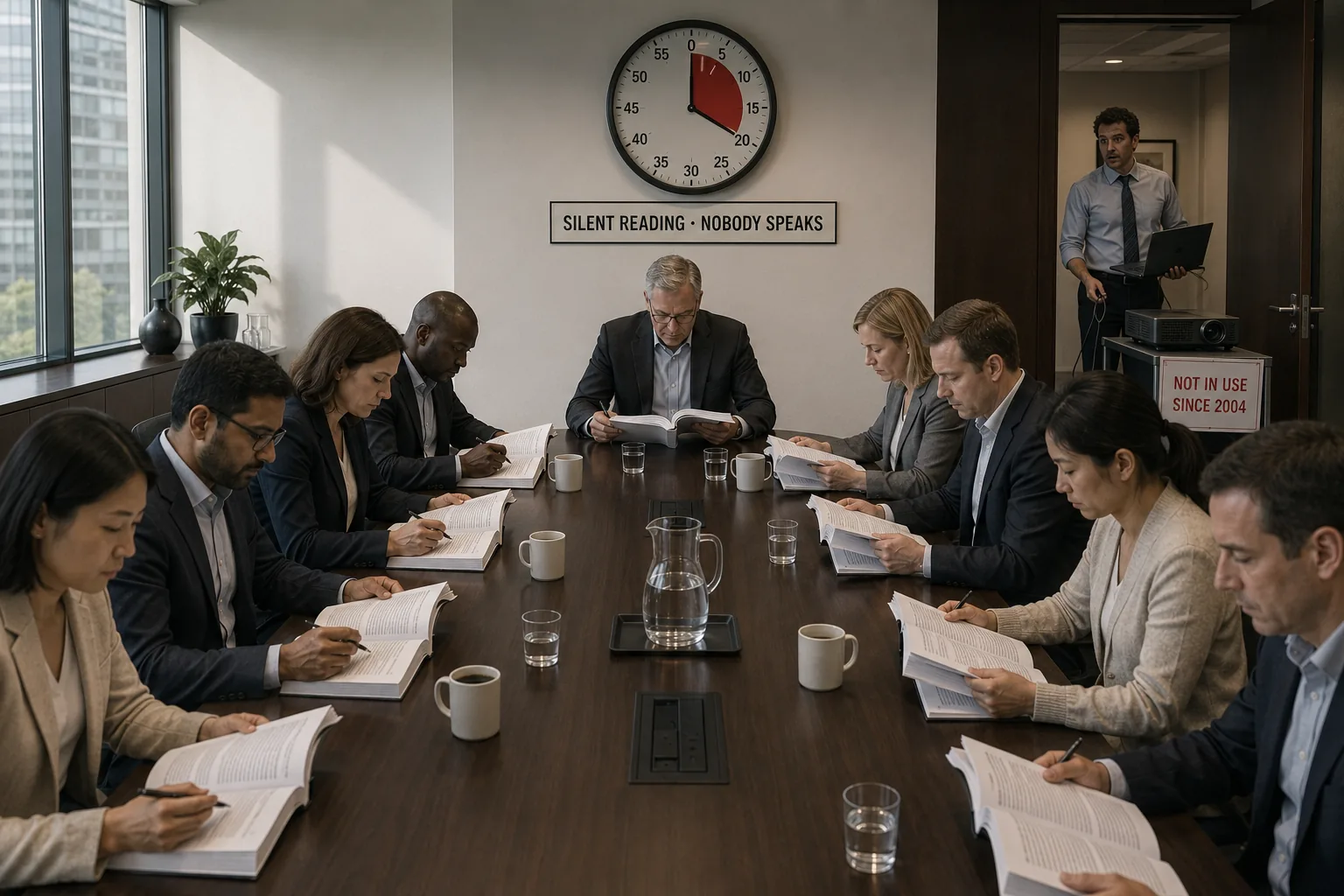
In 2003, the Columbia Accident Investigation Board named PowerPoint in a shuttle disaster: 'The Board views the endemic use of PowerPoint briefing slides instead of technical papers as an illustration of the problematic methods of technical communication at NASA.' A year later, on June 9, 2004, Jeff Bezos emailed Amazon's senior team banning PowerPoint from its meetings — the practice he later called probably the smartest thing we ever did. Amazon replaced slides with six-page narrative memos read silently at the start of each meeting ('study hall'); Bezos's 2004 email argued that the narrative structure of a good memo forces better thought and better understanding of what's more important than what, and how things are related. The same written-first pattern appears independently across companies known for decision quality: Google's design docs (documented in Software Engineering at Google) require written problem statements and alternatives before major technical work; OKRs force written success criteria; Bridgewater under Ray Dalio records meetings and documents disagreements as part of an idea meritocracy; McKinsey writing runs on Barbara Minto's Pyramid Principle — conclusion first, support in order of importance. The real meeting statistics are Perlow, Hadley and Eun's HBR study (2017): among 182 senior managers surveyed, 65% said meetings keep them from completing their own work and 71% called meetings unproductive and inefficient. Implementation for any team: reform one high-stakes meeting; require a written brief 48 hours ahead (what we're deciding, options, recommendation, why); open with silent reading; archive the brief with the decision. The counterargument — writing slows us down — is answered by Bezos's own speed principles (decide with ~70% of the information; disagree and commit): the writing rule governs how reasoning is presented, not how long decisions take.
In 2003, the board investigating the Columbia disaster blamed, among other things, a PowerPoint slide — 'the endemic use of PowerPoint briefing slides instead of technical papers,' in the report's words. A year later Jeff Bezos banned slides from Amazon's meetings and replaced them with six-page narrative memos read in silence. The pattern generalizes: the companies most respected for decision quality independently converged on the same rule — structured writing before the meeting, not presentation during it.
- The real numbers: in HBR's 2017 survey of 182 senior managers, 65% said meetings keep them from completing their own work; 71% called meetings unproductive (Perlow, Hadley & Eun).
- Amazon's mechanism: the six-pager plus 'study hall' silent reading — equal information before anyone speaks, reasoning on the record forever.
- The convergent evolution: Google design docs, OKRs, Bridgewater's recorded idea meritocracy, McKinsey's Pyramid Principle — different formats, one principle.
- Speed is not the price: Bezos paired the writing rule with decide-at-70%-information and disagree-and-commit — the memo governs how reasoning is presented, not how long decisions take.
- Any team can start: one meeting, one written brief 48 hours ahead, ten minutes of silent reading, and the brief archived with the decision.
On January 21, 2003, while the shuttle Columbia was still in orbit, engineers briefed NASA managers on the foam strike its wing had taken at launch. The analysis was real; the format was a PowerPoint slide so crammed with nested bullets and abbreviations that its most alarming finding was nearly invisible. The investigation board later reproduced that slide in its report and remarked that it was easy to understand how a senior manager might read it and not realize it addressed a life-threatening situation — then issued the sentence that made presentation software part of an accident record: the Board views the endemic use of PowerPoint briefing slides instead of technical papers as an illustration of the problematic methods of technical communication at NASA.
Seventeen months later — June 9, 2004, 6:02 PM — Jeff Bezos sent Amazon's senior team an email with the subject line No powerpoint presentations from now on at steam. His stated reason had nothing to do with NASA and everything to do with the same diagnosis: the narrative structure of a good memo, he wrote, forces better thought and better understanding of what's more important than what, and how things are related — and bullet points in Word, he added, would be just as bad. Years later he called the ban probably the smartest thing we ever did.
Now audit your own calendar. How many of this week's meetings will open with someone presenting slides the room is seeing for the first time — the presenter with hours of preparation, the deciders with seconds per bullet? This piece covers what Amazon actually does instead, the same pattern discovered independently at Google, Bridgewater and McKinsey, the honest numbers on what meetings cost, and a four-step version any team can run next quarter.
The endemic use of PowerPoint briefing slides instead of technical papers
as an illustration of the problematic methods of technical communication at NASA.
— Columbia Accident Investigation Board, Report Vol. 1 (2003)
What Slides Do to Decisions
Start with the measured misery. In the survey behind Harvard Business Review's Stop the Meeting Madness (Perlow, Hadley & Eun, 2017), of 182 senior managers across industries, 65% said meetings keep them from completing their own work and 71% called meetings unproductive and inefficient. Those numbers describe the meeting as an institution; the slide deck explains part of the mechanism.
A deck creates information asymmetry by design: the presenter spent hours arranging the material; the room encounters it cold, in real time, while also trying to listen. And the format flatters weak reasoning — a slide reading improve satisfaction → raise NPS → launch loyalty program looks like a causal chain while containing three unexamined arguments. Edward Tufte's essay The Cognitive Style of PowerPoint (2003) made the canonical case — the format's compression flattens relative importance and hides the connective reasoning — and the Columbia board's finding gave the case its grimmest exhibit. Bezos's 2004 email is the same critique in one line: presentations give permission to gloss over ideas, flatten out any sense of relative importance, and ignore the interconnectedness of ideas.
The Amazon Method: Narrative Plus Study Hall
Amazon's replacement has two parts, and the second is as important as the first. The six-pager: a narrative memo, complete sentences and paragraphs, no bullet points, laying out context, the proposal, the expected results, and the risks. And study hall: every meeting built on a memo opens with silent reading — everyone, including the most senior person in the room, reads the same document before anyone speaks. Bezos described the ritual publicly at the Forum on Leadership in 2018; his 2017 shareholder letter added the quality bar: the great memos are written and re-written, shared with colleagues, set aside and edited again — they simply can't be done in a day or two. The decision philosophy the ritual serves — three good decisions a day, and the Type-1 / Type-2 split that decides which ones deserve a memo at all — is set out in his own words here.
The design solves three problems at once. Information symmetry: discussion starts after everyone has absorbed the same reasoning, so meetings begin where informed people disagree rather than at the background briefing. Authorial rigor: prose cannot hide a logical gap the way a bullet can — the author discovers the hole while writing, before the room does. And permanence: the memo is the decision record, not a souvenir of it — the reasoning survives, searchable, which is what makes it decision documentation rather than theater. The deeper anatomy of the six-pager — and the serious accessibility critique it has earned — gets its own companion piece: The Amazon 6-Pager Has a Problem.
Convergent Evolution: Four Companies, One Principle
Google: design docs
Google's engineering culture requires a design doc — problem, proposed approach, alternatives considered, trade-offs — written and reviewed before significant technical work begins; the practice is documented in the company's own Software Engineering at Google. The OKR system (inherited from Andy Grove's Intel, spread by John Doerr) applies the same discipline to goals: success criteria in writing before the work, so improve the product cannot pass as a plan.
Bridgewater: the recorded idea meritocracy
Ray Dalio's Principles (2017) documents the most extreme version: meetings recorded, disagreements worked through explicitly, believability-weighted argument as the norm — an idea meritocracy in which the argument's quality, not the arguer's rank, is meant to decide. Whatever one thinks of the culture's intensity, its direction matches the pattern: reasoning made explicit and inspectable rather than performed and forgotten.
McKinsey: the Pyramid Principle
Barbara Minto's Pyramid Principle — conclusion first, then supporting arguments in order of importance — has governed consulting communication since her McKinsey years. It is the same discipline rotated ninety degrees: the writer must know the conclusion and its support structure before writing, and the reader can attack the reasoning immediately instead of sitting through a build-up. It is the one framework in this list with a full guide of its own: the Pyramid Principle in detail — the three rules that make a pyramid hold, the SCQ introduction, and the four situations where leading with the conclusion is the wrong call.
The common thread
Narratives, design docs, recordings, pyramids — the formats differ; the invariant is that structured argumentation precedes discussion. None of these companies optimized for shorter meetings or slicker facilitation. They moved the thinking upstream of the room, in a form that can be examined — which is why the meeting itself gets shorter and sharper as a side effect. Two of these companies appear again in the disagreement-protocol comparison, and the boundary between the two pieces is worth stating: that one is about the norm — whose dissent is owed, and what happens after the call is made. This one is about the artifact the norm runs on.
But Won't Writing Slow Us Down?
The objection writes itself: a memo takes days; a deck takes an evening; we don't have the time. Bezos's own operating system is the cleanest answer, because the man who imposed the writing rule also imposed the speed rules — most decisions should be made with about 70% of the information you wish you had, and when consensus fails, disagree and commit. The memo discipline governs how reasoning is presented, not how long deciding takes; Amazon paired maximum rigor at the point of presentation with deliberate impatience everywhere else.
The triage from the satisficing playbook completes the answer: written-first treatment is for the consequential, contested, hard-to-reverse decisions — the one-way doors — not for every status update. And note what the writing time actually buys: the hours the author spends are hours the ten-person room does not spend being briefed, which is why the trade nets positive on any meeting whose attendees' time matters. A meeting that could have been absorbed asynchronously probably should have been.
Implementation for Any Size Company
1. Reform one meeting first
Pick the highest-stakes recurring decision meeting — quarterly planning, roadmap review, board prep. One meeting done well is the proof of concept; changing everything at once is how the reform dies.
2. Require a written brief 48 hours ahead
Four sections, no format policing: what we are deciding, what the options are, what we recommend, and why. The discipline of writing matters more than the template.
3. Open with silent reading
Ten to fifteen minutes, even though the brief went out early — it equalizes attention and removes the I-didn't-have-time asymmetry. Discussion starts where informed people disagree.
4. Archive the brief with the decision
The brief is the institutional record of why, not a disposable input. Store it searchably; the difference between minutes and a decision record is its own discipline — and the stakes of skipping it are the subject of the institutional knowledge crisis.
The meeting is downstream
of the writing.
The written-first principle, compressed
The diagnostic question
In your most important recurring meeting, who has spent more time with the reasoning before discussion starts — the presenter, or the people deciding?
Where Argumentree Fits
The written-first principle, taken seriously, ends in structure — which is exactly what Bezos's own words describe: what's more important than what, and how things are related. An argument tree is that structure made explicit. The proposal is the root; the arguments for and against are visible nodes with evidence attached; ratings show where the group actually stands; and the whole object is the permanent, searchable record the memo was always trying to be.
It also removes the memo's asymmetries: contributors add and attack arguments asynchronously before the meeting, the discussion starts from a shared structure rather than a shared reading burden, and nobody's reasoning is trapped in a deck that vanishes when the projector turns off.
The Rule Behind the Rules
Amazon's ban, Google's docs, Bridgewater's recordings and McKinsey's pyramids are one rule wearing four uniforms: thinking is externalized in a structured, examinable form before the room convenes. The Columbia board showed what the opposite costs at the extreme; the HBR numbers show what it costs every ordinary week.
You do not need Amazon's scale to adopt the rule — you need one meeting, one brief, and the discipline to read before you argue. The slides were never the problem, exactly. The problem was letting the presentation substitute for the reasoning. Fix that, and the meeting fixes itself.
The meeting is downstream of the writing.
Move the Thinking Upstream
Structured arguments, evidence attached, discussion that starts where informed people disagree — the written-first meeting, as a format.
Sources & Further Reading
- Columbia Accident Investigation Board (2003). Report Volume 1The primary record behind the cold open, including the PowerPoint finding quoted verbatim.
- Tufte, E. R. (2003). The Cognitive Style of PowerPoint. Graphics PressThe canonical critique of slide-format reasoning, written the same year.
- Bezos, J. (2004). Internal email to Amazon's senior team, June 9, 2004 (as reported)The ban and its reasoning — narrative structure forces better thought; bullets in Word would be just as bad.
- Amazon.com 2017 Letter to Shareholders (Jeff Bezos)The six-pager quality bar: great memos are written and re-written and can't be done in a day or two.
- Bezos, J. (2018). Remarks at the Forum on Leadership, George W. Bush Presidential CenterThe study-hall description and the smartest thing we ever did line.
- Perlow, L. A., Hadley, C. N. & Eun, E. (2017). Stop the Meeting Madness. Harvard Business Review, 95(4), 62–69The 182-senior-manager survey: 65% and 71% — the article's meeting statistics.
- Winters, T., Manshreck, T. & Wright, H. (2020). Software Engineering at Google. O'ReillyGoogle's own documentation of the design-doc practice.
- Dalio, R. (2017). Principles: Life and Work. Simon & SchusterThe recorded-meeting idea meritocracy, from its author.
- Minto, B. (1987). The Pyramid Principle. Minto InternationalConclusion-first structured writing — the consulting standard referenced in the text.
Frequently Asked Questions
Why did Amazon ban PowerPoint?
Jeff Bezos banned PowerPoint from Amazon's senior-team meetings in a June 2004 email, arguing that slide formats let unclear thinking hide: the narrative structure of a good memo forces better thought and better understanding of what's more important than what, and how things are related. He specified that bullet points in a Word document would be just as bad — the target was the format of reasoning, not the software. He later called the ban probably the smartest thing we ever did.
What is the Amazon 6-pager and the study hall?
The six-pager is a narrative memo — complete sentences, no bullet points, at most six pages of core argument — covering context, proposal, expected results and risks. Meetings built on one open with 'study hall': everyone reads the memo silently before discussion, so the room starts with equal information. Per Bezos's 2017 shareholder letter, great memos are written and re-written over a week or more, not produced the day before.
What did the Columbia investigation actually say about PowerPoint?
The Columbia Accident Investigation Board (2003) reproduced a key engineering slide about the foam strike and observed it was easy for a senior manager to read it without realizing it addressed a life-threatening situation. Its general finding: the Board views the endemic use of PowerPoint briefing slides instead of technical papers as an illustration of the problematic methods of technical communication at NASA. It is the most consequential documented case of slide-format reasoning obscuring a critical argument.
How do Google, Bridgewater and McKinsey apply the same principle?
Differently in format, identically in principle. Google requires design docs — written problem statements, approaches and alternatives, reviewed before major technical work (documented in Software Engineering at Google) — and OKRs put success criteria in writing before work begins. Bridgewater records meetings and documents disagreements as part of Ray Dalio's idea meritocracy. McKinsey writing follows Barbara Minto's Pyramid Principle: conclusion first, support in order of importance. All four move structured reasoning upstream of the room.
Doesn't requiring written memos slow decisions down?
Amazon's own pairing answers this: the same leadership that required memos also required deciding with about 70% of the information you wish you had, and disagree-and-commit when consensus fails. The writing rule governs how reasoning is presented for consequential decisions, not how long deciding takes — and it should be triaged like any deliberate-mode practice: full treatment for one-way-door decisions, speed for reversible ones.
How can a small team adopt the written-first meeting?
Four steps: reform one high-stakes recurring meeting; require a four-part written brief 48 hours ahead (what we're deciding, the options, the recommendation, the why); open the meeting with ten minutes of silent reading regardless; and archive the brief with the decision as the searchable record. No six-page format required — the discipline of writing and reading before arguing is the active ingredient.
What's actually wrong with bullet points?
They compress reasoning until the logic disappears. A bullet chain like improve satisfaction → raise NPS → launch loyalty program displays three claims while defending none — each arrow conceals an argument that may not survive scrutiny. Edward Tufte's The Cognitive Style of PowerPoint (2003) is the classic statement: the format flattens relative importance and hides interconnection, which is precisely what Bezos's 2004 email said in a sentence.
Run Your Next Big Decision Written-First
Argumentree gives the brief a structure: arguments explicit, evidence attached, and a record that outlives the meeting.
About Argumentree Team
Corporate Culture
The Argumentree team is building the collaborative decision-making platform Argumentree. Our mission is to transform how organizations make, document, and learn from decisions.
Related Articles
Slides or memos — what should your company outlaw?
Make the case, structured, on the Argumentree forum.
Join the Discussion