
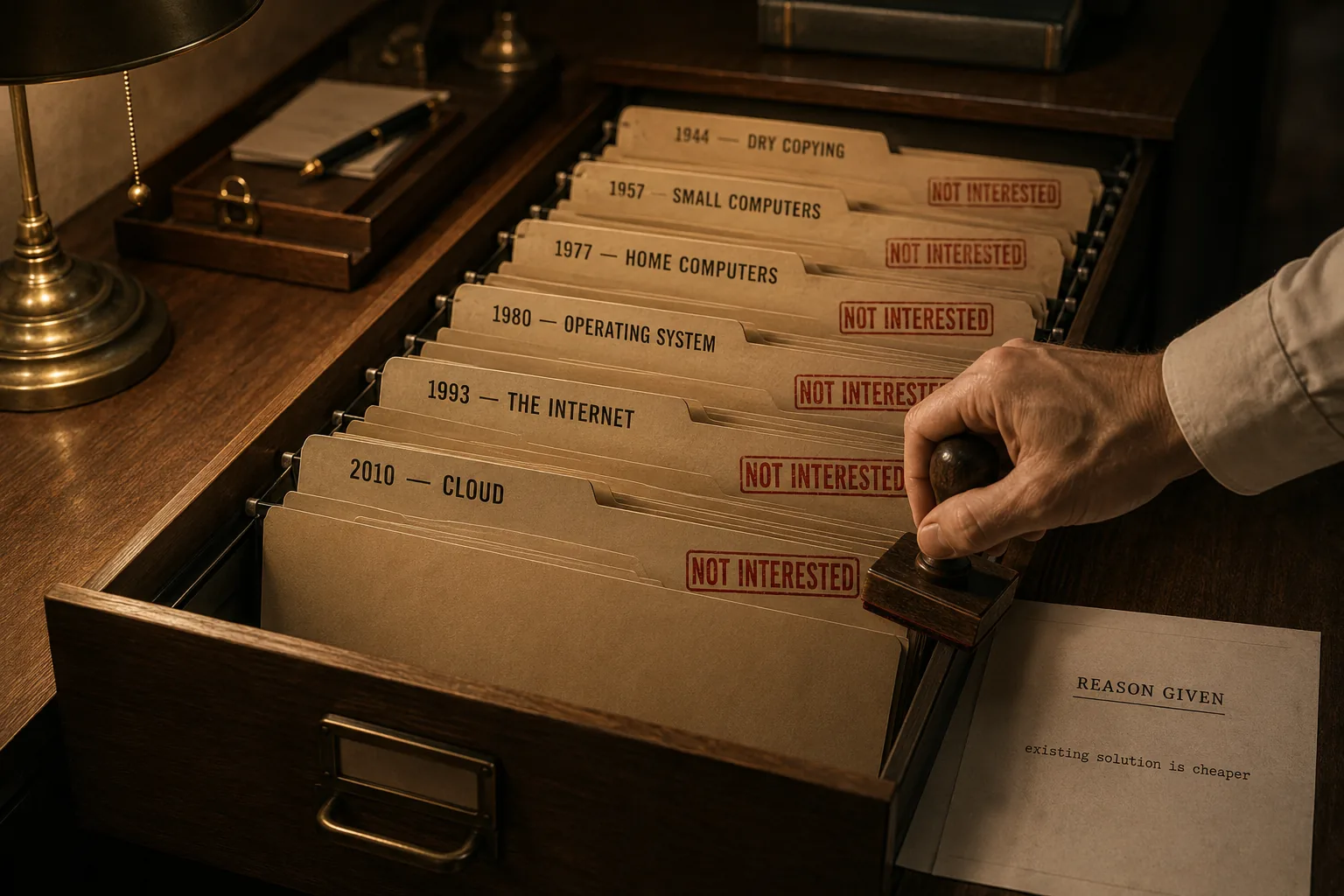
IBM's Pattern of Dismissal: How One Company Missed Every Major Computing Revolution
IBM rejected xerography (1944), dismissed minicomputers (1960s-1976), dismissed personal computers (1977-1980), gave away DOS rights to Microsoft (1980), failed to secure Intel chip exclusivity (1980), launched the failed PCjr (1984), was slow to embrace the internet (1990s), missed cloud computing to AWS (2003-2013), missed the mobile revolution entirely, failed with Watson AI in healthcare ($62M MD Anderson disaster), bought and neglected Lotus Notes ($3.5B to $1.8B), and eventually sold its PC business to Lenovo (2005). This pattern spans 80 years and created competitors worth trillions while IBM's market cap fell from tech leader to ~$200 billion. The recurring decision-making failures include status quo bias, confirmation bias, protecting existing revenue streams, bureaucratic inertia, short-term focus on earnings per share, and failure to recognize emerging technologies until competitors dominated. Microsoft, Apple, Intel, Amazon, Google, and Xerox all grew to dominance in markets IBM dismissed or abandoned.
IBM's history is a masterclass in how dominant companies dismiss emerging technologies — and create their own competitors in the process.
- 12 major misses spanning 80 years: xerography, minicomputers, PCs, DOS, Intel chips, internet, cloud, mobile, AI
- The same pattern: dismiss as "too small," protect existing revenue, enter late, lose to first movers
- The cost: Microsoft ($2.9T), Apple ($3T+), Amazon ($2T+), Google ($2T+) — companies IBM helped create or could have owned
- The lesson: decision-making failures compound. The same biases that dismissed xerography in 1944 dismissed cloud in 2010
It is hard to find a tech company that lost that many chances to be a leader.
That's not a critic's jab. That's the consensus view of IBM's last 80 years.
80 Years of Missed Opportunities
The Most Expensive Pattern in Business History
In 1944, IBM's executives looked at Chester Carlson's xerography invention and said carbon paper was cheaper.
In 1976, IBM finally introduced a minicomputer — after ignoring the market for 19 years while Digital Equipment Corporation grew into the second-largest computer company in the world.
In 1980, IBM signed a contract that let a 24-year-old Bill Gates keep the rights to sell DOS to anyone he wanted. That single clause created Microsoft.
In 2013, IBM spent $130 billion on stock buybacks instead of building cloud infrastructure. Today, AWS generates more revenue than IBM's entire company.
This is not a story about one bad decision. This is a story about a pattern — the same cognitive biases, the same organizational failures, the same dismissal of emerging technologies, repeated across eight decades.
Today, IBM's market cap is approximately $200 billion. Microsoft's is $2.9 trillion. Apple's exceeds $3 trillion. Amazon and Google each top $2 trillion. Every one of these companies grew in markets IBM either dismissed, abandoned, or accidentally helped create.
The question isn't "How did IBM make these mistakes?" The question is: "Why did they keep making the same mistake?"
1. Xerography: The Kitchen Lab Invention IBM Said Nobody Needed (1939-1944)
The Inventor in the Kitchen
Chester Carlson was a patent attorney who hated copying documents by hand. In the 1930s, he began researching what he called "electrophotography" — a dry copying process that didn't require the messy chemicals of existing methods.
Carlson toiled away in crude makeshift labs, sometimes using his kitchen, other times a rented backroom. By the early 1940s, he had a working concept. He just needed funding to commercialize it.
Between 1939 and 1944, Carlson knocked on the doors of more than 20 companies. He approached every major office equipment manufacturer: IBM, General Electric, RCA, Kodak. The response was universal.
Not interested.
The IBM Meeting That Almost Happened
In March 1941, IBM's director of market research actually requested a demonstration of Carlson's invention. This could have been the moment that changed everything.
But Carlson faced a critical problem: he had no working model to show. Despite years of effort and substantial financial investment, his prototype was far from functional. He could explain the concept, but he couldn't produce usable copies.
IBM's persistent requests to see the model left Carlson frustrated and evasive. He knew his invention wasn't ready to demonstrate. The opportunity slipped away.
IBM's official position became clear: they felt that carbon paper was a cheaper alternative. Why invest in an unproven technology when the existing solution worked?
The Decision Logic
From IBM's perspective in 1941-1944, the rejection made sense:
- Carbon paper worked. It was cheap, familiar, and required no new equipment.
- Carlson couldn't demonstrate a functioning product.
- The market for "automatic copying" was unproven.
- IBM's core business was tabulating machines and punch cards, not office consumables.
What Actually Happened
In 1944, the Battelle Memorial Institute — a non-profit research foundation — took a chance on Carlson. In 1947, a small photographic paper company called Haloid licensed the technology.
Haloid became Haloid Xerox in 1958, then Xerox Corporation in 1961.
The Xerox 914 copier, introduced in 1959, became one of the most successful products in American business history. It revolutionized office work and made Xerox a dominant force in business technology.
IBM didn't enter the copier market until 30 years later, in 1970. When they did, Xerox immediately sued them for patent infringement.
The Lesson Ignored
This should have been IBM's wake-up call. A technology they dismissed as unnecessary — because the existing solution seemed "good enough" — created an entirely new industry and a powerful competitor.
But IBM didn't learn this lesson. They would repeat the same pattern, almost verbatim, with the next revolution.
2. Minicomputers: 19 Years of Ignoring the Revolution (1957-1976)
The Birth of DEC
In 1957, Kenneth Olsen founded Digital Equipment Corporation (DEC) with $70,000 in venture capital. His vision was simple: computers didn't have to be room-sized mainframes that cost millions of dollars.
While IBM was selling mainframes to Fortune 500 companies, DEC began building smaller, cheaper machines for scientists, engineers, and researchers who couldn't afford — or didn't need — IBM's massive systems.
IBM's Dismissal
IBM so disregarded minicomputers that they wouldn't introduce one until 1976 — 19 years after DEC was founded.
The logic was familiar: minicomputers were "too small to do serious computing." IBM's customers were large enterprises that needed real processing power. Why would anyone want a smaller, less capable machine?
Meanwhile, between 1968 and 1972, ninety-two companies introduced minicomputers. A new industry was being born, and IBM wasn't in it.
The PDP-8: The Computer That Changed Everything
In 1965, DEC released the PDP-8 for just $18,000 — making it the least expensive computer on the market, dramatically undercutting IBM and other mainframe makers.
The PDP-8 found customers IBM never imagined: research labs, universities, small manufacturers, process control systems. It proved that "smaller" didn't mean "less useful" — it meant "accessible to more people."
Too Little, Too Late
When IBM finally entered the minicomputer market with the Series/1 in 1976, DEC had already established a near-monopoly. By the early 1980s, DEC was the second-largest computer company in the world, directly challenging IBM for market leadership.
The VAX minicomputer was cheap enough that a low-level executive could approve the expenditure. An IBM mainframe purchase required approval at the top executive level. IBM had ceded an entire market segment because they couldn't see value in machines that weren't mainframes.
The Irony
Here's where the story gets interesting: Ken Olsen, who built DEC by exploiting IBM's blind spot, had his own blind spot.
In 1977, at a World Future Society convention, Olsen reportedly said: "There is no reason for any individual to have a computer in their home."
(Olsen later clarified he was talking about centralized "home control" computers, not personal computers. But the quote captured a real failure of imagination that affected DEC's strategy.)
The company that rose by seeing what IBM missed... missed the next revolution themselves. DEC never successfully pivoted to personal computers and was acquired by Compaq in 1998 for $9.6 billion. Compaq was then acquired by HP.
The pattern of dismissal isn't unique to IBM. It's a disease that infects market leaders.
3. Personal Computers: "Too Small to Do Serious Computing" (1977-1980)
The Apple II Arrives
In 1977, two young men named Steve Jobs and Steve Wozniak introduced the Apple II — the first personal computer as we know it today. It had a keyboard, a display, and came fully assembled. Regular people could buy it and use it at home.
IBM's response echoed their minicomputer dismissal: personal computers were "too small to do serious computing" and therefore "unimportant to their business."
The Rejection Pattern
Before Apple became Apple, Jobs and Wozniak tried to sell their invention to established companies. HP rejected them. Commodore rejected them.
IBM never even considered personal computers a market worth entering. Their customers were corporations, not hobbyists.
The Wake-Up Call
By mid-1980, IBM executives had reason to be worried. Personal computers were no longer toys. VisiCalc, the first spreadsheet program, was turning Apple IIs into business tools. Customers were asking about personal computers. Some were buying them with or without IBM's blessing.
It became very clear that IBM needed to sell a personal computer. Their customers expected it. The question was whether IBM could move fast enough to matter.
4. Project Chess: The Decisions That Gave Away the PC Industry (1980-1981)
The Secret Project in Boca Raton
In 1980, William Lowe, director of IBM's General Systems Division lab in Boca Raton, Florida, pitched IBM CEO Frank Cary on an audacious idea: build a personal computer in one year, sell it for $1,500.
Cary gave Lowe a month to develop a prototype — and just one year to get a product to market. For a company where major projects typically took three to five years, this was revolutionary.
Lowe was promoted shortly after, and development fell to Don Estridge — a 43-year-old engineer who would become known as the "father of the IBM PC." The project was code-named "Chess."
The Three Fateful Decisions
To meet the impossible deadline, Estridge's team defied IBM's rigid corporate culture. They made three decisions that would change the industry — and ultimately destroy IBM's position in the market they created:
- Decision 1: Off-the-shelf parts. Instead of designing custom components (IBM's usual approach), they used commercially available parts. The CPU was Intel's 8088 — a chip anyone could buy.
- Decision 2: Open architecture. They published the PC's technical specifications, inviting third-party developers to create software and accessories.
- Decision 3: Licensed operating system. Rather than developing software in-house, they licensed the operating system from Microsoft — a small company run by a 24-year-old named Bill Gates.
Why These Decisions Made Sense (In the Moment)
Each decision was rational given the constraints:
- Custom chips would take years. Intel's 8088 was ready now.
- Proprietary architecture would limit software availability. Open specs meant more developers would build for the platform.
- Building an operating system from scratch would blow the timeline. Microsoft's DOS was (almost) ready.
The Launch
On August 12, 1981, Don Estridge unveiled the IBM PC at New York's Waldorf Hotel. It was a massive success. IBM's brand legitimized personal computing for corporate customers who had dismissed Apple as a toy.
But the three decisions that enabled the rapid launch had already set IBM up for failure.
The Tragedy of Don Estridge
Don Estridge, the visionary who led Project Chess, died on August 2, 1985, in the crash of Delta Flight 191 near Dallas. He was 48.
By then, the clone makers were already eating IBM's lunch. The market Estridge created was slipping away from the company that created it.
5. The DOS Deal: How IBM Created Microsoft (August-November 1980)
The Phone Call
On July 21, 1980, Jack Sams of IBM called a young software entrepreneur in Seattle. "Don't get too excited," Sams told him, "and don't think anything big is about to happen."
The entrepreneur was Bill Gates. He was 24 years old. When Sams and his IBM colleagues arrived at Microsoft's office, Sams thought Gates was the office boy — he had the physique of a 12-year-old.
IBM needed an operating system for their new personal computer. Gates ran Microsoft, which was known for its version of the BASIC programming language. They didn't make operating systems.
The Gary Kildall Saga
Gates told IBM they should contact Gary Kildall at Digital Research. Kildall had created CP/M — the dominant operating system for microcomputers at the time. He was 13 years older than Gates, held a PhD in Computer Science, and ran an established company.
What happened next is one of computing's greatest "what if" stories — and the accounts diverge dramatically.
August 21, 1980: The Meeting That Changed Everything
On Thursday, August 21, 1980, the IBM delegation arrived at Digital Research's headquarters in Pacific Grove, California.
IBM's version: Gary Kildall wasn't there — he was out flying one of his private planes. His wife and business partner, Dorothy McEwen, refused to sign IBM's non-disclosure agreement. After hours of haggling, the frustrated IBM executives left without even starting discussions.
Kildall's version: He returned from a business trip that afternoon, signed the NDA, and met with IBM throughout the day. They reached an understanding to license CP/M. He even changed his flight to travel with the IBM representatives back to Florida. They had a handshake deal.
The Real Issue
Beyond the NDA drama, there were substantive business disagreements:
IBM wanted to pay a flat fee for CP/M rights. Kildall wanted royalties per copy sold.
Kildall had signed "favored nations" contracts with his existing customers. He couldn't give IBM better terms without offering the same deal to everyone else.
Most critically: CP/M-86 (the version that would run on Intel's 8086/8088 chips) couldn't be delivered in IBM's timeline.
Whatever the reason, IBM declared negotiations had failed. They returned to Gates.
Gates Makes His Move
Gates didn't have an operating system. But he knew someone who did.
Seattle Computer Products had developed an operating system called QDOS — "Quick and Dirty Operating System." It was written by Tim Paterson and was designed to be CP/M compatible.
With IBM's secret backing, Microsoft acquired QDOS. Paul Allen negotiated a licensing agreement: a flat fee of $10,000, plus $15,000 per company Microsoft licensed the OS to, with SCP granting non-exclusive rights. Seattle Computer Products didn't know who was really funding the deal — if they had, the price would have been far higher.
In July 1981, Microsoft bought QDOS outright for $50,000. Gates renamed it MS-DOS.
The Clause That Created Microsoft
On November 6, 1980, Microsoft and IBM signed the final contract. Gates agreed to sell DOS to IBM for a modest $50,000 — far less than what CP/M would have cost.
But here's what IBM missed: it was a non-exclusive royalty deal.
IBM's rights were non-exclusive. Gates kept ownership of the DOS program. Microsoft could sell MS-DOS to anyone they wanted — including every PC clone maker who would soon flood the market.
Steve Ballmer, a Microsoft employee, supported Gates during the negotiations. They both understood what IBM's lawyers apparently didn't: the operating system would be more valuable than the hardware.
Bill Gates' Role: More Nuanced Than the Myth
Interestingly, there's no controversy about one aspect: Gates initially tried to help Kildall. He sent the IBM team to Digital Research. When negotiations broke down, he called Kildall to urge him to restart talks.
It was only after Kildall couldn't reach terms with IBM that Gates — convinced by Paul Allen and Kay Nishi — decided Microsoft should offer an operating system to save the project.
Gates didn't steal the opportunity. He was handed it.
6. The Intel Chip Mistake: Enabling the Clone Industry (1980-1981)
The DOS deal wasn't IBM's only critical error. They also failed to secure proprietary rights to the Intel 8088 chip that powered the IBM PC.
This meant Intel could sell the same processors to anyone — Compaq, Dell, HP, and eventually hundreds of "IBM-compatible" clone makers.
IBM had opened both the hardware (Intel chips, published specs) and the software (non-exclusive DOS license). The only thing unique about an IBM PC was the IBM logo.
The Clone Invasion
The open architecture that enabled rapid development also enabled competition. In June 1982 — less than a year after the IBM PC launched — Columbia Data Products released the first functional IBM PC clone.
In 1983, Compaq released the Compaq Portable, advertised as the first "100% IBM compatible" computer. Unlike IBM, Compaq was a nimble startup that could move fast.
IBM had created an industry standard it didn't control. The clone makers could build equivalent hardware cheaper and often innovate faster than IBM's bureaucracy allowed.
Why IBM Did It Anyway
IBM's decisions made sense in the context of a 12-month deadline. Custom chips would take years. An exclusive Intel deal would require more negotiation time. Proprietary architecture would limit software availability.
But these were short-term optimizations that sacrificed long-term strategic position. IBM won the battle (shipping the PC on time) and lost the war (controlling the PC industry).
7. The PCjr Debacle: How IBM Failed at the Home Market (1983-1985)
In an effort to capture the home computer market, IBM launched the PCjr in November 1983. It was specifically designed as a cheaper, consumer-friendly alternative to the IBM PC.
Unfortunately, the PCjr was a commercial failure with poor sales and numerous technical issues. The keyboard — nicknamed the "chiclet keyboard" — was nearly unusable. The machine was underpowered and overpriced compared to competitors.
IBM was forced to discontinue the PCjr just 18 months later, in March 1985. The company that had stumbled into the personal computer market couldn't figure out how to serve home users.
8. The Internet Revolution: Slow to Embrace the Web (1990s)
A Pattern Repeats
IBM's failure to fully embrace the Internet and the rise of mobile computing proved particularly costly. IBM was slow to recognize the transformative potential of the World Wide Web.
While IBM eventually embraced the internet — Steve Mills, head of IBM's software group, led discussions about how to "Webify" the company's enterprise tools, resulting in WebSphere in 1998 — they missed crucial early opportunities.
The Opportunities Lost
IBM missed the chance to establish dominance in:
- Search: Google was founded in 1998 by two Stanford students. IBM had massive computing resources and enterprise relationships. They never seriously pursued search.
- E-commerce: Amazon launched in 1994. IBM was selling to the very enterprises that would become e-commerce giants. They could have been the infrastructure. They weren't.
- Cloud services: This would become their most costly miss of all.
9. Cloud Computing: The $130 Billion Mistake (2003-2013)
Gerstner's Vision
Lou Gerstner is widely credited with saving IBM. When he arrived as CEO in 1993, the company was losing billions and many expected it to be broken up. Instead, Gerstner kept IBM together and repositioned it around services.
When Gerstner left the company in 2002, he left with a clear vision: cloud and on-demand computing would define the future.
He was right.
What IBM's Leaders Actually Believed
But IBM leadership after Gerstner chose to protect existing revenue streams instead of building cloud infrastructure. Former IBMers describe the internal mindset:
- "AWS is losing money."
- "Enterprises won't trust Amazon."
- "We'll enter cloud when the market matures."
- "Our enterprise brand guarantees victory."
The Stock Buyback Strategy
From 2003 to 2013, IBM spent over $130 billion on stock buybacks.
Stock buybacks boost short-term earnings per share — which was directly tied to executive compensation. The strategy optimized for quarterly results while competitors built the future.
During the same period, AWS was learning through iteration, investing in massive infrastructure, building developer loyalty, and accepting early losses to shape a new computing paradigm.
The Softlayer Acquisition
IBM did recognize cloud computing eventually. In 2013, they acquired Softlayer — the #2 cloud provider behind Amazon.
But instead of investing aggressively in Softlayer's growth, IBM continued to prioritize buybacks. They had bought the horse but wouldn't let it run.
The Lost Decade
IBM entered what observers called a "lost decade" from roughly 2012 to 2020. While Amazon, Microsoft, and Google built dominant cloud platforms, IBM fell further behind.
Today, AWS generates more annual revenue than IBM's entire company. Microsoft's Azure has become the enterprise cloud leader. Google Cloud is rapidly growing.
IBM defended the past. AWS built the future. By the time IBM took cloud seriously, the market was already gone.
10. The Mobile Revolution: Complete Absence (2007-Present)
IBM largely missed the mobile computing revolution entirely. No significant play in smartphones. No tablet strategy. No mobile operating system.
When Apple introduced the iPhone in 2007, IBM had no response. When Android emerged as the dominant mobile platform, IBM wasn't a player.
This is remarkable for a company that once defined personal computing. The most personal computers of all — the ones people carry in their pockets — were built entirely by others.
11. Watson for Oncology: The $62 Million AI Disaster (2012-2017)
The Ambitious Promise
In 2012, IBM partnered with MD Anderson Cancer Center in Houston with an audacious mission: use Watson AI to help eradicate cancer.
The project was called the Oncology Expert Advisor (OEA). Watson would use natural language processing to summarize patients' electronic health records, search medical databases, and provide treatment recommendations to oncologists.
It was supposed to demonstrate that Watson could revolutionize healthcare.
The Reality
Five years and $62 million later, MD Anderson let its contract with IBM expire. Watson was never used on actual patients at MD Anderson.
What Went Wrong
Massive Cost Overruns
The original contract: deliver the MDS leukemia product within 6 months at a fixed fee of $2.4 million.
The reality: that contract was extended 12 times, with total fees reaching $39.2 million. In all, MD Anderson spent more than three years and $60 million — much of it on outside consultants — before shelving the effort.
Technical Limitations
Watson was advertised as a "self-learning AI" that continuously digested breaking research. In reality, it functioned as a manually updated rule-based decision tree.
Every update required human experts to manually encode new guidelines into the software. This created an operational bottleneck that prevented the platform from adapting to rapidly evolving standards of care.
Despite Watson's natural language processing abilities, it was not able to interpret data as human doctors could.
Safety Concerns
In 2017 and 2018, investigative reports cited internal IBM Watson Health documents revealing systemic clinical inaccuracies and safety risks. Internal presentations acknowledged that the software frequently offered "unsafe and incorrect" treatment advice.
Governance Failures
The project disintegrated amid allegations of overspending, delays, and mismanagement. Project leadership actively bypassed standard IT governance and procurement procedures, structuring vendor contracts just below financial thresholds to avoid regents oversight.
The administrative and financial fallout ultimately led to the resignation of MD Anderson's President, Dr. Ronald DePinho, in 2017.
The Core Problem
IBM failed in developing Watson for healthcare because:
- The scope was too big. Instead of achievable goals — like predicting cancer probability based on symptoms — they aimed to "eradicate cancer" with an AI module.
- They didn't keep it simple. There were easier ways for AI to address medical problems, but IBM preferred to develop something that sounded fascinating rather than building a practical solution.
The Pattern Continues
Watson for Oncology revealed a fundamental mismatch between IBM's marketing promises and the reality of AI capabilities. They over-promised and under-delivered — a pattern that damaged IBM's credibility in the AI space.
Today, OpenAI, Google, and others lead AI development. Watson, despite IBM's massive early investment, is not a major player.
12. Lotus Notes: From $3.5 Billion to $1.8 Billion (1995-2018)
The Acquisition
In 1995, IBM bought Lotus Development Corporation for $3.5 billion. It was IBM's largest acquisition at the time. Lotus Notes was seen as a powerful collaboration platform that could compete with Microsoft.
At its peak, Lotus Notes had an estimated 10 million applications running on the platform.
The Mismatch
Betsy Kosheff, who did PR for Lotus when it was sold to IBM, later observed: "IBM had no business doing software innovation. That point was very obvious right from the acquisition. It's not their fault — IBM is just not designed that way."
When Lotus was sold to IBM, they were in a head-to-head battle with Microsoft Exchange. But Microsoft had critical advantages: they owned the operating system and had majority market share with Office applications.
IBM intended Lotus Notes to sell more hardware. They never reached out to the experienced community of developers, deployers, and roll-out experts who had actually made Notes successful in corporations.
The Slow Decline
From those 10 million apps at peak, the first seven years under IBM saw a reduction to about 2 million — mostly through attrition and easy migrations to Microsoft SharePoint.
One unique "advantage" of Lotus Notes became its problem: servers and clients ran unattended for years. Customers simply stopped paying IBM for upgrades and support. Most also froze development of Notes apps, drying out associated revenue for IBM Global Services and IBM Partners.
The Sale
In December 2018, IBM sold Notes/Domino and several other software products to HCL Technologies for $1.8 billion.
IBM had spent $3.5 billion to acquire Lotus. Twenty-three years later, they sold the remnants for about half that amount — without adjusting for inflation.
The sale was partly driven by IBM's need for cash: they had just announced a $34 billion acquisition of Red Hat. But it marked the end of IBM's attempt to compete in collaboration software.
13. The Lenovo Sale: Exiting the Market IBM Created (2005)
In 2005, IBM sold its entire PC division to Lenovo for $1.75 billion.
The company that launched the IBM PC in 1981 — the machine that legitimized personal computing for business — no longer made personal computers.
IBM justified the sale by noting that the PC market had become highly commoditized with shrinking profit margins. They would focus on higher-margin software and services.
This was rational. But it was also an admission of total defeat. IBM had created the PC industry standard. They had enabled the clone makers with open architecture. They had given Microsoft the operating system rights. And now they were leaving the industry entirely.
The Pattern: Why Did They Keep Making the Same Mistake?
The Recurring Elements
Across 80 years and 12+ major decisions, the same patterns appear:
"Too Small to Matter"
Xerography was dismissed because carbon paper worked. Minicomputers were dismissed because mainframes were "serious computing." Personal computers were dismissed because they were "too small." Cloud was dismissed because enterprises "wouldn't trust Amazon."
Protect Existing Revenue
IBM consistently optimized for protecting current business lines rather than cannibalizing them with new technologies. Mainframe revenue prevented minicomputer focus. Hardware sales prevented software focus. Services contracts prevented cloud investment.
Enter Late, Lose to First Movers
IBM's minicomputer came 19 years after DEC. IBM's cloud push came a decade after AWS. By the time IBM took emerging technologies seriously, nimbler competitors had established dominant positions.
Short-Term Optimization Over Long-Term Position
The DOS deal optimized for speed (ship in 12 months) at the cost of long-term control. Stock buybacks optimized for quarterly EPS at the cost of cloud investment. Each decision was locally rational but strategically catastrophic.
The Cognitive Biases
These patterns reflect well-documented cognitive biases:
- Status quo bias: Carbon paper works. Mainframes work. Our current business model works. Why change?
- Confirmation bias: Looking for evidence that new technologies won't matter while ignoring signs that they will.
- Innovator's dilemma: Successful companies can't disrupt themselves because doing so threatens existing revenue streams.
- Anchoring: IBM's identity as a mainframe company anchored their thinking even as computing evolved.
The Organizational Factors
Beyond individual biases, IBM's structure made these errors more likely:
- Bureaucratic inertia: Large organizations move slowly. The 12-month PC deadline was exceptional precisely because IBM normally took years.
- Siloed divisions: Divisions competed with each other rather than collaborating on new opportunities.
- Risk aversion: A culture that penalized failure more than it rewarded bold bets.
- Compensation structures: Executives rewarded for quarterly EPS (boosted by buybacks) rather than long-term market position.
The Cost: A Visualization
Today's market capitalizations tell the story:
| Company | Market Cap | IBM's Role |
|---|---|---|
| Microsoft | ~$2.9 trillion | IBM gave them DOS rights |
| Apple | ~$3.0+ trillion | IBM dismissed personal computers |
| Amazon | ~$2.0+ trillion | IBM missed cloud computing |
| Alphabet (Google) | ~$2.0+ trillion | IBM missed search and cloud |
| Intel | ~$150 billion | IBM didn't secure chip exclusivity |
| IBM | ~$200 billion | — |
Combined, Microsoft, Apple, Amazon, and Alphabet are worth over $10 trillion. IBM — the company whose decisions enabled or failed to prevent these competitors — is worth about 2% of that.
The Lessons: How Organizations Can Avoid the IBM Pattern
IBM's history is not just a cautionary tale — it's a decision-making curriculum. Here's what organizations can learn:
Document the "Too Small" Dismissals
When someone says a new technology is "too small to matter" or "not serious," that's a signal to investigate, not dismiss. Create a formal record of what was dismissed and why. Review these records annually.
Separate Evaluation from Incumbent Defense
Have emerging technologies evaluated by teams that don't have incentives to protect existing revenue streams. The mainframe division will never champion minicomputers.
Question Short-Term Optimizations
The DOS deal was optimized for a 12-month deadline. The stock buybacks were optimized for quarterly EPS. Each made sense in isolation but sacrificed strategic position. Ask: "What long-term position are we trading for this short-term gain?"
Track Decision Patterns, Not Just Outcomes
IBM's pattern was consistent across 80 years. If they had analyzed their decision patterns rather than just individual outcomes, they might have recognized the recurring failure mode.
Build Institutional Memory of Mistakes
Did IBM's 1980s executives know about the xerography rejection of 1944? Did the 2010s leaders study the minicomputer miss of the 1970s? Organizations that don't learn from past decision failures are condemned to repeat them.
The Pattern Continues
As of 2026, IBM is attempting another pivot — this time toward AI and cloud computing through acquisitions like Red Hat.
Will this time be different?
The company has new leadership and new strategic priorities. But it also has the same organizational DNA that produced the pattern we've traced across 80 years.
The lesson isn't that IBM was uniquely flawed. The lesson is that the biases and organizational dynamics that drove IBM's failures exist in every large organization. Status quo bias. Confirmation bias. Revenue protection. Short-term optimization. Bureaucratic inertia.
The question for any organization isn't "Are we IBM?" The question is: "What are we dismissing right now because it seems too small to matter?"
Because somewhere, in a kitchen lab or a garage or a dorm room, someone is building the next technology that will be dismissed as "not serious computing."
And 30 years from now, we'll be telling the story of how another dominant company missed it.
Sources & Further Reading
Xerography History
Digital Equipment Corporation & Minicomputers
The DOS Deal & Microsoft
IBM PC & Project Chess
Watson for Oncology
IBM's Decline & Missed Opportunities
Frequently Asked Questions
Did IBM really reject xerography because of carbon paper?
Yes. Between 1939 and 1944, IBM was one of more than 20 companies that rejected Chester Carlson's xerography invention. IBM reportedly dismissed the technology because carbon paper was seen as a cheaper alternative. In March 1941, IBM's director of market research requested a demonstration, but Carlson couldn't produce a working model. The Haloid Corporation eventually licensed the technology in 1947 and became Xerox.
How much did IBM's DOS deal with Microsoft cost them?
The direct cost was minimal — IBM paid about $50,000 for DOS. The strategic cost was catastrophic. By signing a non-exclusive license, IBM allowed Microsoft to sell MS-DOS to every PC clone maker. This single clause enabled Microsoft to become a $2.9 trillion company while IBM eventually exited the PC business entirely, selling to Lenovo in 2005 for $1.75 billion.
What happened with Gary Kildall and CP/M?
The story has conflicting accounts. IBM's version: Gary Kildall was out flying his plane when IBM arrived, and his wife refused to sign the NDA. Kildall's version: He returned that afternoon, signed the NDA, and reached a handshake deal. The substantive issues were that Kildall wanted royalties (IBM wanted a flat fee) and CP/M-86 couldn't be delivered on IBM's timeline. After negotiations failed, Microsoft stepped in with QDOS.
Why did IBM use off-the-shelf parts for the PC?
Time pressure. IBM CEO Frank Cary gave the team just 12 months to ship a personal computer. Building custom chips and proprietary architecture would have taken years. Using Intel's existing 8088 chip and publishing open specifications enabled rapid development but allowed competitors to build "IBM-compatible" clones.
What went wrong with Watson for Oncology?
IBM partnered with MD Anderson Cancer Center in 2012, promising Watson would help "eradicate cancer." Five years and $62 million later, the project was shelved. Problems included: the original 6-month, $2.4M contract was extended 12 times; Watson gave "unsafe and incorrect" treatment advice; it functioned as a manually-updated rule-based system rather than true AI; and project leadership bypassed governance procedures.
How did IBM miss cloud computing?
Lou Gerstner correctly predicted cloud computing would define the future when he left IBM in 2002. But subsequent IBM leadership chose to protect existing revenue streams. From 2003-2013, IBM spent over $130 billion on stock buybacks instead of building cloud infrastructure. IBM even acquired Softlayer (the #2 cloud provider) in 2013 but continued prioritizing buybacks over investment. Today, AWS generates more revenue than IBM's entire company.
What is IBM worth today compared to companies it helped create?
IBM's market cap is approximately $200 billion. Microsoft (which got DOS rights from IBM) is worth $2.9 trillion. Apple (which IBM dismissed in the 1970s) exceeds $3 trillion. Amazon (which dominated cloud while IBM hesitated) is over $2 trillion. Google (which won search while IBM focused elsewhere) is over $2 trillion. Combined, these four companies are worth over $10 trillion — about 50x IBM's value.
What cognitive biases drove IBM's decisions?
Several documented biases appear repeatedly: Status quo bias (carbon paper works, mainframes work — why change?); Confirmation bias (looking for evidence new technologies won't matter); Anchoring (IBM's identity as a mainframe company limited their thinking); and the Innovator's Dilemma (successful companies can't disrupt themselves because doing so threatens existing revenue).
Argumentree Team
Decision Analysis
The Argumentree team analyzes decision-making patterns across organizations. This post examines IBM's historical decisions as a case study in institutional decision-making failures.
The Question for Your Organization
IBM's pattern isn't unique. Status quo bias, revenue protection, and short-term optimization exist in every organization. The question isn't "Are we IBM?" The question is: "What are we dismissing right now because it seems too small to matter?"
Don't Repeat IBM's Pattern
The decisions your organization makes today become tomorrow's competitive position. Capture them with structured decision documentation — before the "too small to matter" dismissals become trillion-dollar regrets.
Start Documenting DecisionsRelated Articles
Jeff Bezos's 3 Decisions a Day: The Warren Buffett Method Behind Amazon
A senior executive should make about three good decisions a day. That's it. Protect your morning energy, document your gut decisions, and build a flywheel of institutional memory.
The Decision Stack: How Business Decisions Really Get Made
From NPV to prospect theory, from real options to cognitive biases — the complete framework for understanding how strategic decisions work.