
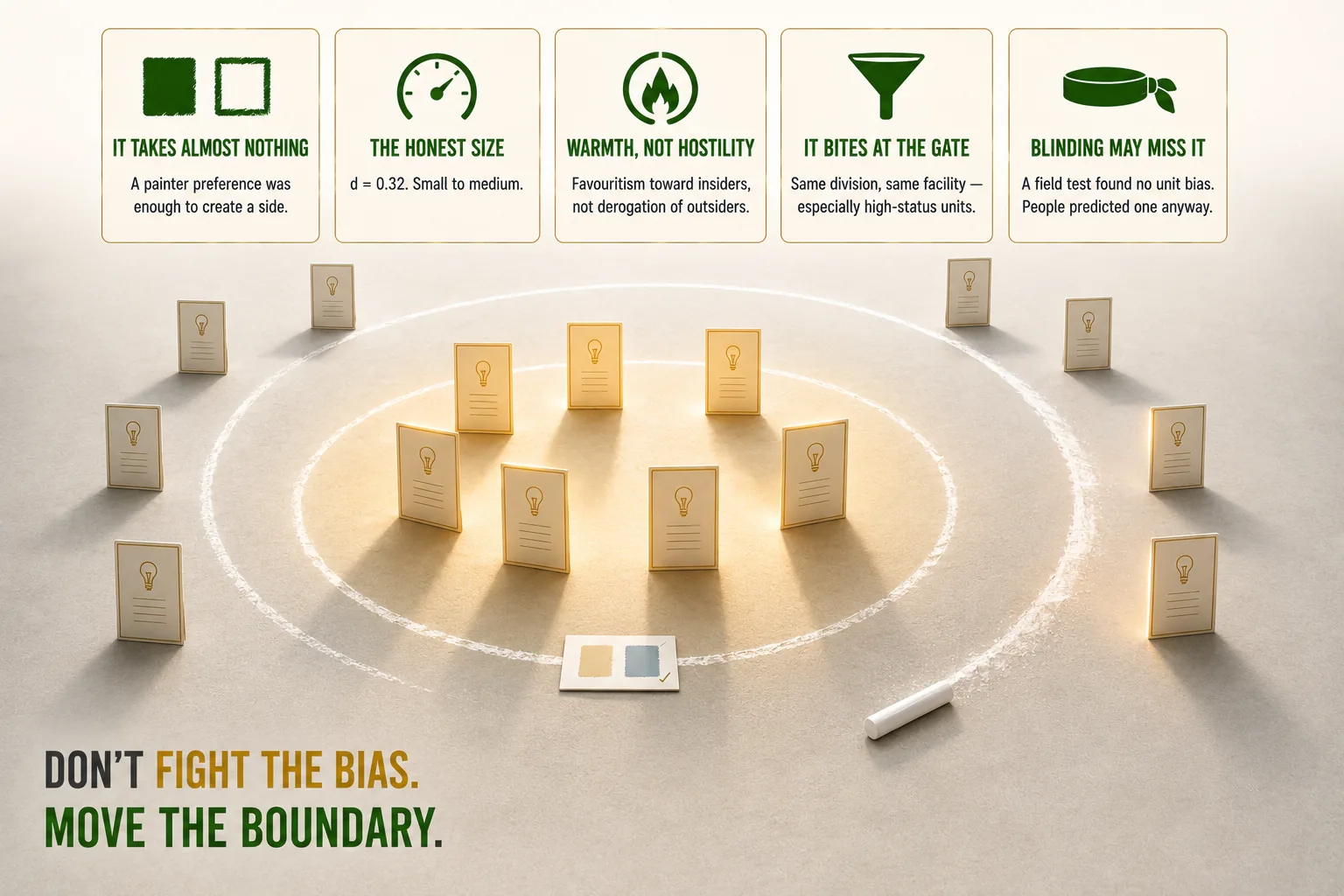
It takes almost nothing to create a side
In 1971 Henri Tajfel and colleagues published the experiment that defined the field. They divided people into groups on the flimsiest possible basis — an estimation task, a preference between two painters — and then asked them to allocate rewards. There was no history between the groups, no competition, no contact, and nothing at stake beyond the allocation itself. The result, in the authors' own words:
The subjects favoured their own group in the distribution of real rewards and penalties in a situation in which nothing but the variable of fairly irrelevant classification distinguished between the ingroup and the outgroup.
— Tajfel, Billig, Bundy & Flament, European Journal of Social Psychology (1971)
The second finding is stranger and more useful. Given a choice between maximising their own group's absolute reward and maximising the gap between the groups, subjects went for the gap — sacrificing objective advantage to stay ahead. That is what "us" does to a decision even when "us" was invented ten minutes ago by a researcher with a clipboard. Now consider that your organisation's groups have names, budgets, histories and rivalries.
How big is it, really?
This is where a good post has to slow down, because the honest number is smaller than the anecdotes suggest — and its shape matters more than its size. Balliet, Wu and De Dreu meta-analysed ingroup favouritism in cooperation for Psychological Bulletin in 2014:
Summarizing evidence across studies, we find a small to medium effect size indicating that people are more cooperative with ingroup, compared to outgroup, members (d = 0.32).
We find support for the hypothesis that intergroup discrimination in cooperation is the result of ingroup favoritism rather than outgroup derogation.
— Balliet, Wu & De Dreu, Psychological Bulletin (2014)
Read that second sentence as a design instruction. If the mechanism were hostility toward outsiders, you would need to reduce animosity — slow, cultural, hard. Because it is warmth toward insiders, the lever is entirely different: change who counts as an insider, and the same mechanism starts working for you. We will come back to that.
Inside real companies, the pattern shows up in the pipeline
Laboratory groups are one thing; idea-selection processes with budgets attached are another. Reitzig and Sorenson studied bottom-up strategy formulation for the Strategic Management Journal in 2013 and found the bias where it costs most — at the gate:
Evaluators are biased in favor of ideas submitted by individuals that work in the same division and facility as they do, particularly when they belong to small or high-status subunits.
— Reitzig & Sorenson, Strategic Management Journal (2013)
A decade later Schweisfurth and colleagues found a second axis in an internal crowdfunding programme at a large industrial manufacturer: evaluators overvalue ideas from people at their own hierarchical level. And the syndrome has a canonical name from long before either study. Katz and Allen defined Not Invented Here in R&D Management in 1982 as the tendency of a project group of stable composition to believe it possesses a monopoly of knowledge of its field, leading it to reject outside ideas to the detriment of its performance.
Their paper is routinely over-claimed as proof that teams reject external ideas. It is a correlational study of 50 R&D project groups, and its real finding is a curve: performance rose to roughly a year and a half of group tenure, plateaued, and had declined noticeably by five years — explained by falling communication both inside the group and with outside sources. The monopoly-of-knowledge line is the paper's framing, not its evidence. (The term itself predates them; it appears in a 1967 MIT master's thesis.)
Now the two findings that should stop you buying the simple version
If this post ended above, it would be tidy and slightly wrong. Two peer-reviewed results cut against the expected story, and taking them seriously changes what you should actually do.
That last finding is the one worth sitting with, because it lands directly on the intervention most companies reach for first. If people confidently predict a bias that a controlled test does not find, then blinding submissions may be solving a smaller problem than the one everyone believes in — while costing you the context that makes an idea judgeable. It also fits the pattern of this whole cluster: the mechanisms are real, the popular effect sizes are inflated, and the fix has to be chosen on evidence rather than on intuition about which bias feels most likely.
- ✗The bias sometimes runs the other way. Menon and Pfeffer, in Management Science (2003), found managers frequently value external knowledge more highly than identical internal knowledge — partly because learning from an internal rival carries a status cost, and partly because internal knowledge is abundant and therefore gets more scrutiny. The consultant who tells you what your own team told you last quarter is a well-documented phenomenon, not a joke.
- ✗And a field experiment found no such bias at all. Dahlander, Thomas, Wallin and Ångström (SMJ, 2023) blinded proposer identity in a real idea-evaluation setting and found no bias against proposers from other units or locations — a result they replicated online. Participants, meanwhile, overestimated how large such biases would be.
The technique: make the in-group bigger
Because the effect is favouritism rather than hostility, the evidence-backed remedy is not neutrality. It is recategorisation — Gaertner and colleagues' common ingroup identity model, where merging two groups into one superordinate "us" reduces bias chiefly by raising the standing of former outsiders. That is Cialdini's unity principle deployed deliberately rather than accidentally.
- ✓Name the superordinate group before the evaluation, not in a values deck. "We are the people accountable for this decision" beats "Platform versus Product" — and it costs one sentence at the top of the meeting.
- ✓Use perspective-taking as the debiasing move. Hannen and colleagues tested countermeasures across 565 R&D projects (Research Policy, 2019) and found perspective-taking an effective indirect route to containing NIH — asking evaluators to argue the proposing team's case before scoring it.
- ✓Mix the evaluation panel across units and levels. Both documented in-firm biases — same-division and same-hierarchical-level — are panel-composition problems before they are attitude problems.
- ✓Score against criteria written in advance. The same move that defeats agenda-setting and reciprocity: if the criteria exist before the source is known, origin has less room to do quiet work.
- ✓Record where each idea came from, and audit acceptance rates later. Do not assume the direction of the bias — measure it in your own decision record. Given Menon and Pfeffer, you may find you are underrating your own people rather than the outsiders.
A bigger us
The temptation with in-group bias is to treat it as a character flaw to be scolded out of people — to ask evaluators to be objective about where an idea came from. Tajfel's boys were objective. They just also wanted their side to be ahead, and their side had existed for ten minutes.
Which is why the finding that the effect is favouritism, not hostility is the most useful sentence in this literature. You are not fighting animosity. You are working with a mechanism that will happily switch sides the moment the boundary moves — so move the boundary, and let unity do the work it was going to do anyway.
Sources & further reading
Every named source in this post, with a link where one exists. Several widely repeated details were deliberately left out because they could not be traced to primary text — including the commonly cited sample description of Tajfel's original study and a frequently quoted prevalence figure for NIH.
- •Tajfel, H., Billig, M. G., Bundy, R. P., & Flament, C. (1971). Social categorization and intergroup behaviour. European Journal of Social Psychology, 1(2), 149–178. — the minimal group paradigm. Note this is the primary report; the 1970 Scientific American piece is a separate, popular account often conflated with it.
- •Balliet, D., Wu, J., & De Dreu, C. K. W. (2014). Ingroup favoritism in cooperation: A meta-analysis. Psychological Bulletin, 140(6), 1556–1581. — d = 0.32; favouritism rather than derogation.
- •Reitzig, M., & Sorenson, O. (2013). Biases in the selection stage of bottom-up strategy formulation. Strategic Management Journal, 34(7), 782–799. — same-division and same-facility favouritism at the evaluation gate.
- •Schweisfurth, T. G., Schöttl, C. P., Raasch, C., & Zaggl, M. A. (2023). Distributed decision-making in the shadow of hierarchy. Strategic Management Journal, 44(7). — evaluators overvalue ideas from their own hierarchical level.
- •Katz, R., & Allen, T. J. (1982). Investigating the Not Invented Here (NIH) syndrome. R&D Management, 12(1), 7–20. — the canonical empirical citation; correlational, 50 R&D groups, the tenure–communication–performance curve.
- •Menon, T., & Pfeffer, J. (2003). Valuing Internal vs. External Knowledge: Explaining the Preference for Outsiders. Management Science, 49(4), 497–513. — the reversal, and why it happens.
- •Dahlander, L., Thomas, A., Wallin, M. W., & Ångström, R. C. (2023). Blinded by the person? Experimental evidence from idea evaluation. Strategic Management Journal, 44(10), 2443–2459. — no unit or location bias found; participants overestimated it.
- •Hannen, J., et al. (2019). Containing the Not-Invented-Here Syndrome in external knowledge absorption and open innovation. Research Policy, 48(9), 103822. — 565 R&D projects; perspective-taking as an indirect countermeasure.
- •Gaertner, S. L., Mann, J., Murrell, A., & Dovidio, J. F. (1989). Reducing intergroup bias: The benefits of recategorization. Journal of Personality and Social Psychology, 57(2), 239–249. — the common ingroup identity model.
- •Antons, D., & Piller, F. T. (2015). Opening the Black Box of 'Not Invented Here'. Academy of Management Perspectives, 29(2), 193–217. — NIH as an attitude-based bias rather than a personality defect.