
Critical Thinking Tools: The Eight-Tool Kit, the Evidence for Argument Mapping, and the 2025 Cognitive-Offloading Warning
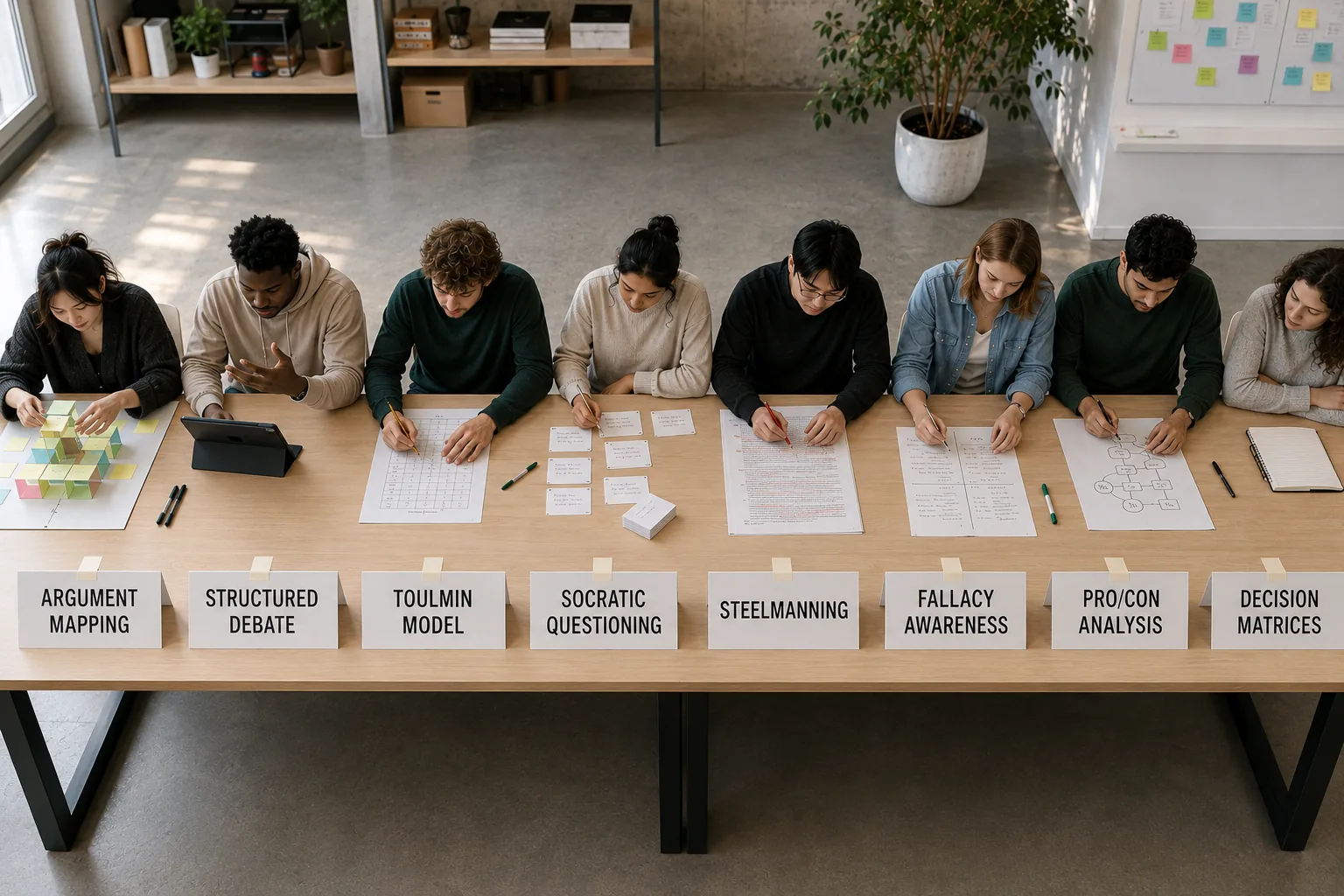
Critical thinking is the disciplined habit of examining reasoning before accepting a conclusion — separating claims from evidence, surfacing hidden assumptions, weighing reasons on their merits, and changing your mind when the stronger case is on the other side. It is learnable, and eight tools build it: argument mapping (see the structure of reasoning), structured debate (pressure-test both sides), the Toulmin model (check a single argument, especially its hidden warrant), Socratic questioning (probe assumptions and evidence), steelmanning (state the opposing view at its strongest), logical-fallacy awareness (spot broken reasoning), pro/con analysis (force both sides onto the table), and decision matrices (compare options against criteria). Argument mapping has the strongest measured evidence: Alvarez-Ortiz's 2007 meta-analysis found semester courses using argument mapping improved critical-thinking scores by about 0.68 standard deviations, rising to about 0.78 SD with intensive mapping practice, and van Gelder's 2015 review puts high-intensity mapping courses around 0.8 SD — roughly a move from the 50th to the 79th percentile, comparable to gains normally associated with three to four years of undergraduate education. The 2025 caution: Gerlich's study of 666 participants (Societies, 2025) found frequent AI-tool use negatively correlated with critical-thinking performance, mediated by cognitive offloading — a correlational finding, but a pointed one. The design question for tools is therefore whether they do your reasoning for you or make you reason better; argument-mapping software externalizes structure while keeping the thinking human.
In 2025, a study of 666 people delivered an uncomfortable correlation: the heaviest AI users scored lowest on critical thinking, with the link running through cognitive offloading — letting the tool do the thinking. Which makes this the right moment for the counter-question: which tools make you reason better instead of reasoning for you? Here are the eight with the best claim, and the one with actual measured effect sizes.
- The kit: argument mapping, structured debate, the Toulmin model, Socratic questioning, steelmanning, fallacy awareness, pro/con analysis, decision matrices — each targets a different reasoning failure.
- Argument mapping is the evidence leader: ~0.68–0.78 SD critical-thinking gains in the Alvarez-Ortiz meta-analysis, ~0.8 SD in van Gelder's review — roughly 50th → 79th percentile in one intensive semester.
- That is 3–4 undergraduate years of gain, compressed — the comparison the mapping literature itself uses.
- The 2025 warning points the other way: offloading reasoning to AI correlates with weaker critical thinking (Gerlich 2025, correlational). Tool design decides which side of that line you're on.
- Software's honest job: externalize the structure and enforce the discipline — evidence required, both sides visible, merit-weighted — while the reasoning stays yours.
In early 2025, a mixed-methods study of 666 participants put a number on a worry many educators had been voicing: frequent AI-tool use was significantly negatively correlated with critical-thinking performance — and the statistical path ran through cognitive offloading, the habit of delegating the reasoning itself to the tool (Gerlich, Societies, 2025). Younger participants showed the highest dependence and the lowest scores; education buffered the effect. The study is correlational, and its author says so — but as a signal flare over the decade every organization is automating its thinking, it is hard to ignore.
Here is the productive way to read it: the variable that matters is not tool use, it is who does the reasoning. Offload the thinking and the muscle atrophies. But there is a whole class of tools built on the opposite design — tools that force you to reason more explicitly than you would unaided. One of them carries the strongest measured effect in the critical-thinking literature.
So before your team adopts one more tool that answers questions, consider the eight that build the capacity to ask them. Critical thinking is not a personality trait; it is a set of habits — separating claims from evidence, surfacing assumptions, weighing both sides on merit, updating when you're beaten — and habits are trained fastest by instruments that force you into them.
Prose hides structure.
A map cannot.
Why argument mapping is the tool to learn first
The Eight-Tool Kit
None of these is a silver bullet and they overlap by design — different instruments for different failures of reasoning. Each entry: what it is best for, and how it works.
1. Argument mapping
Seeing the structure of reasoning — which claims rest on which reasons and evidence.
A map lays a position out as a diagram: the main claim, the reasons supporting it, the objections beside them, the evidence at the leaves. Making structure visible forces you to notice unstated premises and reasons that were never actually given.
2. Structured debate
Pressure-testing an idea by making the strongest case for and against it.
Roles, turns, and a rule that every challenged claim must be defended turn vague disagreement into a fair test. Formats vary — pro/con, red-team, critical discussion — but share one aim: no position survives unchallenged.
3. The Toulmin model
Checking whether a single argument actually holds together.
Stephen Toulmin's parts — claim, grounds, warrant, backing, qualifier, rebuttal — with the warrant as the star move: the hidden assumption that lets the evidence support the conclusion at all.
4. Socratic questioning
Digging beneath a claim to the assumptions and evidence under it.
A disciplined sequence — what do you mean, what is the evidence, what follows, what would change your mind — that probes a position rather than asserting a counter-position. The oldest tool here and still the sharpest; it has its own guide on this blog.
5. Steelmanning
Understanding an opposing view by improving it before you answer it.
The opposite of a straw man: restate the other side's argument so strongly they would sign it — then respond. It guards against beating a caricature and often reveals your own case needs work.
6. Fallacy awareness
Spotting reasoning that feels persuasive but is broken.
Knowing the failure patterns — ad hominem, false dilemma, appeal to authority, slippery slope, circular reasoning — lets you name what went wrong instead of just sensing it. Best learned as rules of fair argument, not a memorized list.
7. Pro/con analysis
Forcing both sides of a decision onto the table before you commit.
The simplest tool and the most neglected: write the reasons for and against, side by side. The value is not the tally but the discipline of actively generating the case against your preferred option — the step motivated reasoning quietly skips.
8. Decision matrices
Comparing several options against several criteria without gut-feel bias.
A weighted grid — options on one axis, criteria on the other — makes trade-offs explicit and the reasoning auditable. It won't decide for you, but it stops one salient factor from silently dominating the rest.
Two of these have full primers of their own: what argument mapping is goes deeper on how a map is built, and what structured debate is covers the rules that keep a debate fair. For the applied version — the 5-step mapping process, the famous cases and when not to map — see the practical argument-mapping guide. The fallacy patterns get their own field guide in 14 Logical Fallacies Hiding in Your Boardroom.
The One With Measured Evidence: Argument Mapping
Of the eight, argument mapping has the strongest measured claim to improving critical thinking as a general skill. Alvarez-Ortiz's 2007 meta-analysis of critical-thinking instruction found that semester courses using argument mapping improved scores on standard critical-thinking assessments by about 0.68 standard deviations — rising to about 0.78 SD in courses with lots of argument-mapping practice. Tim van Gelder's 2015 review of the program he helped build puts high-intensity mapping courses around 0.8 SD: roughly the difference between the 50th and 79th percentile, and comparable to the critical-thinking gains normally associated with three to four years of undergraduate education — from one deliberate semester.
The usual caveats apply and are worth stating: effects depend on intensity and deliberate practice, most studies are from university instruction rather than workplaces, and effect sizes vary across designs. But the mechanism is not mysterious. Prose hides structure — a paragraph can read smoothly while quietly skipping the step that connects its evidence to its conclusion. A map cannot: every reason needs an explicit link to what it supports, so the missing link becomes a visible gap. That is the same joint the Toulmin model probes with its warrant, and it is why mapping trains the other seven tools' habits as a side effect: every claim gets an address, which makes assumptions, fallacies and one-sidedness easier to see.
But Can't the AI Just Do the Thinking?
Increasingly, it can — which is precisely the trap the 2025 offloading data illuminates. If the tool produces the conclusion and you produce the approval, your reasoning gets exactly zero repetitions, and the correlation Gerlich measured suggests what repeated zero-repetition days add up to. The finding is correlational, not a verdict; but no one disputes the underlying mechanics of skill: capacities you stop exercising decay.
The resolution is not tool abstinence — it is tool selection. There is a design line between software that reasons for you and software that makes your reasoning explicit, inspectable and contestable. An argument map with AI assistance sits on the right side of that line when the machine drafts the structure and the humans argue it: extraction accelerates the mapping, but the rating, attacking, supporting and deciding remain human repetitions. The offloading study's own buffer finding points the same way — trained habits of reflection protect against the atrophy. Tools that enforce those habits are how you train them.
The question is not whether to use tools.
It is whether the tool reasons for you — or makes you reason better.
The cognitive-offloading line, drawn
How Software Turns Techniques Into Habits
Every tool on the list runs on a whiteboard — until time pressure, group dynamics, and the pull of a preferred answer erode the discipline. That is the honest case for software: not thinking for you, but making the good habits the path of least resistance. A mapping tool externalizes structure so nobody holds it in their head; it can require evidence before a claim counts; it keeps the case for and against side by side so pro/con analysis happens by default; it lets a group weigh arguments on merit rather than volume; and it preserves the reasoning so decisions are audited rather than re-litigated from memory.
Read that list against the eight tools and the point lands: each is one of the techniques, made automatic. The kit stops being a workshop you attended and becomes the format your decisions travel in — which is also the strongest available answer to the offloading problem, because the format generates reasoning repetitions instead of replacing them.
The diagnostic question
Of the tools your team adopted this year, how many increased the amount of explicit reasoning your people do — and how many replaced it?
Where Argumentree Fits
Argumentree packages the two highest-leverage tools — argument mapping and structured pro/con debate — as one format. A question becomes a living argument map: every argument an explicit node with its evidence attached, the structure visible at a glance. The group weighs arguments by rating rather than volume, steelmanning and fallacy-spotting become natural moves on a visible tree, and the record persists for audit and learning.
The AI does the accelerating, not the concluding: extraction can draft a tree from a document in minutes, and then the genuinely human work — attacking, supporting, rating, deciding — happens on top. In a classroom or a boardroom, that is the offloading line held in the right place. For educators, structured classroom debate shows the same kit as a curriculum.
Pick One Tool, Run It for a Quarter
The eight-tool list is a menu, not a mandate. The evidence and the mechanism both point to the same starting move: make argument structure visible — via mapping — and let the other habits grow on that trellis. One deliberate semester of it moved students from the 50th to roughly the 79th percentile; a quarter of mapped decisions will not leave your team where it started.
And when the next impressive tool arrives promising to think for you, apply the one test this decade demands: does it do your reasoning, or does it make you better at yours? Everything in this kit passes. Choose accordingly.
Tools that reason for you make you weaker. Tools that make you reason make you stronger.
Train the Habit, Don't Outsource It
Argument maps, merit-weighted debate, and required evidence — the critical-thinking kit as your team's default format.
Sources & Further Reading
- Gerlich, M. (2025). AI Tools in Society: Impacts on Cognitive Offloading and the Future of Critical Thinking. Societies, 15(1), 6The 666-participant study behind the cold open: frequent AI use negatively correlated with critical thinking, mediated by cognitive offloading; correlational, with education as a buffer.
- Alvarez-Ortiz, C. (2007). Does Philosophy Improve Critical Thinking Skills? MA thesis, University of Melbourne — meta-analysis of critical-thinking instructionThe meta-analysis behind the 0.68 SD (mapping-inclusive courses) and 0.78 SD (intensive mapping practice) figures.
- van Gelder, T. (2015). Using Argument Mapping to Improve Critical Thinking Skills. In The Palgrave Handbook of Critical Thinking in Higher EducationThe review putting high-intensity mapping courses around 0.8 SD — roughly 50th to 79th percentile, comparable to three to four undergraduate years.
- Twardy, C. (2004). Argument Maps Improve Critical Thinking. Teaching Philosophy, 27(2)An instructor's replication of the mapping gains, with a candid account of the method.
- Toulmin, S. (1958). The Uses of Argument. Cambridge University PressThe claim–grounds–warrant model in tool #3.
Frequently Asked Questions
What is critical thinking, briefly?
The disciplined habit of examining reasoning — your own and others' — before accepting a conclusion: separating claims from evidence, surfacing the assumptions an argument depends on, weighing reasons on their merits rather than their volume, and changing your mind when the stronger case is on the other side. It is a trainable set of habits, not a personality trait, which is why concrete tools help.
Does argument mapping actually improve critical thinking?
It has the strongest measured evidence of any technique on this list. Alvarez-Ortiz's 2007 meta-analysis found semester courses using argument mapping improved critical-thinking scores by about 0.68 standard deviations, rising to about 0.78 SD with intensive practice; van Gelder's 2015 review puts high-intensity courses around 0.8 SD — roughly a 50th-to-79th-percentile move, comparable to several undergraduate years. Effects depend on intensity and deliberate practice; the mechanism — making hidden structure visible — is the part nobody disputes.
Does using AI tools weaken critical thinking?
A 2025 study of 666 participants (Gerlich, Societies) found frequent AI-tool use negatively correlated with critical-thinking performance, mediated by cognitive offloading — delegating the reasoning itself to the tool — with younger users most affected and education buffering the effect. It is correlational, not causal proof. The practical lesson is about tool design: tools that replace your reasoning cost you repetitions; tools that structure your reasoning give you more of them.
Which critical thinking tool should you learn first?
Argument mapping, with Socratic questioning as its no-software companion. Mapping teaches you to see what supports what — the structural foundation the other tools build on — and it carries the best measured gains. Socratic questioning trains the same habits conversationally: what do you mean, what is the evidence, what would change your mind. Steelmanning and fallacy awareness slot in naturally once the structural habit exists.
What is the difference between steelmanning and pro/con analysis?
They target different failures. Steelmanning is fairness to an opposing view — restating someone else's argument at its strongest before critiquing it, so you never beat a caricature. Pro/con analysis is completeness in your own thinking — deliberately generating the case against your preferred option so it cannot be waved through. Together they counter the two classic distortions: misrepresenting the other side, and under-weighting the case against yourself.
How does software support critical thinking without replacing it?
By making structure visible and discipline automatic while leaving the reasoning human: every claim gets an explicit place and a visible link to what it supports, evidence is required before a claim counts, both sides stay on the table, arguments are weighed on merit rather than volume, and the reasoning is preserved for audit. AI can accelerate the scaffolding — extracting a draft map from a document — as long as the arguing, rating and deciding remain human work.
Put the Kit to Work
Argumentree maps the arguments, weighs them on merit, and keeps the reasoning yours.
About Argumentree Team
Deliberation & Decision Science
The Argumentree team is building the collaborative decision-making platform Argumentree. Our mission is to transform how organizations make, document, and learn from decisions.
Related Articles
Is AI making us worse thinkers — or just lazier ones?
Map the argument and find out, on the Argumentree forum.
Join the Discussion