
Satisficing in Business: How to Make Good-Enough Decisions Deliberately, and When to Maximize Instead
Satisficing — Herbert Simon's term combining satisfy and suffice — is the decision strategy of defining minimum acceptance criteria (an aspiration level), searching until an option clears them, and stopping. It is not settling: once search costs are counted, stopping at good enough is the optimizing move for most business decisions. The evidence: Iyengar, Wells and Schwartz (Psychological Science, 2006) found job-seeking maximizers secured starting salaries about 20% higher yet were less satisfied and more negative throughout the process; the broader maximizing literature ties maximizing to more regret and lower well-being. The mathematics of optimal stopping (the 37% rule from the secretary problem) proves even theoretically optimal search looks at only a fraction of options. To satisfice deliberately: (1) define aspiration levels before seeing options, (2) set a search budget, (3) evaluate options sequentially against the criteria, not against each other, (4) select the first option that passes, (5) document the criteria and reasoning, then move on. When to maximize instead: Jeff Bezos' 2015 shareholder-letter distinction — Type 1 decisions (one-way doors, irreversible) deserve slow, deliberate maximizing; Type 2 decisions (two-way doors, reversible) should be made fast, with roughly 70% of the information you wish you had. Most business decisions are Type 2.
In job-search research, the people who insisted on finding the best job earned about 20% more — and felt worse about their jobs and the search. That is the maximizing trade in one result: real search costs, marginal gains, subjective regret. Nobel laureate Herbert Simon named the alternative satisficing — and it is a discipline, not a shrug.
- Define good enough first. Aspiration levels written before you see options are the whole trick — criteria set afterwards bend around favorites.
- Evaluate against criteria, not against other options. Sequential pass/fail beats an ever-growing comparison spreadsheet.
- Stop at the first pass. The math of optimal stopping says even perfect search looks at a fraction of options — your spreadsheet was never going to see them all.
- Reserve maximizing for one-way doors. Bezos' Type 1 / Type 2 rule: irreversible decisions get deliberation, reversible ones get speed — with about 70% of the information you wish you had.
- Document and move on. A recorded criteria-and-reasoning trail is what lets a team trust the stop.
One man proved you can't make perfect decisions, told you what to do instead, and then built the first artificial intelligence on the same principle. Three connected pieces on Herbert Simon: the theory, the practice, and the machines.
- 1.Herbert Simon Won a Nobel Prize for Proving You Can't Make Perfect Decisions. Here's What to Do Instead.
- 2.Stop Searching for the Perfect Decision. Nobel Prize Research Says "Good Enough" Wins.You are here
- 3.The Decision Theorist Who Co-Founded AI: How Herbert Simon's Christmas Thinking Machine Changed Everything
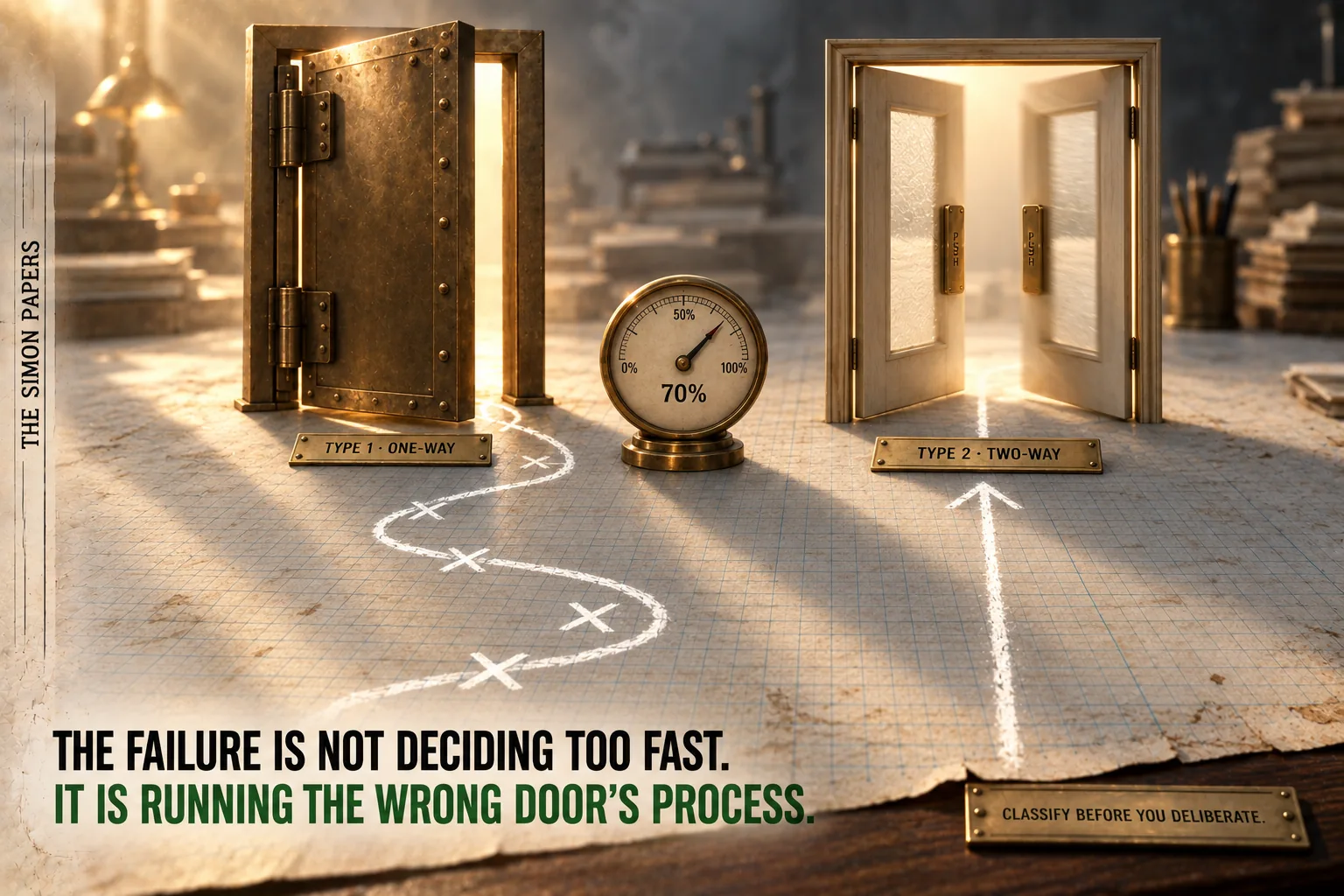
The best-documented satisficing rule in modern business sits in a shareholder letter. In his 2015 letter, Jeff Bezos split decisions into two kinds: Type 1 — consequential, irreversible or nearly so, one-way doors, to be made methodically, carefully, slowly — and Type 2 — changeable, reversible, two-way doors, where a suboptimal call can simply be walked back. His diagnosis: as organizations grow, they run the heavyweight Type 1 process on everything, and the result is slowness and diminished invention. The following year's letter added the number: most decisions should be made with somewhere around 70% of the information you wish you had.
Bezos was writing operating advice, but he was restating a Nobel-winning result. Herbert Simon proved in the 1950s that exhaustive search for the best option is not what rational decision-making looks like — not for people, not for organizations, not even in principle. He named the actual strategy satisficing: satisfy plus suffice. Define what good enough means, search until you find it, stop.
Now look at the comparison spreadsheet currently open somewhere in your organization — fourteen vendors, forty criteria columns, a decision meeting that keeps rescheduling. This piece is about why that spreadsheet is usually the expensive mistake, what the evidence says it costs the people who build it, and how to satisfice deliberately — including the cases where you genuinely should maximize. The theory behind it all has its own companion piece: Simon's bounded rationality.
Decision makers can satisfice either by finding optimum solutions for a simplified world,
or by finding satisfactory solutions for a more realistic world.
— Herbert A. Simon, Nobel Memorial Lecture (December 8, 1978)
Doing Better, Feeling Worse: What Maximizing Actually Buys
The classic test tracked university students through their final-year job search. Sheena Iyengar, Rachael Wells and Barry Schwartz measured who approached the search as maximizers — determined to find the best possible job — and who satisficed against their own criteria. The maximizers won on paper: starting salaries about 20% higher. And they lost everywhere else: less satisfied with the jobs they took, more pessimism, stress and regret throughout the process (Psychological Science, 2006 — the paper's title says it: Doing Better but Feeling Worse).
The broader maximizing literature, running from Schwartz's original 2002 studies through recent reviews, repeats the pattern: maximizing tendencies correlate with more regret, more decision difficulty, more depression and less life satisfaction — with regret doing much of the damage. A 20% salary bump is real money and may be worth it once, at a career hinge. As a default operating mode for a team, maximizing buys marginal object-level gains at a compounding subjective and organizational cost: slower decisions, exhausted deciders, and choices everyone second-guesses because the process promised best and best is unfalsifiable.
The Math Was Never on the Spreadsheet's Side
Even if search were free of regret, it isn't free of time — and the mathematics of when to stop searching has an exact answer for an idealized case. In the classic secretary problem (rank candidates seen one at a time, no going back), the provably optimal strategy is to observe the first 37% of options without committing, then take the first one better than everything seen so far. Not 100%. Not most. Thirty-seven percent — and that is the optimal policy, in a setting engineered to favor thorough search.
Real decisions are messier than the theorem, but its lesson transfers: rational search examines a fraction of the option space and commits. Three forces guarantee it. Search costs are real — every evaluation hour has an opportunity cost. Returns diminish — the difference between the 90th and 95th percentile option is small and shrinking. And delay compounds — the market a decision was meant to serve moves while the decision is being perfected. A good decision executed for two months usually beats a slightly better one that arrives two months late.
The Satisficing Framework: Five Steps
Satisficing done deliberately is a process, and the discipline is front-loaded:
1. Define aspiration levels first
Before seeing a single option, write the minimum criteria: what must it do, the budget ceiling, the risk floor. Criteria written after the demos start get bent around whichever option demoed best.
2. Set a search budget
Decide upfront how much time and how many options the decision gets — proportional to stakes and reversibility. Five options and two weeks is a policy; we'll know it when we see it is not.
3. Evaluate sequentially, against the criteria
Each option is checked against the written criteria — pass or fail — not ranked against the other options. Cross-option comparison is what turns evaluation into an unbounded tournament.
4. Take the first pass
This is the counterintuitive step and the whole point. An option cleared the bar you set when you were thinking clearly about what mattered. One more look, just to be sure re-opens infinite search.
5. Document, then move on
Record the criteria, what was evaluated, and why the pick passed — then release the team's attention to the next decision. The record is what stops the re-litigation.
When to Maximize Instead: The One-Way Doors
Satisficing is a default, not a dogma, and the exceptions are exactly Bezos' Type 1 decisions. Maximize when the decision is irreversible or nearly so (an acquisition, a platform migration, a co-founder); when the option space is small enough to actually enumerate; when nothing forces speed; or when tiny quality differences compound for years. Those decisions deserve the full apparatus — wide search, structured debate, devil's advocates, time.
The failure mode is almost never maximizing a two-way door too little. It is running the one-way-door process on two-way doors — fourteen-vendor spreadsheets for a tool you could swap out next quarter. The skill is triage: classify the door first, then pick the process. Product teams will recognize satisficing under its other names — the MVP, the iteration, Reid Hoffman's famous advice that a first version which doesn't embarrass you shipped too late. Agile is satisficing applied to scope: ship good enough, learn, adjust — because the market lesson you buy by shipping is worth more than the polish you'd buy by waiting.
But What If We Miss Something Better?
You will. That is not a flaw in satisficing — it is a fact about option spaces, and it holds for maximizers too. There is always another vendor, another candidate, another framework; the exhaustive search that would rule them all out does not terminate. Maximizing doesn't close the gap, it only moves the moment of stopping later and prices it higher.
And the fear points the wrong way, because the regret data runs against the maximizers, not the satisficers. The people most determined not to miss something better are the ones the studies find least satisfied with what they chose. Well-set aspiration levels are the honest answer to the fear: if something genuinely important would be missed, it belongs in the criteria — and then satisficing protects it better than an open-ended search does, because the criteria are written down and checked instead of floating in the room.
The residual risk is real but different: aspiration levels can be set badly. Too low, and you accept the mediocre; too high, and nothing ever passes — which is decision paralysis wearing a process costume. Calibration comes from the record: when you document criteria and outcomes, you find out which bars were wrong and move them — that is what the decision log is for.
The question was never whether something better is out there.
It is whether finding it is worth what the search costs.
The satisficing calculation, compressed
The diagnostic question
Which decision on your desk right now is a two-way door being run through your one-way-door process — and what has that delay cost so far?
Where Argumentree Fits
The hardest part of satisficing is not understanding it — it is trusting the stop. Teams keep searching because nobody can see that the bar was genuinely cleared. Argumentree makes the stop trustworthy: the criteria live in a shared structure everyone sees before options arrive; the arguments for and against each option are laid out and rated instead of re-argued from memory; and the record — criteria, evaluations, reasoning — persists, so the decision doesn't get re-opened every time someone new hears about a shinier alternative.
Visible criteria, weighed arguments, a durable record: that is the environment in which good enough is a defensible standard instead of a hopeful shrug.
Start With One Decision
Pick one decision your team is currently maximizing. Classify the door — if it's reversible, write the criteria, set the budget, take the first pass, and log it. The discomfort you feel at stopping is not the feeling of doing something wrong; it is the feeling of doing something different, with a Nobel Prize, a stopping theorem and a stack of regret studies behind it.
Simon's standard was never mediocrity. It was reliability: the organization that decides well consistently beats the one that decides perfectly occasionally, because the second one doesn't exist.
The goal isn't maximum decision quality. It's sufficient quality at the right speed, delivered reliably.
Make Good Enough Defensible
Shared criteria, weighed arguments and a permanent decision record — the infrastructure that lets a team stop searching with confidence.
Sources & Further Reading
- Simon, H. A. (1978). Rational Decision-Making in Business Organizations. Nobel Memorial Lecture, December 8, 1978Source of the pull quote — the two ways decision-makers can satisfice.
- Iyengar, S. S., Wells, R. E. & Schwartz, B. (2006). Doing Better but Feeling Worse: Looking for the 'Best' Job Undermines Satisfaction. Psychological Science, 17(2), 143–150The job-search study: maximizers' starting salaries ~20% higher, satisfaction and affect lower.
- Schwartz, B., Ward, A., Monterosso, J., Lyubomirsky, S., White, K. & Lehman, D. R. (2002). Maximizing versus satisficing: Happiness is a matter of choice. Journal of Personality and Social Psychology, 83(5), 1178–1197The original maximization-scale studies linking maximizing to regret, depression and lower life satisfaction.
- Misuraca, R. & Fasolo, B. (2018). Maximizing versus satisficing in the digital age. Personality and Individual Differences, 122, 152–160Review of the maximizer/satisficer evidence and its measurement debates.
- Amazon.com 2015 Letter to Shareholders (Jeff Bezos)The Type 1 / Type 2 decision distinction — one-way and two-way doors — quoted in the cold open; the ~70% figure appears in the following year's letter.
- Ferguson, T. S. (1989). Who Solved the Secretary Problem? Statistical Science, 4(3), 282–289The optimal-stopping literature behind the 37% rule.
Frequently Asked Questions
What does satisficing mean in business?
Satisficing means defining minimum acceptance criteria for a decision — an aspiration level — searching until an option clears them, and stopping. The term, coined by Nobel laureate Herbert Simon from satisfy and suffice, describes the rational strategy when time, information and attention are limited: for most business decisions, the cost of continued search exceeds the value of a marginally better find.
Is satisficing just settling for less?
No. Satisficing optimizes the complete decision, including the cost of deciding. A team that picks a good-enough tool in two weeks and executes beats a team that finds a marginally better tool in three months, because the delay itself is a cost. Settling is accepting an option that fails your criteria; satisficing is refusing to keep paying for search after an option has passed them.
What is the evidence that maximizing backfires?
In Iyengar, Wells and Schwartz's 2006 job-search study, maximizers secured starting salaries about 20% higher than satisficers yet were less satisfied with their jobs and experienced more negative emotion throughout the search. The wider literature since Schwartz's 2002 studies consistently links maximizing tendencies with more regret and decision difficulty and lower well-being — objectively better, subjectively worse.
When should you maximize instead of satisfice?
Maximize on Type 1 decisions, in Jeff Bezos' 2015 shareholder-letter terms: consequential one-way doors that are irreversible or nearly so, where the option space is small enough to enumerate, delay is cheap, and quality differences compound for years. Satisfice on Type 2 decisions — reversible two-way doors — which describes most vendor, hiring, prioritization and process choices.
What is the 37% rule?
It is the solution to the secretary problem in optimal-stopping mathematics: when options arrive one at a time and cannot be revisited, the optimal strategy is to observe the first 37% without committing, then choose the first option better than everything seen so far. Its practical lesson is that even provably optimal search examines only a fraction of the options before committing.
How do you implement satisficing in a team?
Five steps: define aspiration levels before seeing options; set a search budget in time and option count; evaluate options sequentially against the written criteria rather than against each other; select the first option that passes; and document the criteria and reasoning so the decision is not re-litigated. The written criteria are what prevent goalpost-shifting.
How does satisficing relate to agile and the MVP?
Agile is satisficing applied to product scope: ship the increment that meets user needs, learn from reality, iterate. The minimum viable product is an aspiration level for a release. Both rest on Simon's logic — the cost of delay (missed learning, moved markets) exceeds the cost of imperfection you can correct later.
Stop Searching. Start Deciding.
Define the criteria, weigh the arguments, keep the record — satisficing with the confidence of a visible process.
About Argumentree Team
Decision Science
The Argumentree team is building the collaborative decision-making platform Argumentree. Our mission is to transform how organizations make, document, and learn from decisions.
Related Articles
Is good enough ever good enough for strategy?
Argue the one-way-door exception — structured — on the Argumentree forum.
Join the Discussion