
Decision Fatigue in Teams: The Honest Science and the Practices That Survive It
Decision fatigue in teams: the honest state of the science, and the sequencing practices that work regardless. The classic ego-depletion model (Baumeister 1998) failed a 23-lab registered replication in 2016 (Hagger et al.), and the famous hungry-judges parole study (Danziger 2011) has a documented case-ordering critique (Weinshall-Margel & Shapard) — so treat the willpower-battery mechanism as contested. What teams should do anyway, because the practices are free and the cost asymmetry favors them: put consequential decisions early on the agenda, batch trivial choices behind defaults, separate deliberation meetings from decision meetings, cap consequential decisions per session, and never decide the biggest item in the last five minutes of an overrunning meeting.
"Decision fatigue" is one of the most-cited ideas in productivity writing — and its scientific foundations are genuinely shaky. This post gives you both halves honestly: what the replication record actually says, and the team practices worth adopting regardless of how that debate resolves:
- The mechanism is contested. Ego depletion failed a 23-lab registered replication (Hagger et al., 2016); the famous hungry-judges study has a published case-ordering critique. The willpower battery is not settled science.
- The practices don't need the mechanism. Attention and patience degrade across long sessions for mundane, uncontroversial reasons — and decision sequencing costs nothing to fix.
- The five team fixes: big decisions early on the agenda · trivial choices batched behind defaults · deliberation separated from deciding · a cap on consequential calls per session · and no major decision in an overrunning meeting's last five minutes.
- The last one is the real enemy — the end-of-meeting pile-up, where the hardest item gets the tiredest room and the least time.
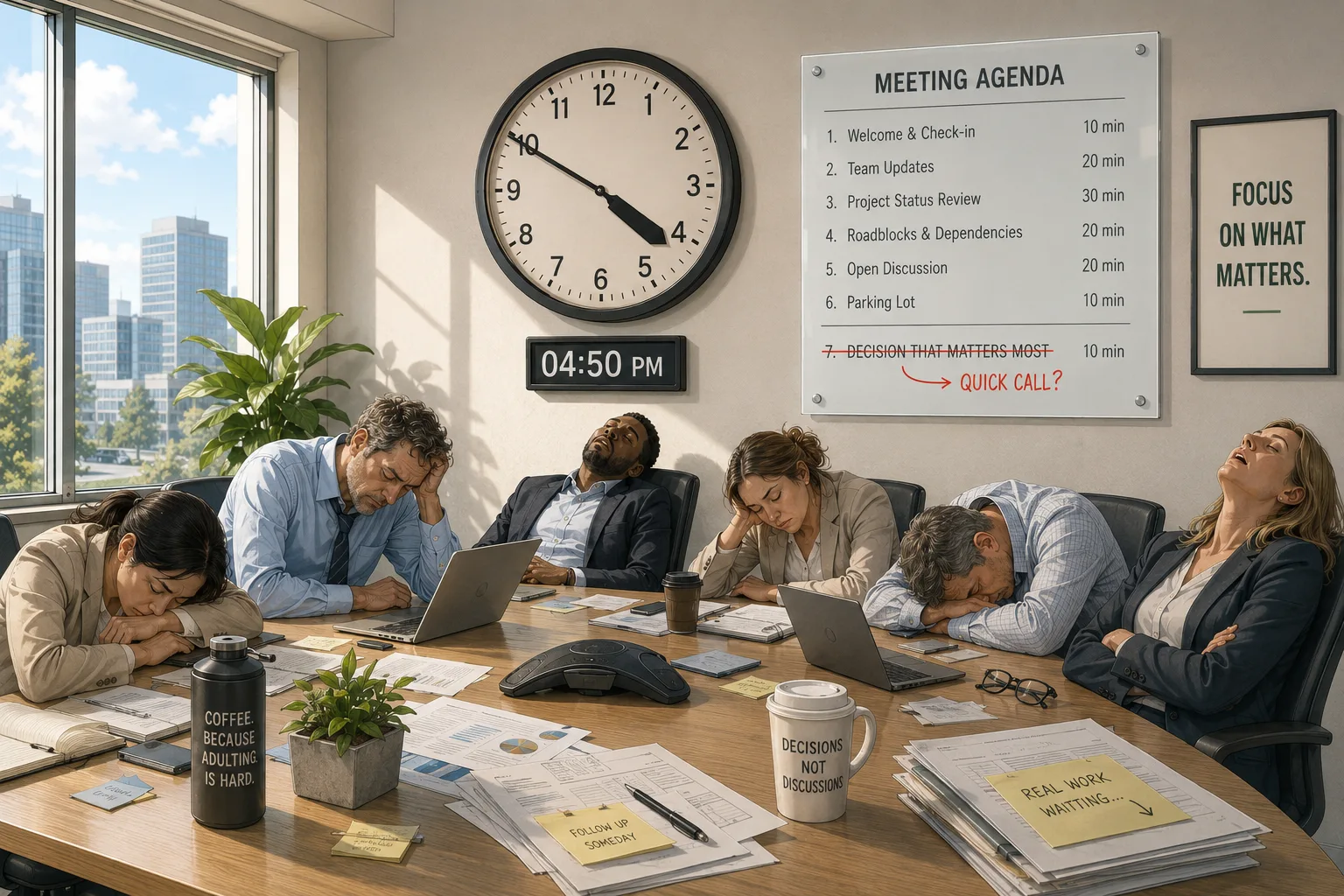
It's 4:50 on a Thursday. The architecture review has run ninety minutes; two easy items ran long, everyone's next meeting starts at five. The chair looks at the last agenda item — the one that commits the team for two years — and says the sentence every engineer has heard: "We're almost out of time, so — quick call on this one?"
The room takes the quick call. Not because anyone weighed the options and found them close, but because it was late, everyone was tired, and agreeing was the fastest way out the door. Eleven months later, that two-year commitment is the decision nobody can quite defend.
The popular name for this is decision fatigue — and this post is going to do something most coverage of it won't: tell you honestly that the science behind the popular story is contested, and show you why the team-level fixes are worth adopting anyway. The two halves belong together, because practices built on a myth eventually collapse with it — practices built on cost asymmetry don't. (One boundary up front: this post is about team sequencing — agendas, batching, meeting design. Individual-level decision hygiene is a different toolkit — the full five-move process lives in how to make better decisions.)
The question isn't whether your willpower is a battery.
It's why your hardest decision got the meeting's worst five minutes.
The practical core of decision fatigue, mechanism aside
The Famous Story — What Decision Fatigue Claims
The claim comes in two layers. The lab layer is ego depletion: Roy Baumeister's 1998 experiments suggested self-control draws on a limited resource — exert it on one task (resisting cookies, suppressing emotion) and you have less for the next. Hundreds of studies built on the model; "willpower is a muscle that tires" became one of psychology's most exported ideas.
The headline layer is the hungry-judges study: Danziger and colleagues' 2011 analysis of over a thousand Israeli parole rulings found favorable decisions starting near 65% at the beginning of a session and collapsing toward zero before food breaks — then rebounding after. It became the go-to illustration: even trained judges, the story goes, default to the easy "no" as the session grinds on.
What the Research Honestly Says
Both layers have taken serious, documented hits. In 2016, a 23-laboratory registered replication (Hagger et al., over two thousand participants, protocol agreed in advance) found an ego-depletion effect statistically indistinguishable from zero. That doesn't prove the phenomenon is nothing — the debate continues, and later work explores when and for whom effects appear — but it means the strong "willpower battery" model you've read in productivity books is contested at its foundation.
The hungry-judges study has its own published critique: Weinshall-Margel and Shapard showed the case ordering wasn't random — unrepresented prisoners tended to cluster later in sessions, and the board scheduled prisons in blocks — which can produce the dramatic curve without any fatigue at all. Danziger's team published a reply defending their result; the honest summary is that the most famous decision-fatigue graph in the world has a live, unresolved methodological dispute attached to it.
So: anyone selling you decision-fatigue advice because the science proves it is overclaiming. What actually survives scrutiny is more modest and more useful — sustained attention, patience and willingness to engage genuinely degrade across long sessions (nobody disputes that meetings decay; pick your own memory of minute 85), and the order in which a team takes its decisions is a free variable. You don't need a glucose model to justify not deciding the biggest thing last.
Why Teams Should Sequence Anyway
Here is the reframe that makes the contested science almost irrelevant: the team-level practices are nearly free, and the downside they insure against is expensive. Moving the consequential item to the top of the agenda costs nothing. Batching trivial choices costs nothing. If late-session judgment decline is real, these practices capture the benefit; if it's smaller than claimed, they cost you nothing to have adopted. That asymmetry — not the parole graph — is the actual argument.
And teams have one exposure individuals don't: the end-of-meeting pile-up. Agendas are ordered by politeness and habit, not by stakes — status updates first, hard calls last — so the most consequential item structurally inherits the tiredest room, the thinnest remaining attention, and the social pressure to just agree and leave. That failure mode needs no contested psychology at all; it's visible in any calendar.
Cheap practices don't need
expensive proof.
The Five Team-Level Practices
All five are agenda and process design — no willpower required, which is rather the point:
1. Big decisions first
The consequential item opens the meeting, when attention and dissent are cheapest. Status updates survive a tired room; two-year commitments shouldn't have to.
2. Batch the trivial behind defaults
Recurring small choices get standing defaults decided once — meeting cadences, tool conventions, formats. Every default adopted is a decision the team stops re-making weekly, which is worth having even if depletion were zero.
3. Separate deliberation from decision
Explore options in one session; decide in another, shorter one. The gap removes the worst coupling — where the same exhausting discussion must also produce the verdict before the room empties.
4. Cap consequential calls per session
One, maybe two significant decisions per meeting. A ten-decision agenda guarantees that decisions six through ten get a different, worse process than one through five — whatever the mechanism.
5. Never decide big in the overrun
The rule that would have saved the 4:50 architecture call: an overrunning meeting may schedule the big decision, never take it. "Quick call on this one?" is a process smell, not a time-saver — the re-litigation it buys costs ten times the minutes it saved.
"If the Science Is Shaky, Why Change Anything?"
The skeptic's case deserves its strongest form: ego depletion failed its flagship replication; the judges study may be an ordering artifact; so "decision fatigue" is a productivity-industry myth, and reorganizing meetings around a myth is cargo-cult management. Worse, the concept invites abuse — "I was decision-fatigued" becomes an unfalsifiable excuse for any bad call made after lunch.
Half of that critique this post simply accepts — which is why the practices above were argued from cost asymmetry and agenda design, not from the contested mechanism. Putting the big item first needs no psychology: it needs only the observation that time pressure and attention are worse at minute 85 than minute 5, which nobody disputes. The practices are robust to the science resolving either way; that's what makes them worth adopting, and it's the standard this site's groupthink post applies to its own contested lens.
The abuse concern is also right — so don't weaponize the term. "Decision fatigue" is a reason to design better agendas before the meeting, never an excuse presented after a bad call. If the phrase appears in your retros more often than in your agenda planning, it's being used backwards.
The Diagnostic
Pull up the agenda of your team's last three decision meetings. Where did the most consequential item sit — and how many minutes actually remained when the room reached it? If the answer is "last" and "four", you don't have a willpower problem. You have an agenda problem.
How Argumentree Removes the 4:55 Deadline
The deepest fix isn't a better agenda — it's decoupling the decision from the meeting clock entirely. In Argumentree, the deliberation lives in a structured argument tree that doesn't evaporate when the meeting ends: options, pro and con arguments, and ratings accumulate asynchronously, so people contribute when they're sharp rather than when the calendar says the room is booked.
That turns practice 3 — separate deliberation from decision — from a scheduling discipline into a default: the arguments are already assembled and weighed before anyone convenes, the meeting (if one is needed at all) only confirms the call, and the decision record exists automatically. Nothing consequential ever again depends on what a tired room could manage in its final five minutes.
Design the Agenda, Skip the Debate
The decision-fatigue literature will keep arguing about mechanisms, and the honest position is to hold that debate loosely. What your team controls today is sequence: which decision meets the fresh room and which meets the exhausted one — and right now, in most organizations, that assignment is exactly backwards.
So take the Thursday meeting from the opening and change one line of it: the two-year commitment goes first, the status updates go last, and if the clock runs out it runs out on the updates. Same people, same hour, same tiredness — different decision quality. No glucose required.
Put the decision that matters where the attention still is.
Take the Clock Out of the Decision
Async, structured deliberation — arguments assembled before anyone is tired, and a record that outlasts the meeting.
Sources & Further Reading
- Baumeister, R. F., Bratslavsky, E., Muraven, M., & Tice, D. M. (1998). Ego Depletion: Is the Active Self a Limited Resource? Journal of Personality and Social Psychology, 74(5), 1252–1265.The original ego-depletion experiments the popular model is built on.
- Hagger, M. S., et al. (2016). A Multilab Preregistered Replication of the Ego-Depletion Effect. Perspectives on Psychological Science, 11(4), 546–573.The 23-lab registered replication: effect statistically indistinguishable from zero.
- Danziger, S., Levav, J., & Avnaim-Pesso, L. (2011). Extraneous Factors in Judicial Decisions. PNAS, 108(17), 6889–6892.The hungry-judges parole study — the most famous decision-fatigue graph in the world.
- Weinshall-Margel, K., & Shapard, J. (2011). Overlooked Factors in the Analysis of Parole Decisions. PNAS, 108(42), E833.The case-ordering critique: non-random session ordering can produce the curve without fatigue. Danziger's team published a reply; the dispute remains live.
Frequently Asked Questions
What is decision fatigue?
The claim that decision quality and willingness to engage decline as decisions accumulate across a session — popularized through ego-depletion research and the hungry-judges parole study. The strong version (willpower as a depletable resource) is scientifically contested; the practical version (long sessions degrade attention, so sequence decisions deliberately) is uncontroversial.
Is decision fatigue scientifically proven?
The mechanism is contested. Ego depletion failed a 23-laboratory preregistered replication in 2016 (Hagger et al.), and the famous parole study has a published case-ordering critique with an unresolved back-and-forth. The team practices in this post are argued from cost asymmetry and agenda design, so they hold regardless of how the scientific debate resolves.
What happened with the hungry-judges study?
Danziger et al. (2011) found parole approvals collapsing before food breaks and rebounding after. Weinshall-Margel and Shapard showed the case ordering was not random — unrepresented prisoners clustered later in sessions — which can produce the pattern without fatigue. Danziger's team replied defending the result; cite the study only together with the critique.
How do teams reduce decision fatigue in meetings?
Five sequencing practices: put the most consequential decision first on the agenda; batch trivial recurring choices behind standing defaults; separate deliberation sessions from decision sessions; cap consequential decisions at one or two per meeting; and never take a major decision in the closing minutes of an overrunning meeting — schedule it instead.
Why order the agenda by stakes instead of by convention?
Because conventional agendas put status updates first and hard calls last, which structurally assigns the most consequential item the tiredest room, the least remaining time, and the strongest social pressure to just agree. Reversing the order costs nothing and removes that exposure entirely.
Does asynchronous deliberation help with decision fatigue?
Yes, by removing the coupling entirely: when options and arguments accumulate asynchronously in a structured format, people contribute at their sharpest rather than in a booked room's final minutes, and the eventual decision confirms an already-assembled case instead of being produced under the clock.
Stop Deciding Big Things in Tired Rooms
Structured async deliberation with automatic decision records — the case is built before the clock matters.
About Argumentree Team
Decision Science
The Argumentree team is building the collaborative decision-making platform Argumentree. Our mission is to transform how organizations make, document, and learn from decisions.
Related Articles
Think ego depletion will replicate after all?
Make the case — structured — on the Argumentree forum.
Join the Discussion