
Three lines on a card, and the reason your meeting agrees too fast
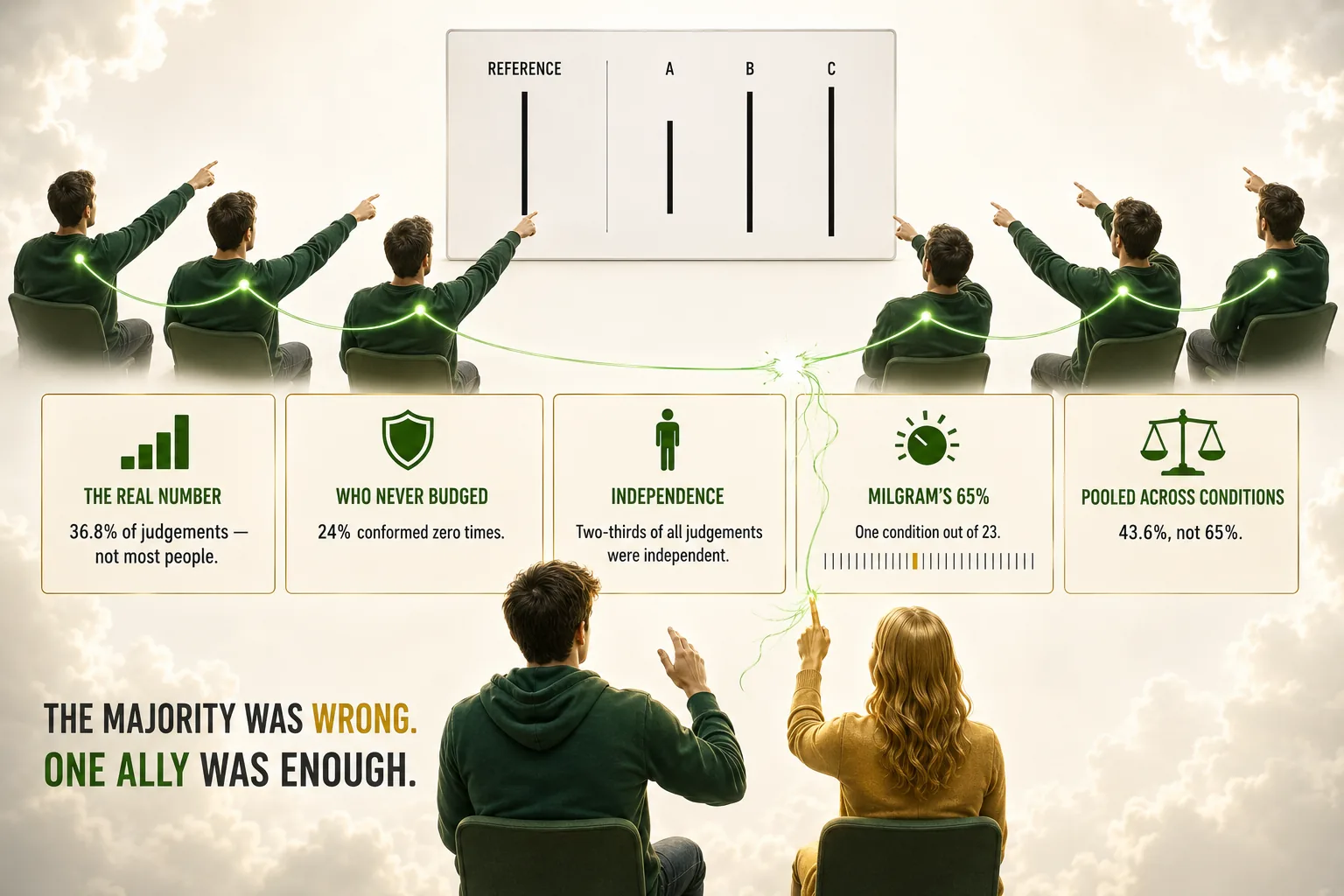
The setup was almost insultingly simple. A card with one reference line, a second card with three comparison lines, and a question a child could answer: which one matches? In the control condition, people got it right more than 99 per cent of the time. Then Solomon Asch seated one real participant among confederates instructed to give the same wrong answer out loud, in turn, before the real subject had to speak.
Asch published the definitive account in Psychological Monographs in 1956, based on 123 critical subjects. His own summary:
The action of the majority distorted one-third of the reported estimates, in contrast with errors of less than 1 per cent under control conditions.Sit with the size of that. The task had an objectively correct answer, visible on the table, and unanimous social pressure moved more than a third of the answers. Now consider that your last strategy meeting had no objectively correct answer visible on the table, and that the people speaking before you were not strangers but your colleagues and your boss.
— Solomon E. Asch, Studies of Independence and Conformity: I (1956), p. 10
But the textbook version gets Asch backwards
Here is where most retellings go wrong, and where the finding gets more useful rather than less. Asch himself emphasised the resistance. Roughly 24 per cent of subjects never conformed once, and about two-thirds of all judgements were independent. At the other end, 27 per cent conformed on eight to twelve of the twelve critical trials. As he put it:
One-fourth of the experimental groups (24 per cent) gave errorless estimates, while an approximately equal number (27 per cent) gave majority-determined estimates from eight to twelve times.
— Asch (1956), p. 11
Two more corrections worth carrying. First, the 32 per cent figure you have probably seen quoted is not the number Asch published — his own figure, in both the 1955 Scientific American article and the 1956 monograph, is 36.8 per cent. Second, the sample was 123 white male American college students in the early 1950s, which is precisely the caveat Bond and Smith's 1996 meta-analysis in Psychological Bulletin put to the test across 133 studies from 17 countries:
Bond & Smith found the Asch effect robust — but higher in collectivist than individualist cultures, and declining in US samples since the 1950s. That is the most actionable sentence in this literature: if conformity moves with context, then context is something you can design. A meeting is a context.
Milgram, and the number that is really one condition out of twenty-three
Stanley Milgram's obedience study is the other pillar, and its headline is even more misused. His first report, in the Journal of Abnormal and Social Psychology in 1963, was unambiguous about what happened with 40 men from New Haven:
Of the 40 subjects, 26 obeyed the orders of the experimenter to the end, proceeding to punish the victim until they reached the most potent shock available on the shock generator.
— Stanley Milgram, Behavioral Study of Obedience (1963), p. 376
Sixty-five per cent. The trouble is that Milgram ran 23 conditions, not one, and the famous figure comes from a single small sample. When Haslam, Loughnan and Perry pooled the 21 comparable conditions in PLOS ONE in 2014, the obedience rate across 740 participants was 43.6 per cent, with individual conditions ranging from 2.5 per cent to 92.5 per cent. "Sixty-five per cent of people obey" is not a fact about people. It is a fact about one room, one script, and forty men.
- ✗The replication is narrower than it sounds. Jerry Burger's 2009 partial replication (American Psychologist) found 70 per cent continuing past 150 volts, close to Milgram's comparable condition — but Burger stopped everyone at 150 volts on ethical grounds and inferred forward, and his screening excluded 38.2 per cent of second-stage volunteers.
- ✗Belief contamination is the damaging one. Perry, Brannigan, Wanner and Stam, working from Milgram's own unpublished analysis (Social Psychology Quarterly, 2020), found fewer than half of subjects expressed no doubt the shocks were real — and that scepticism increased obedience, while believing the pain was real increased defiance.
- ✗The script drifted. Stephen Gibson's rhetorical analysis (British Journal of Social Psychology, 2013) documents the experimenter departing from the standardised prods — the fourth and most coercive prod produced further shocks from only 2 of the 23 participants it was used on.
So what survives — and why it matters more at work than in a lab
Strip both studies back to what the evidence actually supports and you are left with something narrower but genuinely load-bearing: unanimity moves judgement even when the answer is checkable, and instruction from a perceived authority moves behaviour further than people predict it will. Both effects vary enormously with conditions. Neither is destiny.
The organisational evidence is a different genre, and in some ways more alarming. In 1966 Charles Hofling and colleagues ran a field experiment in real hospitals: an unknown "doctor" phoned nurses and ordered a clearly excessive dose of a fictitious drug, breaking several standing rules at once. Nearly all of the nurses on the ward were prepared to comply — while nurses asked about the same scenario on paper overwhelmingly said they would refuse. What people predict about their own deference is not what they do. (A 1977 replication by Rank and Jacobson, where nurses knew the drug and could consult colleagues, found compliance collapsed — which is itself the design lesson.)
And then there is the meeting everyone in this field eventually reaches for, because it is documented rather than anecdotal. On 27 January 1986, Thiokol engineers recommended against launching Challenger below 53°F. After an off-line caucus, management came back with a different answer. The Rogers Commission recorded it plainly: Thiokol Management reversed its position and recommended the launch of 51-L, at the urging of Marshall and contrary to the views of its engineers. Roger Boisjoly's testimony preserved the moment it turned — a senior manager asking a colleague to take off his engineering hat and put on his management hat.
The technique: design the conditions, not the character
The single most useful detail in Asch's work is one people rarely mention: the effect collapsed when the subject had one ally. Not a majority — one. That is a design parameter, and every item below is a way of manufacturing it.
- ✓Collect positions before anyone speaks. Asch's pressure needs an audience and an order of speaking. Written, independent input removes both — this is the same move that defuses social proof and authority in one step.
- ✓Have the senior person go last, always. Not as courtesy — as method. Authority stated first does not add information; it removes it.
- ✓Assign the dissent so nobody has to volunteer it. A rotating role means the lone objector is executing an assignment rather than risking a reputation, which is the manufactured ally Asch's variations found so powerful.
- ✓Record who disagreed and why. A decision record that preserves the minority position turns dissent into an asset — and makes it much harder for a room to quietly reverse its engineers.
- ✓Rate the argument, not the arguer. When claims are scored on their evidence in the tree, agreeing with the boss and agreeing with the case become visibly different acts.
One ally was enough
The tempting reading of Asch and Milgram is bleak: people fold, people obey, resistance is rare. The evidence does not support that, and the corrected numbers are the good news. A quarter of Asch's subjects never budged. Obedience across Milgram's conditions was under half, and swung from almost nobody to almost everybody depending on how the room was arranged.
Which means the useful question was never whether your colleagues have the character to dissent. It is whether your meeting is arranged so that they need to be heroes in order to do it — because the one intervention that reliably worked in Asch's lab was not courage. It was company.
Sources & further reading
Every named source in this post, with a link where one exists. Where a number is contested, the body says so rather than picking the impressive version.
- •Asch, S. E. (1956). Studies of independence and conformity: I. A minority of one against a unanimous majority. Psychological Monographs, 70(9), Whole No. 416. — 123 critical subjects; 36.8% of estimates distorted; 24% never conformed.
- •Asch, S. E. (1955). Opinions and Social Pressure. Scientific American, 193(5), 31–35. — the accessible account, and the source of the 36.8% figure in Asch's own words.
- •Bond, R., & Smith, P. B. (1996). Culture and conformity: A meta-analysis of studies using Asch's line judgment task. Psychological Bulletin, 119(1), 111–137. — 133 studies, 17 countries; higher conformity in collectivist cultures; US decline since the 1950s.
- •Milgram, S. (1963). Behavioral Study of Obedience. Journal of Abnormal and Social Psychology, 67(4), 371–378. — 26 of 40 to the maximum switch.
- •Haslam, N., Loughnan, S., & Perry, G. (2014). Meta-Milgram: An empirical synthesis of the obedience experiments. PLOS ONE, 9(4), e93927. — 43.6% across 740 participants in 21 comparable conditions.
- •Burger, J. M. (2009). Replicating Milgram: Would people still obey today? American Psychologist, 64(1), 1–11. — the 150-volt partial replication and its screening protocol.
- •Perry, G., Brannigan, A., Wanner, R. A., & Stam, H. (2020). Credibility and incredulity in Milgram's obedience experiments. Social Psychology Quarterly, 83(1), 88–106. — belief contamination: scepticism inflated obedience.
- •Gibson, S. (2013). Milgram's obedience experiments: A rhetorical analysis. British Journal of Social Psychology, 52(2), 290–309. — the experimenter's departures from the standardised script.
- •Hofling, C. K., et al. (1966). An experimental study in nurse-physician relationships. Journal of Nervous and Mental Disease, 143(2), 171–180. — authority deference in a real hospital; see also Rank & Jacobson (1977), the failed replication under better conditions.
- •Presidential Commission on the Space Shuttle Challenger Accident (1986). Report, Vol. 1, Ch. V. — the documented reversal of the engineers' no-launch recommendation.