
Medieval Scholastic Logic: How the University Invented the Structured Argument
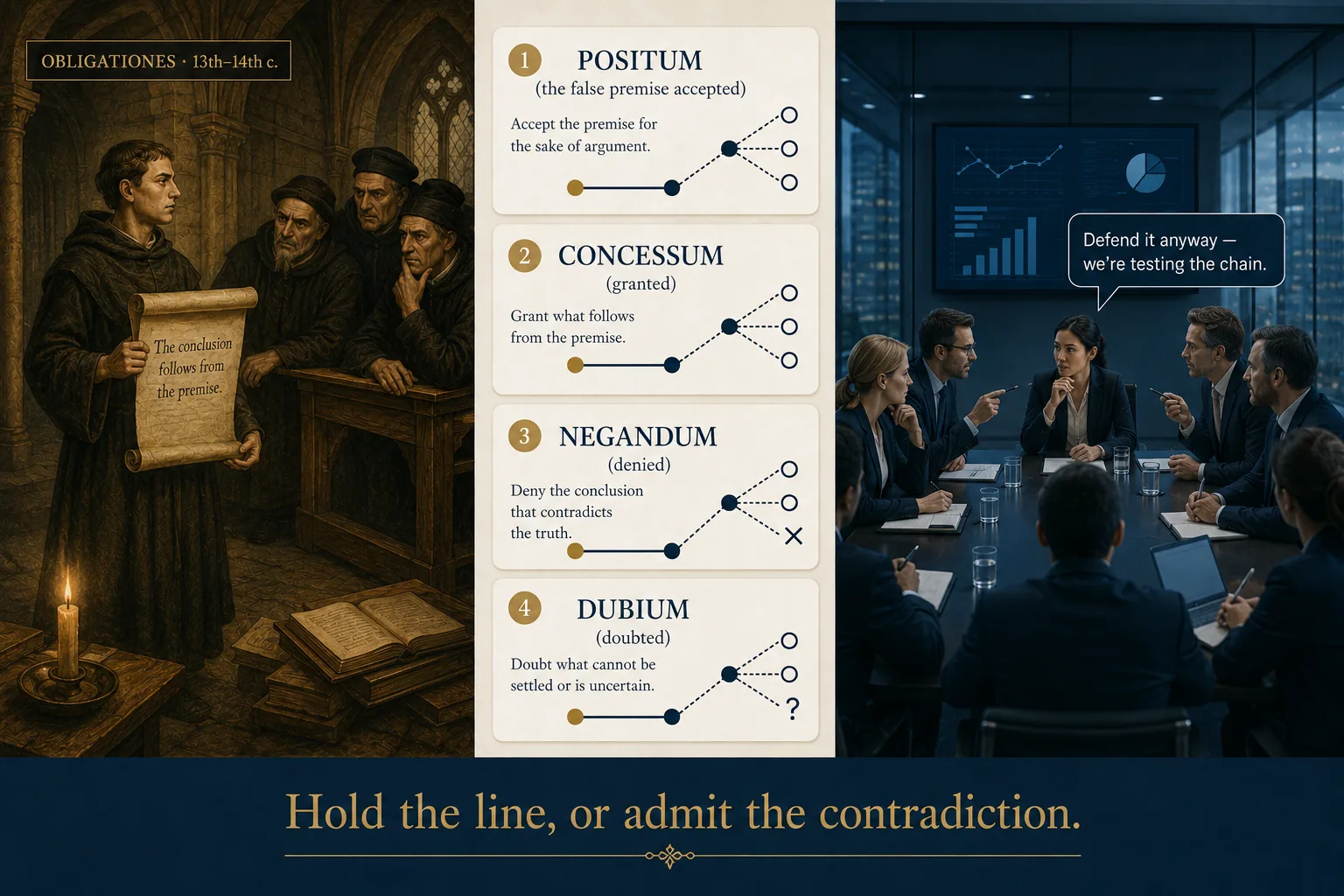
Medieval Latin scholastic logic spans roughly a millennium, from Boethius (c. 475–526 CE), who translated Aristotle's logical works into Latin, through the Port-Royal Logic of 1662. The tradition's distinctive achievement was not formal innovation in syllogistic but the institutionalization of structured argument as curriculum. Boethius's translations and commentaries defined the logica vetus that trained scholars until the full Aristotelian corpus arrived in the twelfth century. Peter Abelard's Sic et Non (c. 1121) pioneered the method of juxtaposing contradictory authorities and resolving them through dialectical analysis — the template for scholastic disputation. By the thirteenth century, universities formalized two disputation types: the ordinary quaestio disputata, where a master set the topic, and the quodlibet, where any audience member could pose any question. Aquinas's Summa Theologica follows the disputational structure: objections, sed contra, respondeo, replies. Most distinctive was obligationes — a logical game in which the respondent must defend an explicitly false proposition while remaining consistent, testing commitment management under adversarial conditions. Walter Burley codified four rules; Roger Swyneshed proposed alternatives. The format has no Greek precedent and anticipates modern thesis defenses. Renaissance humanists like Lorenzo Valla criticized scholastic logic as impractical; the Port-Royal Logic (1662) pivoted from syllogistic to epistemology and method, closing the scholastic era while preserving its argumentative rigor. The tradition's legacy is the university seminar, the thesis defense, and the expectation that intellectual progress emerges from formalized disagreement.
Medieval Europe did not merely inherit Greek logic — it built an institution around it. The university's entire teaching method was structured disagreement: a master presiding, a respondent defending, an opponent attacking, an audience watching to see who lost. The result was a thousand years of refinement in how to argue well under adversarial conditions — and a format we still use today, whether we know its name or not.
- Boethius transmitted Aristotle: his sixth-century translations and commentaries defined the logica vetus that trained scholars for six hundred years
- Abelard invented the method: Sic et Non (c. 1121) juxtaposed contradictory authorities and demanded resolution — the template for all scholastic disputation
- The university institutionalized conflict: the quaestio disputata and the quodlibet made structured argument the curriculum itself
- Obligationes tested consistency: a game in which you must defend a false proposition without contradicting yourself — the most distinctive Latin contribution, with no Greek precedent
- Port-Royal closed the era: the 1662 Art of Thinking pivoted from syllogistic to epistemology, marking the transition to modern logic
Aristotle was neither the first nor the only thinker to systematize argument. Eight connected pieces on the traditions that built the anatomy of reasoned disagreement — and what each one saw that the others missed.
- 1.The Global Roots of Reasoned Argument: How Three Civilizations Invented Logic
- 2.Indian Logic: The 2,500-Year Tradition from Nyāya to Buddhist Debate
- 3.Mohist Logic: The Chinese Art of Drawing Distinctions
- 4.Aristotle's Logic: The Mediterranean Foundation of Western Argument
- 5.Islamic Dialectics: From Theological Debate to the Science of Disputation
- 6.Medieval Scholastic Logic: How the University Invented the Structured ArgumentYou are here
- 7.Five Syllogisms: Comparing Argument Structures Across Civilizations
- 8.Schopenhauer's Art of Being Right: The First Field Guide to Bad-Faith Argument
- 9.Galileo's Dialogue: Four Days, Three Speakers, and the Argument He Got Wrong
The Day You Had to Defend Something You Knew Was False
Picture the scene: a thirteenth-century lecture hall at Oxford or Paris. A master presides. A student called the respondens sits in the hot seat. Another student, the opponens, is about to state a proposition — and whatever it is, the respondens must grant it and then defend it against all comers, without falling into contradiction.
The proposition might be obviously false. That is the point. The exercise is not about finding truth. It is about consistency under pressure — can you hold a position, any position, against an adversary trained to trap you in self-contradiction? The audience is watching to see who loses.
This is obligationes, a genre of medieval logic that has no Greek precedent and no modern equivalent outside the academic thesis defence it quietly became. It is the most distinctive thing the Latin scholastic tradition ever built — and almost no one outside medieval studies has heard of it.
This article is part of the Roots of Reasoning series on the world's argumentation traditions.
Boethius: The Man Who Saved Aristotle for Europe
Anicius Manlius Severinus Boethius (c. 475–526 CE) lived through the fall of Rome and died in prison under Ostrogothic rule. In between, he translated nearly the entire Aristotelian Organon into Latin — the Categories, On Interpretation, and the works of Porphyry that introduced the Greek corpus. His translation of the Posterior Analytics was later lost, but the rest survived.
For six hundred years, this was all Western Europe had. Historians call it the logica vetus — the old logic. Boethius's commentaries were the primary instruments by which ninth-through-twelfth-century scholars understood Aristotle, grappled with his problems, and preserved interpretations by earlier Greek commentators whose works did not otherwise survive.
When the full Aristotelian corpus arrived in the twelfth century — translated from Arabic and Greek, sometimes through multiple intermediary languages — it became the logica nova, the new logic. But the framework for reading it was still Boethius. His monographs on syllogisms taught students the form before they ever saw the Prior Analytics.
None of this was innovation in the formal sense. Boethius was a translator and commentator, not a Dignāga or an Ibn Sīnā. His achievement was transmission — and transmission, across a civilizational collapse, is achievement enough.
Abelard and Sic et Non: The Template for Scholastic Method
Peter Abelard (1079–1142) was a celebrity teacher, a controversialist, and — in his own telling — the most brilliant philosopher of his age. He was also the man who turned contradiction into method.
Around 1121 he compiled Sic et Non ("Yes and No"): 158 theological questions, each followed by quotations from Church Fathers that appeared to answer the question in contradictory ways. Is faith based on reason? Here is Augustine saying yes; here is Gregory saying no. Are priests required to be celibate? Here are authorities on both sides.
Abelard's innovation was to leave the contradictions unresolved — and to explain, in a prologue, how they might be resolved. Perhaps the same word meant different things to different authors. Perhaps one passage was meant figuratively. Perhaps one authority was better informed than another. The reader's job was to work through the apparent conflict and find the underlying harmony.
This was revolutionary. It was also, in the eyes of his critics, heretical — the contradictions were sacred texts, and leaving them exposed seemed to undermine faith. But the method stuck. Within a generation, the quaestio — a structured examination of arguments on both sides of a question, followed by the master's determinatio — became the standard form of scholastic teaching.
By doubting we come to questioning, and by questioning we perceive the truth.
The University: Institutionalizing Conflict
The medieval university — Paris, Oxford, Bologna — was not like a modern university. There was no campus. There were no departments in the modern sense. What there was, was a guild of masters and students, licensed to teach and examine, with a curriculum built almost entirely around structured argument.
The trivium — grammar, rhetoric, and logic — was the foundation. Logic meant Aristotle, read through Boethius, applied through disputation. By 1255, the entire Aristotelian corpus was required reading in the Paris arts faculty. And the method of reading it was not silent contemplation but oral combat.
Two disputation formats dominated:
- Quaestio disputata: the master sets a topic, divides it into articles, hears arguments on both sides, and delivers a determinatio — his authoritative resolution
- Quodlibet (de quolibet ad voluntatem cuiuslibet): held during Advent and Lent, open to the public, on any question proposed by anyone present — a high-wire act that only senior masters attempted
The quodlibet was a public spectacle. Other masters attended, students from other schools, townspeople. The questions ranged from the highest theology ("Can God make the past not have happened?") to the practical ("Is it permissible to charge interest on a loan?") to the absurd. The master had to answer without preparation, on his feet, before an audience ready to judge him.
This is what medieval historians mean by "the institutionalization of conflict". The entire curriculum assumed that truth emerged from structured disagreement — that you learned by attacking and defending, not by receiving doctrine passively. The form is still with us, in thesis defenses and academic seminars, though the intensity has faded.
The diagnostic question
When was the last time someone in your organization was formally required to state the best arguments against their own proposal, in front of an audience empowered to declare them defeated? If never, you have less structured conflict than a thirteenth-century theology student — and probably worse decisions as a result.
Aquinas and the Summa Form
Thomas Aquinas (1225–1274) was the master who turned the disputation into literature. His Summa Theologica — possibly the most influential work in the Western intellectual tradition — follows the quaestio structure in writing: question, objections, sed contra ("but on the other hand…"), respondeo ("I answer that…"), replies to objections.
The form is so familiar that it is easy to miss how strange it is. Aquinas does not simply state his position. He states the strongest objections first, in their own voice, and then responds to each one by name. The reader is never allowed to forget that the question is contested.
The Summa was never finished — Aquinas stopped writing in December 1273 after what may have been a stroke or a mystical experience, and died three months later. But the form was complete. It became the model for systematic theology, and through theology, for any discipline that aspired to comprehensiveness.
What Aquinas gave the West was not just content but structure: the expectation that a serious argument must engage its opponents explicitly, state their best case, and only then respond. It is the structure of the academic article, the legal brief, and — in attenuated form — the product requirements document that lists "risks and mitigations".
Obligationes: The Logic Game Europe Forgot
The most distinctive scholastic contribution to argumentation theory is one almost no one outside medieval studies has heard of. Obligationes — literally "obligations" — was a formal disputation game that tested logical consistency under adversarial conditions.
The setup: an opponent states a proposition, called the positum. The respondent must grant it — even if it is obviously false — and then defend consistency as the opponent presents further propositions. For each new proposition, the respondent must:
- Grant it if it follows logically from the positum and prior concessions
- Deny it if it contradicts the positum or prior concessions
- Answer based on its actual truth value if it is irrelevant to the prior commitments
The opponent wins by trapping the respondent in contradiction. The respondent wins by maintaining consistency to the end of the disputation. The audience watches to see who slips.
Walter Burley (c. 1275–1344) codified the standard theory around 1302, with six obligation types and four essential rules. Roger Swyneshed proposed a rival theory in the 1330s that allowed a respondent to give contradictory answers across the sequence, as long as each individual answer followed the rules — a move that generated heated debate about what "consistency" even meant.
The genre has no Greek precedent. Aristotle never asked what happens when you are required to defend a false proposition. Indian logic has nigraha-sthānas — grounds of defeat — but not a game explicitly built around defending falsehoods. Islamicate jadal assigned roles, but the roles were claimant and questioner, not defender of a known falsehood.
What the scholastics built was a training regime for commitment management — the skill of tracking what you have granted, what follows from it, and what would contradict it. It is the skill a lawyer uses under cross-examination, a negotiator uses when concessions start to pile up, and a philosopher uses when an opponent pulls out an implication you did not see coming.
But Wasn't This Just Sterile Hair-Splitting?
The criticism is as old as the Renaissance. Lorenzo Valla (c. 1407–1457) complained that scholastic syllogisms were "useless for orators" — too far from natural speech, too detached from practical affairs. Humanists ridiculed the crabbed Latin of the Summists, their obsession with minute distinctions, their apparent distance from anything that mattered.
There is truth in this. By the fifteenth century, obligationes had become an insular academic exercise, the quodlibet had lost its public spectacle quality, and the whole apparatus looked to outsiders like a self-referential game played by clerics for clerics.
The defence is twofold. First, the skills transferred. The lawyer's training in adversarial reasoning, the diplomat's training in commitment tracking, the scientist's training in stating and answering objections — all descend from scholastic disputation, whether or not the practitioners know the genealogy. Second, the form survives. The academic thesis defence is obligationes with the Latin stripped out. The structured debate in which a chair presides, a candidate defends, and examiners attack is the quodlibet in modern dress.
The humanists won the culture war but lost the curriculum. Renaissance rhetoric replaced scholastic logic as the prestige discipline — but universities kept examining students through structured disputation, and they still do.
Port-Royal: The Logic That Closed an Era
The Port-Royal Logic (1662) — formally La Logique, ou l'Art de Penser — was written by Antoine Arnauld and Pierre Nicole, Jansenist theologians associated with the Port-Royal monastery outside Paris. It became the most widely read logic textbook from Aristotle through the nineteenth century.
The work marks a decisive break. Where scholastic logic was syllogistic — focused on the valid forms of categorical inference — Port-Royal is epistemological. It asks not "what follows from what?" but "how do we think clearly?" The emphasis shifts from formal rules to the psychology of error, the sources of confusion, the art of distinguishing ideas.
Part IV adds something entirely new: scientific method. Influenced by Descartes and Pascal, the authors discuss analysis, synthesis, demonstration, and the resolution of apparent conflicts between faith and reason. This is logic as prolegomenon to natural philosophy, not logic as grammar of argument.
Port-Royal did not abolish scholastic argument — the Summa was still read, disputations still held. But it shifted the centre of gravity. Logic became preparation for science rather than training for debate. The adversarial element faded; the methodological element rose. And when Frege and Russell rebuilt logic in the nineteenth century, they built on the methodological turn, not the disputational one.
That is why medieval logic looks strange to a modern reader. It was built for a different purpose — not to ground mathematics, but to train people to disagree well in public. The purpose changed; the form atrophied; the skills dispersed into other disciplines. But the descendant of obligationes is still sitting in the examination room, defending a thesis against hostile questions, trying not to contradict what they said ten minutes ago.
What Scholastic Logic Offers a Modern Team
Strip away the Latin and five things transfer directly:
- State the objections first. Aquinas's structure — objection, counter-authority, response, reply — forces you to engage the strongest case against your position before you state your position. A proposal that cannot do this is not ready.
- Assign adversarial roles. Obligationes worked because the opponent's job was to find the trap and the respondent's job was to avoid it. Without assigned roles, everyone defaults to advocacy; with them, critique becomes permissible.
- Define defeat in advance. Medieval masters knew when a disputation was over — the respondent contradicted themselves, or the time ran out, or the opponent failed to find a flaw. Your meetings probably do not have this. They should.
- Track your commitments. The core skill of obligationes is knowing what you have already granted and what follows from it. The modern version is: can you list, at any moment in a negotiation, what you have conceded and what those concessions imply?
- Publish the structure, not just the conclusion. The Summa survives because readers can see the argument unfold, not just the answer. A decision without visible reasoning is a decision that cannot be audited, improved, or trusted.
The scholastic tradition did not invent structured argument — Greece, India, China, and the Islamic world all had their own. But it did something none of the others did at the same scale: it made structured argument the central method of an entire educational system, for half a millennium, across an entire continent.
That is why the thesis defence exists, why the seminar has a chair and a discussant, why the academic paper has a "related work" section that engages objections. The forms are scholastic. The Latin is gone; the structure remains.
The Roots of Reasoning Series
This article is part of a series exploring the world's argumentation traditions:
Hub overview: how India, China, Greece, and the Islamic world systematized argument independently.
The five-member syllogism, the 22 grounds of defeat, and the wheel of reasons.
Biàn, analogy, naming, and the path Chinese logic took.
The Organon, the syllogism, the Rhetoric, and Western logic's foundation.
Theological disputation, legal analogy, and the science of debate.
The Indian, Greek, Chinese, Islamic, and Buddhist argument forms side by side.
The shadow chapter: 38 stratagems for winning without being right — catalogued around 1831, countered by structure.
Sources & Further Reading
Catarina Dutilh Novaes's survey of argumentation across five traditions. The backbone of this series, including the section on medieval Latin scholasticism.
The reference for obligationes: the positio format, Burley's rules, Swyneshed's alternative, and the connection to thesis defences.
Boethius's translations, commentaries, and role in transmitting Aristotle to the Latin West.
The Sic et Non method, Abelard's Dialectica, and the origins of scholastic disputation.
The quaestio disputata, the quodlibet, sentence commentaries, and the summa form — the genres of scholastic argument.
The 1662 Art of Thinking: its four parts, its break from syllogistic, and its role in closing the scholastic era.
A history of scholastic disputation from its monastic origins through its university peak.
Frequently Asked Questions
What is scholastic disputation?
Scholastic disputation was a formalized debate method that dominated medieval European universities from the twelfth through fifteenth centuries. A master presided while students or other masters argued both sides of a question, after which the master delivered an authoritative resolution called the determinatio. The two main formats were the quaestio disputata (on a topic set by the master) and the quodlibet (on any question from any audience member). The method embodied 'the institutionalization of conflict' — the assumption that truth emerged from structured adversarial argument.
What are obligationes in medieval logic?
Obligationes was a logical disputation game that emerged in thirteenth-century European universities and peaked in the fourteenth. An opponent states a proposition (the positum), often obviously false, and the respondent must grant it and defend consistency as further propositions are presented. The respondent must grant what follows from prior concessions, deny what contradicts them, and answer irrelevant propositions by their actual truth value. The opponent wins by trapping the respondent in contradiction. The format has no Greek precedent and trained skills of commitment management now associated with cross-examination and thesis defence.
Who was Boethius and why does he matter for medieval logic?
Anicius Manlius Severinus Boethius (c. 475–526 CE) was a Roman philosopher who translated Aristotle's Categories, On Interpretation, Prior Analytics, and Porphyry's Isagoge into Latin. These translations, along with his commentaries, defined the logica vetus — the 'old logic' that trained Western scholars for six hundred years before the full Aristotelian corpus arrived in the twelfth century. Without Boethius, medieval Europe would have lost access to Greek logic during the post-Roman collapse.
What is Abelard's Sic et Non?
Sic et Non ('Yes and No'), compiled by Peter Abelard around 1121, is a collection of 158 theological questions, each followed by apparently contradictory quotations from Church Fathers. Abelard's prologue explains methods for resolving the contradictions — different word meanings, figurative language, differing authority — but leaves the questions open. The work pioneered the scholastic method of juxtaposing opposing authorities and resolving them through dialectical analysis, becoming the template for the quaestio form that dominated university teaching.
How does the structure of Aquinas's Summa Theologica reflect disputation?
The Summa Theologica follows the quaestio structure in writing: each article states objections first, then a counter-authority (sed contra), then Aquinas's resolution (respondeo), and finally replies to each objection. This forces the author to engage opposing arguments explicitly before stating a position — the written form of the oral disputation. The structure became the model for systematic theology and, indirectly, for any academic writing that requires engagement with objections.
What was the Port-Royal Logic?
The Port-Royal Logic (1662), formally La Logique, ou l'Art de Penser, was written by Antoine Arnauld and Pierre Nicole. It became the most influential logic textbook from Aristotle through the nineteenth century. Unlike scholastic logic, which focused on syllogistic validity, Port-Royal emphasized epistemology — clear thinking, sources of error, and scientific method. It marks the transition from medieval to modern logic, closing the scholastic era while preserving its concern for rigorous argument.
Why did Renaissance humanists criticize scholastic logic?
Humanists like Lorenzo Valla criticized scholastic logic as impractical — 'useless for orators' — and disconnected from natural speech. They objected to the crabbed Latin, the obsession with minute distinctions, and the apparent distance from real-world affairs. The criticism had merit: by the fifteenth century, scholastic disputation had become an insular academic exercise. But the humanists won the culture war while losing the curriculum — universities kept examining students through structured disputation, and the thesis defence survives to this day.
What is the legacy of medieval scholastic logic?
The scholastic tradition's legacy is structural, not formal. The thesis defence, the academic seminar with a chair and discussant, the research paper's 'related work' section engaging objections — all descend from scholastic disputation. The core skills — stating objections before conclusions, tracking commitments across an argument, defining defeat conditions in advance — remain relevant wherever adversarial reasoning matters: negotiation, cross-examination, rigorous product decisions. The Latin is gone; the form survives.
Argumentree Team
Decision Science
The Argumentree team explores the science of better decisions—from ancient philosophy to modern AI.
Keep reading the series
Six more traditions, six more toolkits — and a side-by-side comparison of what each one can and cannot do.
Structure your arguments. Decide better.
Argumentree brings the world's argumentation traditions into a pro/con tree your team can build, rate, and keep — with AI extraction, multi-dimensional scoring, and a full decision audit trail.
Start Free 14-Day Trial →