
Islamic Dialectics: From Theological Debate to the Science of Disputation | Argumentree
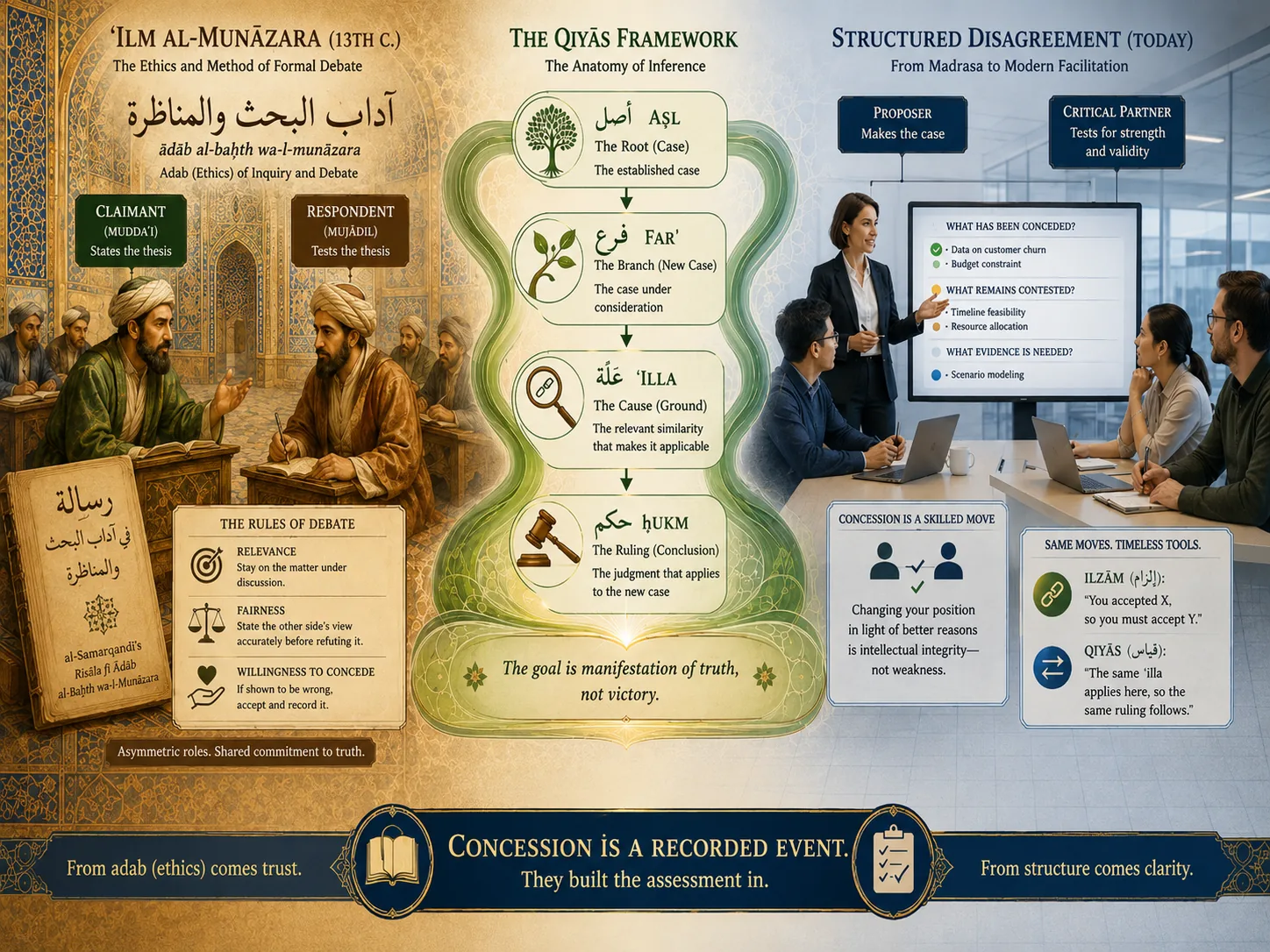
The Islamicate world produced three intersecting argumentation traditions that must be distinguished. Arabic formal logic, mantiq, began with the translation of Aristotle's Organon from the eighth century onward and was not independent of Greece; al-Fārābī commented on the whole Organon, and Ibn Sīnā reconstructed the inherited tradition so extensively that later Arabic logic became more Avicennan than Aristotelian, with major innovations in modality, hypothetical and disjunctive propositions, and demonstration. Kalām, Islamic rational theology, developed dialectical practices called jadal in the ninth and tenth centuries, initially separate from Greek-derived logic, with treatises specifying who asks and who answers, what counts as a relevant objection, how contradiction and concession work, and what signals defeat. Islamic legal theory, uṣūl al-fiqh, systematized qiyās, analogical extension with four named elements: the aṣl or root case, the farʿ or branch case, the ʿilla or legally operative cause, and the ḥukm or ruling transferred from root to branch. From the late thirteenth century, ādāb al-baḥth wa-l-munāẓara emerged as an independent discipline of the rules and manners of inquiry and disputation, associated above all with Shams al-Dīn al-Samarqandī. It assigns asymmetric roles — a claimant states and supports a thesis, a respondent tests the thesis, its evidence, and the connection between them — and declares the goal to be the manifestation of truth rather than victory, governing the participant's character as well as their moves.
The Islamicate case has to be divided carefully, because the honest story is more interesting than the flattering one. Arabic formal logic was inherited from Aristotle and then radically rebuilt. Arabic dialectic was largely home-grown — and it produced something Greece never had: a discipline of disputation that graded you on your conduct.
- Say it plainly: Arabic formal logic (mantiq) was not an independent invention. It began in translation — and then Ibn Sīnā rebuilt it so thoroughly that later Arabic logic is more Avicennan than Aristotelian
- Jadal was largely indigenous: theological disputation developed its own rules of role, objection, concession and defeat before Greek logic was fully absorbed
- Qiyās: legal analogy with four named parts — root case, branch case, operative cause, transferred ruling. The hard step is justifying which similarity is legally operative
- ʿIlm al-munāẓara: from the late 13th century, a standalone discipline of debate — asymmetric roles, burdens, admissible objections, defined defeat
- And an ethics: the stated goal is the manifestation of truth, not winning. The discipline judges relevance, fairness, and your willingness to concede
Aristotle was neither the first nor the only thinker to systematize argument. Six connected pieces on the traditions that built the anatomy of reasoned disagreement — and what each one saw that the others missed.
- 1.The Global Roots of Reasoned Argument: How Three Civilizations Invented Logic
- 2.Indian Logic: The 2,500-Year Tradition from Nyāya to Buddhist Debate
- 3.Mohist Logic: The Chinese Art of Drawing Distinctions
- 4.Aristotle's Logic: The Mediterranean Foundation of Western Argument
- 5.Islamic Dialectics: From Theological Debate to the Science of DisputationYou are here
- 6.Five Syllogisms: Comparing Argument Structures Across Civilizations
A Discipline That Graded You on Losing Well
By the fourteenth century, students in madrasas across the Islamicate world were studying a subject called ādāb al-baḥth wa-l-munāẓara — roughly, the rules and manners of inquiry and disputation. It sat in the curriculum alongside logic and grammar, taught from concise manuals, elaborated in commentaries, and practised in live debate.
The <em>ādāb</em> in the title is doing more work than "rules" suggests. The discipline governed the logical moves — what counts as a relevant objection, when a burden shifts, what constitutes defeat — and it governed the disputant. Relevance. Fairness. Not quarrelling. Willingness to criticize your own position. Willingness to concede when you have been answered. The declared aim was the manifestation of truth, not victory, and a participant who won by evading was not held to have won.
Sit with how unusual that is. We have plenty of institutions today that teach people to argue — law school, debate club, the average leadership offsite — and almost none that formally assess whether you concede gracefully. Ask yourself when you last saw someone in a meeting change their position on the record and be treated as having done something skilled rather than something embarrassing. This tradition built the assessment in.
This article is part of the Roots of Reasoning series on the world's argumentation traditions.
Three Traditions, Not One — and One Honest Concession
Popular accounts collapse everything Islamicate into a single "Islamic logic", usually to make one of two arguments: that Arab scholars merely warehoused Aristotle for Europe, or that they invented logic all over again. Both are wrong, and the reason is that there were <em>three</em> distinct traditions here with different origins.
<strong>Arabic formal logic (<em>mantiq</em>) was not independent of Aristotle.</strong> It begins with the translation and study of Greek logical works from the eighth century onward. This is a history of reception and radical creative reconstruction — not of independent invention — and saying so clearly is the price of being taken seriously about everything else.
Kalām and its jadal were largely indigenous. The earliest systematic theories of theological disputation emerge around the turn of the ninth to tenth century, initially rather separate from the philosophers' Greek-derived logic. Until roughly the eleventh century there was little cross-pollination between the two.
Legal reasoning was its own tradition again. Uṣūl al-fiqh systematized qiyās out of the practical demands of deriving rulings, with its own debates about when an analogy holds — debates that did not wait for Aristotle.
The mature systems are therefore hybrid: Greek formal apparatus absorbed into, and reshaped by, home-grown theological and legal dialectic. That hybridity is the achievement. It is also why the Islamicate contribution to argumentation theory is largest exactly where Greek logic was thinnest — in procedure and conduct.
Kalām: Dialectic Before the Translations
Kalām — literally "speech" or "discourse" — is Islamic rational theology, and from the eighth century it deployed structured argument on questions with real stakes: is the Qurʾān created or eternal, do humans have genuine agency, what does it mean to attribute qualities to God.
The Muʿtazilites (8th–10th centuries) were the first major school, and they insisted doctrines be defended by argument rather than authority alone. Their disputes generated standard moves: state the thesis, offer proof, anticipate objections, answer them. The Ashʿarites, from the tenth century, moderated the doctrine while keeping the method — al-Ashʿarī had been a Muʿtazilite and brought the dialectical training with him.
The showpiece is al-Ghazālī (1058–1111), whose Tahāfut al-Falāsifa (The Incoherence of the Philosophers) attacks the falāsifa using their own logical apparatus against them. Ibn Rushd's reply, Tahāfut al-Tahāfut (The Incoherence of the Incoherence), is one of history's great sustained rebuttals — the two texts together are as close as the pre-modern world comes to a formally structured public disagreement conducted entirely in writing.
The treatises that theorized this practice addressed exactly what a modern dialogue protocol addresses: which party asks and which answers; how a claim must be stated; what counts as a relevant objection; how counter-objection and response work; how contradiction and concession are handled; rules of conduct; and the signs that a participant has been defeated. Theological jadal was then adapted by jurists for disagreements about legal interpretation.
Qiyās: Legal Analogy With Four Named Parts
Islamic jurisprudence faced a permanent practical problem: scripture and prophetic precedent do not address every situation that arises. Uṣūl al-fiqh, legal theory, systematized the methods for deriving rulings — and the engine is qiyās, analogical extension.
A classic qiyās argument names four elements:
- Aṣl — the established or "root" case, with a known ruling
- Farʿ — the new "branch" case requiring one
- ʿIlla — the legally relevant cause or feature shared by both
- Ḥukm — the ruling transferred from root to branch
The stock illustration: a prohibition attaching to one intoxicating substance extends to another, because intoxication is identified as the operative cause. Stated that way it sounds like a loose resemblance argument. It is not, and the reason is the whole point of the discipline.
The hard step is never noticing that two cases are similar. Any two cases are similar in indefinitely many ways. The hard step is justifying why one particular similarity is legally operative while all the others are irrelevant — and then defending that against four kinds of attack. Jurists argued over how the ʿilla is discovered in the first place, whether it is stated clearly enough and generally enough, whether counterexamples defeat it, and whether the proposed extension collides with an authoritative text.
That is a mature theory of analogical argument with an explicit burden attached, and it is the same problem the Mohists were circling with their models and their warnings about "wild presenting", and the same problem the Nyāya example (udāharaṇa) exists to solve. Three traditions, arriving independently at the conclusion that analogy is where arguments actually live and die.
The diagnostic question
Next time someone justifies a decision with "it's the same situation as last time", ask them to name the ʿilla — the one feature that actually carries the ruling across. Then ask what would have to be different for the analogy to fail. If they can answer both, it's an argument. If they can only answer the first, it's a resemblance dressed as a reason.
The Translation Movement
The Abbasid Caliphate (750–1258) sponsored the systematic rendering of Greek philosophical and scientific works into Arabic, from the eighth century onward, culminating around 830 in the circle of al-Kindī in Baghdad and associated with the Bayt al-Ḥikma.
The central figure for logic is Ḥunayn ibn Isḥāq (809–873) and his circle, who translated most of the Organon — Categories, On Interpretation, Prior and Posterior Analytics, Topics, Sophistical Refutations — plus Porphyry's Isagoge and the Greek commentators.
Translation was never passive. It required inventing a philosophical vocabulary in Arabic, and the choices stuck: qiyās for syllogism, muqaddima for premise, natīja for conclusion. Note the first of those. The word Arabic logicians used for the Greek syllogism is the same word the jurists used for legal analogy — a small lexical fact that quietly guaranteed the two traditions would have to be related to each other.
Crucially, the Arabic tradition inherited Aristotle's full range, not just the Prior Analytics. Al-Fārābī read the Organon as a graded set of instruments — demonstration for certainty, dialectic for debate, rhetoric for persuasion, poetics for imagination — each with its proper domain. That framing made it natural to ask how the Greek apparatus related to kalām and fiqh, rather than treating it as a replacement for them.
Ibn Sīnā Rebuilds the Inheritance
Al-Fārābī (c. 872–950), "the Second Teacher" after Aristotle himself, commented on the entire Organon and wrote the classification of the sciences that organized the field for centuries. But the transformation belongs to Ibn Sīnā (c. 980–1037), Latin Avicenna.
Ibn Sīnā did not annotate Aristotle. He reconstructed the inherited tradition so extensively that later Arabic logic is more accurately described as Avicennan than Aristotelian — a claim now standard among historians of Arabic logic, and one that should retire the "preservation" narrative for good.
- Modality: a far more developed treatment of necessity, possibility and impossibility, separating types of modality Aristotle had run together
- Hypothetical and disjunctive propositions: systematic treatment of if–then and either–or reasoning, well beyond the categorical syllogism
- Proposition interpretation and demonstration: a reworking of how propositions are read and what makes a demonstration produce certainty
- An epistemological turn: logic reoriented around concept formation and judgment — mental acts — rather than Aristotle's more linguistic and dialectical emphasis
That last one has a consequence worth naming, because it cuts against this article's own theme. By pulling logic toward epistemology and away from dialectic, Ibn Sīnā helped split mantiq from jadal. Logic became the study of how a mind reaches certainty; disputation went off to become its own discipline. The two lines that Aristotle had kept adjacent in the Organon separated — which is precisely why ādāb al-baḥth had to be invented as a standalone field a few centuries later.
When Latin scholars in twelfth-century Toledo and Sicily translated these works, this is what crossed the Pyrenees: not Aristotle in the original, but Aristotle rebuilt. Ibn Rushd (1126–1198), Averroes, whose commentaries were often closer to the Greek text, arrived alongside and provoked the fights that ended in the Paris condemnations of 1277. Scholastic logic is the product of that transmission as much as of the Greek original.
ʿIlm al-Munāẓara: Disputation Becomes a Field
From the late thirteenth century, ādāb al-baḥth wa-l-munāẓara crystallized into an independent discipline with its own literature of manuals, commentaries and glosses. The founding text is the Risāla fī ādāb al-baḥth of Shams al-Dīn al-Samarqandī (c. 1250 – c. 1310), a logician and Ḥanafī jurist from Samarkand, and the field it opened produced treatises for the next six hundred years.
Its structure is genuinely procedural, and — this is the part usually missed — the roles are asymmetric:
- The claimant states a thesis and must support it. The burden begins here and does not silently move.
- The respondent does not defend a counter-thesis. Their job is to test three separate things: the thesis, the evidence offered for it, and the connection between the two.
- Objections are typed. Denying a premise, demanding a proof, and challenging the inference are different moves with different obligations attached.
- Concession is a recorded event. What has been granted stays granted, and arguing as though it hadn't is itself a fault.
- Defeat is defined. The exchange ends on stated conditions, not on whoever is still talking.
The asymmetry is the sophisticated bit. Assigning the respondent the job of testing the <em>link</em> between evidence and claim — as a distinct move from disputing the evidence — is exactly the distinction that Toulmin had to reintroduce in 1958 when he separated the warrant from the grounds, and that Walton's critical questions operationalize scheme by scheme. It was on the syllabus in Samarkand.
And it was taught. Not published and shelved — taught, in madrasas, alongside logic and the linguistic sciences, through short manuals and practised disputation. Argumentation was treated as a trainable skill with an examinable standard, which is more than most modern organizations manage for the single activity their decisions actually depend on. It is the same finding collective intelligence research keeps rediscovering: structure decides whether groups get smarter.
But Wasn't This Just Aristotle in Arabic?
The objection deserves a straight answer, and half of it lands. For formal logic, yes: the syllogistic came from the Greek text, and no amount of enthusiasm changes that. Anyone claiming Arabic logic invented the syllogism independently is overselling, and the overselling is why the genuine achievements get discounted.
But the objection quietly assumes that formal logic is the whole of argumentation, which is the assumption this entire series exists to question. On the procedural and ethical side the debt runs the other way. Aristotle's Topics sketches dialectical practice; it does not give you typed objections, an asymmetric burden structure, recorded concessions, defined defeat conditions, and an examinable code of conduct. Kalām jadal built those out of theological necessity, jurists adapted them for legal disagreement, and ādāb al-baḥth turned them into a taught discipline.
So the accurate summary is unglamorous and more useful than either myth: borrowed the calculus, rebuilt it substantially, and independently developed the protocol layer that the calculus never covered.
What the Islamicate Tradition Offers Today
Four things transfer more or less intact:
- Name the operative reason. Qiyās demands you identify the ʿilla — the one feature that carries a ruling from the old case to the new one — and defend it against counterexamples. That is the discipline missing from most precedent-based reasoning in organizations.
- Make the burden asymmetric on purpose. A challenger who must also defend a rival thesis is a weaker challenger. Letting the respondent attack the claim, the evidence, and the link between them, without owning a counter-position, produces sharper testing.
- Attack the link, not just the evidence. The three-way split — thesis, evidence, connection — is the single most portable idea here, and it is what argument mapping makes visible on a page.
- Grade the conduct, not only the case. Relevance, fairness, non-quarrelling, willingness to concede. Treat these as part of the standard and disagreement stops being a threat to the room.
The last one is the hardest to import and the most valuable. Every organization says it wants people to change their minds when the evidence changes. Almost none of them has a way of recognizing it when someone does. Ādāb al-baḥth's answer was to write it into the assessment: the declared purpose is the manifestation of truth, and a debater who cannot concede is not a good debater, however many exchanges they survive.
The Roots of Reasoning Series
This article is part of a series exploring the world's argumentation traditions:
Hub overview: how India, China, and Greece systematized argument independently.
The five-member argument, the 22 grounds of defeat, and Dignāga's wheel of reasons.
Biàn, models, the four techniques, and the path Chinese logic took.
The Organon, the syllogism, the Rhetoric, and Western logic's foundation.
The Indian, Greek, Chinese, Islamic, and Buddhist argument forms compared.
Sources & Further Reading
The framing used here: three intersecting Islamicate traditions, the caution that Arabic formal logic was not independent of Aristotle, and the emergence of ādāb al-baḥth as a distinct discipline in the 14th century.
The reference survey of mantiq, the translation movement, and the madrasa curriculum in which logic and disputation were taught.
Avicenna's reconstruction of the inherited tradition — modality, hypothetical propositions, and the epistemological reorientation that separated logic from dialectic.
The book-length treatment of jadal from its theological origins through juridical dialectic to ādāb al-baḥth; the source for the discipline's periodization.
How legal disputation actually worked in practice, and how the back-and-forth of objection and response shaped the substance of Islamic law.
The standard corrective to the claim that Arabic logic declined after Averroes — and the reference for the post-classical madrasa logic curriculum.
The founding treatise of the science of disputation, which generated centuries of commentaries and glosses across the Islamicate world.
Frequently Asked Questions
Was Arabic logic independent of Aristotle?
No, and it is worth saying plainly. Arabic formal logic (mantiq) began with the translation and study of Greek logical works from the eighth century onward — a history of reception and major creative reconstruction rather than independent invention. What was substantially independent was the dialectical side: kalām jadal and legal qiyās developed out of theological and juridical practice with their own origins, and the mature systems are hybrids of the two lineages.
What is kalām?
Kalām, literally 'speech' or 'discourse', is Islamic rational theology. From the eighth century its practitioners used structured argument on questions such as whether the Qurʾān is created or eternal and whether humans have genuine agency. The Muʿtazilites were the first major school, insisting doctrines be defended by argument rather than authority; the Ashʿarites moderated the doctrine while keeping the method. Kalām developed an argumentation culture before Greek logic was fully absorbed.
What is qiyās in Islamic jurisprudence?
Qiyās is analogical extension from an established case to a new one, with four named elements: the aṣl or root case with a known ruling, the farʿ or branch case needing one, the ʿilla or legally relevant cause shared by both, and the ḥukm or ruling transferred from root to branch. The classic illustration extends a prohibition on one intoxicant to another because intoxication is the operative cause. The difficult step is not noticing similarity but justifying why one particular similarity is legally operative while others are not.
What is jadal?
Jadal is the Arabic term for dialectic or disputation — both the practice of structured debate and the discipline that theorizes it. Its earliest systematic forms developed in theological controversy around the turn of the ninth to tenth century, initially separate from the philosophers' Greek-derived logic. Treatises addressed which party asks and which answers, how a claim is stated, what counts as a relevant objection, how contradiction and concession work, rules of conduct, and the signs that a participant has been defeated. Jurists later adapted it for legal disagreement.
What is ʿilm al-munāẓara / ādāb al-baḥth?
From the late thirteenth century, ādāb al-baḥth wa-l-munāẓara — the rules and manners of inquiry and disputation — became an independent discipline, associated above all with Shams al-Dīn al-Samarqandī (c. 1250 – c. 1310) and his Risāla fī ādāb al-baḥth. It assigns asymmetric roles: a claimant states and supports a thesis, while a respondent tests the thesis, the evidence for it, and the connection between them. The declared goal is the manifestation of truth rather than victory, and the discipline governs the participant's conduct — relevance, fairness, and willingness to concede — as well as the logical moves.
Who were al-Fārābī and Ibn Sīnā?
Al-Fārābī (c. 872–950), called the Second Teacher after Aristotle, commented on the whole Organon and read logic as a graded set of instruments for demonstration, dialectic, rhetoric and poetics. Ibn Sīnā (c. 980–1037), Latin Avicenna, reconstructed the inherited tradition so extensively that later Arabic logic became more Avicennan than Aristotelian, with major innovations in modality, hypothetical and disjunctive propositions, and demonstration, and an epistemological reorientation that pulled logic away from dialectic.
How did Islamic scholars transmit Greek logic to Europe?
The Abbasid translation movement rendered Aristotle's Organon into Arabic from the eighth century onward, culminating around 830 in the circle of al-Kindī. Islamic philosophers then extended and rebuilt it. In the twelfth century, translators in Toledo and Sicily rendered the Arabic works into Latin. What Europe received was therefore Greek logic as reconstructed by Islamic philosophy — the modal distinctions, the epistemological framing, the separation of logic from rhetoric — which is why Scholastic logic is a product of that transmission as much as of the Greek original.
What can modern argumentation theory learn from Islamic dialectics?
Four things transfer directly: qiyās as a model of analogy with a named operative reason and an explicit burden to defend it; asymmetric role assignment, where the respondent tests a claim without having to defend a rival one; the three-way split between attacking a thesis, its evidence, and the connection between them, which anticipates Toulmin's separation of grounds from warrant; and the treatment of conduct as part of the standard, including the willingness to concede — a criterion almost no modern institution assesses.
Argumentree Team
Decision Science
The Argumentree team explores the science of better decisions—from ancient philosophy to modern AI.
Keep reading the series
Four more traditions, four more toolkits — and a side-by-side comparison of what each one can and cannot do.
Structure your arguments. Decide better.
Argumentree brings the world's argumentation traditions into a pro/con tree your team can build, rate, and keep — with AI extraction, multi-dimensional scoring, and a full decision audit trail.
Start Free 14-Day Trial →