
The Global Roots of Reasoned Argument: How Three Civilizations Invented Logic | Argumentree
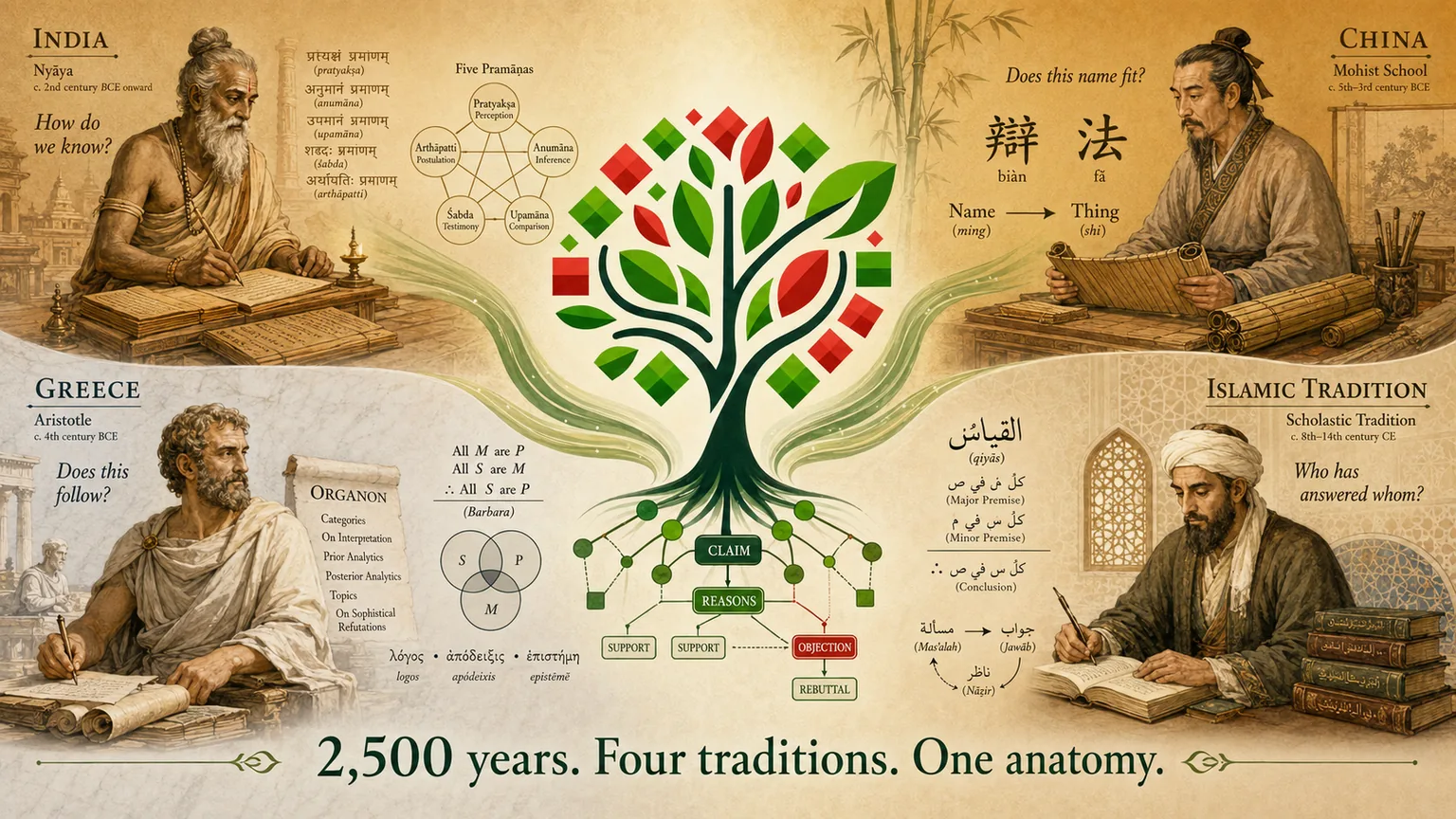
Aristotle was neither the first nor the only thinker to systematize argument, but different traditions systematized different aspects of reasoning. Aristotle's distinctive achievement was a theory of propositions, syllogistic validity, demonstration, dialectic, and fallacy. Indian authors often began instead from sources of knowledge and regulated debate, formalizing the pramāṇas, a five-member argument, three types of debate, catalogues of pseudo-reasons, and 22 named grounds of defeat; Buddhist logicians added the three conditions on a valid reason, the nine-cell wheel of reasons, prasaṅga, and the tetralemma, while Jain philosophers developed anekāntavāda and the sevenfold syādvāda. Chinese thinkers began from distinction-making, language, and analogical extension: the Mohists reasoned from models and standards and named four techniques — pì analogy, móu paralleling, yuán pulling, tuī pushing — alongside a stated fairness principle. Islamicate scholars combined Greek-derived formal logic with indigenous theological disputation and legal interpretation, producing jadal, the four-element qiyās, and from the late thirteenth century ādāb al-baḥth wa-l-munāẓara as an independent discipline of debate. A chronological caution applies: Indian and Chinese argumentative practices are ancient and largely independent in formation, but many surviving Indian technical manuals were written after Aristotle, and the Islamicate world is later still, with its formal logic substantially Aristotelian even though its legal and theological dialectics had partly separate roots. Collectively these traditions mapped nearly the complete anatomy of argument, treating reasoning as cognitive process, linguistic performance, social interaction, ethical discipline and institutional practice.
Logic was not invented once, and the interesting part is not who was first. It is that each tradition systematized a different part of argument — and that between them, long before modern argumentation theory, they had written down nearly the complete anatomy of reasoned disagreement.
- India: began from sources of knowledge and regulated contest — pramāṇas, a five-member argument, three debate types, and 22 named grounds of defeat
- China: began from distinction-making and language — models and standards, whether a name fits a thing, and four named techniques of analogical extension
- Greece: began from propositions and form — syllogistic validity, demonstration versus dialectic, and the first catalogue of fallacies
- Islamicate: a hybrid — Greek-derived formal logic plus home-grown theological disputation and legal analogy, ending in a taught science of debate
- The comparative lesson: "logic" is only one part of structured argument. The rest is warrant, procedure, conduct, and knowing what defeat looks like
Aristotle was neither the first nor the only thinker to systematize argument. Six connected pieces on the traditions that built the anatomy of reasoned disagreement — and what each one saw that the others missed.
- 1.The Global Roots of Reasoned Argument: How Three Civilizations Invented LogicYou are here
- 2.Indian Logic: The 2,500-Year Tradition from Nyāya to Buddhist Debate
- 3.Mohist Logic: The Chinese Art of Drawing Distinctions
- 4.Aristotle's Logic: The Mediterranean Foundation of Western Argument
- 5.Islamic Dialectics: From Theological Debate to the Science of Disputation
- 6.Five Syllogisms: Comparing Argument Structures Across Civilizations
The Question That Was Asked Four Different Ways
Ask a fourth-century Athenian what makes an argument good and you will get an answer about <em>form</em>: does the conclusion follow from the premises, regardless of what they are about. Ask a Nyāya philosopher and you will get an answer about <em>knowledge</em>: by what process does a cognition come to count as known. Ask a Mohist and you will get an answer about <em>naming</em>: does this term correctly fit this thing, and which similarity says so. Ask a jurist in fourteenth-century Samarkand and you will get an answer about <em>procedure and conduct</em>: whose turn is it, what may be objected, what has been conceded, and whether you are behaving like someone seeking truth or someone seeking a win.
Four answers, none of them wrong, almost no overlap. That is the finding this series is built on, and it is more useful than the usual story about who invented logic first.
Because if you have ever sat in a meeting that went badly, you already know the diagnosis is rarely formal. Nobody affirmed the consequent. What happened was that a premise everyone accepted was never examined, or an analogy to last quarter didn't hold, or two people were using the same word for different things, or the argument simply never ended — there was no shared notion of what it would mean for someone to have been answered. Three of those four failure modes are invisible to the Greek toolkit, and each of them was named, analysed and taught somewhere else.
This article is the hub of the Roots of Reasoning series. It sketches the four great traditions and what each contributed. The companion posts go deep: Indian logic, Mohist logic, Aristotle's logic, Islamic dialectics, and a comparative analysis of the five argument structures.
A Chronological Caution, Before Anything Else
Comparative history of this kind attracts two opposite errors, and both are worth heading off in the first minute.
The first is the triumphalist story: Greece invented logic, everyone else did something vaguer, and the Islamic world kindly held Aristotle's coat until Europe was ready. The second is the corrective overshoot: every tradition had everything, priority claims flow the other way, and pointing out Greek achievements is provincialism.
The defensible position is narrower than either. Indian and Chinese argumentative practice is ancient and largely independent in formation — debate theory appears in India around the period of the Buddha in the sixth century BCE, and Chinese disputation flourishes in the Warring States period, contemporaneous with Aristotle and with no known contact. But many surviving Indian technical manuals were written after Aristotle: the Nyāya-sūtra reaches its present form in the early centuries CE, Dignāga in the fifth to sixth, Gaṅgeśa in the fourteenth. And the Islamicate world is later still, with its formal logic substantially Aristotelian in origin — though its legal and theological dialectics had partly separate roots.
So: practice is old and independent; written systematization is staggered; and the genuinely interesting variable is not date but <em>subject matter</em>. They were not racing. They were working on different problems.
What Each Tradition Actually Systematized
| Tradition | Approximate formation | What was systematized |
|---|---|---|
| Indian debate and Nyāya | Debate theory from c. 6th c. BCE; systematic texts mostly early centuries CE | Sources of knowledge, inference, five-part arguments, types of debate, fallacies, objections, and formal conditions of defeat |
| Buddhist and Jain argumentation | Early Buddhist dialogue from 5th c. BCE; major logical systems 5th–7th c. CE | Valid reasons, inference for oneself vs argument for others, counterexample testing, reductio, tetralemmas, perspectival qualification |
| Mohist and early Chinese disputation | Warring States, esp. 4th–3rd c. BCE | Correct application of names, drawing distinctions, models and precedents, analogical extension, opponent commitments, practical deliberation |
| Greek dialectic and syllogistic | 5th–4th c. BCE | Propositions, syllogistic validity, demonstration versus dialectic, argument patterns (topoi), and the first catalogue of fallacies |
| Islamicate jadal, uṣūl al-fiqh, munāẓara | 8th–14th c. CE | Question-and-answer dialectic, legal analogy, textual interpretation, burdens and objections, debate ethics and rules of defeat |
| Arabic mantiq | From 8th-c. translations; transformed by Avicenna | Aristotelian syllogistic plus major innovations in modality, hypothetical propositions, demonstration, and the classification of argument types |
India: Reasoning as Knowledge Acquisition and Regulated Contest
Indian traditions are probably the clearest large-scale independent counterpart to Greek logic — and the least familiar to Western readers. Public and court-sponsored debate existed well before the surviving manuals; by the third and second centuries BCE, monks and Brahmins were expected to have debate training.
The starting question is not "does this follow?" but by what process does a cognition count as knowledge? Nyāya recognized four pramāṇas — perception, inference, comparison, and testimony from a competent speaker. Other schools adjusted the list. The consequence is that logic sits inside epistemology: an inference is not an arrangement of sentences but a process by which someone moves from what they know to what they did not.
The widely taught argument form has five members: thesis (there is fire on the hill), reason (because there is smoke), example or general rule (wherever there is smoke, there is fire — as in a kitchen), application (the hill has smoke of that kind), conclusion (therefore there is fire). One of the earliest surviving statements of it is in the Caraka-saṃhitā, a medical text — debate training was part of a physician's education.
It is not an unnecessarily long syllogism. The extra members do dialogical work: announce the disputed claim, give the reason, supply an agreed case, connect it to the subject, restate what has been established. The form was initially strongly analogical; later authors made the universal connection increasingly explicit and stringent.
Then the part with no Greek counterpart. Nyāya classified debates by purpose — vāda (cooperative truth-seeking), jalpa (competitive), vitaṇḍā (attacking without defending a thesis of one's own) — and catalogued not only pseudo-reasons but nigraha-sthānas, grounds of defeat. The Nyāya-sūtra lists 22, mixing logical errors with procedural violations: shifting your thesis, mere repetition, silence, evasion, conceding a point and arguing on regardless. Defeat was a defined, observable event.
Buddhist authors refined the evidential side. Dignāga separated inference for oneself from argument for another, and required a valid reason to be present in the subject, present in similar cases, and absent from all dissimilar ones — then arranged the possibilities in a nine-cell matrix in which only two yield sound inferences. Buddhist prasaṅga exposes unacceptable consequences of an opponent's view, and the catuṣkoṭi examines a claim under four alternatives — is, is not, both, neither — as a dialectical technique whose exact logical interpretation is still disputed. Jain philosophers added anekāntavāda, many-sidedness, and the sevenfold syādvāda: state the respect in which your claim holds, so a partial description cannot pose as an exhaustive one. Full story: Indian Logic: The 2,500-Year Tradition from Nyāya to Buddhist Debate.
China: Argument as Distinction, Semantic Fit, and Analogical Extension
Early Chinese argumentation was roughly contemporary with Aristotle and arose independently. During the Warring States period, Mohists, Confucians, Daoists and the thinkers later grouped under the School of Names engaged in <strong>biàn</strong> — disputation, but more literally <em>distinguishing</em>.
The central question was characteristically not "does this conclusion follow?" but: does this name, category or prescription correctly fit this object or situation? One party calls it "ox", the other "non-ox"; they cannot both fit, so one does not.
Mohist thinkers reasoned from fǎ — models, standards, exemplars. You identify an ox, a just action or a beneficial policy by comparing the case to a reliable model and determining which similarities are relevant. Early Mohist argument appealed to three standards: precedents set by exemplary rulers, evidence from ordinary experience, and consequences for social benefit.
The Lesser Selection names four argumentative techniques, and they are widely mis-glossed, so here they are correctly:
- Pì — analogy: introduce another case to clarify the present one
- Móu — paralleling: place similarly structured expressions side by side
- Yuán — pulling: cite something the opponent already accepts and ask why the present case should be treated differently
- Tuī — pushing: extend an accepted judgment to a relevantly similar case
Pulling effectively shifts the burden to the opponent to identify a relevant disanalogy; pushing relies on consistency with their prior commitments. They are a repertoire, not a fixed sequence. The Mohists paired them with a stated fairness principle — what we accept in our own case we do not reject in the opponent's — and with a hard-won warning: parallels between expressions are correct only up to a point.
They also recognized principles resembling non-contradiction and excluded middle, but formulated semantically — "ox" and "non-ox" cannot both fit the same object in the same dispute — keeping the focus on terms and classification rather than an abstract propositional calculus. And they described deliberation as weighing benefit and harm: where all options involve harm, choose the least. Full account: Mohist Logic: The Chinese Art of Drawing Distinctions.
Greece: Logic as Formal Validity
The Greek tradition is the one most readers already know, so it can be brief. It grows out of Athenian democracy between 508 and 322 BCE, where the assembly, the boule and the law courts all settled matters by debate and vote — making persuasive speech directly valuable, and creating the market the Sophists served by teaching it for a fee.
Plato promoted dialectic instead: structured question-and-answer, with the questioner extracting a thesis and trying to force its contradictory, and the answerer's sole job being to remain un-refuted within a fixed time. Aristotle's Topics and Sophistical Refutations are the first systematization of that practice — the first written rulebook for an argumentative sport.
Aristotle (384–322 BCE) then built the thing nobody else built. The Organon covers categories, propositions, syllogistic, demonstration, dialectic and fallacy, and its core innovation is the categorical syllogism: validity as a property of structure, independent of content. Substitute any terms into a valid form and it stays valid. That abstraction is genuinely singular, and saying so plainly is what makes the rest of this comparison honest rather than defensive.
The Rhetoric added the three appeals — ethos, pathos, logos — and the enthymeme, the syllogism with a premise left for the audience to supply. The Topics catalogued argument patterns for dialectic, the direct ancestor of modern argumentation schemes. Post-Aristotle the Stoics developed propositional logic, stating modus ponens with numerals for whole propositions; it was closer to the base of modern symbolic logic and was transmitted badly, so syllogistic held the curriculum until Frege. Detail: Aristotle's Logic: The Mediterranean Foundation of Western Argument.
The Islamicate World: Three Intersecting Traditions
This case has to be divided carefully, and one concession comes first: Arabic formal logic was not independent of Aristotle. Mantiq begins with the translation of Greek logical works from the eighth century onward. Al-Fārābī read logic as a graded set of instruments for demonstration, dialectic, rhetoric and poetics; Ibn Sīnā then reconstructed the inherited tradition so extensively that later Arabic logic is more Avicennan than Aristotelian, with major innovations in modality, hypothetical and disjunctive propositions, and demonstration. That is reception plus radical rebuilding — not independent invention.
But two other traditions here were substantially home-grown. Kalām, rational theology, generated dialectical practices called jadal whose earliest systematic forms developed in theological controversy around the turn of the ninth to tenth century, initially separate from the philosophers' Greek-derived logic. Their treatises specified which party asks and which answers, how a claim is stated, what counts as a relevant objection, how contradiction and concession work, rules of conduct, and the signs that a participant has been defeated. Jurists then adapted the machinery for legal disagreement.
Uṣūl al-fiqh, legal theory, systematized qiyās with four named elements: the aṣl or root case, the farʿ or branch case, the ʿilla or legally operative cause shared by both, and the ḥukm or ruling transferred from root to branch. A prohibition on one intoxicant extends to another because intoxication is identified as the operative cause. This is more structured than loose resemblance: the hard step is not noticing similarity but justifying why this similarity is legally operative while others are not — and defending that against counterexamples and conflicting texts.
From the late thirteenth century, ādāb al-baḥth wa-l-munāẓara became a distinct discipline — the rules and manners of inquiry and disputation. Roles are asymmetric: a claimant states and supports a thesis; a respondent tests the thesis, its evidence, and the connection between them. The declared goal is the manifestation of truth, not victory, and the discipline governs the participant's character as well as their moves — relevance, fairness, avoidance of quarrelling, willingness to criticize, willingness to concede. It was taught in madrasas alongside logic and the linguistic sciences. Full story: Islamic Dialectics: From Theological Debate to the Science of Disputation.
The diagnostic question
Your team can almost certainly tell you what a good idea looks like. Can it tell you what a finished argument looks like — what counts as a relevant objection, when a point has been conceded, and how you would know the discussion was over? Four civilizations wrote that down. Most organizations have never once tried.
What Each Tradition Sees (and Misses)
Laid side by side, the contrasts are instructive:
| Tradition | Core question | Key unit | Characteristic move | Blind spot |
|---|---|---|---|---|
| Indian (Nyāya / Buddhist) | How do we know? | Five-member inference | Example-based generalization plus vyāpti | Less focus on validity independent of content |
| Chinese (Mohist) | Is this name correct? | Disputation (biàn) | Models, analogy, and opponent commitments | No developed deductive calculus |
| Greek (Aristotelian) | Does this follow? | Categorical syllogism | Formal validity check | Little attention to the warrant for premises |
| Islamicate (jadal / qiyās) | Who has answered whom? | Disputation rules; four-element analogy | Procedure plus a named operative cause | Formal apparatus is largely inherited |
No tradition is complete, and the gaps are not symmetrical. Indian logic ties inference tightly to epistemology — a strength when you care <em>why</em> the premises are credible, a cost when you only need to check the form. Greek logic abstracts from content — decisive for formal proof, silent when the premises themselves are what's contested. Chinese logic handles analogy and naming with a care the West largely skipped, and never built machinery for chaining deductions. Islamicate disputation theory adds procedure and ethics, and presupposes the Greek formal apparatus.
The structure-by-structure comparison — the five-member Nyāya form, the three-member syllogism, Mohist technique, qiyās, and the tetralemma — is in Five Syllogisms: Comparing Argument Structures Across Civilizations.
What They Collectively Identified
Put the traditions end to end and something striking appears: between them, they had written down and taught nearly the complete anatomy of argument.
- Before arguing: define the question, classify the kind of dispute, and establish which sources or authorities are admissible.
- Building a case: state a thesis, give a reason, supply a rule, model or precedent, demonstrate that it applies, draw the conclusion.
- Testing the connection: look for positive cases, negative cases, counterexamples, irrelevant similarities, hidden assumptions, and circularity.
- Managing the dialogue: allocate roles, burdens, rights to question and obligations to answer; record concessions; determine when a position has been abandoned.
- Diagnosing failure: classify bad reasons, deceptive analogies, irrelevant responses, regress, contradiction, equivocation, and procedural grounds of defeat.
- Ending the process: establish knowledge, reach a legal or practical judgment, expose incoherence, persuade an audience — or, in less cooperative settings, win.
Almost every item on that list is something a modern organization handles by instinct, if at all. It has all been written down for centuries.
Why This Matters Now
Modern argumentation theory, computational argumentation and AI reasoning draw — often unknowingly — on all of these.
Argumentation schemes (Walton, Reed, Macagno) catalogue recurring patterns like argument from expert opinion, from analogy, from cause to effect, each with critical questions to test it. That is Aristotle's Topics meeting Mohist analogical analysis, with a layer of jadal's procedural awareness.
Abstract argumentation frameworks (Dung, 1995) represent arguments as nodes with attack relations and compute which sets can rationally be accepted together. The underlying question — which arguments survive? — is the jadal question, formalized in graph theory.
Argument mapping and the Toulmin model make structure explicit: claim, grounds, warrant, backing, rebuttal, qualifier. Toulmin is in direct conversation with Aristotle's enthymeme; the insistence on explicit backing echoes the Nyāya udāharaṇa; and the qualifier is syādvāda's "in some respect" in modern dress.
And the collective intelligence research programme — from Condorcet's jury theorem to the c-factor studies — keeps confirming what the debating traditions already knew: structure decides whether groups get smarter. Independent input, explicit aggregation, procedural fairness, a record of the reasoning. Those are the conditions, and they are what Argumentree builds into the decision process.
The largest comparative lesson is the one this whole series exists for: "logic" is only one part of structured argument. Long before modern argumentation theory, these traditions treated reasoning simultaneously as a cognitive process, a linguistic performance, a social interaction, an ethical discipline and an institutional practice. They were not building curiosities. They were building the machinery of reasoned agreement — the alternative to coercion, tradition, and accident. Twenty-five centuries later, the project continues.
The Roots of Reasoning Series
This article is the hub. The spokes go deep:
The five-member argument, the 22 grounds of defeat, Dignāga's nine-cell wheel, and Jain qualification.
Biàn, models and standards, the four techniques, and the discovery that grammar lies.
The Organon, the syllogism, the Rhetoric, and the dialectical game underneath it all.
Kalām, jadal, qiyās, and a discipline that graded you on your willingness to concede.
The Indian, Greek, Chinese, Islamic and Buddhist argument forms, side by side.
Sources & Further Reading
Catarina Dutilh Novaes's survey of argumentation across five traditions — ancient Greek, classical Indian, classical Chinese, medieval Latin and medieval Islamicate. The backbone of this hub article.
The authority for biàn, models and standards, the four techniques of the Lesser Selection, and the Mohist analysis of weighing benefit and harm.
The five-member argument, vyāpti, Dignāga's three conditions and the hetucakra, and the later Navya-Nyāya formalism.
The translation movement, Avicenna's reconstruction, and the madrasa curriculum in which logic and disputation were taught side by side.
The argument that deduction itself emerged from adversarial dialogical practice — the framing this series builds on.
The standard modern treatment of the Indian debate tradition, the grounds of defeat, and the relationship between logic and epistemology.
Frequently Asked Questions
Did India, China, and Greece develop logic independently?
As far as historians can tell, the argumentative practices formed independently: there is no evidence of intellectual transmission between the three during the Axial Age. The important qualification is chronological. Indian and Chinese debate practice is genuinely ancient, but many surviving Indian technical manuals postdate Aristotle, and the Islamicate tradition is later still, with its formal logic substantially Aristotelian in origin even though its legal and theological dialectics had partly separate roots.
Which logical tradition is oldest?
The question is less useful than it sounds. Indian debate theory appears around the period of the Buddha in the sixth century BCE; the Mohist school flourishes in the fifth to third centuries BCE; Aristotle completes the Organon in the fourth. All three have earlier roots in practice, and all three were written down later than they were practised. The genuinely interesting variable is not date but subject matter: each tradition systematized a different part of argument.
How does Indian logic differ from Aristotelian logic?
Indian logic begins from epistemology rather than form. Inference is one of the pramāṇas — the reliable processes that produce knowledge — so the question is whether an inference delivers knowledge, not merely whether a conclusion follows. The five-member argument includes an agreed example and restates the conclusion because it is built for public debate. Indian authors also formalized what Greek logic largely left implicit: debate types, admissible objections, and 22 named grounds on which a debater is declared defeated.
What is Mohist logic?
The Mohist school, followers of Mòzǐ (c. 470–391 BCE), developed a theory of disputation (biàn) centred on whether a name correctly fits a thing. They reasoned from fǎ — models or standards — and named four argumentative techniques in the Lesser Selection: pì, giving an analogy; móu, placing parallel expressions side by side; yuán, pulling, which cites the opponent's own accepted case and asks why this one differs; and tuī, pushing, which extends an accepted judgment to a similar case. They had no deductive calculus, but they analysed analogy and its failure modes with a precision the Greek tradition lacked.
What is jadal in Islamic philosophy?
Jadal is the Arabic term for dialectic or disputation — both the practice and the discipline theorizing it. Its earliest systematic forms developed in theological controversy around the turn of the ninth to tenth century, initially separate from the philosophers' Greek-derived logic, and were later adapted by jurists. From the late thirteenth century, ādāb al-baḥth wa-l-munāẓara emerged as an independent discipline with asymmetric roles, typed objections, and defined defeat conditions, declaring its goal to be the manifestation of truth rather than victory.
Was Arabic logic independent of Aristotle?
No, and the honest answer matters. Arabic formal logic (mantiq) began with the translation and study of Greek logical works from the eighth century onward — a history of reception and major creative reconstruction rather than independent invention, with Avicenna transforming the inherited tradition so extensively that later Arabic logic became more Avicennan than Aristotelian. What was substantially independent was the dialectical and legal side: kalām jadal and qiyās had their own origins, and the mature systems are hybrids.
Why does non-Western logic matter for modern argumentation?
Because most arguments fail in ways formal validity cannot detect. Modern argumentation theory has independently rebuilt what the other traditions mapped: argumentation schemes catalogue patterns like argument from analogy, a Mohist strength; abstract argumentation frameworks formalize which arguments survive, the jadal question; the Toulmin model's backing echoes the Nyāya example and its qualifier echoes Jain syādvāda; and pragma-dialectics' rules of critical discussion are a grounds-of-defeat list in modern dress. The comparative lesson is that logic is one part of structured argument, not the whole of it.
Argumentree Team
Decision Science
The Argumentree team explores the science of better decisions—from ancient philosophy to modern AI.
Start the series
Five deep dives, one per tradition, plus the side-by-side comparison that puts them together.
Structure your arguments. Decide better.
Argumentree brings 2,500 years of argumentation theory into a pro/con tree your team can build, rate, and keep — with AI extraction, multi-dimensional scoring, and a full decision audit trail.
Start Free 14-Day Trial →