
Aristotle's Logic: The Mediterranean Foundation of Western Argument | Argumentree
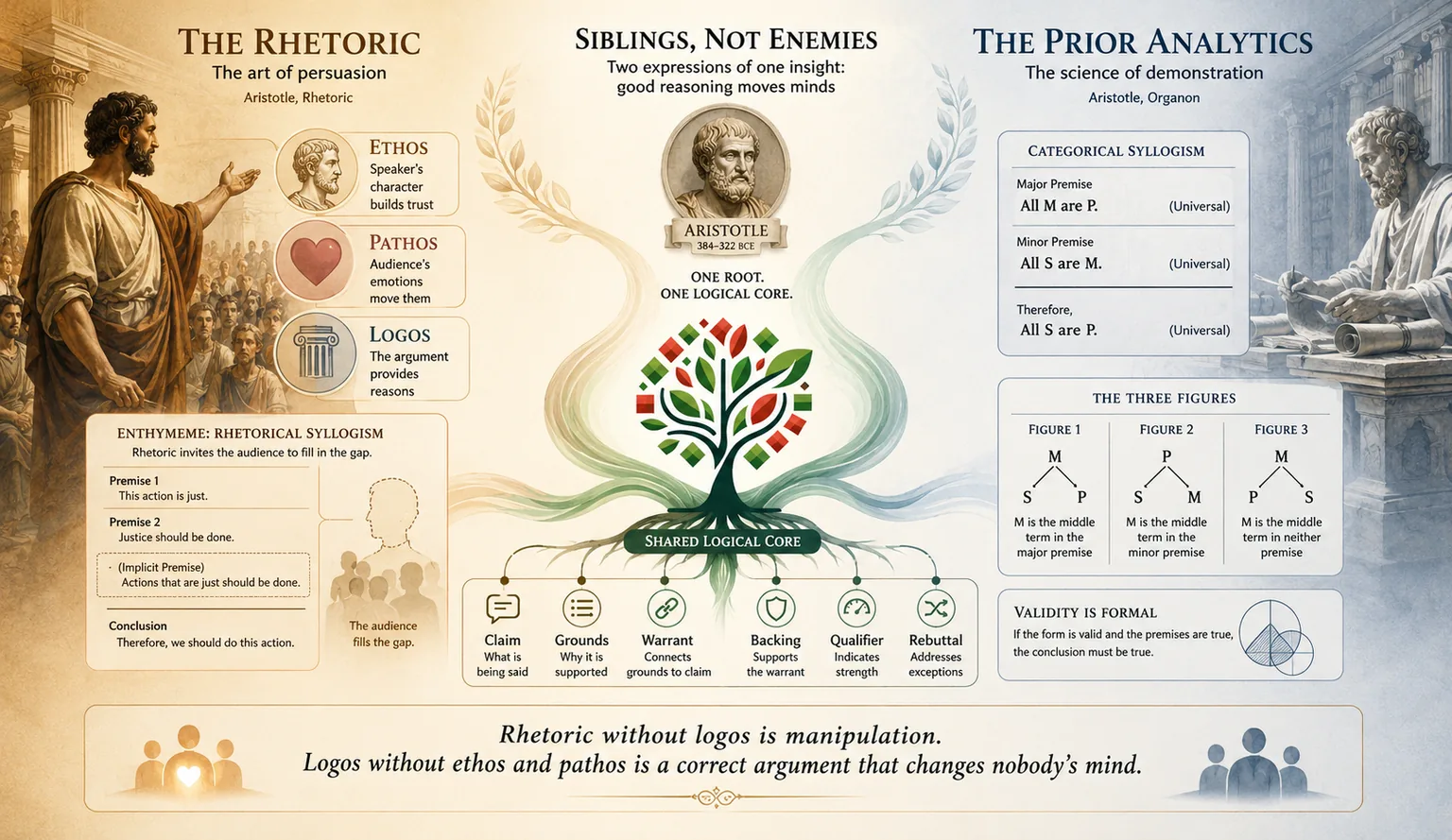
Aristotle (384–322 BCE) created the formal study of logic in the Western tradition, but he did so by regimenting an existing practice. Athenian democracy between 508 and 322 BCE decided matters in the assembly, the boule, and the law courts, so persuasive speech had direct political value, and the Sophists sold training in it. Plato promoted dialectic instead: structured question-and-answer in which a questioner extracts a thesis from an answerer and tries to force the answerer into contradicting it, while the answerer's sole task is to remain un-refuted within a fixed time. Aristotle's Topics and Sophistical Refutations are the first systematization of that practice. His Organon comprises Categories, On Interpretation, Prior Analytics, Posterior Analytics, Topics, and Sophistical Refutations. The categorical syllogism is the central innovation: validity determined by structure rather than content, with three figures, named valid moods, and demonstrated invalidity for the rest. The Posterior Analytics distinguishes demonstration, which proceeds from true and necessary premises to produce knowledge, from dialectic, which reasons from endoxa or commonly accepted opinions toward probable conclusions. The Sophistical Refutations catalogues thirteen fallacies, six dependent on language and seven independent of it, and establishes the idea that fallacies are systematic and learnable. The Rhetoric adds ethos, pathos, and logos, and the enthymeme, a syllogism with a premise left for the audience to supply. After Aristotle the Stoics developed propositional logic, formulating modus ponens with numbers standing for whole propositions, an approach closer to the base of modern symbolic logic than syllogistic is.
Aristotle is usually introduced as the man who invented logic. It is more accurate, and far more interesting, to say he wrote down the rules of a game Athenians were already playing — and then discovered, in the middle of doing so, that the winning moves could be described without mentioning what the argument was about.
- It started as a game with roles: a questioner extracts a thesis and tries to force its contradictory; the answerer's only job is to stay un-refuted for a fixed time
- The Organon: six treatises — categories, propositions, syllogistic, demonstration, dialectic, fallacies. A toolkit, not a book
- The breakthrough: validity as structure. Swap every term in a valid syllogism and it stays valid — reasoning about reasoning, abstracted from subject matter
- Rhetoric is not the opposite of logic: ethos, pathos and logos are three genuine grounds of conviction, and the enthymeme wins by letting the audience supply the missing premise
- What it doesn't cover: propositional connectives (the Stoics did those), quantifier scope, analogy, the epistemic warrant of premises, and the procedure of debate itself
Aristotle was neither the first nor the only thinker to systematize argument. Six connected pieces on the traditions that built the anatomy of reasoned disagreement — and what each one saw that the others missed.
- 1.The Global Roots of Reasoned Argument: How Three Civilizations Invented Logic
- 2.Indian Logic: The 2,500-Year Tradition from Nyāya to Buddhist Debate
- 3.Mohist Logic: The Chinese Art of Drawing Distinctions
- 4.Aristotle's Logic: The Mediterranean Foundation of Western ArgumentYou are here
- 5.Islamic Dialectics: From Theological Debate to the Science of Disputation
- 6.Five Syllogisms: Comparing Argument Structures Across Civilizations
The Rule That Let You Lose Without Being Wrong
In the dialectical contests Aristotle describes in the Topics, two people take fixed roles. The questioner first extracts a thesis from the answerer — a starting point that can be affirmed or denied, so "what is knowledge?" is not allowed as an opener. The questioner then tries, by securing a series of small agreements, to force the answerer into asserting the contradictory of their own thesis, or into plain absurdity. The answerer has exactly one job: remain un-refuted until time runs out.
And then there is a rule that tells you what kind of activity this really was. If the answerer <em>is</em> refuted, they are expected to make clear that it was not their fault — that the fault lay in the starting point they were handed.
Read that again. The tradition that gave the West its idea of rigorous proof began as a timed, role-based game with an explicit provision for losing without personal disgrace, because the thesis being defended was not necessarily yours. The separation of the person from the position — the thing every modern facilitator begs a room to do — was baked into the format from the start.
This article explains what Aristotle actually built on top of that game, what preceded it, what came after, and where the framework runs out. It is part of the Roots of Reasoning series, whose whole premise is that Aristotle's is one solution among several — but you cannot see the limits of a framework until you know what is in it.
Why Athens, and Why Then
Logic did not appear in Greece because Greeks were unusually rational. It appeared because Athens made argument load-bearing. Between roughly 508 and 322 BCE, citizens decided matters in three bodies — the assembly, the boule, and the law courts — and all three settled questions by debate followed by a vote.
In that system the ability to speak persuasively converts directly into political outcomes and legal survival. There was no professional class of advocates to hire; you spoke for yourself. So a market appeared for people who could teach it, and the Sophists filled it — Protagoras, Gorgias, Hippias and others, itinerant professionals charging fees for training in rhetoric.
That market context matters for how the story is usually told. Plato's attack on the Sophists — that they chased persuasion rather than truth — landed after the Peloponnesian War (431–404 BCE) had gone catastrophically for Athens and confidence in democratic deliberation had collapsed. It is, among other things, a political judgement, and a somewhat unfair one. The Sophists' actual contribution was the premise everything else rests on: that arguing is a skill, and a skill can be analysed and taught.
Before Aristotle: Dialectic as a Practice
Plato's alternative to long rhetorical speeches was dialectic — the art of conversation. Instead of an orator holding the floor, two interlocutors take rapid turns, one proposing and the other testing. The practice seems to predate Socrates: the Eleatics, Parmenides and Zeno, appear to have been practising something like it already. Plato was arguably the first to theorize the difference between the two styles.
The engine of the method is elenchus — refutation. Read any Socratic dialogue and the shape is the same: Socrates elicits a series of commitments from an interlocutor, then shows that taken together they cannot all stand. The interlocutor is refuted and must revise something to restore coherence. Notice what this is not: it is not Socrates proving a rival thesis. It is Socrates demonstrating that your position is internally inconsistent — the same move Buddhist logicians would call prasaṅga and Mohists would call pulling.
Plato left the method as practice and example. Turning it into explicit theory — roles, permitted moves, starting points, what counts as a refutation, what counts as cheating — is Aristotle's Topics and its ninth book, the Sophistical Refutations. Those two treatises are, in effect, the first written rulebook for an argumentative sport.
The Organon: Aristotle's Toolkit
Later editors grouped Aristotle's logical treatises under the title Organon — "instrument" or "tool". It is not a book but a kit of six:
- Categories: the kinds of thing that can be predicated — substance, quantity, quality, relation, place, time, position, state, action, affection. The building blocks of predication.
- On Interpretation: the analysis of propositions — statements capable of truth or falsity — sorted by affirmative/negative, universal/particular, necessary/contingent.
- Prior Analytics: the formal theory of the syllogism. The valid figures and moods, and proofs that the rest are invalid.
- Posterior Analytics: the theory of demonstration. What it takes for a syllogism to yield knowledge (epistēmē) rather than mere true belief.
- Topics: a catalogue of argument patterns (topoi) for dialectical debate, arguing from endoxa — commonly accepted opinions — toward probable conclusions.
- Sophistical Refutations: the catalogue of fallacies — arguments that look valid and are not. Thirteen of them, in two families.
The ordering is worth noticing. Three of the six treatises — Topics, Sophistical Refutations, and much of the Posterior Analytics' concern with what an audience will grant — are about argument between people. The Western tradition inherited the Organon and then spent two thousand years reading mostly the Prior Analytics. That selective reading, more than anything Aristotle wrote, is why "logic" came to mean formal validity and nothing else.
The Categorical Syllogism
The centrepiece is the categorical syllogism: a deductive argument in which a conclusion follows necessarily from two premises, each a categorical statement about all, some, or no members of a class.
The standard example:
- All humans are mortal. (Major premise)
- All Greeks are humans. (Minor premise)
- Therefore, all Greeks are mortal. (Conclusion)
Every syllogism has three terms: the major term (predicate of the conclusion — "mortal"), the minor term (its subject — "Greeks"), and the middle term, which appears in both premises and not in the conclusion ("humans"). The middle term is the hinge; everything the syllogism does, it does by linking the other two through it.
Aristotle sorted syllogisms into three figures by where the middle term sits:
- First figure: middle term is subject of the major premise, predicate of the minor (the example above)
- Second figure: middle term is predicate of both premises
- Third figure: middle term is subject of both premises
Within each figure, the combinations of universal/particular and affirmative/negative give different moods, only some of which are valid. Medieval teachers encoded the valid ones as mnemonic names whose vowels carry the pattern — Barbara, Celarent, Darii, Ferio in the first figure. Barbara is three universal affirmatives: all M are P, all S are M, so all S are P.
The breakthrough is formality. Validity turns on structure, not content. Replace "humans", "Greeks" and "mortal" with any terms you like and a valid form stays valid — which is why Aristotle could use letters as placeholders at all. He was not reasoning about Greeks. He was reasoning about reasoning, and he had found a way to do it that did not require knowing what anyone was talking about. Nothing in the Indian, Chinese or later Islamicate traditions does exactly this, and it is the one place where the standard triumphalist story is simply correct.
One consequence is easy to miss and worth stating: because validity is independent of content, a valid syllogism can have false premises and a false conclusion and still be a perfectly good syllogism. Aristotle knew this and thought it a feature. It is also precisely the move that the Nyāya tradition declined to make — for them an inference that does not deliver knowledge is not an achievement, however elegant its form.
Demonstration and Dialectic
Aristotle put syllogistic to two very different uses, and the difference is one of the most useful things in the Organon.
Demonstration (apodeixis) produces scientific knowledge. Its premises must be true, primary, necessary, and better known than the conclusion. The Posterior Analytics is essentially one long answer to "what does it take to really know something?", and the answer is: to be able to demonstrate it from first principles.
Which raises the obvious regress. Demonstration needs premises already known — where do those come from? Aristotle's answer is nous, a direct intellectual grasp of first principles that cannot itself be demonstrated. It is the least satisfying part of the system and the most honest: he saw the problem of the starting point clearly and declined to fake a solution.
Dialectic reasons from endoxa — what is commonly accepted, or accepted by the wise. Here you do not claim your premises are certain, only that they are plausible and defensible against objection. This is the logic of debate, of inquiry, of philosophy done before you have first principles rather than after.
The Topics is the manual: a catalogue of topoi, "places", argument patterns usable to attack or defend a thesis, organized around definition, genus, property and accident. It is the direct ancestor of modern argumentation schemes — recurring patterns paired with critical questions that test whether the pattern holds this time.
For anyone running actual meetings, this distinction is the practical payoff of the whole treatise. Most organizational disputes are dialectical and get treated as demonstrative. People demand proof where the honest standard is "most defensible position given what we accept", then stall because nobody can supply certainty. Naming which of the two games you are in resolves a surprising number of stuck rooms.
The diagnostic question
In your last unresolved debate, was anyone actually in a position to demonstrate their claim — true, necessary premises, better known than the conclusion? If not, you were doing dialectic, and demanding proof was a category error. Ask instead which position best survives objection, and write down why.
The Rhetoric: Persuasion Is Not the Enemy
Aristotle defines rhetoric as the faculty of observing, in any given case, the available means of persuasion. Not persuading — <em>observing what would persuade</em>. It is an analytic discipline about a practical art.
The three modes of persuasion, the famous three appeals:
- Ethos: the character of the speaker. We are moved by those we take to be competent and well-intentioned.
- Pathos: the state of the audience. Persuasion often works by putting listeners into the frame — anger, pity, fear, hope — in which a consideration lands with its true weight.
- Logos: the argument itself: structure, evidence, inference.
The central rhetorical device is the enthymeme — a syllogism with a premise left out. "Socrates is mortal, because he is human" never states that all humans are mortal. Aristotle's insight is that this is not sloppiness but the source of the form's power: the audience supplies the missing premise themselves, and having supplied it, they are participants in the argument rather than its targets. Every effective slogan, headline and pitch deck bullet you have ever seen is an enthymeme.
The treatise also covers speech structure, the three rhetorical settings — deliberative (about the future), forensic (about the past), epideictic (about praise and blame) — and which topics suit each. It is a working manual for anyone who must persuade a room.
And it is emphatically not opposed to logic. Aristotle's position is that ethos and pathos are <em>genuine</em> grounds of conviction, not cheats: a speaker's track record really is evidence about their claims, and an audience's emotional state really is relevant to how they weigh competing considerations. Rhetoric without logos is manipulation. Logos without ethos and pathos is a correct argument that changes nobody's mind — which, as a practical matter, is a failed argument.
The Sophistical Refutations: Thirteen Ways to Cheat
The Sophistical Refutations catalogues arguments that appear to refute and do not. It is, in the original setting, a manual for the dialectical game — how to spot the move being pulled on you, and how not to be caught pulling it yourself.
Thirteen fallacies, in two families:
- Dependent on language (in dictione): equivocation (a word used in two senses), amphiboly (grammatical ambiguity), composition (what holds of the parts must hold of the whole), division (the reverse), accent (ambiguity from emphasis), and figure of speech (misleading grammatical form)
- Independent of language (extra dictionem): accident (applying a general rule to an exceptional case), secundum quid (dropping a qualification), ignoratio elenchi (refuting something other than the thesis), petitio principii (assuming what you set out to prove), affirming the consequent, false cause, and complex question (smuggling a presupposition into a question)
Later logicians have extended the list endlessly, but the framework is the contribution: fallacies are systematic, not random. They recur, they have names, and they can be taught. That idea — that bad reasoning has a taxonomy — is Aristotle's, and it is why every critical-thinking course still ships with a fallacy list. The boardroom versions are the same thirteen in business dress.
After Aristotle: The Stoics Take the Other Road
Aristotle's was not the only ancient logic, and the alternative turned out to matter more. From the third century BCE the Stoics developed propositional logic — the logic of "if", "and", "or" and "not" — which the Organon barely touches.
The difference is visible in the notation. Aristotle used letters standing for terms; the Stoics used ordinal numbers standing for whole propositions, and stated modus ponens as: if the first, then the second; but the first; therefore the second. They identified five basic indemonstrable inference patterns and derived the rest from them.
That is closer to the base of modern symbolic logic than syllogistic ever was. But Stoic logic was transmitted badly — much of it survives only in fragments and hostile summaries — while Aristotle's was transmitted institutionally, and so syllogistic held the curriculum for two millennia. It took Frege's predicate logic in 1879 to make the limits of the syllogism unmistakable.
It is a useful corrective to any tidy story about intellectual progress: the more powerful ancient system lost, and it lost for reasons of transmission and institutional adoption rather than merit.
But Didn't Frege Make All of This Obsolete?
The objection is real and half right. As a formal system, Aristotelian syllogistic is strictly weaker than first-order predicate logic. It cannot express relations properly, cannot handle nested quantifier scope — "every man loves some woman" is genuinely ambiguous and syllogistic has no way to disambiguate it — and its treatment of existential import is a mess that took logicians centuries to tidy. No working logician reasons in Barbara.
But "superseded as a formal calculus" and "obsolete" are different claims, and conflating them is how the most useful parts of Aristotle got quietly dropped. Predicate logic replaced the Prior Analytics. It replaced nothing in the Topics, the Rhetoric, or the Sophistical Refutations — and those are the parts that describe what humans actually do when they disagree.
Modern argumentation theory has spent seventy years rebuilding exactly what those treatises contained: argumentation schemes are topoi, critical questions are the objections a dialectical answerer would raise, defeasible reasoning is what arguing from endoxa always was, and every fallacy textbook is a descendant of one 30-page Greek treatise. The formal crown moved to Frege. The practical apparatus stayed where it was.
Why Aristotle Dominated
Two thousand years of curricular monopoly needs explaining. Five reasons, roughly in order of weight:
- Systematization: the Organon was comprehensive and organized — terms, propositions, inference, demonstration, debate and error in one coherent frame. Nothing else on offer was.
- Formalization: validity as structure was a genuine intellectual breakthrough, and it is legitimately Aristotle's.
- Institutional embedding: logic became one third of the medieval trivium, alongside grammar and rhetoric. It was simply what an educated person learned.
- Transmission: Islamic philosophers translated, extended and rebuilt Aristotle; when the Latin West recovered him in the twelfth century it received him through Ibn Sīnā and Ibn Rushd, not in the original.
- No transmitted rival: Stoic propositional logic was the better system and did not survive in usable form. Absent a competitor, syllogistic was logic.
The dominance was not unearned. But note how much of it is about institutions and manuscripts rather than about the arguments — which is worth remembering the next time a framework's ubiquity is offered as evidence of its correctness.
What Aristotle Missed
Every tradition has blind spots. Here is where this one runs out — and, in each case, who covered it instead:
- Propositional connectives: the logic of if, and, or — developed by the Stoics and then neglected for two millennia inside the Aristotelian curriculum.
- Quantifier scope: "every man loves some woman" has two readings and syllogistic cannot separate them. This waits for Frege.
- Analogy: the Mohists analysed analogical extension rigorously, including how it fails. Aristotle acknowledges analogy and never formalizes it — despite most real-world reasoning being analogical.
- The warrant for premises: Indian logic refuses to separate "is it valid?" from "does it deliver knowledge?". The Posterior Analytics engages this, but the tradition read the Prior Analytics.
- Debate procedure: the Topics catalogues patterns; it does not codify the process. Typed objections, asymmetric burdens, recorded concessions and defined defeat conditions come from the Islamicate and Indian traditions.
None of this makes Aristotle wrong. It makes him incomplete — which is exactly what he would have expected of a first systematization, and exactly what the comparative post in this series sets out to map.
And it returns us to where we started. The tradition began as a timed game with a rule for losing gracefully, because the thesis you defended was not necessarily yours. Somewhere between the Topics and the modern seminar room, the West kept the proofs and lost the rule. Getting it back may be worth more than another fallacy list.
The Roots of Reasoning Series
This article is part of a series exploring the world's argumentation traditions:
Hub overview: how India, China, and Greece systematized argument independently.
The five-member argument, the 22 grounds of defeat, and Dignāga's wheel of reasons.
Biàn, models, the four techniques, and the path Chinese logic took.
Kalām, jadal, qiyās, and the discipline that graded you on conduct.
The Indian, Greek, Chinese, Islamic, and Buddhist argument forms compared.
Sources & Further Reading
The reference treatment of the Organon, the figures and moods of the syllogism, and the relationship between the Prior and Posterior Analytics.
The source for the questioner/answerer reconstruction, the Athenian democratic context, and the placement of Greek dialectic alongside the Indian, Chinese, Latin and Islamicate traditions.
Stoic propositional logic, the five indemonstrables, and the numeral notation for whole propositions.
The dialectical treatises the tradition read least and this article leans on most: starting points, roles, permitted moves, and the thirteen fallacies.
Ethos, pathos and logos; the enthymeme; the deliberative, forensic and epideictic settings.
The argument that deduction itself grew out of adversarial dialogical practice — the scholarly backbone of this article's framing.
Frequently Asked Questions
What is the Organon?
The Organon (Greek for 'instrument') is the collective name later editors gave Aristotle's six logical treatises: Categories, On Interpretation, Prior Analytics, Posterior Analytics, Topics, and Sophistical Refutations. Together they cover terms, propositions, the syllogism, scientific demonstration, dialectical debate, and fallacies. Notably, three of the six are principally about argument between people rather than about formal validity — the part of the collection the later tradition read least.
What is a categorical syllogism?
A categorical syllogism is a deductive argument with two premises and a conclusion, each a categorical proposition asserting that all, some, or no members of one class belong to another. The standard example is 'All humans are mortal; all Greeks are humans; therefore all Greeks are mortal.' Aristotle sorted syllogisms into three figures by the position of the middle term, identified which moods within each figure are valid, and demonstrated that the rest are not.
What did the questioner and answerer do in Greek dialectic?
In the dialectical practice Aristotle regiments in the Topics, the questioner first extracts a thesis from the answerer — one that can be affirmed or denied, so an open question like 'what is knowledge?' is not a permitted starting point. The questioner then tries to secure agreements that force the answerer into the contradictory of that thesis or into absurdity. The answerer's only task is to remain un-refuted within a fixed time, and if refuted, is expected to make clear that the fault lay in the starting point rather than in their own play.
What are Aristotle's three appeals?
In the Rhetoric, Aristotle identifies three modes of persuasion: ethos, the character of the speaker; pathos, the state of the audience; and logos, the argument itself. He does not treat the first two as cheats. A speaker's credibility really is evidence bearing on their claims, and an audience's emotional state really does affect how they weigh competing considerations. Rhetoric without logos is manipulation; logos without ethos and pathos persuades nobody.
What is an enthymeme?
An enthymeme is a rhetorical syllogism with a premise left unstated. 'Socrates is mortal, because he is human' never says that all humans are mortal. Aristotle treats this as the source of the form's persuasive power rather than as sloppiness: the audience supplies the missing premise themselves and thereby becomes a participant in the argument. Most slogans, headlines, and pitch-deck bullets are enthymemes.
What is the difference between demonstration and dialectic?
Demonstration (apodeixis) proceeds from premises that are true, primary, necessary, and better known than the conclusion, and produces knowledge. Dialectic (dialektikē) reasons from endoxa — commonly accepted opinions — toward conclusions that are probable and defensible rather than certain. Most organizational disagreements are dialectical but get treated as if demonstration were available, which is why rooms stall waiting for proof that nobody could supply.
What did the Stoics contribute to logic?
The Stoics developed propositional logic — the logic of if, and, or, and not — which Aristotle had largely left alone. Where Aristotle used letters for terms, the Stoics used ordinal numbers for whole propositions, stating modus ponens as 'if the first, then the second; but the first; therefore the second.' They identified five basic indemonstrable patterns and derived others from them. This is closer to the base of modern symbolic logic than syllogistic, but it was transmitted poorly and remained a footnote for two millennia.
Did Frege make Aristotelian logic obsolete?
As a formal calculus, largely yes: first-order predicate logic is strictly more powerful, handles relations and nested quantifier scope that syllogistic cannot, and resolves the existential-import problems that troubled the older system. But predicate logic replaced the Prior Analytics only. It replaced nothing in the Topics, the Rhetoric, or the Sophistical Refutations — and modern argumentation theory has spent decades rebuilding precisely what those contain: argumentation schemes are topoi, critical questions are dialectical objections, and every fallacy textbook descends from one short Greek treatise.
Argumentree Team
Decision Science
The Argumentree team explores the science of better decisions—from ancient philosophy to modern AI.
Keep reading the series
Four more traditions, four more toolkits — and a side-by-side comparison of what each one can and cannot do.
Structure your arguments. Decide better.
Argumentree brings the world's argumentation traditions into a pro/con tree your team can build, rate, and keep — with AI extraction, multi-dimensional scoring, and a full decision audit trail.
Start Free 14-Day Trial →