
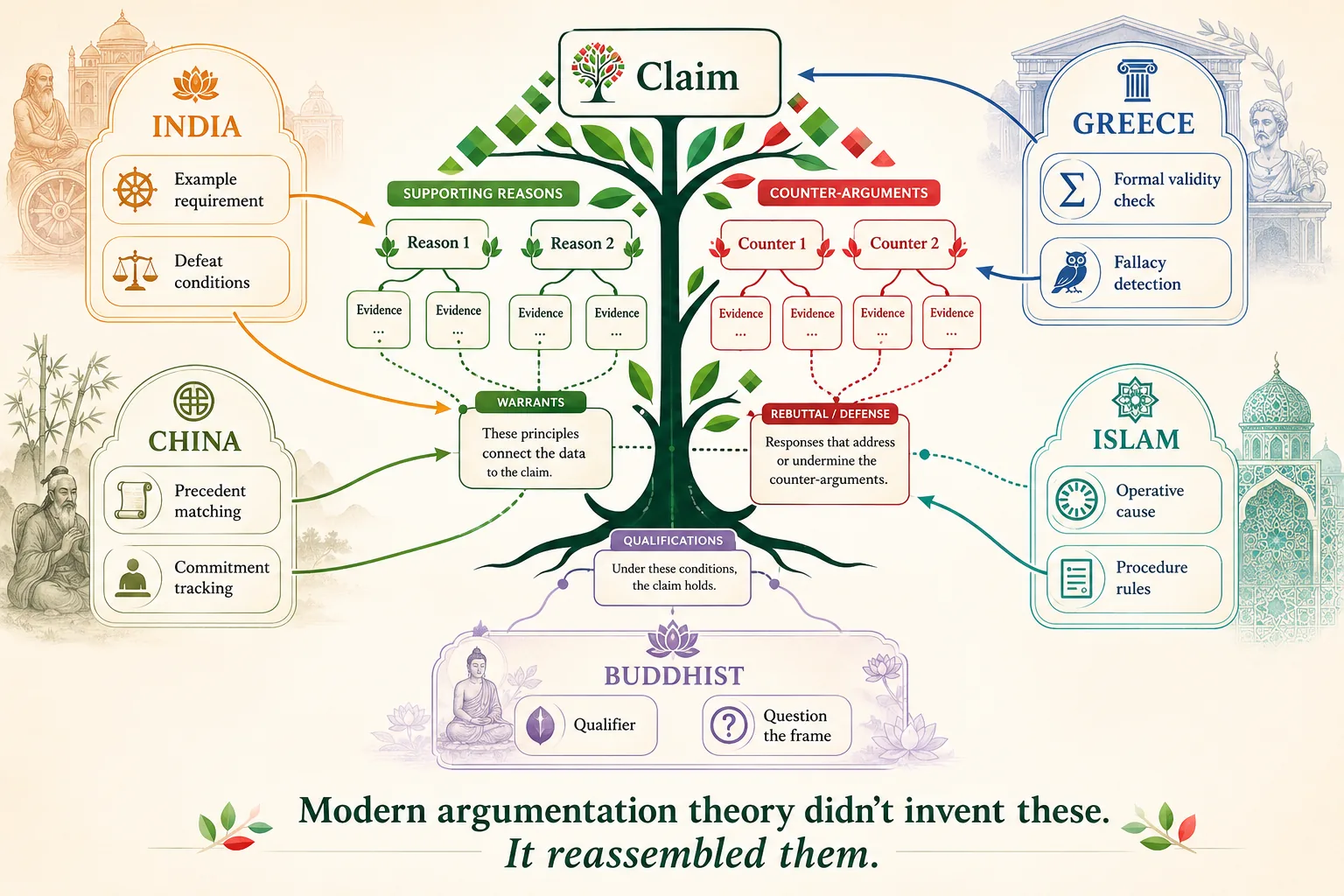
Five Syllogisms: Comparing Argument Structures Across Civilizations | Argumentree
The world's argumentation traditions built different structures because they were answering different questions. The Indian five-member Nyāya argument runs thesis, reason, example, application, conclusion, and asks whether an inference delivers knowledge. The Greek three-member Aristotelian syllogism runs major premise, minor premise, conclusion, and asks whether a conclusion follows by structure alone. Mohist argumentation supplies four techniques from the Lesser Selection — pì or analogy, móu or paralleling, yuán or pulling, tuī or pushing — and asks whether a name correctly fits an object. Islamic qiyās names four elements — aṣl the root case, farʿ the branch case, ʿilla the legally operative cause, and ḥukm the transferred ruling — and asks whether a similarity is the kind that carries a rule. The Buddhist catuṣkoṭi or tetralemma examines a claim under four alternatives — is, is not, both, neither — and asks whether the question itself rests on a defective presupposition, though its logical interpretation remains disputed. Jain syādvāda adds a seventh-fold qualification that applies across all of these, requiring a speaker to state the respect in which a claim holds. Comparing the structures shows that formal validity is one concern among several, and that the fuller anatomy of argument includes epistemic warrant, analogical relevance, procedural roles, and the obligation to qualify scope.
Five structures, five different questions. Lay them side by side and the useful discovery is not that one wins — it is that each was built to answer a question the others largely ignored, and that a modern team needs all five at different moments of the same meeting.
- Indian (Nyāya) five-member: thesis → reason → example → application → conclusion. Asks: does this deliver knowledge?
- Greek (Aristotle) three-member: major → minor → conclusion. Asks: does this follow by structure alone?
- Chinese (Mohist) four techniques: pì, móu, yuán, tuī. Asks: does this name fit this thing?
- Islamic qiyās, four elements: aṣl → farʿ → ʿilla → ḥukm. Asks: is this the similarity that carries the rule?
- Buddhist catuṣkoṭi, four corners: is, is not, both, neither. Asks: is the question itself broken?
Aristotle was neither the first nor the only thinker to systematize argument. Six connected pieces on the traditions that built the anatomy of reasoned disagreement — and what each one saw that the others missed.
- 1.The Global Roots of Reasoned Argument: How Three Civilizations Invented Logic
- 2.Indian Logic: The 2,500-Year Tradition from Nyāya to Buddhist Debate
- 3.Mohist Logic: The Chinese Art of Drawing Distinctions
- 4.Aristotle's Logic: The Mediterranean Foundation of Western Argument
- 5.Islamic Dialectics: From Theological Debate to the Science of Disputation
- 6.Five Syllogisms: Comparing Argument Structures Across CivilizationsYou are here
Same Hill, Same Fire, Five Different Arguments
Here is a claim: there is fire on that hill, because there is smoke. Everyone in this article's cast agrees it is a good argument. Almost nobody agrees on <em>why</em>.
An Aristotelian will tell you it is good because the form is valid — put anything you like in place of "smoke" and "fire" and the structure holds. A Nyāya logician will tell you the form is beside the point: it is good because smoke is pervaded by fire, so the inference actually delivers knowledge rather than merely preserving truth. A Mohist will ask which model you are matching this hill against and which similarity you think is doing the work. A jurist trained in qiyās will ask you to name the operative feature and then defend it against the case where it fails. And a Madhyamaka Buddhist may decline the question and ask what you are assuming by treating "hill" and "fire" as the kind of things that stand in fixed relations at all.
Five traditions, one uncontroversial inference, five incompatible accounts of what makes it work. That is not a scandal. It is the most useful fact in the comparative study of argument — because each account names a way arguments fail in practice, and the failure modes are different. Most bad meetings are not bad because someone committed a formal fallacy. They are bad because nobody checked the warrant, or the analogy, or the framing.
This article is the comparative capstone of the Roots of Reasoning series. It lays the five structures side by side — not to crown a winner, but to show what each catches and what each lets through.
The Five Structures at a Glance
| Tradition | Structure | Members | Core question | Best for |
|---|---|---|---|---|
| Indian (Nyāya) | Five-member argument | Thesis → Reason → Example → Application → Conclusion | Does this inference deliver knowledge? | Public debate; epistemically grounded reasoning |
| Greek (Aristotle) | Three-member syllogism | Major premise → Minor premise → Conclusion | Does this follow by structure alone? | Formal proof; a calculus you can check mechanically |
| Chinese (Mohist) | Four argumentative techniques | Pì / Móu / Yuán / Tuī | Does this name correctly fit this thing? | Case-based reasoning; precedent; naming disputes |
| Islamic (qiyās) | Four-element analogy | Aṣl → Farʿ → ʿIlla → Ḥukm | Is this the similarity that carries the rule? | Legal and policy reasoning; extending rules |
| Buddhist (catuṣkoṭi) | Four-cornered examination | Is / Is not / Both / Neither | Is the question itself defective? | Exposing false dichotomies and bad framings |
The Indian Five-Member Argument (Nyāya)
The Nyāya form has five members (avayava):
- 1. Pratijñā (thesis): "There is fire on the hill."
- 2. Hetu (reason): "Because there is smoke."
- 3. Udāharaṇa (example / general rule): "Wherever there is smoke, there is fire — as in a kitchen."
- 4. Upanaya (application): "The hill has smoke of that kind."
- 5. Nigamana (conclusion): "Therefore there is fire on the hill."
Why five? Because the form is built for a live opponent and an audience. The thesis announces what is in dispute. The example supplies a case both sides already grant, which is how shared ground is established rather than assumed. The application connects that granted case to the contested one. The conclusion restates the result for people who are listening rather than reading. The extra members are dialogical work, not logical redundancy.
What it catches: the epistemic question. Nyāya will not separate "is it valid?" from "does it deliver knowledge?", and vyāpti — invariable concomitance — is the relation that must actually hold in the world. Dharmakīrti went further and required the relation be grounded in causation or identity of nature, not accidental correlation. In modern terms: bring a mechanism, not a scatter plot.
What it lets through: nothing much, but it costs you. Five members is verbose for formal purposes, and Dignāga and Dharmakīrti themselves argued three suffice. The form stayed standard anyway, because teaching people to argue is not the same as teaching them to prove.
The Greek Three-Member Syllogism (Aristotle)
The Aristotelian syllogism has three:
- 1. Major premise: "All humans are mortal."
- 2. Minor premise: "All Greeks are humans."
- 3. Conclusion: "Therefore all Greeks are mortal."
Why three? Because three is the minimum that displays the logical relation: a major term, a minor term, and a middle term linking them. Aristotle sorted the possibilities into figures and moods, identified the valid ones, and demonstrated the rest invalid.
What it catches: form, and nothing but form — which is exactly the achievement. Substitute any terms into Barbara and validity survives. This is the one thing on this page that no other tradition built, and pretending otherwise does the comparison no favours.
What it lets through: a great deal. Propositional connectives (the Stoics had to add those), quantifier scope ("every man loves some woman" has two readings syllogistic cannot separate), analogy (acknowledged, never formalized), and — most consequentially for practical argument — the epistemic status of the premises. A valid syllogism from false premises is still a valid syllogism, and Aristotle counted that a feature. Nyāya counted it a confession.
The Chinese Four Techniques (Mohist)
The Mohists built no syllogistic. What the Lesser Selection gives instead is a repertoire of four named moves — frequently mis-glossed, so here as the text has them:
- Pì (譬) — analogy: present another case to clarify the one in dispute.
- Móu (侔) — paralleling: place structurally similar expressions side by side so accepting some pressures you to accept the rest.
- Yuán (援) — pulling: "You are so, how is it that I alone cannot be so?" Cite the opponent's own accepted case and make them find the difference.
- Tuī (推) — pushing: extend a judgment the opponent already accepts to a relevantly similar case they do not.
Why techniques rather than a form? Because the Mohist question is whether a name fits a thing. You settle that by comparing the case to a model (fǎ) and arguing about which similarities are the relevant ones — not by deriving it from premises.
What it catches: two things nothing else on this page catches. First, commitment: pulling and pushing both argue from what the opponent has already granted, which is the machinery formal dialogue systems had to reinvent in the 1990s. Second, the treachery of grammar. The Mohists affirm "white horses are horses, and riding white horses is riding horses" — and deny "carts are wood, therefore riding carts is riding wood". Identical syntax, opposite verdicts. Their conclusion, stated in the text itself, is that parallels between expressions are correct only up to a point, and that analogies fail when taken too far.
What it lets through: chaining. There is no calculus here for stacking inferences into extended proofs. For formal work that is a real gap; for law, policy and everyday argument, it is arguably the more applicable toolkit.
The Islamic Four-Element Analogy (Qiyās)
Islamic legal theory names four elements:
- 1. Aṣl (root case): an established case with a known ruling.
- 2. Farʿ (branch case): the new case requiring one.
- 3. ʿIlla (operative cause): the legally relevant feature shared by both — for instance, intoxication.
- 4. Ḥukm (ruling): the ruling transferred from root to branch because they share the ʿilla.
Why four? Because naming the ʿilla separately is the entire point. Any two cases resemble each other in indefinitely many ways; the argument only works if you can say which resemblance carries the rule — and then defend that choice.
What it catches: the burden on analogy. Jurists argued over how an ʿilla is discovered, whether it is stated clearly and generally enough, whether counterexamples defeat it, and whether the extension collides with authoritative text. That is four distinct attack surfaces on a single analogical step — more scrutiny than most organizational precedent reasoning receives in its lifetime.
What it lets through: it extends authority rather than establishing it. Qiyās presupposes a body of accepted precedent and can only reason outward from it. For theoretical inquiry that is a constraint; for law and policy it is an accurate description of how decisions actually accumulate.
The Buddhist Four-Cornered Examination (Catuṣkoṭi)
The tetralemma, associated above all with Nāgārjuna (c. 2nd century CE), examines a proposition under four alternatives:
- 1. It is.
- 2. It is not.
- 3. It both is and is not.
- 4. It neither is nor is not.
Why four corners? Here the popular account usually goes wrong, so it is worth being careful. This is not straightforwardly a four-valued truth table with one correct cell to select. In its characteristic Madhyamaka use, the arguer works through all four corners and rejects each — in order to show that the conceptual presupposition generating the question was defective. The target is the question, not the answer. The precise logical interpretation remains disputed among specialists, with paraconsistent, presupposition-failure and purely dialectical readings all seriously defended.
<strong>What it catches:</strong> broken framings. Every team has had the argument where both the affirmative and the negative feel wrong — build or buy, centralize or federate, ship or wait. The tetralemma's practical instruction is that when all the available answers are unsatisfying, the fault is upstream in how the question was posed.
What it lets through: construction. It is a solvent, not a scaffold. It can dismantle a bad framing and will not build you a good one; for that you need the other four.
The Sixth Thing: Jain Qualification
One tradition on this page is not a rival structure but a modifier that applies to all of them. Jain anekāntavāda — many-sidedness — holds that a complex reality resists exhaustive description from any single unqualified standpoint. Its syādvāda discipline turns this into a rule of speech: a sevenfold pattern of conditional predication, each form prefixed by syāt, "in some respect".
In some respect it is; in some respect it is not; in some respect both; in some respect inexpressible; plus three combinations of inexpressibility with the first three.
This gets misfiled as relativism, and it is closer to the opposite: an obligation to state scope. You may not present a partial description as an exhaustive one. Say which respect you mean.
Applied to the other five, it is a universal precondition. A Nyāya thesis, an Aristotelian premise, a Mohist name, a juristic ʿilla — each is only assessable once you know the respect in which it is being asserted. "The migration is risky" is not yet a claim. Risky in schedule, in cost, in security, in morale? Force the qualification and a surprising share of deadlocked disagreements turn out to have been two people describing different faces of the same thing.
The diagnostic question
Take the argument your team is currently stuck on and run all five checks. Does the conclusion follow? Do we actually know the premises, or just accept them? Which precedent are we matching, and on which feature? Is that the feature that carries the rule? And — the one people skip — is the question itself well formed? If the argument only fails on the fifth check, no amount of better evidence will fix it.
What Each Tradition Sees
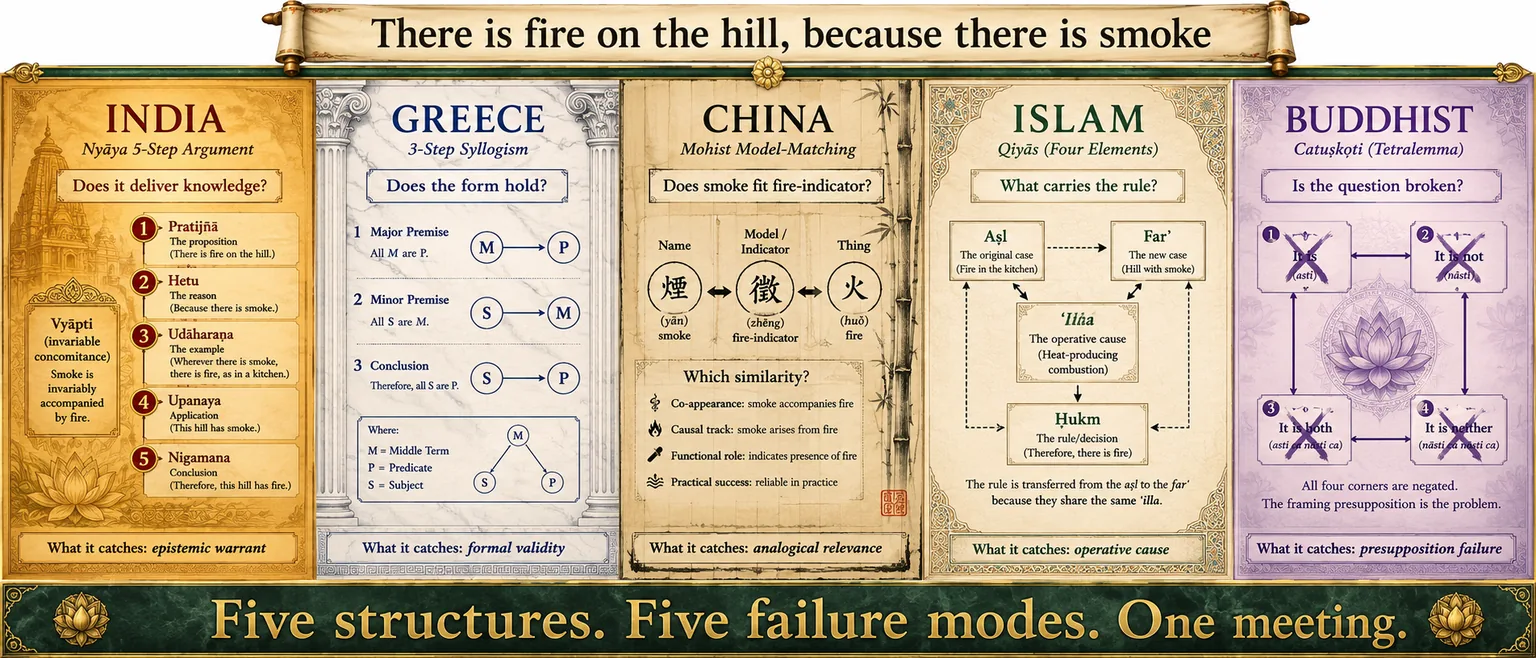
Side by side, the pattern is that each structure is precise about exactly what the others leave vague:
| Structure | Core question | Strength | Blind spot |
|---|---|---|---|
| Nyāya five-member | Does this deliver knowledge? | Epistemic warrant; built for a live audience | Verbose as pure formalism |
| Aristotelian three-member | Does this follow formally? | Content-independent validity; mechanically checkable | Silent on warrant, analogy, procedure |
| Mohist four techniques | Does this name fit? | Commitment tracking; analogy and its failure modes | No calculus for chaining inferences |
| Islamic qiyās | Is this the operative similarity? | An explicit burden attached to every analogy | Extends authority rather than establishing it |
| Buddhist catuṣkoṭi | Is the question defective? | Attacks framing, not just content | Deconstructive; builds nothing |
| Jain syādvāda | In which respect? | Forces scope to be stated before assessment | A precondition, not an argument form |
No tradition is complete, and the incompleteness is not symmetrical. Greek logic is unmatched at the one thing it does and largely silent on everything else. Indian logic covers warrant and procedure and pays in verbosity. Mohist analysis owns analogy and commitment and never scales to proof. Qiyās is the most rigorous treatment of precedent anyone produced and cannot originate authority. The tetralemma is the only one that will question the question.
So the honest comparative claim is not that the West got it wrong. It is that the West got one part right, kept only that part, and spent the twentieth century rebuilding the rest under new names.
Isn't This Just Relativism With Better Footnotes?
The objection deserves an answer, because it is the reasonable worry. If every tradition has its own criteria, isn't "good argument" just whatever your culture says it is? And isn't celebrating five incompatible standards a way of avoiding the fact that one of them produced modern mathematics and the others did not?
No, on both counts. The traditions are not offering competing answers to one question; they are offering answers to different questions, and the questions are not culturally arbitrary — they are the actual joints of argument. Whether a conclusion follows, whether the premises are warranted, whether an analogy is relevant, whether the framing is sound, whether the scope is stated: these are five genuinely distinct ways an argument can be defective, and they remain distinct in any language.
And the asymmetry is real and should be stated. Formal validity as a content-independent property is a Greek achievement, it was not matched elsewhere, and it is the foundation of everything from predicate logic to the machine you are reading this on. Conceding that plainly is what makes the rest of the comparison credible rather than defensive.
What does not follow is that formal validity is the <em>whole</em> of argument. It is one of five checks, and in ordinary organizational life it is the check that fails least often. Nobody's product strategy collapsed because they affirmed the consequent. They collapsed because the analogy to the last launch didn't hold, or the premise everyone accepted was never examined, or the question was wrong.
Modern Argumentation Rebuilt All of This
The strongest evidence that these are real joints, not cultural quirks, is that twentieth-century argumentation theory reconstructed every one of them — independently, and mostly without knowing it:
- Argumentation schemes (Walton, Reed, Macagno) catalogue recurring patterns — argument from expert opinion, from cause, from analogy — each with critical questions that test whether it holds this time. That is the Mohist and qiyās project with a bibliography.
- Abstract argumentation frameworks (Dung, 1995) model arguments as nodes with attack relations and compute which sets survive together. "Which arguments survive?" is the jadal question rendered in graph theory.
- Defeasible and non-monotonic logics handle conclusions that must be withdrawn when new information arrives — the formal home for reasoning that is good without being truth-preserving, which is most reasoning.
- The Toulmin model (claim, grounds, warrant, backing, rebuttal, qualifier) separates the warrant from the grounds — the distinction ādāb al-baḥth built into its role structure, and the qualifier is syādvāda's "in some respect" wearing a lab coat.
- Pragma-dialectics and dialogue games specify stages, roles, burdens and the rules of critical discussion — a nigraha-sthāna list and a munāẓara protocol, rediscovered.
Read that list next to the table above and the conclusion is hard to avoid: the anatomy of argument is roughly fixed, most of it was mapped before 1400, and the twentieth century's contribution was formalization rather than discovery.
Structure Decides
This series began with a simple observation: argument was systematized more than once, in different places, largely independently. It ends with the consequence: they systematized different parts, and the parts fit together.
Put end to end, the traditions cover the whole lifecycle. Before arguing: define the question, classify the dispute, agree what sources count. Building a case: state a thesis, give a reason, supply a rule or precedent, show it applies, draw the conclusion. Testing it: hunt positive cases, negative cases, irrelevant similarities, hidden assumptions, circularity. Managing the exchange: allocate roles and burdens, record concessions, know what defeat looks like. Diagnosing failure: bad reasons, false analogies, irrelevance, regress, contradiction, equivocation, procedural violation. Ending it: knowledge, a ruling, a decision, a persuaded audience — or, in less cooperative rooms, a win.
Which is the largest lesson of the comparison, and the reason it is not merely historical. "Logic" is one part of structured argument. These traditions treated reasoning simultaneously as a cognitive process, a linguistic performance, a social interaction, an ethical discipline and an institutional practice — and every one of those layers is where real disagreements actually go wrong. Making the structure explicit is what argumentation theory, argument mapping, and tools like Argumentree exist to do.
Five civilizations, one uncontroversial hill, five accounts of the fire. Not one of them was wrong.
The Roots of Reasoning Series
This article completes the series exploring the world's argumentation traditions:
Hub overview: how India, China, and Greece systematized argument independently.
The five-member argument, the 22 grounds of defeat, and Dignāga's wheel of reasons.
Biàn, models, the four techniques, and the path Chinese logic took.
The Organon, the syllogism, the Rhetoric, and Western logic's foundation.
Kalām, jadal, qiyās, and the discipline that graded you on conduct.
Sources & Further Reading
The five-tradition survey this comparison is built on: ancient Greek, classical Indian, classical Chinese, medieval Latin and medieval Islamicate argumentation.
The authority for the four techniques of the Lesser Selection and the 'this and so' / 'this but not so' classification of parallel expressions.
The five-member argument, vyāpti, and the Dignāga–Dharmakīrti conditions on a valid reason.
Figures, moods, and the relationship between demonstration and dialectic.
The modern catalogue of argument patterns with critical questions — the direct descendant of the Topics, the Mohist techniques, and qiyās.
The founding paper of abstract argumentation frameworks: arguments as nodes, attacks as edges, and a formal answer to which sets survive together.
Frequently Asked Questions
Why compare argument structures across civilizations?
Because each was built to answer a different question, and the questions correspond to genuinely different ways an argument can fail. Aristotelian syllogistic tests whether a conclusion follows by structure. Nyāya tests whether the inference delivers knowledge. Mohist technique tests whether an analogy and a naming are apt. Qiyās tests whether a similarity is the one that carries a rule. The tetralemma tests whether the question is well formed. A reasoner who has only one of these checks will miss the failures the others catch.
How does the Indian five-member argument differ from the Greek syllogism?
The Nyāya form has five members — thesis, reason, example or general rule, application, and conclusion — where Aristotle's has three. The extra members do dialogical rather than logical work: the thesis announces what is disputed, the example supplies a case both parties already accept, and the conclusion restates the result for an audience. Nyāya also refuses to separate validity from knowledge, requiring that the reason genuinely track reality through vyāpti rather than merely preserving truth formally.
What are the four Mohist argumentative techniques?
The Lesser Selection names pì (譬), analogy — presenting another case to clarify this one; móu (侔), paralleling — placing structurally similar expressions side by side; yuán (援), pulling — citing something the opponent already accepts and asking why the present case differs; and tuī (推), pushing — extending an accepted judgment to a relevantly similar case. Pulling and pushing both argue from the opponent's own prior commitments, anticipating the commitment-tracking of modern formal dialogue systems.
What is qiyās and what makes it more than loose analogy?
Qiyās is Islamic legal analogy with four named elements: the aṣl or root case with a known ruling, the farʿ or branch case needing one, the ʿilla or legally operative cause shared by both, and the ḥukm or ruling transferred from root to branch. What makes it rigorous is that the ʿilla must be named separately and then defended: jurists disputed how it is discovered, whether it is clear and general enough, whether counterexamples defeat it, and whether the extension conflicts with authoritative text.
Is the Buddhist tetralemma a four-valued logic?
Not straightforwardly, and the flat description is where most popular accounts go wrong. The catuṣkoṭi examines a claim under four alternatives — is, is not, both, neither — but in its characteristic Madhyamaka use the arguer works through and rejects all four in order to show that the presupposition generating the question was defective. The target is the question rather than the answer. The precise logical interpretation remains disputed, with paraconsistent, presupposition-failure and purely dialectical readings all defended by specialists.
Where does Jain syādvāda fit among these structures?
It is not a rival structure but a precondition that applies to all of them. Anekāntavāda holds that complex reality resists exhaustive description from a single unqualified standpoint, and syādvāda turns that into a sevenfold pattern of conditional predication, each form prefixed with syāt, 'in some respect'. The practical effect is a requirement to state scope before a claim can be assessed at all — which is why so many deadlocked disagreements dissolve once both parties name the respect they are talking about.
Doesn't comparing traditions like this amount to relativism?
No. The traditions are not giving competing answers to one question; they are answering different questions, and those questions correspond to real and distinct ways arguments fail in any language. It is also worth conceding the asymmetry plainly: formal validity as a content-independent property is a Greek achievement that was not matched elsewhere, and it underpins modern logic and computation. What does not follow is that formal validity is the whole of argument — in ordinary organizational life it is the check that fails least often.
Which argument structure is best?
None, for all purposes. Use the syllogism when you need mechanically checkable validity. Use the Nyāya form when you need to establish shared ground with a live opponent. Use Mohist technique when you are reasoning from precedent or testing an analogy. Use qiyās when you are extending a rule and must justify why one similarity carries it. Use the tetralemma when every available answer feels wrong and the framing is the likely culprit. And use syādvāda's discipline throughout, by stating the respect in which each claim holds.
Argumentree Team
Decision Science
The Argumentree team explores the science of better decisions—from ancient philosophy to modern AI.
Read the series from the start
Each tradition in depth — where it came from, what it built, and what it could not see.
The hub: why argument was systematized more than once, and what each tradition contributed.
Twenty-two named ways to lose an argument, and a nine-cell test for good evidence.
Four argument moves, a fairness rule, and the discovery that grammar lies.
Structure your arguments. Decide better.
Argumentree brings 2,500 years of argumentation theory into a pro/con tree your team can build, rate, and keep — with AI extraction, multi-dimensional scoring, and a full decision audit trail.
Start Free 14-Day Trial →