
Mohist Logic: The Chinese Art of Drawing Distinctions | Argumentree
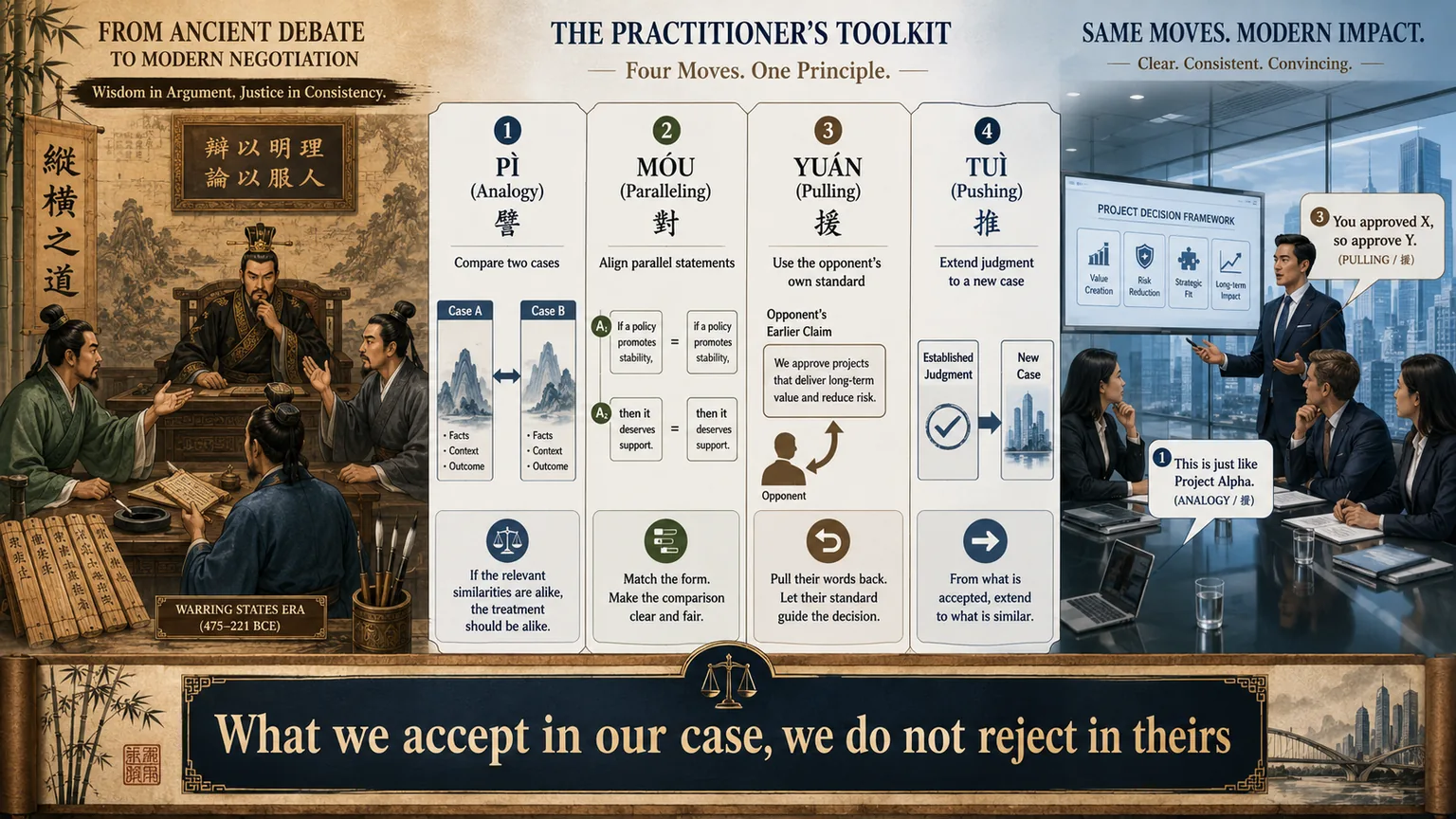
Classical Chinese thought systematized argument around biàn — disputation, more literally the drawing of distinctions. The Mohist school, followers of Mòzǐ (c. 470–391 BCE), produced the most systematic treatment in the Later Mohist Canons, Explanations, and the essays known as the Greater and Lesser Selection. Where Greek logic asked whether a conclusion follows from premises, Mohist logic asked whether a name correctly fits an object or situation. The Mohists reasoned from fǎ — models, standards, or exemplars — judging a case by whether it matches the model. Early Mohist argument appealed to three standards: the precedent of exemplary rulers, the evidence of ordinary experience, and consequences for social benefit. The Lesser Selection names four argumentative techniques: pì, giving an analogy; móu, placing parallel expressions side by side; yuán, pulling, which cites a precedent the opponent already accepts and asks why the present case differs; and tuī, pushing, which extends an accepted judgment to a relevantly similar case. It also states a fairness principle: what we accept in our own case we do not reject in the opponent's. The Mohists recognized that syntactically parallel expressions can behave differently — white horses are horses and riding white horses is riding horses, but carts are wood and riding carts is not riding wood — and used that distinction to defend the contested claim that killing robbers is not killing people. They also treated practical deliberation as weighing benefit and harm, choosing the greatest benefit or the least harm.
The Mohists were doing philosophy of language and theory of argument in the third century BCE, and they were doing it well. Their question was not "does this follow?" but "does this name fit this thing?" — and out of that question they built four named argumentative moves, a fairness rule, and a hard-won discovery that grammar is a treacherous guide to meaning.
- Biàn (辯): disputation — literally distinguishing. A dispute is a contest over whether a name fits an object, and exactly one side can be right
- Fǎ (法): models or standards. You judge a case by comparing it to a paradigm and asking which similarities are the relevant ones
- Four techniques: pì (analogy), móu (paralleling), yuán (pulling — cite the opponent's own precedent), tuī (pushing — extend their accepted judgment)
- A stated fairness rule: "Having it in our case, we do not reject it in the other's" — the same standard applies to both sides, written down
- Grammar lies: riding white horses is riding horses, but riding carts is not riding wood. Identical syntax, opposite verdicts — and the Mohists knew why it mattered
Aristotle was neither the first nor the only thinker to systematize argument. Six connected pieces on the traditions that built the anatomy of reasoned disagreement — and what each one saw that the others missed.
- 1.The Global Roots of Reasoned Argument: How Three Civilizations Invented Logic
- 2.Indian Logic: The 2,500-Year Tradition from Nyāya to Buddhist Debate
- 3.Mohist Logic: The Chinese Art of Drawing DistinctionsYou are here
- 4.Aristotle's Logic: The Mediterranean Foundation of Western Argument
- 5.Islamic Dialectics: From Theological Debate to the Science of Disputation
- 6.Five Syllogisms: Comparing Argument Structures Across Civilizations
"Robbers Are People, But Killing Robbers Is Not Killing People"
That sentence is not a riddle or a translation error. It is the conclusion of a sustained argument in the Lesser Selection, one of the core Mohist dialectical texts, and the Mohists knew exactly how strange it sounded. They were being accused of inconsistency: your school preaches impartial concern for everyone, robbers are people, so how can you also endorse executing them?
Their answer was not to soften either commitment. It was to argue that the inference itself is broken — that "robbers are people, therefore killing robbers is killing people" belongs to a class of arguments where the grammar looks fine and the conclusion does not follow. They proved it by lining up cases everyone already accepted. Carts are wood, but riding carts is not riding wood. Boats are wood, but getting into boats is not getting into wood. Her brother is a handsome man, but caring about her brother is not caring about a handsome man.
Whether or not the defence works — Xúnzǐ thought it didn't, and modern readers often side with him — look at what is happening. Third-century-BCE philosophers had noticed that two sentences can share a syntactic form and diverge completely in what makes them true, and they had built an argumentative practice around that fact. That is a discovery about language, arrived at under adversarial pressure, in defence of a policy position. It is also the exact move a modern executive makes when they say "yes, technically it's a reorg, but this isn't *that kind* of reorg" — and the Mohists would want to know precisely which similarity you think is doing the work.
This article is part of the Roots of Reasoning series on the world's argumentation traditions.
Biàn: Argument as Distinction-Drawing
The Warring States period (475–221 BCE) was politically fragmented and intellectually crowded. Confucians, Mohists, Daoists, Legalists and the thinkers later grouped as the School of Names (<em>Míngjiā</em>) argued in front of rival courts, and rulers hired advisers who could win. The pressure produced reflection on what makes an argument work.
The organizing term is biàn (辯). It is usually rendered "disputation", but its literal sense is distinguishing — as a verb, the act of telling things apart; as a noun, the distinctions themselves. So the central question of a Chinese dispute is characteristically not "does this conclusion follow from these premises?" but:
Does this name, category, or prescription correctly fit this object or situation?
The Mohist Canons put the structure crisply: one party calls it "ox", the other calls it "non-ox". That is contending over converses. The two cannot both fit the object, so one of them does not fit. The Mohists recognized principles resembling non-contradiction and excluded middle — but formulated them semantically, about names fitting things, rather than as abstract truths about propositions. That single framing choice sets the whole tradition on a different track from Greece.
Models, Not Premises
If argument is about whether a name fits, the natural tool is not a premise but a fǎ (法) — a model, standard, or exemplar. You learn to identify an ox, a just action, or a beneficial policy by comparing the case in front of you to a reliable model and judging whether the similarities that matter are present.
Early Mohist argument appealed to three such standards:
- Precedent: what the exemplary rulers of the past actually did
- Experience: what ordinary people have seen and heard
- Consequence: whether adopting it benefits the state and the people
That third standard is doing real work — it is the Mohists' consequentialism showing through, and it made them willing to attack ritual practices the Confucians defended on precedent alone. But notice the shape of the whole apparatus: to support a claim, cite a model for the term you are applying, then show that the case matches the model. Support is <em>matching</em>, not derivation.
The Later Mohist texts then push on the hard part: which similarities count? They investigate sameness and difference, whole and part, cause, and the grounds for classifying something as a kind. Their term for citing a bad criterion is kuáng jǔ — "wild presenting", picking out features arbitrarily. Oxen and horses both have teeth and tails, so teeth and tails cannot be what distinguishes them; only some oxen have horns, so horns cannot define the kind either. Getting the relevant similarity right is the whole game.
The Four Techniques of the Lesser Selection
The Lesser Selection (Xiǎo Qǔ) — probably the single most important text in the history of Chinese logic — names four argumentative techniques. They are commonly mis-glossed in secondary accounts, so here they are as the text describes them:
- Pì (譬) — analogy: "Presenting other things and using them to clarify it." Bring in a second case to illuminate the one in dispute.
- Móu (侔) — paralleling: "Placing expressions side by side and jointly proceeding." Line up structurally similar statements so that accepting some pressures you into accepting the rest.
- Yuán (援) — pulling: "You are so, how is it that I alone cannot be so?" Cite something the opponent has already accepted and challenge them to explain why the present case should be treated differently.
- Tuī (推) — pushing: Propose a claim on the grounds that what the opponent does not accept is relevantly the same as what they do accept — extending their own judgment into new territory.
These are not a fixed sequence of steps. They are a repertoire, and a debater reaches for whichever fits. But look at what pulling and pushing actually do: they are arguments from the opponent's own prior commitments. Pulling shifts the burden — you now have to identify a relevant disanalogy, or my claim stands. Pushing extends consistency — you accepted it there, so accept it here or explain the difference.
In modern terms, these are commitment-based moves, the machinery that formal dialogue systems in argumentation theory had to reinvent in the 1990s: track what each party has conceded, and hold them to it. The Mohists were tracking commitment stores in the third century BCE.
And they paired the techniques with a stated principle of fairness: having it in our case, we do not reject it in the other's; lacking it in our case, we do not demand it in the other's. The same standard applies to both sides. That is a written rule against special pleading, roughly two millennia before anyone in Europe wrote one down.
The diagnostic question
Think of the last time your team approved something "because we did the same thing with Project X." Now ask the Mohist question: which similarity to Project X is doing the work — and is it actually present this time? If nobody can name the relevant feature, that wasn't reasoning by precedent. It was wild presenting with a slide deck.
The Discovery That Grammar Lies
The Mohists' deepest result came from pushing paralleling until it broke. The simple starting model of language — the one most people default to — is that each name maps to one kind of thing. String two names together and the meaning should compose predictably. It does not.
Combine "oxen" and "horses" and you get the sum of both kinds; nothing in "oxen-and-horses" is only oxen. Combine "hard" and "white" and you get neither a sum nor an alternation but the things that are both at once, in the same place. "White horse" and "blind horse" share a grammatical shape, but a white horse is white all over while a blind horse is not blind all over — only its eyes are.
So the Lesser Selection sorts parallel constructions into classes. Some are "this and so": white horses are horses, and riding white horses is riding horses. Black horses are horses, and riding black horses is riding horses. The parallel holds and can be extended to new cases.
Others are "this but not so": carts are wood, but riding carts is not riding wood. Boats are wood, but getting into boats is not getting into wood. Identical syntax to the horse cases; opposite verdict. Which is precisely where the robbers argument is filed — the Mohists claim it belongs with the carts, not with the horses.
The text then draws the moral itself, and it is the most quotable thing in classical Chinese logic: things have respects in which they are similar, yet it does not follow that they are completely similar; parallels between expressions are correct only up to a point. Analogies "become dangerous as they change direction, fail when taken too far, and leave their roots as they flow" — so one cannot use them uncritically. A tradition that had just built four analogical techniques wrote the warning label for them in the same essay.
But Isn't the Robbers Argument Just Sophistry?
It is worth conceding the objection, because it is a good one and Xúnzǐ made it first. The Mohists never explain <em>why</em> killing robbers lands in the "this but not so" bin rather than the "this and so" bin. They assert the classification and point at the carts. A critic can fairly say the whole category looks assembled to reach a predetermined conclusion — and that granting sibling affection differs from sexual attraction, caring about your handsome brother is still caring about someone who is a handsome man.
There was a cleaner route available, and Xúnzǐ took it: distinguish kinds of killing. "Killing people" covers a range — including morally wrong killing of the innocent and community-sanctioned execution of the guilty. Killing robbers can then be killing people without being wrongful killing, no paradox required. Xúnzǐ made exactly this move for "honour", splitting moral honour from status honour by compounding names.
Why didn't the Mohists? Plausibly because they never fully escaped the one-name-one-thing assumption. Their own work had shown that phrases don't compose predictably, and their response was to try to pin each phrase to its own discrete slice of reality — rectifying phrases rather than only names. That instinct is what forces the paradoxical formulation. It is a real limitation, and it is also the most interesting kind: a school defeated by the depth of its own discovery.
The Rectification of Names
Running through Confucian, Mohist and Legalist thought is zhèngmíng (正名), the rectification of names: social order depends on names being used correctly. If a "minister" does not act as a minister should, calling him minister is a misuse that breeds confusion. Confucius put it that if names are not correct, speech does not accord with things, and affairs do not succeed (Analects 13.3). Xúnzǐ (c. 310–235 BCE) devotes a full chapter to how names arise by convention, how usage drifts, and how to restore it.
This is not a quaint concern. Public argument today turns constantly on whether a name applies — is it a tax or a fee, a restructuring or a layoff, a security incident or a breach, an outage or degraded service? These are treated as semantic quibbles and they are nothing of the kind: the name selects which rules, obligations and precedents come along with it. The Chinese tradition took that seriously enough to make it a governance question.
The School of Names
The most provocative arguments come from the School of Names (Míngjiā). Gongsun Long (c. 320–250 BCE) is famous for the White Horse Dialogue, arguing that a white horse is not a horse: "horse" picks out shape, "white" picks out colour, and the compound is therefore not identical to either. It is best read as probing predication and reference rather than as a sincere denial.
Hui Shi (c. 380–305 BCE), Zhuangzi's friend and sparring partner, offered paradoxes: the greatest has nothing beyond it, the smallest nothing within; today I set out for Yue and arrived yesterday. Like Zeno's, these probe the limits of spatial and temporal concepts.
Confucians, Mohists and Daoists all dismissed the School of Names as clever wordplay. But the Later Mohists engaged seriously enough to argue against them — canon B72 in effect attacks the position that anything can arbitrarily be deemed so, insisting that whether something falls under a name is settled by whether it really resembles the other things that take that name, not by our decision to call it that.
Weighing: Practical Reasoning Under Bad Options
One more piece, easy to overlook and directly usable. The Mohists analysed quán (權), weighing — what to do when the values conflict or when every available option is harmful.
Their rule: among benefits select the greatest, among harms select the least. Their example is a traveller seized by robbers who must give up a finger, an arm, or his life. In absolute terms he is choosing something harmful. The Mohists insist that choosing the least harmful option counts as choosing benefit, not harm, because his choices were not fully his to set.
This is the earliest explicit treatment of least-bad-option reasoning in the Chinese tradition, and it names something teams routinely get wrong: the meeting where every path has a serious cost, and the group stalls because nobody wants to be the one who proposed harm. The Mohist answer is that under constrained options, picking the smallest harm <em>is</em> the beneficial act, and treating it as a failure is a category error.
Why No Syllogistic?
Western historians keep asking why China did not develop a formal syllogistic. The candidate answers:
- Linguistic structure: classical Chinese lacks a copula and does not mark number or tense as Indo-European languages do, so "All S are P" is not a natural sentence shape.
- Intellectual priorities: the interest was in ethics, governance and the right use of language. Logic was an instrument for arguing and governing well, not a subject in itself.
- Textual accident: the Mohist school faded in the early Han, and its dialectical texts were transmitted in poor condition — terse, disordered, in places corrupt — and largely neglected for two millennia.
- Sufficiency: if models and analogical extension handle your problems, a deductive calculus is not obviously missing.
None is fully satisfying, and the question may be the wrong one. The Mohists explicitly told us what they were building: accept and propose on the basis of kinds. They were not attempting formal validity and failing. They were studying fair analogical persuasion and getting a long way — which is why the honest comparison is not "who had logic" but "who studied which part of argument", the question the comparative post in this series takes up.
What Mohist Logic Offers Today
Four things transfer directly into how a modern team argues:
- Name the relevant similarity. Precedent-based reasoning is the default in every organization. The Mohists demand you say which feature of the precedent is doing the work — the difference between reasoning and "wild presenting".
- Use pulling and pushing deliberately. Cite what your counterpart already accepts and ask what makes this case different. It shifts the burden honestly and turns a clash of assertions into a search for the actual disanalogy.
- Apply the fairness rule out loud. What we accept in our own case we do not reject in theirs. Written down, it is the cheapest available guard against special pleading.
- Distrust parallel phrasing. "It's just like X" is a claim, not evidence. Riding white horses is riding horses; riding carts is not riding wood. Same grammar, opposite answers — check which one you have.
Modern argumentation theory arrived here late. Argument from analogy is now a standard scheme with critical questions attached, precisely because analogy is how people actually reason and deduction alone never described it. The Mohists would recognize the project, and would probably point out that they had already written the warning label.
The Roots of Reasoning Series
This article is part of a series exploring the world's argumentation traditions:
Hub overview: how India, China, and Greece systematized argument independently.
The five-member argument, the 22 grounds of defeat, and Dignāga's wheel of reasons.
The Organon, the syllogism, the Rhetoric, and Western logic's foundation.
Kalām, jadal, qiyās, and the synthesis that transmitted Aristotle.
The Indian, Greek, Chinese, Islamic, and Buddhist argument forms compared.
Sources & Further Reading
The reference treatment of the Canons, Explanations, and the Greater and Lesser Selection — the source for the four techniques, the parallel-expression classes, the robbers argument, and the analysis of weighing.
Places biàn alongside the Greek, Indian, Latin and Islamicate traditions, and gives the canon A74 "ox / non-ox" passage in context.
Gongsun Long, Hui Shi, the White Horse Dialogue, and the disputation context the Mohists were arguing inside.
The foundational modern reconstruction of the Mohist dialectical corpus. Still the starting point for anyone working on these texts.
The influential argument that classical Chinese semantics is mass-noun-like and non-mentalistic — the source of much of the debate about why Chinese logic looks as it does.
The primary texts themselves: two books of Canons, two of Explanations, and the Greater and Lesser Selection.
Frequently Asked Questions
What is biàn in Chinese philosophy?
Biàn (辯) is usually translated as disputation or argumentation, but its literal sense is distinguishing — as a verb, telling things apart; as a noun, the distinctions themselves. A biàn is a contest over whether a name (míng) correctly fits an object or situation (shí). The Mohist Canons put it as one party calling something 'ox' and the other calling it 'non-ox': they are contending over converses, they cannot both fit, so one of them does not.
What are the four Mohist argumentative techniques?
The Lesser Selection names four. Pì (譬), analogy: presenting another case to clarify the one in dispute. Móu (侔), paralleling: placing structurally similar expressions side by side so that accepting some pressures you to accept the rest. Yuán (援), pulling: citing something the opponent already accepts and asking why the present case should be treated differently. Tuī (推), pushing: extending an opponent's accepted judgment to a relevantly similar case. They are a repertoire rather than a fixed sequence, and pulling and pushing are both arguments from the opponent's own prior commitments.
What is a fǎ (model) in Mohist reasoning?
A fǎ (法) is a model, standard, or exemplar. Rather than deriving a conclusion from premises, Mohist argument cites a model for the term being applied and shows that the case at hand matches it. Early Mohist argument appealed to three standards: the precedent of exemplary rulers, the evidence of ordinary experience, and consequences for social benefit. Citing an irrelevant or unreliable criterion is called 'wild presenting' (kuáng jǔ) — for example, distinguishing oxen from horses by teeth and tails, which both have.
Why do the Mohists say that killing robbers is not killing people?
They were answering a charge of inconsistency: Mohism preaches impartial concern for all, robbers are people, so how can executing them be permissible? Rather than abandon either commitment, they argued the inference is invalid, placing it in a class of cases where parallel grammar does not transfer — carts are wood, but riding carts is not riding wood; boats are wood, but getting into boats is not getting into wood. Critics from Xúnzǐ onward have found the classification ad hoc, noting that distinguishing kinds of killing — wrongful killing versus sanctioned execution — would resolve the issue without the paradox.
Is 'riding a white horse is riding a horse' true for the Mohists?
Yes. The Mohists explicitly affirm it as a 'this and so' case: white horses are horses, and riding white horses is riding horses. It is often misreported as one of their failing parallels. The contrasting 'this but not so' class contains cases like carts are wood but riding carts is not riding wood. The Mohists' point is that the two classes are syntactically indistinguishable, so grammatical parallelism alone can never settle whether an inference goes through.
What is the rectification of names (zhèngmíng)?
Zhèngmíng (正名) is the idea that social order depends on names being used correctly: if a minister does not act as a minister should, calling him minister is a misuse that produces confusion. It is central to Confucian, Mohist and Legalist thought — Confucius states it in Analects 13.3, and Xúnzǐ devotes a chapter to how names arise by convention and how correct usage is restored. The modern analogue is any dispute over whether something counts as a tax or a fee, a restructuring or a layoff, an incident or a breach.
What is 'weighing' (quán) in Mohist practical reasoning?
Quán (權) is the Mohist analysis of choice under conflicting values or uniformly bad options: among benefits select the greatest, among harms select the least. Their example is a traveller seized by robbers who must sacrifice a finger, an arm, or his life. He is choosing something harmful in absolute terms, but because his options were constrained, the Mohists count selecting the least harmful as selecting benefit rather than harm.
Why didn't China develop a formal syllogistic?
Proposed explanations include classical Chinese lacking a copula so that 'All S are P' is not a natural sentence shape; intellectual priorities focused on ethics, governance and correct language rather than abstract formal relations; and the textual accident that the Mohist school faded in the early Han and its dialectical writings survived in terse, disordered condition and were neglected for two millennia. None is fully satisfying, and the question may be mal-posed: the Lesser Selection states that arguments are accepted and proposed on the basis of kinds, so the Mohists were studying fair analogical persuasion rather than attempting formal validity and failing.
Argumentree Team
Decision Science
The Argumentree team explores the science of better decisions—from ancient philosophy to modern AI.
Keep reading the series
Four more traditions, four more toolkits — and a side-by-side comparison of what each one can and cannot do.
Structure your arguments. Decide better.
Argumentree brings the world's argumentation traditions into a pro/con tree your team can build, rate, and keep — with AI extraction, multi-dimensional scoring, and a full decision audit trail.
Start Free 14-Day Trial →