
Indian Logic: The 2,500-Year Tradition from Nyāya to Buddhist Debate | Argumentree
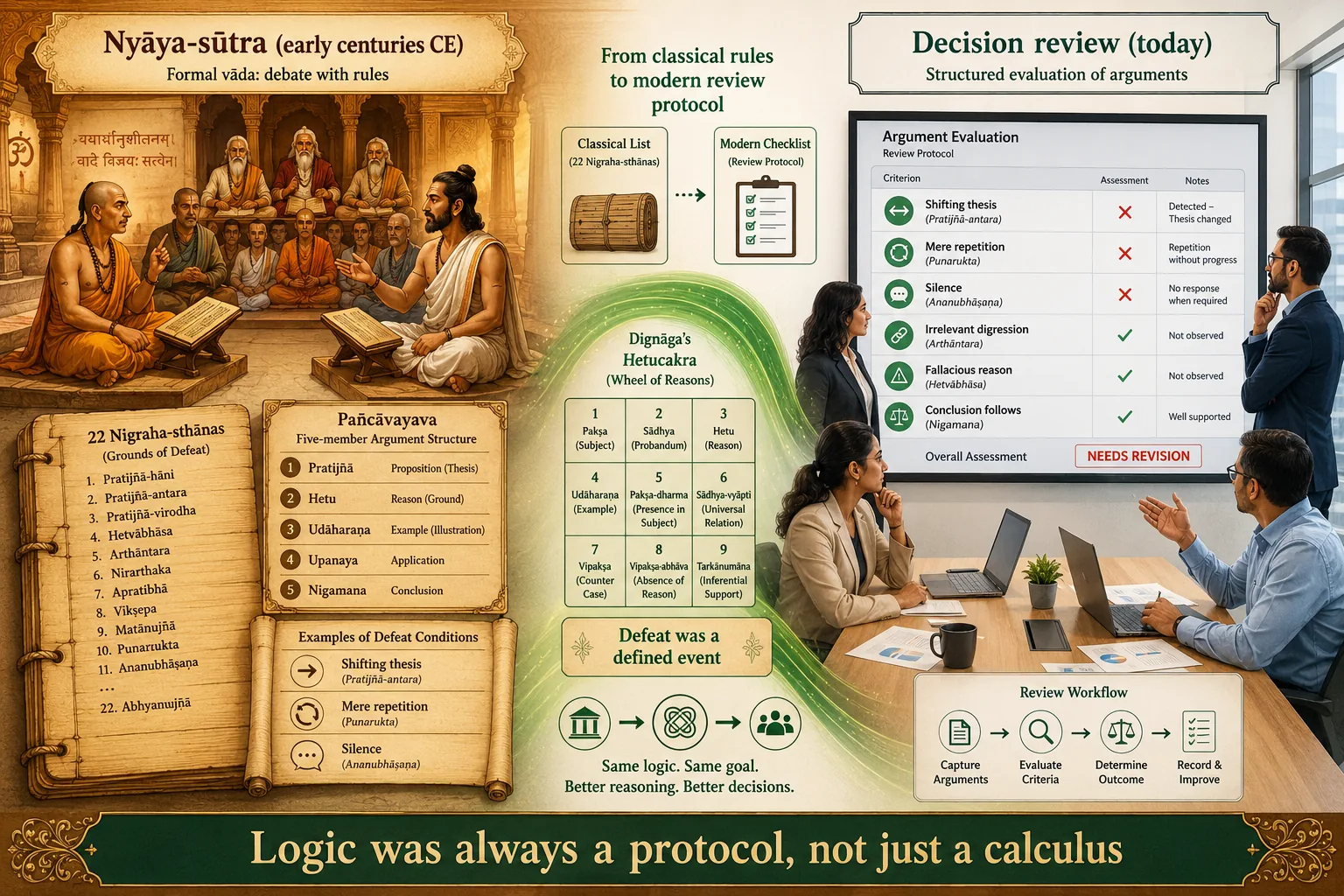
Indian logic grew out of institutional debate rather than abstract proof. The Nyāya-sūtra, attributed to Akṣapāda Gautama and available in something like its surviving form by the early centuries CE, formalizes a five-member argument (pratijñā, hetu, udāharaṇa, upanaya, nigamana) and embeds it in an epistemology of pramāṇas — perception, inference, comparison, and testimony. It also lists 22 nigraha-sthānas, named grounds on which a debater loses, mixing logical errors with procedural violations. Nyāya distinguishes vāda (cooperative truth-seeking), jalpa (competitive victory-seeking), and vitaṇḍā (attacking without defending a thesis of one's own). The Buddhist logician Dignāga (c. 480–540 CE) separated inference for oneself from argument for another, and set three conditions a valid reason must meet: it is present in the subject, present in similar cases, and absent from all dissimilar cases. His hetucakra arranges the possibilities in a nine-cell matrix in which only two yield sound inferences. Dharmakīrti tightened the grounding of vyāpti, invariable concomitance. Buddhist prasaṅga reasoning exposes unacceptable consequences of an opponent's position, and the catuṣkoṭi or tetralemma examines a claim under four alternatives — is, is not, both, neither — though its exact logical interpretation remains disputed among scholars. Jain philosophers added anekāntavāda, many-sidedness, and syādvāda, a sevenfold pattern of conditional predication requiring speakers to state the respect in which a claim holds. Navya-Nyāya, founded by Gaṅgeśa Upādhyāya in 14th-century Mithila, built a technical Sanskrit idiom for logical relations that scholars compare to predicate logic. The tradition treats argument simultaneously as cognition, social interaction, and regulated procedure.
Indian philosophers did not begin with valid sentence forms. They began with two questions the Greek tradition mostly left implicit: how does a cognition come to count as knowledge, and what are the rules of the contest we are having right now. The result is a logic braided together with epistemology and with debate procedure — including a numbered list of ways to lose.
- Logic inside epistemology: inference (anumāna) is one of four pramāṇas — reliable processes that turn cognition into knowledge — not a free-standing formal calculus
- The five-member argument: thesis, reason, example, application, conclusion — the extra members do dialogical work, not logical work
- 22 grounds of defeat: the Nyāya-sūtra names the ways a debater loses, mixing bad reasoning with procedural violations — a rulebook, not just a logic
- Dignāga's three-condition test: a reason must be present in the subject, present in similar cases, and absent from all dissimilar ones — arranged in a nine-cell matrix where only two cells are sound
- Jain qualification: anekāntavāda and the sevenfold syādvāda force a speaker to state the respect in which a claim holds, so a partial description can't pose as a complete one
Aristotle was neither the first nor the only thinker to systematize argument. Six connected pieces on the traditions that built the anatomy of reasoned disagreement — and what each one saw that the others missed.
- 1.The Global Roots of Reasoned Argument: How Three Civilizations Invented Logic
- 2.Indian Logic: The 2,500-Year Tradition from Nyāya to Buddhist DebateYou are here
- 3.Mohist Logic: The Chinese Art of Drawing Distinctions
- 4.Aristotle's Logic: The Mediterranean Foundation of Western Argument
- 5.Islamic Dialectics: From Theological Debate to the Science of Disputation
- 6.Five Syllogisms: Comparing Argument Structures Across Civilizations
Twenty-Two Ways to Lose an Argument
The Nyāya-sūtra contains a numbered list of 22 nigraha-sthānas — literally "grounds of defeat". Not 22 fallacies. Twenty-two named conditions under which a participant in a formal debate has lost, and the audience is entitled to say so out loud.
Some are what you would expect: contradicting yourself, giving a reason that proves the opposite of your thesis, arguing in a circle. Others are procedural in a way that has almost no Greek counterpart — shifting your thesis mid-argument, repeating yourself instead of answering, failing to reply within the allotted turns, saying something the audience cannot understand, or conceding your opponent's point while continuing to argue as if you hadn't. Losing was a *defined event*, and the definition was written down.
That tells you what Indian logic actually is. It is not primarily a theory of which sentence forms preserve truth. It is a theory of what happens when two trained people disagree in public and something has to be settled. Run that test on your own meetings: your team almost certainly has an unwritten sense of who "won" a discussion, and almost certainly no shared definition of it. Nyāya wrote the definition down two thousand years ago.
This article is part of the Roots of Reasoning series on the world's argumentation traditions.
A Chronological Caution, Stated Up Front
Indian argumentative practice is genuinely ancient and formed independently of Greece. Public and court-sponsored debate predates the surviving logical manuals; theories of argument appear around the period of the Buddha in the sixth century BCE, and by the third and second centuries BCE monks and Brahmins were expected to have debate training.
But the surviving technical texts are later. The Nyāya-sūtra reaches something like its present form in the early centuries CE. Dignāga writes in the fifth to sixth century CE, Dharmakīrti in the sixth to seventh, Gaṅgeśa in the fourteenth. So the honest claim is not "India got there first." It is that the practice is old and independent, that the written systematization is mostly post-Aristotelian, and that what was systematized is different in kind from what Aristotle systematized. Priority is the least interesting thing about it.
Logic as a Branch of Epistemology
Start where the Indian authors started. The organizing question is not "does this conclusion follow from these premises?" but "by what process can a cognition count as knowledge?" Those processes are the pramāṇas. Nyāya recognizes four:
- Pratyakṣa (perception): direct sensory contact with an object
- Anumāna (inference): moving from something known to something not yet known
- Upamāna (comparison): knowledge acquired through similarity
- Śabda (testimony): knowledge from a competent, reliable speaker
Other schools adjust the list. Some add presumption (arthāpatti) or non-perception (anupalabdhi); Buddhist logicians reduce it to perception and inference; materialists accept perception alone. The lists differ, but the framing does not: logic lives inside epistemology. An inference is not an arrangement of sentences that happens to be truth-preserving. It is a process by which a particular person comes to know something they did not know before.
That single decision explains most of the differences that follow. Aristotle can call a syllogism valid while its premises are false, because validity is a property of form. For Nyāya that would be a strange thing to be interested in. The interesting question is whether the reason you gave actually delivers the knowledge you claim it delivers.
The Five-Member Argument — and Why the Extra Members Are There
The canonical presentation, with the standard fire-on-the-hill example:
- Pratijñā (thesis): "There is fire on the hill."
- Hetu (reason): "Because there is smoke."
- Udāharaṇa (example / general rule): "Wherever there is smoke, there is fire — as in a kitchen."
- Upanaya (application): "The hill has smoke of that kind."
- Nigamana (conclusion): "Therefore there is fire on the hill."
One of the earliest surviving statements of this five-part structure is not in a philosophical text at all — it is in the Caraka-saṃhitā, a medical compendium. Debate training was part of a physician's education, because diagnosis is inference under uncertainty in front of people who may disagree with you.
The obvious Western reaction is that this is Aristotle's syllogism padded out to five steps. That reading misses what the extra members do. They are not logical redundancy; they are dialogical moves. The thesis announces what is in dispute so the opponent knows what to attack. The example supplies a case both parties already accept, which is how you establish shared ground rather than asserting it. The application connects that agreed case to the contested one. The conclusion restates what has now been established, for the benefit of an audience that has been listening rather than reading.
The form was initially strongly analogical — the kitchen is offered as a *case like this one*. Later authors made the universal connection between reason and conclusion progressively more explicit and more deductively stringent. Dignāga and Dharmakīrti eventually argued that three members suffice, converging on something closer to the Greek shape. But the five-member form stayed the pedagogical standard, because teaching people to argue and teaching them to prove are not the same task.
Three Kinds of Debate — and 22 Ways to Lose
Nyāya authors classified debates by purpose, and treated the classification as load-bearing:
- Vāda: cooperative, truth-oriented discussion — both parties want the right answer
- Jalpa: competitive debate aimed at victory, using any legitimate means
- Vitaṇḍā: attacking the opponent's position without defending a positive thesis of one's own
This is a meta-level move Aristotle never quite makes. The Greek tradition separates dialectic from eristic, but Nyāya turns dialogue type into a formal category with different admissible moves in each — which is exactly what contemporary argumentation theory rediscovered when Douglas Walton catalogued persuasion, inquiry, negotiation, deliberation, information-seeking, and quarrel as distinct dialogue types with distinct norms.
The manuals then catalogue what can go wrong. There are hetvābhāsa — "pseudo-reasons", the fallacy list proper, including the inconclusive reason, the contradictory reason, the reason contradicted by perception, the unestablished reason, and the reason that would equally prove the opposite. There are illegitimate rejoinders (jāti), the sophistical moves an opponent uses when they have nothing better. And there are the nigraha-sthānas: the 22 grounds of defeat.
The nigraha-sthāna list is the part with no clean Western analogue, because it mixes two categories the West keeps separate. Some entries are logical defects. Others are procedural: shifting your thesis, shifting your reason, saying something meaningless or incoherent, saying something the audience cannot follow, saying things out of order, omitting a required member of the argument, adding superfluous ones, mere repetition, silence, evasion, admitting your opponent's point, or failing to notice that your own position has already been refuted.
Put plainly: Nyāya had written down burden of proof, relevance, admissible challenge, concession, procedural violation, and defeat — the machinery of a *protocol*, not merely a calculus. This is the part of the tradition that generalizes most directly to a modern meeting, and the part most often left out of the summary.
The diagnostic question
Your team has an unwritten sense of who won yesterday's argument. Ask three people who it was — and ask each of them what rule they used to decide. If you get three different rules, you don't have a debate, you have a popularity contest with better vocabulary. Nyāya's answer was to name the 22 conditions in advance.
Dignāga: Three Conditions and a Nine-Cell Wheel
Dignāga (c. 480–540 CE) made two moves that still look modern. The first is a distinction: inference for oneself (svārthānumāna), the internal cognitive transition from knowing one thing to knowing another, versus argument for another (parārthānumāna), its verbal presentation to someone who does not yet accept it. Reasoning and arguing are related but not identical, and confusing them is why so many technically correct arguments fail to persuade anyone.
The second is the trairūpya — three conditions a reason must satisfy to be a good one:
- It is present in the subject under discussion (the hill really does have smoke)
- It is present in similar cases — at least some place where the conclusion holds also shows the reason (kitchens have smoke and fire)
- It is absent from every dissimilar case — nowhere that lacks fire does the smoke appear
The third condition is the sharp one, and it is a universal negative: a single counterexample kills the reason. This is not a vague appeal to "good evidence". It is a specified search — for confirming cases and, more importantly, for the disconfirming case that would break the connection.
Dignāga then did something a modern logician recognizes immediately. In the hetucakra, the "wheel of reasons", he laid out the possible distributions of a reason across similar and dissimilar cases as a nine-cell matrix — present in all, some, or none of the similar cases, crossed with present in all, some, or none of the dissimilar ones. Of the nine cells, only two yield sound inferences. Two are outright contradictory. The remaining five are inconclusive.
That is a decision procedure. Not a list of fallacies to memorize, but an exhaustive enumeration of the ways evidence can relate to a claim, with the sound cases identified by position in the table. Nothing in the Organon works quite like it.
Vyāpti and the Problem of Induction
Underneath the trairūpya sits vyāpti — invariable concomitance, or pervasion. Smoke is a good reason for fire because smoke pervades only fire-bearing places. The inference works because that relation holds without exception.
Which raises the obvious problem: how would you ever establish a universal from finite observation? Indian logicians met this head-on. Their answer combined repeated observation (bhūyodarśana), the failure to observe counterexamples (vyabhicāra-adarśana), and — the decisive move — a demand for a grounding relation. Dharmakīrti argued that vyāpti is trustworthy when it rests on either a causal connection (smoke is an effect of fire) or an identity-of-nature connection (this is an oak, therefore it is a tree). Accidental correlations do not qualify.
So the Indian answer to the problem of induction is: don't accept a generalization merely because you have seen many instances; accept it when you can say <em>why</em> the connection cannot fail. That is a stronger standard than most boardroom reasoning meets. It is also, roughly, what a modern reader means by asking for a mechanism rather than a correlation.
Prasaṅga and the Tetralemma
Buddhist authors developed prasaṅga — reasoning that draws out a consequence of the opponent's own position that the opponent cannot accept. It is close to reductio, with one important difference in the Madhyamaka use of it: the arguer need not be committed to any thesis themselves. They are showing that your commitments do not survive contact with each other.
Then there is the catuṣkoṭi, the tetralemma, associated above all with Nāgārjuna (c. 2nd century CE): a proposition is examined under four alternatives — it is, it is not, both, neither.
It is tempting to file this as "four-valued logic," and that is where popular accounts usually go wrong. In Madhyamaka usage the four corners are typically not four truth values on offer, one of which you pick. They are four positions the arguer works through and rejects, in order to show that the conceptual presupposition generating the question was defective in the first place. The point is not to land on corner three; it is to stop asking the question in that shape. The precise logical interpretation of the catuṣkoṭi remains actively disputed among specialists — paraconsistent readings, presupposition-failure readings, and purely dialectical readings all have serious defenders. That dispute is a reason to treat it carefully, not a reason to flatten it.
What survives any interpretation is the practical technique: when both the affirmation and the denial of a question look wrong, suspect the question. Anyone who has watched a team argue itself in circles over "is this a build or a buy decision?" — when the real answer is that the framing hides a third option — has met the tetralemma without knowing its name.
The Jain Contribution: Say Which Respect You Mean
Jain philosophers pressed a different point. Anekāntavāda — many-sidedness — holds that a complex reality cannot be exhaustively captured from a single unqualified standpoint. Their syādvāda tradition turns that into a discipline of speech: a sevenfold pattern of conditional predication, each form prefixed with syāt, "in some respect".
Roughly: in some respect it is; in some respect it is not; in some respect it both is and is not; in some respect it is inexpressible; and three further combinations pairing inexpressibility with the first three.
This is routinely misread as woolly relativism. It is closer to the opposite — a demand for precision about scope. You may not assert a partial description as though it were exhaustive. State the standpoint, the condition, or the respect under which your claim holds. The associated parable of the blind men and the elephant is usually told as a story about the limits of knowledge; in Jain hands it is a story about the obligation to qualify your report.
Translate it into a meeting and it becomes a rule with teeth: "the migration is risky" is not a claim until you say risky in what respect — schedule, cost, security, morale. Most unresolvable disagreements dissolve the moment both parties are forced to name the respect they are talking about, because they turn out to have been describing different faces of the same elephant.
But Isn't This Just a Clumsier Syllogism?
It is worth stating the skeptical case properly, because it is the one most Western-trained readers arrive with. It runs: the five-member form is padded; the tetralemma is either trivially about ambiguity or straightforwardly incoherent; Navya-Nyāya never produced a symbolic calculus; and no Indian school proved anything like a completeness result. On the narrow question of formal logic as the twentieth century defines it, the Greek line really does lead somewhere the Indian line did not.
That is fair, and the answer is not to deny it but to notice that it scores one event and calls it the whole meet. Judged as a theory of *formal validity*, Indian logic is not where you go. Judged as a theory of **regulated disagreement** — dialogue types, burden of proof, admissible challenge, grounds of defeat, the separation of reasoning from arguing, the obligation to qualify a claim's scope — it is far ahead of anything in the Organon, and much closer to what modern argumentation theory ended up needing.
The traditions were not answering the same question badly. They were answering different questions well. And the question Indian logicians answered is the one that comes up in every meeting you will attend this week.
Navya-Nyāya: The New Logic
The tradition's technical peak is Navya-Nyāya ("New Nyāya"), founded by Gaṅgeśa Upādhyāya in 14th-century Mithila. His Tattvacintāmaṇi built a specialized Sanskrit idiom for stating logical relations without ambiguity — relational abstracts (the property of being a pot, distinct from a pot), quantification, nested negation (the absence of the absence of X), and precise conditions under which a term applies.
How close is this to predicate logic? Closer than most Western histories admit and further than enthusiasts claim. The apparatus handles quantification and nested relations with real rigour, but it stays inside natural language: there is no symbolic notation, and therefore no calculus you can manipulate mechanically. Whether that is a limitation or a design choice depends on whether you think the point of logic is to be computed or to be argued.
Navya-Nyāya dominated Sanskrit scholarship — spilling into grammar, poetics, law, and theology — until colonial-era disruption of traditional education. Its serious comparison with Western logic is barely a century old.
What Indian Logic Offers a Modern Team
Strip away the Sanskrit and five things transfer directly:
- Name the dialogue type first. Vāda, jalpa, or vitaṇḍā — are we solving this together, competing, or is someone just attacking? Most bad meetings are two people playing different games without saying so.
- Define defeat in advance. The 22 grounds exist so that "you've lost this point" is an observation rather than an insult. Agree what counts as a conceded point before you need the rule.
- Hunt the dissimilar case. Dignāga's third condition is a standing instruction to look for the counterexample rather than pile up confirmations. It is the discipline behind steelmanning.
- Demand a mechanism, not a correlation. Vyāpti is only trustworthy when grounded in cause or nature — the ancient version of "correlation is not causation", with a stated remedy.
- Qualify the respect. Syādvāda's discipline: no unqualified claims about complex things. Say which respect you mean, and half your disagreements evaporate.
Modern argumentation theory arrived at strikingly similar places by a different route. Toulmin's "backing" plays the role of the Nyāya udāharaṇa. Walton's critical questions test, case by case, what vyāpti tests in general. Pragma-dialectics' rules of critical discussion are a nigraha-sthāna list with different manners. And the whole enterprise of argument mapping is an attempt to make the structure visible enough to check — which is what a five-member form was doing out loud.
None of this replaces Aristotle. It completes the picture. The Greek tradition asked whether a conclusion follows and answered brilliantly. The Indian tradition asked how disagreement gets settled between people who both think they are right — and wrote down the answer, including the part about how to lose.
The Roots of Reasoning Series
This article is part of a series exploring the world's argumentation traditions:
Hub overview: how India, China, and Greece systematized argument independently.
Biàn, analogy, naming, and the path Chinese logic took.
The Organon, the syllogism, the Rhetoric, and Western logic's foundation.
Kalām, jadal, qiyās, and the synthesis that transmitted Aristotle.
The Indian, Greek, Chinese, Islamic, and Buddhist argument forms compared.
Sources & Further Reading
Catarina Dutilh Novaes's survey of argumentation in five traditions: ancient Greek, classical Indian, classical Chinese, medieval Latin, and medieval Islamicate. The source for the vāda/jalpa/vitaṇḍā framing and the debate-culture context.
The technical reference for the five-member argument, trairūpya, the hetucakra, and the Dignāga–Dharmakīrti developments.
The pramāṇa framework and the school-by-school disagreements about which knowledge sources are fundamental.
The standard modern treatment of the debate tradition, the nigraha-sthānas, and the relationship between Indian logic and epistemology.
Primary texts in translation with commentary, including the Nyāya-sūtra material on defeat conditions and the Buddhist logical works.
The founding text: pramāṇas, the members of an argument, the three debate types, the pseudo-reasons, and the 22 grounds of defeat.
Frequently Asked Questions
What is Nyāya logic?
Nyāya is one of the six orthodox schools of Hindu philosophy, founded on the Nyāya-sūtra attributed to Akṣapāda Gautama and available in something like its surviving form by the early centuries CE. It treats logic as part of epistemology: inference (anumāna) is one of four pramāṇas, the reliable processes that produce knowledge. Its distinctive contributions are a five-member argument built for public debate, the concept of vyāpti (invariable concomitance), a three-way classification of debate types, and a list of 22 named grounds on which a debater is declared defeated.
What are the 22 grounds of defeat in the Nyāya-sūtra?
The nigraha-sthānas are 22 named conditions under which a participant in formal debate has lost. They mix logical defects with procedural violations: shifting your thesis or your reason mid-argument, arguing in a circle, giving a reason that proves the opposite, saying something incoherent or incomprehensible, presenting the members of an argument out of order, omitting a required member, mere repetition, silence or evasion, conceding the opponent's point while continuing to argue, and failing to recognize that your position has already been refuted. The list is best understood as a debate protocol rather than a fallacy taxonomy — it defines defeat as an observable event.
How does the Indian five-member argument differ from Aristotle's syllogism?
Aristotle's categorical syllogism has three parts: major premise, minor premise, conclusion. The Nyāya form has five: thesis (pratijñā), reason (hetu), example or general rule (udāharaṇa), application (upanaya), and conclusion (nigamana). The extra members are not logical redundancy — they do dialogical work. The thesis announces what is in dispute, the example supplies a case both parties already accept, the application connects it to the contested case, and the conclusion restates the result for an audience. It is a form built for live disagreement rather than for private proof.
What are Dignāga's three conditions and the hetucakra?
Dignāga (c. 480–540 CE) held that a valid reason must satisfy three conditions, the trairūpya: it is present in the subject under discussion, present in relevant similar cases, and absent from every dissimilar case. The third is a universal negative, so a single counterexample defeats the reason. His hetucakra, or wheel of reasons, arranges the possible distributions of a reason across similar and dissimilar cases in a nine-cell matrix. Of the nine cells only two yield sound inferences, two are contradictory, and the rest are inconclusive — a systematic procedure for testing evidence rather than a list of fallacies to memorize.
What is the tetralemma (catuṣkoṭi), and is it a four-valued logic?
The catuṣkoṭi examines a proposition under four alternatives: it is, it is not, both, and neither. It is associated above all with Nāgārjuna (c. 2nd century CE) and the Madhyamaka school. Calling it simply a four-valued truth table is misleading. In its characteristic Madhyamaka use it is a dialectical technique: the arguer works through and rejects all four corners in order to show that the conceptual presupposition behind the question was defective. The precise logical interpretation remains disputed among specialists, with paraconsistent, presupposition-failure, and purely dialectical readings all defended.
What is vyāpti, and how did Indian logicians handle induction?
Vyāpti is invariable concomitance, or pervasion — the universal relation that makes an inference work, as when smoke pervades only fire-bearing places. Indian logicians established it through repeated observation, the failure to find counterexamples, and crucially a grounding relation: Dharmakīrti argued vyāpti is trustworthy when it rests on causation or identity of nature, not on accidental correlation. In modern terms, they required a mechanism rather than a correlation before accepting a generalization.
What are anekāntavāda and syādvāda in Jain logic?
Anekāntavāda is the Jain doctrine of many-sidedness: a complex reality cannot be exhaustively described from one unqualified standpoint. Syādvāda is the corresponding sevenfold pattern of conditional predication, each form prefixed with syāt, 'in some respect' — in some respect it is, in some respect it is not, in some respect both, in some respect inexpressible, plus three further combinations. It is not relativism. It is a requirement that a speaker state the standpoint or respect under which a claim holds, so that a partial description cannot be mistaken for a complete one.
Is Indian logic older than Greek logic?
Indian argumentative practice is ancient and formed independently of Greece — debate theories appear around the period of the Buddha in the sixth century BCE, and by the third and second centuries BCE debate training was expected of monks and Brahmins. But most surviving technical manuals are later than Aristotle: the Nyāya-sūtra reaches its present form in the early centuries CE, Dignāga writes in the fifth to sixth century CE, Gaṅgeśa in the fourteenth. The defensible claim is independence and antiquity of practice, not priority of systematization — and what was systematized differs in kind from Aristotle's project.
Argumentree Team
Decision Science
The Argumentree team explores the science of better decisions—from ancient philosophy to modern AI.
Keep reading the series
Four more traditions, four more toolkits — and a side-by-side comparison of what each one can and cannot do.
Structure your arguments. Decide better.
Argumentree brings the world's argumentation traditions into a pro/con tree your team can build, rate, and keep — with AI extraction, multi-dimensional scoring, and a full decision audit trail.
Start Free 14-Day Trial →