
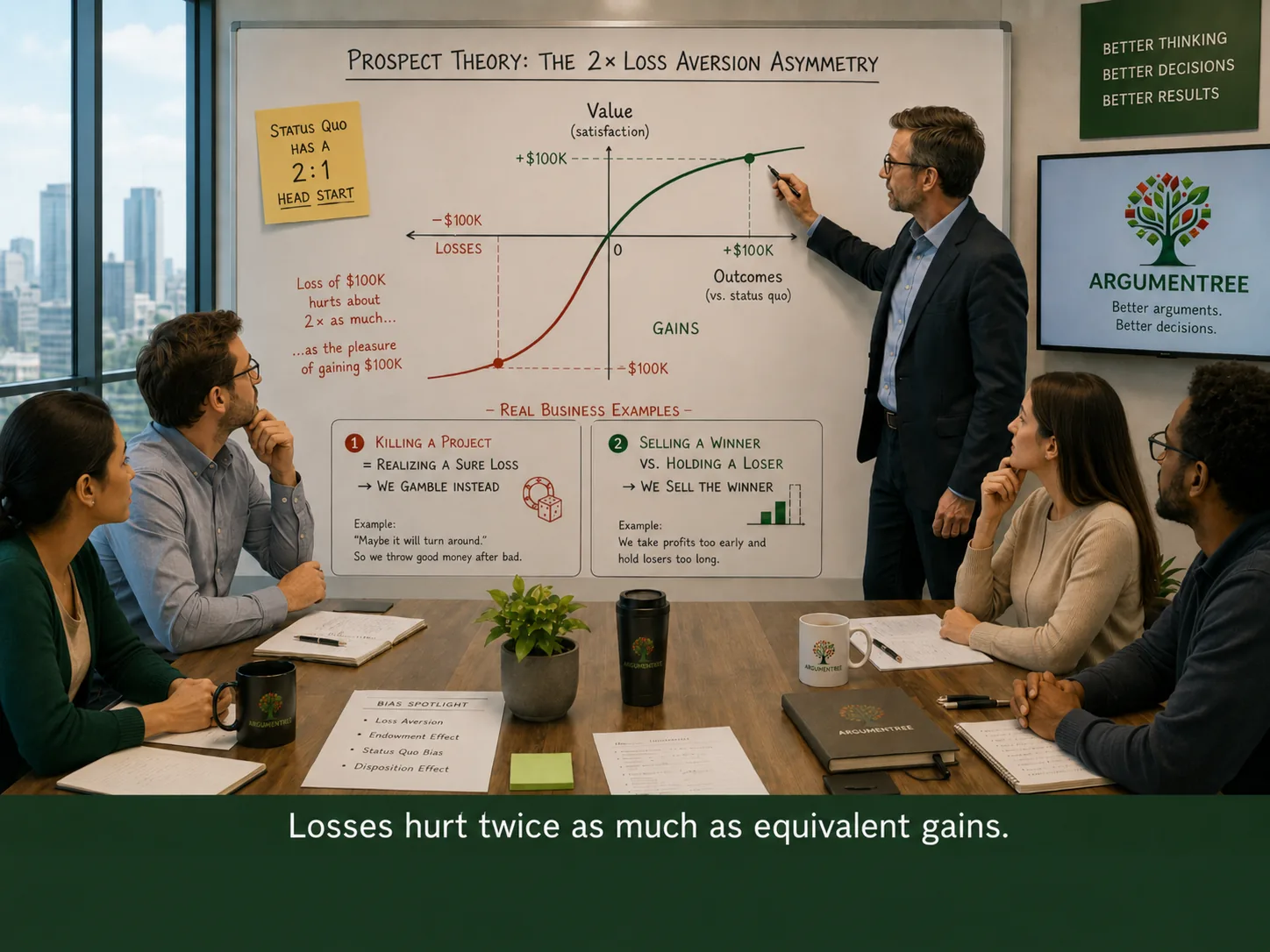
Prospect Theory: Why Your Team Fears Losses Twice as Much as It Values Wins
Prospect theory is Daniel Kahneman and Amos Tversky's 1979 account of how people actually decide under risk, published in Econometrica and central to the work for which Kahneman received the 2002 Nobel Memorial Prize in Economic Sciences (Tversky died in 1996 and could not share it). Its core findings: people evaluate outcomes as gains and losses relative to a reference point, not as final states; losses loom roughly twice as large as equivalent gains (loss aversion); people are typically risk-averse for gains but risk-seeking when facing sure losses; and the framing of a choice changes the choice — in Tversky and Kahneman's 1981 Asian disease experiment, 72 percent chose the safe program under a lives-saved frame while 78 percent chose the gamble under a lives-lost frame, for identical outcomes. In business this shows up as doubling down on failing projects to avoid realizing a sure loss, the disposition effect in investing (selling winners, holding losers — documented by Terrance Odean in 1998), and the endowment effect in negotiations. Later research, notably Gal and Rucker (2018), disputes how universal loss aversion is — the magnitude varies with stakes and context — but reference dependence and framing effects remain robust. The practical defense is the frame flip: state every significant proposal in both its gain frame and its loss frame before deciding, and make both frames visible as competing arguments so the asymmetry is exposed rather than exploited.
In 1981, Tversky and Kahneman showed that flipping a life-and-death problem from a lives-saved frame to a lives-lost frame reversed the majority choice — 72 percent picked the safe option in one frame, 78 percent picked the gamble in the other. Same numbers, opposite decisions. Prospect theory explains why: we decide relative to reference points, and losses loom roughly twice as large as gains. Your budget meetings run on the same physics.
- Reference points rule — we don't evaluate outcomes; we evaluate changes from where we think we stand
- Losses ≈ 2× gains — which is why sure losses get gambled on and failing projects get doubled down
- The frame is a decision input — whoever states the problem has already shaped the answer
- The defense is the frame flip — state every proposal in both frames before deciding, and put both on the record
Better process, better decision quality: five connected pieces on judging, choosing, and challenging the tools behind big decisions.
- 1.Decision Quality: The Six Elements of a Good Decision — Before You Know the Outcome
- 2.Business Decision Frameworks: Which One to Use, When — The Complete Chooser's Guide
- 3.Prospect Theory: Why Your Team Fears Losses Twice as Much as It Values WinsYou are here
- 4.Real Options: Why Keeping the Door Open Is a Decision Too
- 5.NPV Says Yes. Should You? What Discounted Cash Flow Can't Tell You
Try It on Yourself: The Experiment That Flips
A disease outbreak is expected to kill 600 people, and you must choose between two response programs. Program A saves 200 people for certain. Program B gives a one-third chance that all 600 are saved and a two-thirds chance that no one is saved. Pick one — really pick — before reading on.
In Tversky and Kahneman's 1981 experiment, published in Science, 72 percent chose Program A. The certain save feels responsible. But a second group saw the same problem worded differently: Program C means 400 people will die for certain; Program D gives a one-third chance that nobody dies and a two-thirds chance that all 600 die. Faced with that wording, 78 percent chose D — the gamble. Look closely: A and C are the same program. B and D are the same program. The outcomes never changed. The words did, and the majority flipped.
If a room full of people can reverse a life-and-death choice because someone swapped 'saved' for 'die,' consider what happens in your own planning meetings — where every proposal arrives pre-framed by whoever wrote the slide. That flip is not a curiosity. It is the signature of the machinery prospect theory describes, and that machinery is running in every decision your team makes about money, projects, and risk.
The Paper That Broke Rational Economics
In 1979, two Israeli psychologists — Daniel Kahneman and Amos Tversky — published Prospect Theory: An Analysis of Decision under Risk in Econometrica, the flagship journal of the very discipline they were dismantling. Economics assumed people evaluate choices by final outcomes, weighted by probabilities. Kahneman and Tversky showed, experiment after experiment, that real people do something different — and predictably different, which is what made it a theory rather than a complaint.
Three findings carry most of the weight. First, reference dependence: we evaluate outcomes as gains or losses relative to where we think we stand, not as absolute end states. A bonus of 5,000 feels entirely different depending on whether you expected 3,000 or 10,000. Second, loss aversion: losses hurt roughly twice as much as equivalent gains please — in Tversky and Kahneman's later measurements, the coefficient came out near 2.25. Third, the reflection effect: we are risk-averse when choices are framed as gains, but risk-seeking when facing a sure loss — we will gamble to avoid locking in a certain defeat.
The work reshaped economics into what is now behavioral economics. Kahneman received the Nobel Memorial Prize in Economic Sciences in 2002 for it; Tversky had died in 1996, and Nobel rules do not allow posthumous awards, so the prize could not be shared with the man whose name sits first on the paper. Kahneman spent much of his Nobel lecture crediting him.
Where the Asymmetry Bites in Business
Prospect theory would be trivia if it stayed in the lab. It does not. The same three mechanisms produce recognizable, expensive patterns in organizational decisions:
Doubling down on failing projects
Killing a project means converting a paper loss into a certain, owned, attributable loss — exactly the situation where humans become risk-seeking. So the struggling initiative gets one more quarter, one more reorg, one more pivot. The gamble to avoid the sure loss is the reflection effect wearing a project plan.
Selling winners, keeping losers
Terrance Odean's 1998 study of 10,000 brokerage accounts documented the disposition effect: investors realized their gains far more readily than their losses. Locking in a gain feels like winning; locking in a loss feels like admitting defeat — so the losers stay in the portfolio, underperforming.
Overpricing what we already own
In Kahneman, Knetsch and Thaler's 1990 experiments, people given a coffee mug demanded roughly twice as much to sell it as buyers would pay for the identical mug. The endowment effect haunts every divestiture debate, every legacy-product sunset, every reorg that takes something away from someone.
Status quo as the invisible reference point
Every change proposal is silently framed as a loss of the current state. That gives incumbency a roughly two-to-one head start before any argument is made — which is why 'we've always done it this way' feels so much stronger than it argues.
Hasn't Loss Aversion Been Debunked?
You may have seen the headlines. In 2018, David Gal and Derek Rucker published The Loss of Loss Aversion in the Journal of Consumer Psychology, arguing that loss aversion is far less universal than the textbooks claim — that for small stakes, losses often do not loom larger than gains, and that some classic demonstrations have alternative explanations. The critique is serious and partly right, and pretending otherwise would be exactly the kind of motivated reasoning this post is about.
Here is the honest state of play. The magnitude of loss aversion varies — with stake size, context, and how the choice is elicited; the tidy universal 2× is too tidy. But the findings a decision-maker actually needs have held up robustly: reference dependence is not in serious dispute, framing effects like the Asian disease flip replicate, and the behavioral patterns above — escalation, disposition, endowment — are documented in field data, not just lab vignettes. The practical conclusion survives the academic fight: the frame of a choice is an input to the choice, and unmanaged frames systematically favor whoever set them.
The Defense: Flip Every Frame, Then Argue Both
You cannot switch off the machinery — Kahneman himself was pessimistic about debiasing individuals. What you can do is change the decision process so the frame stops being invisible. The tool is almost embarrassingly simple: before deciding anything significant, restate the proposal in its opposite frame. 'This migration saves 200 hours a quarter' becomes 'not migrating costs 200 hours a quarter.' 'Killing the project writes off 2 million' becomes 'continuing spends 3 million more for a one-in-four chance of recovery.' If the room's preference flips with the wording, the preference was never about the substance.
This is where structured argumentation earns its keep. In an argument tree, both frames exist as explicit competing claims with evidence attached — the gain frame and the loss frame literally sit side by side, and argument mapping makes their asymmetry visible instead of exploitable. Multi-dimensional ratings expose when an option is being punished for feeling like a loss rather than measuring like one. And anonymous input matters more than it seems: the status-quo defense is strongest when attached to the person who owns the status quo. It is a process fix for a bias no amount of awareness fixes — one more case of the thesis in our decision quality deep dive: improve the process, and the quality follows.
The Diagnostic Question
What is your team currently refusing to kill because stopping would turn a paper loss into a real one? Name it — then restate the continue-decision in its loss frame and see if the argument survives.
What to Do With This
Flip the frame before every major decision
State the proposal as a gain and as a loss. If the preference moves, the frame was doing the deciding.
Audit who set the reference point
Budgets anchored on last year, targets anchored on the optimistic case, comparisons anchored on the current state — each anchor is a choice someone made. Make it consciously.
Separate the loss from the loser
Escalation feeds on attribution. Reviews that judge the decision process rather than assigning blame make it cheaper to stop — which is the whole case against resulting.
Pre-commit kill criteria
Decide the abandonment conditions when the project starts — while it is still a gain-framed choice — not when stopping means owning a loss.
Put both frames on the record
A decision record that preserves the gain and loss framing of the argument keeps the next decision from inheriting an invisible anchor.
Same Numbers, Opposite Decisions
Seventy-two percent chose the certain save. Seventy-eight percent chose the gamble. Same disease, same 600 people, same arithmetic — the only thing that changed was the sentence. Kahneman and Tversky's deepest finding was never that people are irrational; it was that the irrationality has structure, and structure can be engineered around.
Your organization cannot out-willpower a two-to-one asymmetry that operates below awareness. It can out-process it: flip the frames, expose the reference points, argue both sides where everyone can see them.
The words changed, and the majority flipped. Make sure it is never just the words deciding for you.
Sources & Further Reading
The founding paper: reference dependence, loss aversion, and the value function
The Asian disease experiment and the 72/78 percent framing flip
Kahneman's own account of the research program, including prospect theory for general readers
The disposition effect documented in 10,000 real brokerage accounts
The coffee-mug experiments: owners demand roughly double what buyers offer
The strongest published critique: loss aversion's magnitude varies far more than the textbook story admits
The story of the Kahneman-Tversky collaboration itself
Frequently Asked Questions
What is prospect theory in simple terms?
Prospect theory is Daniel Kahneman and Amos Tversky's 1979 description of how people actually make decisions under risk. Instead of weighing final outcomes, people evaluate choices as gains or losses from a reference point; losses hurt roughly twice as much as equivalent gains feel good; and people take fewer risks to secure gains but more risks to avoid sure losses. Because of this, how a choice is worded — its frame — can change the decision even when the outcomes are identical.
What is the Asian disease problem?
It is the classic framing experiment from Tversky and Kahneman's 1981 Science paper. A disease is expected to kill 600 people. Framed as lives saved (save 200 for certain vs. a gamble), 72 percent of subjects chose the certain option. Framed as lives lost (400 die for certain vs. the same gamble), 78 percent chose the gamble. The programs are mathematically identical in both framings — only the wording changed, and the majority choice reversed.
Did Kahneman and Tversky both win the Nobel Prize for prospect theory?
No. Daniel Kahneman received the Nobel Memorial Prize in Economic Sciences in 2002, largely for the research program built with Amos Tversky. Tversky died in 1996, and Nobel prizes are not awarded posthumously, so he could not share it. Kahneman consistently credited the work as joint — Tversky is first author on the 1981 framing paper and co-author of the 1979 prospect theory paper.
What is loss aversion, and is it real?
Loss aversion is the finding that losses loom larger than equivalent gains — Tversky and Kahneman's 1992 measurements put the ratio near 2.25. Its universality is genuinely debated: Gal and Rucker's 2018 paper The Loss of Loss Aversion shows the effect can shrink or vanish for small stakes and depends on context. What remains robust is reference dependence and framing: choices change when the frame changes, and field patterns like the disposition effect and escalation to avoid sure losses are well documented.
How does prospect theory affect business decisions?
Four patterns recur: teams double down on failing projects because killing one converts a paper loss into a certain, attributable loss; investors and managers sell winners while holding losers (the disposition effect, documented by Odean in 1998); organizations overvalue what they already own in divestiture and sunset decisions (the endowment effect); and the status quo acts as an invisible reference point, framing every change as a loss and giving incumbency an unearned advantage.
What is the frame flip technique?
Before deciding anything significant, restate the proposal in its opposite frame: a saving becomes an avoided cost, a write-off becomes the price of continuing, a new-initiative gain becomes a status-quo loss. If the room's preference changes with the wording, the frame — not the substance — was driving the choice. Making both frames explicit, ideally as side-by-side arguments with evidence, converts an invisible bias into a visible disagreement that can actually be resolved.
Can you train away loss aversion?
Individual debiasing has a poor track record — Kahneman himself was skeptical that awareness alone changes behavior. The reliable countermeasures are process-level: flip frames systematically, pre-commit kill criteria while a project is still gain-framed, review decisions by process quality rather than outcomes so stopping is cheaper, and use structures — like argument trees with both frames stated — that expose reference points instead of letting them operate silently.
Argumentree Team
Decision Science
The Argumentree team explores the science of better decisions—from 18th-century mathematics to modern AI.
The Bias Reading List
Prospect theory is one engine of bad group decisions. These cover the others — and the structures that counter them.
Why judging decisions by outcomes (resulting) teaches teams the wrong lessons
Cascades, bubbles, and herding — group-level failure modes on top of individual bias
Build the strongest opposing case before deciding — the frame flip's argumentative cousin
Make both frames argue it out.
Argumentree puts the gain frame and the loss frame side by side as explicit arguments — rated in the open, challenged on evidence, and preserved in the decision record.
Start Free 14-Day Trial →