
Decision Quality: The Six Elements of a Good Decision — and Why Improving the Process Improves the Quality
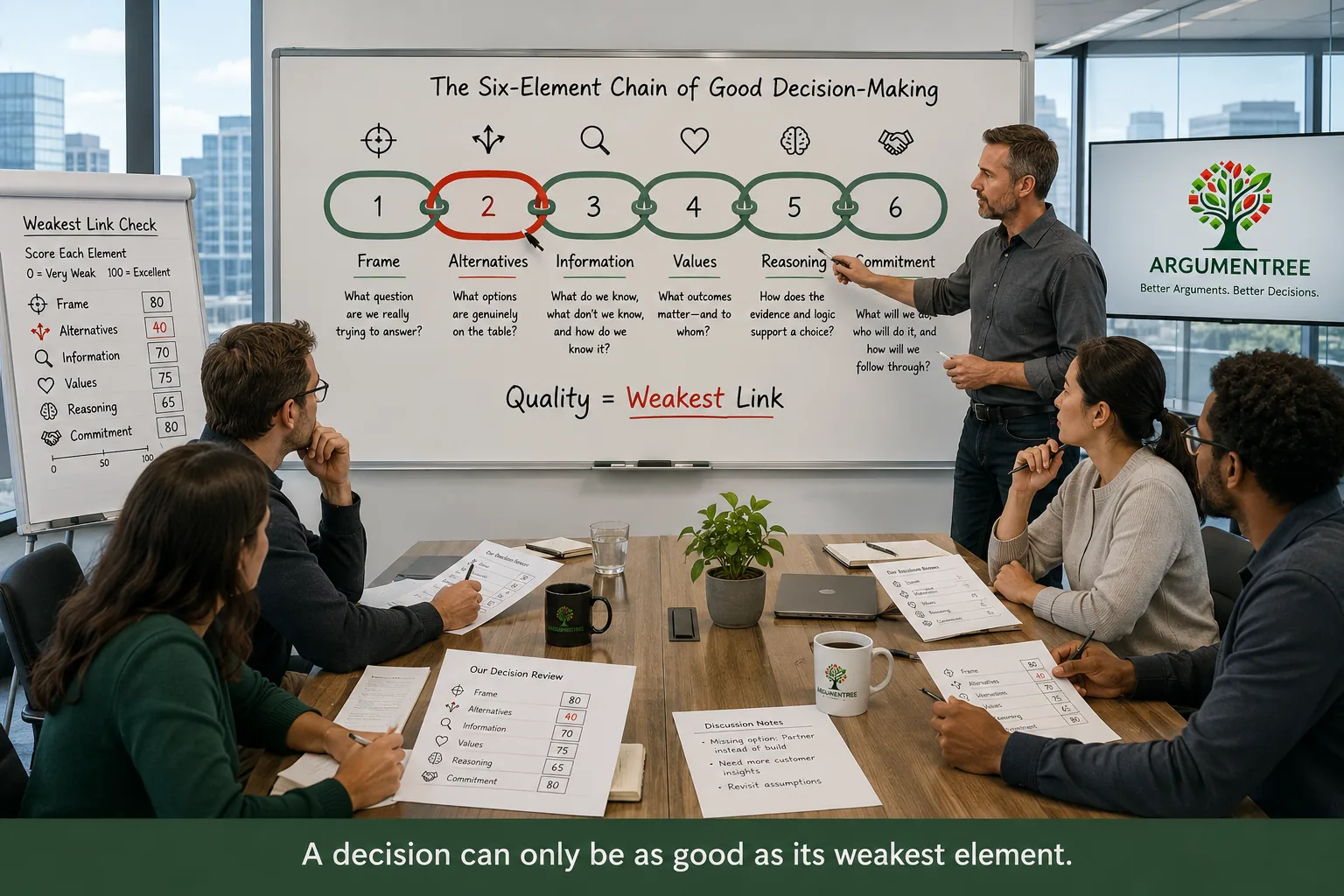
Decision quality (DQ) is a framework for judging how good a decision is at the moment it is made — before the outcome is known. Its foundations were laid by Ronald Howard at Stanford, who coined the term decision analysis in his 1966 paper, and it was formalized as a six-element model by Carl Spetzler, Hannah Winter, and Jennifer Meyer in Decision Quality: Value Creation from Better Business Decisions (2016). The six elements are: an appropriate frame, creative alternatives, meaningful and reliable information, clear values and trade-offs, sound reasoning, and commitment to action. A decision is like a chain: its quality equals the weakest of the six links. Decision quality is not the same as a good outcome — luck can rescue bad decisions and sink good ones, a confusion the poker champion and author Annie Duke calls resulting. Because you cannot control outcomes, the only lever you control is the process: if you improve the decision process, you improve the decision quality. Bain research found decision effectiveness correlates strongly with financial results, and McKinsey surveys find only about one in five organizations say they excel at decision making. Argumentree strengthens each link in the chain with structured argument trees: a shared frame, competing alternatives side by side, evidence attached to claims and tested through question-and-answer chains, explicit multi-dimensional ratings for values and trade-offs, visible pro/con reasoning, and a documented audit trail that carries commitment through to review. Classic frameworks such as SWOT, cost-benefit analysis, or Porter's Five Forces feed information and alternatives into the chain; the argument tree is the sound-reasoning layer that turns any framework's output into a quality decision.
A good decision and a good outcome are not the same thing — luck sits between them. Decision quality (DQ), the framework built on Ronald Howard's Stanford work and formalized by Carl Spetzler and colleagues, judges a decision at the moment it is made, using six elements that form a chain no stronger than its weakest link. The practical consequence is our operating thesis: if we improve the decision process, we also improve the decision quality.
- Six elements, one chain — frame, alternatives, information, values, reasoning, commitment; overall quality equals the weakest link
- Stop judging decisions by outcomes — that shortcut has a name (resulting) and it teaches your team the wrong lessons
- Process is the only lever you control — outcomes carry luck; the process that produced the decision is fully yours to improve
- Frameworks feed the chain — SWOT, cost-benefit, Five Forces produce inputs; structured reasoning is what turns them into a decision
Better process, better decision quality: five connected pieces on judging, choosing, and challenging the tools behind big decisions.
- 1.Decision Quality: The Six Elements of a Good Decision — Before You Know the OutcomeYou are here
- 2.Business Decision Frameworks: Which One to Use, When — The Complete Chooser's Guide
- 3.Prospect Theory: Why Your Team Fears Losses Twice as Much as It Values Wins
- 4.Real Options: Why Keeping the Door Open Is a Decision Too
- 5.NPV Says Yes. Should You? What Discounted Cash Flow Can't Tell You
Twenty-Six Seconds, One Yard, and the Worst Call in History
February 1, 2015. Super Bowl XLIX. The Seattle Seahawks have the ball on the New England one-yard line, twenty-six seconds left, down by four — and Marshawn Lynch, the most feared short-yardage runner in football, standing in the backfield. Head coach Pete Carroll calls a pass. Malcolm Butler, an undrafted rookie, jumps the route and intercepts it. Game over.
By morning, sports pages were calling it the worst play call in Super Bowl history. But the poker champion Annie Duke opens her book Thinking in Bets with a different verdict: the call was defensible — perhaps even good — given what Carroll knew at the time. The interception rate on that throw was tiny; the clock-and-downs math gave Seattle extra chances. One low-probability event happened, and the world graded the decision by the outcome.
Duke has a name for that shortcut: resulting — judging the quality of a decision by the quality of its result. Now run the test on your own organization. When a project fails, do you ask what was known and reasoned at the time of the decision — or does the post-mortem quietly become a search for who to blame? If the outcome is the only thing you grade, you are training your team to be lucky, not good.
What Decision Quality Actually Means
There is a discipline built precisely on separating the decision from the outcome. Ronald Howard of Stanford coined the term decision analysis in his 1966 paper Decision Analysis: Applied Decision Theory, and spent the following decades building methods for making high-stakes choices under uncertainty. Carl Spetzler — chairman of Strategic Decisions Group, the consultancy that grew out of that Stanford lineage — formalized the practical framework with Hannah Winter and Jennifer Meyer in the 2016 book Decision Quality: Value Creation from Better Business Decisions.
Their central move is deceptively simple: define what a good decision is at the moment it is made, using only what could be known then. A decision has quality — measurable, improvable quality — independent of how the dice land afterward. That definition is what makes decision-making a skill rather than a lottery ticket.
The framework describes six elements that every significant decision contains, whether you manage them deliberately or not. Picture them as links in a chain — because the model's sharpest claim is about what happens when one of them is weak.
The Six Elements of a Good Decision
1. An appropriate frame
Are you solving the right problem, at the right scope, with the right people? Most bad decisions are good answers to the wrong question.
Weak-link symptom: the team debates options for weeks, then someone asks what problem this actually solves.
2. Creative, doable alternatives
A decision can only be as good as the best alternative on the table. One option plus the status quo is not a decision — it is a ratification.
Weak-link symptom: the deck presents one proposal and a strawman.
3. Meaningful, reliable information
What do we know, how well do we know it, and what remains genuinely uncertain? Information quality includes being honest about the error bars.
Weak-link symptom: a single unchallenged forecast carries the whole business case.
4. Clear values and trade-offs
What do we actually want, and what are we willing to give up to get it? Unstated criteria are how decisions get relitigated for months.
Weak-link symptom: every stakeholder ranks the options differently and nobody can say why.
5. Sound reasoning
Does the choice actually follow from the frame, the alternatives, the information, and the values? Reasoning is the link that connects all the others.
Weak-link symptom: the conclusion was written before the analysis.
6. Commitment to action
A brilliant choice nobody executes is worth exactly nothing. Commitment is built during the decision, not after it — by the people who must carry it out.
Weak-link symptom: the meeting ends in agreement and nothing changes.
The Chain Rule: Quality Equals the Weakest Link
Here is the part of the framework most teams miss. The six elements do not average out. Spetzler and his co-authors are explicit: a decision is like a chain, and its overall quality equals the quality of the weakest element. Brilliant analysis (element 3) cannot compensate for solving the wrong problem (element 1). Perfect reasoning (element 5) built on a single alternative (element 2) is perfect reasoning about a non-choice.
The framework even gives each link a working definition of 100 percent: the point where additional effort would cost more than it could improve the decision. You are not chasing perfection on all six — you are chasing the moment when strengthening the weakest link is no longer worth the delay. That reframing turns decision quality from philosophy into a checklist you can actually run.
If Results Are What Count, Why Judge the Process?
The obvious objection: businesses are paid for outcomes, not process hygiene. A beautifully reasoned failure is still a failure. Why should anyone care how the sausage was made?
Two answers. The first is statistical: you do not make one decision, you make thousands. Any single outcome is decision quality plus luck — but across a portfolio of decisions, luck washes out and process quality is what remains. Poker players understand this instinctively, which is why Duke's resulting concept came from poker: a player who judges every hand by whether it won will systematically learn the wrong lessons, because good plays lose all the time.
The second answer is empirical. Bain research by Marcia Blenko, Michael Mankins, and Paul Rogers, published in Decide & Deliver (2010), found that decision effectiveness — quality, speed, yield, and effort — correlates strongly with financial performance across every industry and geography they studied. Meanwhile a McKinsey survey found only about one in five organizations say they excel at decision making, while executives report spending a large share of their time on decisions. The gap between those two findings is the business case for working on process at all.
Improve the Decision Process, Improve the Decision Quality
Put the chain rule and the resulting trap together and you arrive at the thesis this entire platform is built on: if we improve the decision process, we also improve the decision quality. Not as a slogan on a wall — as a mechanical consequence. The six elements are process properties. Every one of them is determined before the outcome exists. Every one of them can be strengthened by changing how the decision is made.
You cannot control whether the market turns, the rookie jumps the route, or the technology bet pays off. You can control whether the frame was explicit, the alternatives were real, the evidence was tested, the trade-offs were stated, the reasoning was visible, and the people in the room actually committed. The process is the only part of the decision you fully own — which makes it the only part worth systematically improving.
How Argumentree Strengthens Each Link
Argumentree is a decision-quality machine wearing the clothes of a discussion platform. Each of the six elements maps to a structural feature — not a best-practice reminder, but a mechanism the process runs through:
Frame → a named, shared decision question
Every discussion starts as an explicit question with a visible scope, organized by department and category. Reframing happens in the open — editing the root of the tree, not rewriting history in a hallway conversation.
Alternatives → competing branches, side by side
Options live as parallel branches in the same tree, compared against the same evidence. Anonymous input means alternatives surface on merit — not filtered by who proposed them. AI-assisted extraction pulls the alternatives already buried in your documents and meeting transcripts.
Information → evidence attached, then interrogated
Claims carry their supporting evidence, and the structured question-and-answer chain lets anyone interrogate a weak claim in place — a four-step back-and-forth that leaves a record instead of an unresolved thread.
Values → explicit, multi-dimensional ratings
Instead of one unspoken gut ranking, arguments are rated on multiple dimensions. The criteria are visible, so disagreement about values shows up as data — not as a mysterious deadlock.
Reasoning → the argument tree itself
Supporting and attacking arguments are structurally connected to the claims they touch. Sound reasoning stops being a subjective compliment and becomes something you can inspect: every conclusion shows the arguments that survived to support it. The compromise workflow does the same for trade-off negotiation.
Commitment → consensus tracking and an audit trail
Consensus is tracked while the decision forms, so commitment is built in, not requested afterward. The decision record — who argued what, what was known, why the choice was made — becomes the institutional memory that the review workflow closes the loop on later.
Where the Classic Frameworks Fit
Decision quality also explains something practical about the classic toolbox — SWOT, cost-benefit analysis, Porter's Five Forces, scenario planning and the rest. Those frameworks are input generators for specific links in the chain. A SWOT sharpens the frame and surfaces information. Cost-benefit analysis and NPV feed the information and values links. Scenario planning stress-tests information under uncertainty. Alternatives-generation techniques attack link two.
What none of them provides is link five. A filled-in SWOT template is four lists — it does not weigh one strength against two threats, or record why the opportunity outweighed the risk. That connective tissue is reasoning, and it is exactly the layer a structured argument tree supplies: the framework's outputs become claims, the claims attract supporting and attacking arguments, and the decision inherits a visible, testable justification. Run the framework for inputs; run the argument for the decision. That is also why argument mapping pairs naturally with every framework on the list rather than competing with them.
The Technique: A Fifteen-Minute Weakest-Link Check
The most usable piece of the DQ framework costs one meeting agenda item. Before committing to any significant decision, have each participant privately score all six elements from 0 to 100 percent — where 100 means more effort on that element would no longer be worth the delay. Then compare scores.
The lowest-scored element is your decision quality, full stop. If alternatives score 40 percent, the decision is a 40-percent decision no matter how elegant the financial model looks. The disagreements between scorers are just as valuable: when the CFO scores information at 80 and the engineering lead scores it at 30, you have found the exact conversation the decision still needs. Strengthen the weakest link, re-score, and only then commit.
The Diagnostic Question
Take your current biggest in-flight decision and score the six elements honestly. Which link is weakest — and is anyone actually working on that link, or is everyone polishing the strong ones?
What to Do With This
Separate decision reviews from outcome reviews
Judge decisions by what was known and reasoned at the time; judge outcomes for what they teach about the world. Mixing the two is resulting — and it corrodes honest risk-taking.
Run the weakest-link check before committing
Six scores, fifteen minutes. The lowest score is the decision's quality and the meeting's real agenda.
Demand real alternatives
One proposal plus a strawman is a ratification. If nobody can name the second-best option and what was attractive about it, element two failed.
Make the reasoning inspectable
If the connection between evidence and conclusion lives in one person's head, sound reasoning cannot be verified — or improved. Write the argument down where it can be attacked.
Treat frameworks as input generators
SWOT, CBA, and Five Forces produce claims. They do not produce decisions. Budget explicit time for the reasoning step that turns their outputs into a choice.
The Part You Control
Pete Carroll's play call will be argued about forever, which is precisely the point: the outcome ended the argument for most people, and the outcome was the least informative part of the story. The frame, the alternatives, the information, the values, the reasoning, the commitment — all of that existed before Malcolm Butler moved, and none of it changed when he did.
Organizations that grade only outcomes learn slowly and gamble often. Organizations that grade the six elements get compounding returns, because process improvements apply to every future decision at once.
You cannot control the outcome. The process is yours. Improve the decision process, and you improve the decision quality.
Sources & Further Reading
The canonical formulation of the six elements, the chain metaphor, and the 100-percent standard
SDG's overview of the DQ framework and its Stanford decision-analysis lineage
The paper that coined the term decision analysis, presented at the Fourth International Conference on Operational Research
The resulting concept and the Super Bowl XLIX analysis that opens the book
Bain's research linking decision effectiveness to financial performance across industries
Survey research on how few organizations excel at decision making and how much executive time decisions consume
Frequently Asked Questions
What is decision quality?
Decision quality (DQ) is a framework for judging how good a decision is at the moment it is made, independent of its eventual outcome. Formalized by Carl Spetzler, Hannah Winter, and Jennifer Meyer in Decision Quality (2016), building on Ronald Howard's Stanford decision-analysis work, it defines a good decision by six elements: an appropriate frame, creative alternatives, meaningful and reliable information, clear values and trade-offs, sound reasoning, and commitment to action.
What are the six elements of decision quality?
The six elements are: (1) an appropriate frame — solving the right problem; (2) creative, doable alternatives — real options to choose among; (3) meaningful, reliable information — knowing what you know and how well; (4) clear values and trade-offs — explicit criteria for what you want; (5) sound reasoning — a choice that actually follows from the first four; and (6) commitment to action — the people who must execute are genuinely on board. A decision's overall quality equals the weakest of the six.
Why isn't a good outcome proof of a good decision?
Because luck sits between decisions and outcomes. A sound decision can be sunk by a low-probability event, and a reckless one can be rescued by chance. Judging decisions purely by results — what Annie Duke calls resulting in Thinking in Bets — systematically teaches the wrong lessons, because it rewards lucky recklessness and punishes sound risk-taking. Decision quality judges the decision by what could be known and reasoned at the time it was made.
Who created the decision quality framework?
The intellectual foundations come from Ronald Howard at Stanford, who coined the term decision analysis in his 1966 paper Decision Analysis: Applied Decision Theory. The six-element decision quality framework was formalized by Carl Spetzler — chairman of Strategic Decisions Group, a firm rooted in that Stanford lineage — with co-authors Hannah Winter and Jennifer Meyer in the 2016 book Decision Quality: Value Creation from Better Business Decisions.
How do you measure decision quality?
Score each of the six elements from 0 to 100 percent, where 100 percent means additional effort on that element would cost more than it could improve the decision. The overall decision quality equals the lowest of the six scores — the weakest link in the chain. Scoring is most useful when done independently by several participants before committing: the lowest-scored element shows where more work is needed, and large disagreements between scorers show where the team is not yet aligned.
How does improving the decision process improve decision quality?
All six elements of decision quality are properties of the process, determined before any outcome exists: how the problem was framed, how alternatives were generated, how evidence was tested, how trade-offs were stated, how the reasoning was connected, and how commitment was built. Outcomes add luck on top; the process is the only controllable input. That is why improving the decision process directly improves the decision quality — and why Bain's research found decision effectiveness strongly correlated with financial performance.
How does Argumentree improve decision quality?
Argumentree gives each of the six elements a structural mechanism: discussions start from a named, shared decision question (frame); options live as competing branches compared side by side, with anonymous input and AI-assisted extraction (alternatives); evidence attaches to claims and is interrogated through structured question-and-answer chains (information); multi-dimensional ratings make criteria explicit (values); the argument tree itself makes reasoning visible and testable, with a compromise workflow for trade-offs (sound reasoning); and consensus tracking plus a documented decision record carry commitment through to review (commitment to action).
Argumentree Team
Decision Science
The Argumentree team explores the science of better decisions—from 18th-century mathematics to modern AI.
How This Connects Across the Decision Stack
Decision quality is the umbrella; structured reasoning is the load-bearing link. These pieces show the other links in action.
The enterprise discipline that puts data and AI behind the information link
How elite organizations engineer the sound-reasoning link with structured dissent
What happens to information and reasoning when cascades replace independent judgment
Improve the process. Improve the quality.
Argumentree turns the six elements into structure: a shared frame, competing alternatives, tested evidence, explicit ratings, visible reasoning, and a decision record your organization keeps.
Start Free 14-Day Trial →