
Business Decision Frameworks: Which One to Use, When — The Complete Chooser's Guide
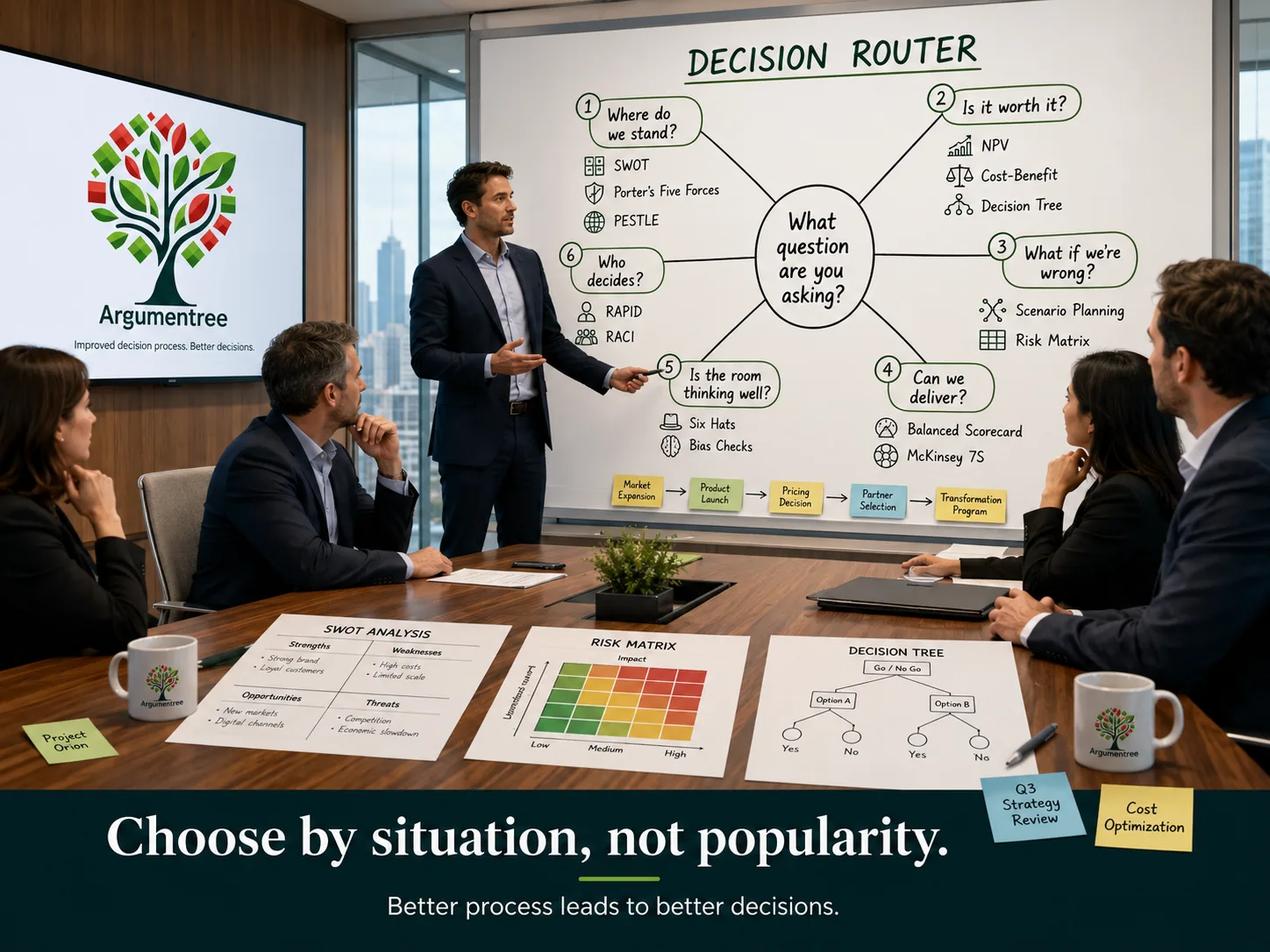
Business decision frameworks are structured analysis tools — SWOT, PESTLE, Porter's Five Forces, the BCG matrix, cost-benefit analysis, decision trees, real options, scenario planning, Six Thinking Hats, the balanced scorecard, McKinsey 7S, PDCA, and enterprise risk management — that organize the inputs to a significant business decision. The right way to choose among them is by decision situation, not popularity: SWOT, PESTLE, Porter's Five Forces and the BCG matrix answer where-do-we-stand questions about strategic position; cost-benefit analysis, NPV, decision trees and real options answer is-it-worth-the-money questions; scenario planning and enterprise risk management answer what-if-we-are-wrong questions about uncertainty; the balanced scorecard, McKinsey 7S and PDCA answer are-we-set-up-to-deliver questions about execution; Six Thinking Hats and an awareness of prospect-theory biases improve how the group itself thinks; and role frameworks like RAPID settle who decides. No framework makes the decision. In the language of decision quality, frameworks feed the frame, alternatives, information and values elements of a good decision — but the sound-reasoning element, connecting those inputs to a justified choice, is exactly what a filled-in template does not provide. That connective layer is structured argumentation: framework outputs become claims, claims attract supporting and attacking arguments and evidence, and the decision inherits a visible, testable justification. Match the framework to the situation, cap the analysis in time, and budget explicit effort for the reasoning step that turns the framework's output into a decision.
There are dozens of named business decision frameworks, and most teams need about a half-dozen — chosen by decision situation, not by popularity. This guide routes you: strategic position, money, uncertainty, execution, group thinking, and roles. One warning up front: no framework decides anything. Frameworks generate inputs; the decision still needs a reasoning step that connects those inputs to a choice.
- Choose by situation — where do we stand? / is it worth it? / what if we're wrong? / can we deliver? / is the room thinking well? / who decides?
- Frameworks are input generators — in decision-quality terms they feed frame, alternatives, information, and values; none of them supplies the reasoning
- The template trap is real — a filled-in SWOT is four lists until something connects the boxes to a conclusion
- Two or three per decision, max — stacking five frameworks on one decision is procrastination wearing a lanyard
Better process, better decision quality: five connected pieces on judging, choosing, and challenging the tools behind big decisions.
- 1.Decision Quality: The Six Elements of a Good Decision — Before You Know the Outcome
- 2.Business Decision Frameworks: Which One to Use, When — The Complete Chooser's GuideYou are here
- 3.Prospect Theory: Why Your Team Fears Losses Twice as Much as It Values Wins
- 4.Real Options: Why Keeping the Door Open Is a Decision Too
- 5.NPV Says Yes. Should You? What Discounted Cash Flow Can't Tell You
The Most-Used Framework in Business Has No Verified Inventor
The SWOT analysis — strengths, weaknesses, opportunities, threats — is probably the most widely taught business framework on Earth. And nobody can prove who invented it. The standard story credits Albert Humphrey at the Stanford Research Institute in the 1960s, but management historians have never located the supporting documents, and Humphrey's own account named a different framework. The four-box grid that anchors a million strategy offsites is, historically speaking, an orphan.
That never slowed it down — and that is the interesting part. Frameworks spread because they are useful containers, not because anyone checked their pedigree. Porter's Five Forces has an unambiguous author and a 1979 Harvard Business Review paper behind it; SWOT has a shrug. Both sit in the same slide decks. The market for frameworks selects for memorability, not provenance.
Which raises the question this guide answers: with dozens of named frameworks competing for your next decision, how do you pick? Not by fame. You pick by decision situation — and then you do the one thing the framework cannot do for you. Run your own last big decision through the sections below and see where it would have landed.
Six Questions, Six Families of Frameworks
Every framework in the classic toolbox exists to answer one kind of question well. Ask which question your decision is actually posing, and the field of dozens collapses to two or three candidates. Here is the router — each capsule says what the tool does, when to reach for it, and which elements of a quality decision it feeds.
“Where do we stand?” — strategic position
Use these when the decision depends on an honest reading of your position: entering a market, responding to a competitor, setting strategy for the next cycle.
SWOT Analysis
Maps internal strengths and weaknesses against external opportunities and threats in four boxes. Fast, universal, and — precisely because it is so easy — the framework most often left as four disconnected lists.
Reach for it at the start of any strategy conversation; treat its boxes as claims to be argued, not conclusions.
PESTLE Analysis
Scans six macro forces — political, economic, social, technological, legal, environmental — descended from Francis Aguilar's 1967 environmental-scanning work. It widens the frame beyond your own industry.
Use before commitments whose payoff depends on the outside world staying cooperative: expansions, regulated markets, long-horizon bets.
Porter's Five Forces
Michael Porter's 1979 HBR framework reads an industry's profit pressure through five forces: rivalry, buyer power, supplier power, new entrants, substitutes.
Use when the real question is whether an industry is worth being in at all — entry, exit, and pricing-power decisions.
BCG Growth-Share Matrix
Bruce Henderson's 1970 portfolio grid — stars, cash cows, question marks, dogs — for allocating resources across business units by market growth and relative share.
Use for portfolio-level allocation debates; the plotting is trivial, so the value is in arguing why a unit sits where it sits.
“Is it worth the money?” — financial evaluation
Use these when alternatives are on the table and the question is economic. All four produce numbers; none of the numbers is a verdict.
Cost-Benefit Analysis
Totals the expected costs and benefits of an option, monetizing what it can. Roots reach back to Jules Dupuit in 1848; modern public-sector practice standardized it.
Use when options differ mainly in economics — and be explicit about which impacts resisted monetization instead of dropping them.
NPV / IRR
Discounted-cash-flow arithmetic: net present value states value created in currency; internal rate of return states it as a percentage. Roughly three-quarters of CFOs use both routinely.
Use for capital allocation — while treating the assumptions behind the cash flows as attackable claims, not settled facts.
Decision Tree Analysis
Howard Raiffa's decision-analysis workhorse: map sequential choices and chance events with probabilities and payoffs, then fold expected values back through the branches.
Use for staged decisions under quantifiable uncertainty — pilots, phased rollouts, litigation strategy.
Real Options
Stewart Myers's 1977 insight: strategic investments behave like options — the right, not the obligation, to expand, defer, or abandon as uncertainty resolves. Waiting has calculable value.
Use when flexibility is the actual asset: staged R&D, land banking, platform bets.
“What if we're wrong about the future?” — uncertainty and risk
Use these when the decision's payoff hangs on futures nobody controls — or when the job is to keep low-probability failures from being surprises.
Scenario Planning
Builds a small set of divergent, plausible futures and tests strategy against each — the discipline Pierre Wack ran at Shell in the 1970s, drawing on Herman Kahn's Cold-War work.
Use for long-horizon commitments where forecasting has failed you before; the output is a strategy robust across futures, not a prediction.
Enterprise Risk Management
The organization-wide discipline (COSO 2017, ISO 31000) of identifying, weighing, and owning risks against objectives — a standing process rather than a per-decision tool.
Use to give big decisions a standing counterparty: every major proposal should meet its risk register on the way to approval.
“Are we set up to deliver?” — organization and execution
Use these when the choice is made and the question becomes whether the organization can actually carry it — or when performance itself is the decision topic.
Balanced Scorecard
Kaplan and Norton's 1992 HBR framework translates strategy into linked objectives across four perspectives: financial, customer, internal process, learning and growth.
Use when strategy keeps failing at the execution seam — it forces the debate about what actually drives what.
McKinsey 7S
Seven interdependent elements — strategy, structure, systems, shared values, skills, style, staff — from Peters, Waterman, Pascale and Athos's late-1970s work on why reorganizations fail.
Use for change and integration decisions: the argument is about which elements are misaligned and what that costs.
PDCA Cycle
The Deming-Shewhart improvement loop — plan, do, check, act (Deming himself insisted on study over check). Small decisions, fast feedback, compounding learning.
Use when the smartest decision is a cheap experiment instead of a big commitment.
“Is the room thinking well?” — group process and bias
Use these when the bottleneck is not analysis but the humans doing it — one voice dominating, one frame unexamined, losses looming larger than gains.
Six Thinking Hats
Edward de Bono's 1985 protocol has the whole room think in one mode at a time — facts, feelings, caution, optimism, creativity, process — instead of adversarial cross-talk.
Use when meetings collapse into position warfare, or when the caution voice and the creative voice keep talking over each other.
Prospect Theory (bias lens)
Kahneman and Tversky's 1979 account of how people actually choose under risk: losses loom roughly twice as large as gains, and the frame of a choice changes the choice.
Not a process to run but a lens to hold up: state every significant proposal in both its gain frame and its loss frame before deciding.
“Who decides?” — roles and fast techniques
Two families sit adjacent to the analysis frameworks and get confused with them. Role frameworks — RAPID, DACI, RACI — decide who recommends, who inputs, and who calls it; we compare them in RAPID vs DACI vs RACI. And the quick decision techniques — the 10-10-10 rule, pre-mortems, weighted scoring — are covered in our better decision-making strategies guide. Rule of thumb: frameworks structure the analysis, techniques structure the moment, role models structure the people.
Which Framework When? The Master Table
One row per situation. The decision-quality column says which elements of a good decision the framework feeds — and the point of the whole table is the column it doesn't have: none of these tools supplies the reasoning that turns their output into a choice.
| Your situation | Reach for | Feeds (DQ elements) |
|---|---|---|
| Setting or challenging strategy | SWOT, then PESTLE to widen the lens | Frame, information |
| Enter / exit / pricing power in an industry | Porter's Five Forces | Frame, information |
| Allocating across a portfolio | BCG matrix | Alternatives, values |
| Comparing options economically | Cost-benefit analysis; NPV/IRR | Information, values |
| Staged choice under quantifiable uncertainty | Decision trees | Alternatives, reasoning structure |
| Flexibility is the asset | Real options | Alternatives, values |
| Long horizon, untrustworthy forecasts | Scenario planning | Information, frame |
| Standing guard on downside | Enterprise risk management | Information (attacking side) |
| Strategy keeps dying in execution | Balanced scorecard; McKinsey 7S | Values, commitment |
| Cheap experiment beats big bet | PDCA | Information, commitment |
| The room argues badly | Six Thinking Hats; prospect-theory frame check | Alternatives, frame |
| Unclear who actually decides | RAPID / DACI / RACI | Commitment |
Aren't Frameworks Just Corporate Theater?
A fair objection, and often true in practice. Everyone has watched a SWOT get filled in, admired, photographed, and forgotten. McKinsey's survey research finds only about one in five organizations say they excel at decision making — and it is not for lack of frameworks. If templates made decisions good, the four-box grid would have fixed strategy decades ago.
But look at where the theater actually happens: at the hand-off. The framework does its job — it surfaces factors, structures information, widens the frame. Then the output just sits there. Four lists do not weigh a strength against two threats. A five-forces chart does not decide that supplier power outweighs the entry barrier. In decision-quality terms, frameworks feed the frame, alternatives, information, and values elements — and stop exactly one element short: sound reasoning, the link that connects inputs to a justified choice.
So the fix is not fewer frameworks or fancier ones. It is refusing to let the analysis end at the template. Bain's research found decision effectiveness strongly correlated with financial results — and effectiveness lives in that connective step, where factors become arguments and arguments survive challenge or don't.
The Step Every Framework Skips: From Boxes to Arguments
Here is the operating move. Take any framework's output and treat every entry as a claim rather than a fact: the strength you listed is a claim that it matters; the threat is a claim about likelihood and impact; the NPV is a claim resting on attackable assumptions. Put the decision itself at the root — should we do X? — and let the framework's entries take sides as supporting and attacking arguments, each carrying its evidence.
That is precisely what a structured argument tree does, and it is why argument mapping pairs with every framework in this guide rather than competing with any of them. In Argumentree, the framework supplies the inputs; the tree supplies the reasoning — claims challenged through structured question-and-answer, trade-offs made explicit with multi-dimensional ratings, consensus tracked, and the whole justification preserved as a record. The framework fills the boxes. The argument connects them. The connection is the decision — the thesis we unpack fully in Decision Quality: The Six Elements of a Good Decision.
The Technique: Two Questions Before You Pick a Framework
Before the next significant decision, spend five minutes on two questions. First: which of the six situations above is this, really? That alone cuts the toolbox to two or three candidates and stops the reflex reach for SWOT. Second: which element of the decision is currently weakest — the frame, the alternatives, the information, or the values? Pick the framework that feeds that element, not the one the last consultant used.
Then timebox it. A framework that earns more than a week of analysis on a reversible decision is no longer analysis — it is avoidance. Cap the framework work, and spend the reclaimed time on the step that actually produces the decision: building and stress-testing the argument.
The Diagnostic Question
Take your last major decision. Which framework did the analysis use — and can you point to the place where that framework's output became the explicit argument for the choice? If the trail goes cold between the template and the decision, you've found your gap.
The Rules of Thumb
Match the framework to the situation
Six questions, six families. A money question answered with a SWOT produces vibes; a positioning question answered with NPV produces false precision.
Two or three frameworks per decision, maximum
Each additional framework adds inputs, not decisions. Past the third, you are decorating a delay.
Treat every output as a claim
Nothing a framework produces is a conclusion. Strengths, forces, scores, NPVs — all of it is raw material for an argument that still has to be made and challenged.
Timebox the template, budget for the reasoning
Most teams over-invest in filling boxes and spend nothing on connecting them. Flip the ratio.
Record why, not just what
The framework artifact is not the decision record. The record is the reasoning — which arguments won, which were overruled, and on what evidence.
The Orphan and the Argument
Nobody can prove who invented SWOT, and in the end it does not matter — the grid was never the point. Every framework in this guide, pedigreed or orphaned, does the same honest work: it organizes inputs. And every one of them stops at the same threshold, because organizing inputs is not deciding.
Choose by situation. Cap the analysis. Then do the work the template cannot: make the argument, test it, and keep the reasoning. Nobody knows who invented SWOT — but everyone can tell when a decision was actually argued for, and when the boxes were just filled in.
Frameworks fill the boxes. Arguments make the decision.
Sources & Further Reading
The original Five Forces paper; the framework with the clearest pedigree in the toolbox
The paper that introduced the four-perspective scorecard
Shell's scenario-planning pioneer on using divergent futures instead of forecasts
The six-element framework this guide uses to classify what each tool feeds — and what none of them supplies
The survey documenting that roughly three-quarters of CFOs routinely use NPV and IRR
Survey research on how few organizations rate their own decision making as excellent
Bain's research linking decision effectiveness to financial performance
Frequently Asked Questions
What is a business decision framework?
A business decision framework is a structured analysis tool that organizes the inputs to a significant decision — examples include SWOT, PESTLE, Porter's Five Forces, the BCG matrix, cost-benefit analysis, decision trees, scenario planning, the balanced scorecard, and PDCA. Each frames a particular kind of question (strategic position, economics, uncertainty, execution). Frameworks structure information and alternatives; they do not by themselves produce or justify the final choice.
Which decision framework should I use?
Choose by decision situation. For strategic-position questions use SWOT, PESTLE, Porter's Five Forces, or the BCG matrix. For economic comparisons use cost-benefit analysis, NPV/IRR, decision trees, or real options. For deep uncertainty use scenario planning and enterprise risk management. For execution and alignment use the balanced scorecard, McKinsey 7S, or PDCA. For group-thinking problems use Six Thinking Hats and a prospect-theory frame check. For unclear decision rights use RAPID, DACI, or RACI. Two or three frameworks per decision is the practical maximum.
What is the difference between SWOT, PESTLE, and Porter's Five Forces?
They scan at different altitudes. SWOT maps your own position — internal strengths and weaknesses against external opportunities and threats. PESTLE scans the macro environment: political, economic, social, technological, legal, and environmental forces that affect every player. Porter's Five Forces sits between them, reading one industry's structure — rivalry, buyer and supplier power, entrants, substitutes — to judge how much profit pressure the industry itself exerts. They are complements, not substitutes: PESTLE for the world, Five Forces for the industry, SWOT for you.
How many decision frameworks does a team actually need?
A working set of about six covers most organizations: one positioning tool (SWOT plus PESTLE when the horizon is long), one industry lens (Five Forces) if strategy work is common, one economic tool (cost-benefit or NPV with decision trees for staged choices), one uncertainty tool (scenario planning), one execution tool (balanced scorecard or PDCA), and one group-process protocol (Six Thinking Hats). Depth of use beats breadth of collection — a team that argues one SWOT properly outperforms a team that fills in five templates.
What is the difference between decision frameworks and decision-making strategies?
Frameworks are structured analysis tools you run over hours or days — SWOT, cost-benefit analysis, scenario planning — producing organized inputs for a significant decision. Decision-making strategies are quick techniques applied in the moment: the 10-10-10 rule, the pre-mortem, weighted scoring, reversibility testing. Frameworks structure the analysis; strategies structure the moment of choosing; role models like RAPID structure who chooses.
Why do decision frameworks fail in practice?
Mostly at the hand-off: the framework gets filled in, but nothing connects its output to a justified choice. Four SWOT lists do not weigh a strength against a threat; an NPV does not defend its own assumptions. In decision-quality terms, frameworks feed the frame, alternatives, information, and values elements of a good decision but not the sound-reasoning element. The fix is to treat every framework output as a claim, build the explicit argument for and against the decision, and let the reasoning — not the template — carry the choice.
Do I still need frameworks if I use structured argumentation?
Yes — they solve different problems. Structured argumentation connects inputs to a justified conclusion, but it needs good inputs; frameworks are the fastest reliable way to generate them. A five-forces scan surfaces factors an unstructured discussion would miss; a scenario exercise produces futures worth arguing about. The strongest process runs them in sequence: framework for the inputs, argument tree for the reasoning, decision record for the memory.
Argumentree Team
Decision Science
The Argumentree team explores the science of better decisions—from 18th-century mathematics to modern AI.
Go Deeper on the Decision Stack
The frameworks organize the inputs. These pieces cover the rest of the stack — the quality standard, the reasoning layer, and the people problems.
The chain rule this guide's DQ column comes from — and why process beats outcomes
The quick techniques — 10-10-10, pre-mortem, weighted scoring — for the moments between frameworks
How elite organizations engineer the challenge step that templates skip
Turn framework outputs into argued decisions.
Argumentree is the reasoning layer: framework entries become claims, claims attract evidence and challenge, trade-offs get rated in the open, and the justification survives as a record.
Start Free 14-Day Trial →