


In 2018, Google did something unusual: they created an entirely new job title. Cassie Kozyrkov became the company's first Chief Decision Scientist — not Chief Data Officer, not VP of Analytics, but someone whose explicit job was to help the organization make better decisions.
Why? Because Google had figured out what most organizations still haven't: having data isn't the same as using data well. They had petabytes of information, armies of data scientists, and world-class ML infrastructure. But they kept seeing the same pattern: brilliant analysis that nobody acted on, dashboards that nobody changed behavior because of, AI models that produced insights but not impact.
"Decision Intelligence is the discipline of turning information into better action at any scale, in any setting."
This isn't just a new label for old ideas. Decision Intelligence represents a fundamental shift in how organizations think about the relationship between data, analysis, and action. If you've read our guide on Collaborative Decision Making, you've seen the human side of this equation — the 240 years of research from Condorcet to Google Project Aristotle proving that diverse perspectives, properly aggregated, beat individual judgment.
Decision Intelligence takes that foundation and asks: what happens when we add AI, causal modeling, and systematic feedback loops?
The $3.1 Trillion Problem: Insight Without Action
Here's a number that should alarm every executive: 65% of organizations still use data selectively to justify decisions they've already made, rather than letting data actually drive decisions (Gartner, 2024). They have Business Intelligence dashboards. They have Data Science teams. But the data isn't changing behavior.
The Analytics-Action Gap
- BI tells you: "Sales dropped 12% in Q3."
- Data Science tells you: "Sales will likely drop another 8% in Q4."
- Neither tells you: What specific action to take, what the likely outcome will be, or how to know if it worked.
McKinsey estimates this analytics-action gap costs enterprises $3.1 trillion annually in unrealized value from data investments.
This is the problem Decision Intelligence solves. Not by adding more dashboards or more ML models — but by redesigning the entire flow from information to action to outcome measurement.
A Brief History: From Decision Engineering to Decision Intelligence
The conceptual roots of Decision Intelligence trace back to the 1950s — to the same era that gave us artificial intelligence, operations research, and Herbert Simon's Nobel Prize-winning work on bounded rationality. But the modern discipline emerged from two parallel tracks:
The Academic Track
Dr. Lorien Pratt (Rutgers PhD, former DARPA researcher) coined "Decision Engineering" in 2010, renamed to "Decision Intelligence" in 2012. Her work synthesized machine learning, causal reasoning, and organizational decision-making into a coherent engineering discipline.
"The term 'Decision Engineering' just wouldn't sell. We changed all our collateral and positioning."
The Industry Track
Cassie Kozyrkov (Duke PhD, statistician) built Google's Decision Intelligence function from 2018-2023. She trained thousands of Googlers in DI methods, sitting between Research/ML and the operating business. Google calls it "Decision Intelligence Engineering."
"Data science plus the social and managerial sciences."
The convergence happened because both tracks hit the same wall: technical sophistication without decision impact. Pratt's academic work showed why (missing causal reasoning); Kozyrkov's industry work showed how to fix it at scale.
Business Intelligence vs Data Science vs Decision Intelligence
The clearest way to understand DI is by contrast. Here's how the three disciplines differ:
| Aspect | Business Intelligence | Data Science | Decision Intelligence |
|---|---|---|---|
| Core Question | "What happened?" | "What will happen?" | "What should we do?" |
| Analytics Type | Descriptive | Predictive | Prescriptive + Feedback |
| Output | Reports, dashboards | Models, forecasts | Decisions + outcomes |
| Time Orientation | Past/present | Future | Full loop (past → action → future → learn) |
| Human Role | Interpret reports | Interpret predictions | Own accountability, values, tradeoffs |
The key insight: DI doesn't replace BI or Data Science — it completes them. BI provides the historical context. Data Science provides the predictions. DI adds the decision logic, the action recommendations, and the feedback loop that closes the gap between insight and impact.
The Decision Intelligence Framework
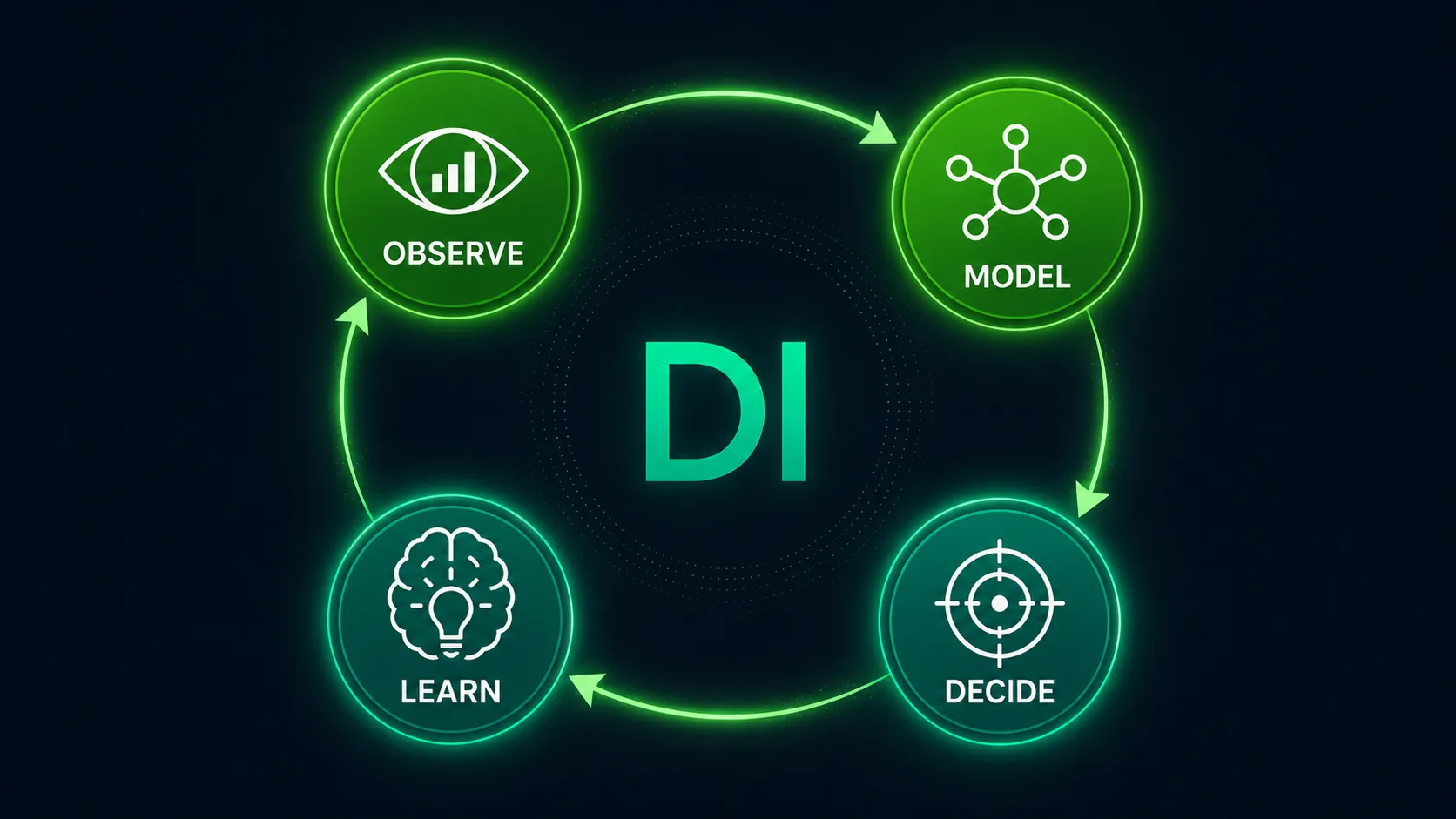
At its core, DI operates on a simple but powerful model:
Observe
Collect data on current state
Model
Map causal relationships
Decide
Choose action with predicted outcome
Learn
Measure outcome, update model
The Decision Intelligence Loop: Observe → Model → Decide → Learn → (repeat)
This looks superficially like the OODA loop (Observe-Orient-Decide-Act) from military strategy. But there's a critical difference: the Learn step. OODA was designed for real-time combat decisions where you can't pause to measure outcomes. DI is designed for organizational decisions where you can — and must — systematically learn from results.
Causal Decision Diagrams: Seeing the Cause-Effect Map
The heart of Decision Intelligence is causal reasoning — understanding not just what correlates with what, but what actually causes what. This is the difference between:
Correlation-Based Analytics
"Customers who buy product A also tend to buy product B."
Problem: If we promote B, will A sales increase? We don't know.
Causal Decision Diagram
"Price reduction on A → increased A sales → increased B sales (complementary use)."
Actionable: We know the lever (A price) and the mechanism (complement effect).
A Causal Decision Diagram (CDD) visualizes these cause-effect relationships. It shows:
- Goals: What outcomes we're trying to achieve
- Levers: What actions we can take
- Intermediates: The chain of effects between lever and goal
- Externals: Factors we can't control but must account for
"It's better to organize information around the decision to be made, rather than around the data surrounding the decision."
Where AI Fits: Augmentation, Not Replacement
This is where Decision Intelligence differs most sharply from both "AI will automate everything" hype and "humans must always decide" traditionalism. DI's position: AI augments human decision-making; humans retain accountability.
What AI Does Well in DI
Information Synthesis
Process data volumes impossible for humans. Summarize 10,000 documents to relevant insights.
Pattern Detection
Find correlations and anomalies across high-dimensional data that humans would miss.
Outcome Simulation
Model "what-if" scenarios faster and more comprehensively than manual analysis.
What Humans Do That AI Can't
Values & Ethics
Decide what tradeoffs are acceptable. Balance competing stakeholder interests.
Context & Judgment
Apply organizational knowledge, relationship awareness, and situational nuance.
Accountability
Own the decision. Be the human-in-the-loop that regulators and stakeholders require.
Netflix offers a perfect example. Their recommendation engine (AI) processes viewing patterns for 300 million subscribers. It predicted House of Cards would succeed before a single episode was filmed. But humans — studio executives — made the actual decision to greenlight the $100 million production. The AI handled the cognitive load of pattern detection; humans handled the accountability.
80% of content watched on Netflix comes from the recommendation engine. But Netflix maintains that "humans, not machines, are the ultimate decision makers."
The 2025-2030 Adoption Wave
Decision Intelligence has moved from academic theory to enterprise adoption faster than most disciplines:
Current State (Gartner, 2025)
- 33% of organizations have deployed DI
- 17% committed to pilot within 6 months
- 19% considering deployment in 6-12 months
- 25% investigating for 12-24 months
- Only 7% stated no interest
Market Projection
The 2025 Gartner AI Hype Cycle recognizes Decision Intelligence as a transformational technology — placing it at 5-20% current adoption with mainstream maturity expected in 2-5 years. Organizations that build DI capability now will have refined processes and organizational expertise by the time it becomes table stakes.
From Collaborative Decision Making to Decision Intelligence
If you've read our Collaborative Decision Making guide, you'll recognize the foundation DI builds upon:
What CDM Established
- Diverse perspectives beat individual judgment (Condorcet, 1785)
- Psychological safety enables perspective-sharing (Google Project Aristotle)
- Divergent-convergent phases structure group exploration
- Cognitive biases can be mitigated with structured frameworks
What DI Adds
- AI augmentation: Handle information volumes impossible for human processing
- Causal modeling: Map cause-effect relationships for "what-if" analysis
- Feedback loops: Systematic measurement of decision outcomes
- Decision automation: Routine decisions handled by AI with human oversight
Think of it this way: CDM is the human-centric foundation; DI is the technology-augmented system built on that foundation. You can't have good DI without the collaborative decision principles. But you can extend CDM's power dramatically by adding DI's capabilities.
How Argumentree Implements Decision Intelligence
Argumentree applies Decision Intelligence principles to real organizational decision-making. Instead of treating decisions as one-time events, the platform creates a continuous learning system:
The result: every decision becomes a learning opportunity. Teams build organizational memory. New members can understand not just what was decided, but why — and whether the reasoning held up against reality.
The Complete Guide
This post covers the essentials of Decision Intelligence. For the comprehensive deep-dive — including the full framework architecture, implementation patterns, causal diagram templates, and integration with existing BI/DS infrastructure — see our definitive resource:
What Is Decision Intelligence?
The complete reference guide
5,000+ words covering the full DI framework: origins, architecture, causal modeling techniques, AI integration patterns, organizational implementation, and the research behind it all.
Read the Complete GuideContinue Reading
Related Articles
The Meeting Intelligence Revolution: Turning Meetings Into Traceable Decisions
Collective Intelligence: 240 Years of Research — From Condorcet to AI
Collaborative Decision Making: 240 Years of Proof That Groups Beat Individuals
Across the ecosystemAI Audit Trails
Enterprise decision intelligence increasingly runs on AI, and AI-assisted decisions need an audit trail to stay accountable.