
When LLMs Met Argument Mining: What Changed and What Didn't | Argumentree
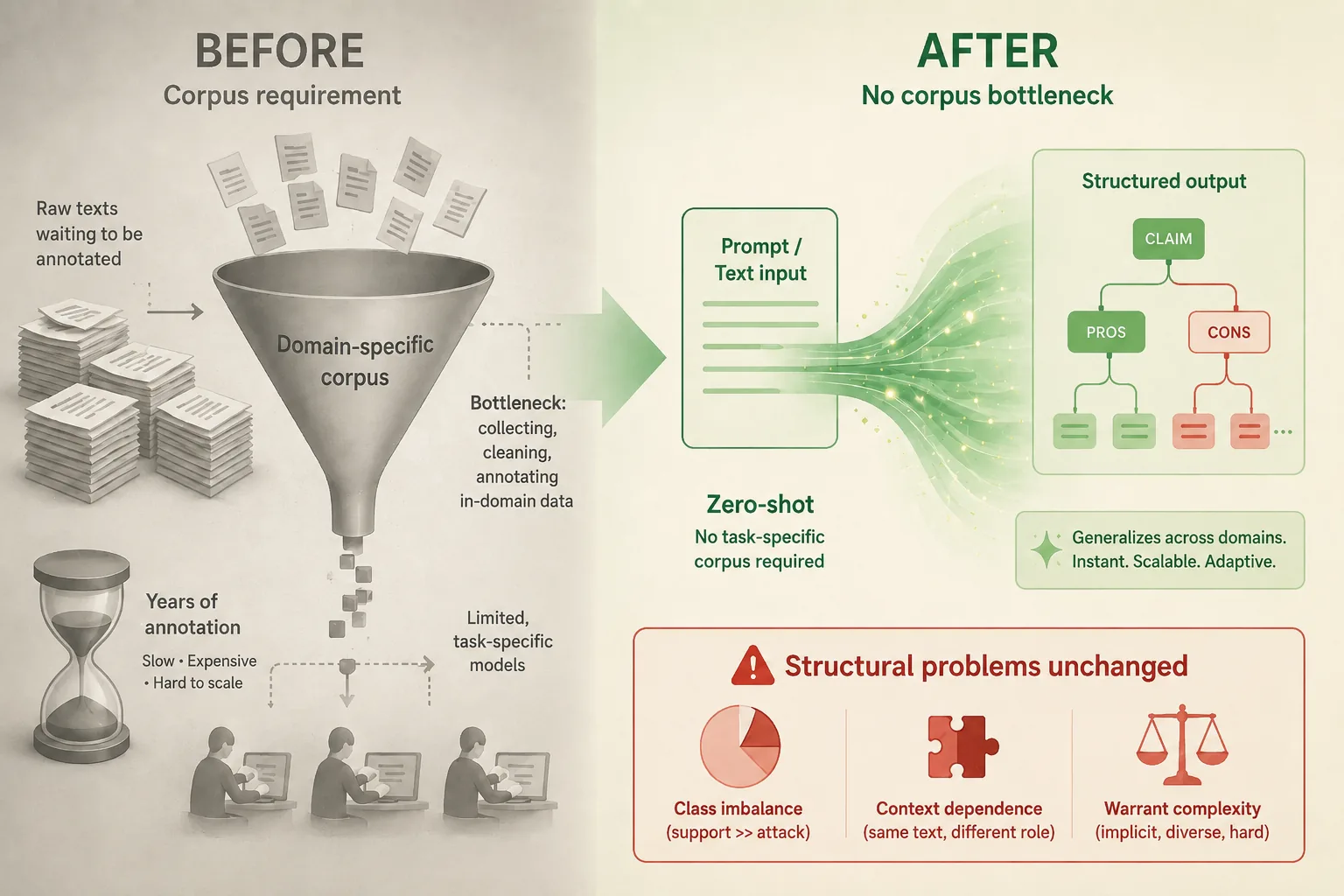
For most of its history, computational argument mining required a hand-annotated corpus for every new domain. That requirement was the field's binding constraint: the annotation effort was large, the guidelines were contested, and a system tuned on student essays transferred poorly to meeting transcripts or public comments. Large language models removed that constraint. A general-purpose model can perform component detection and relation classification from a prompt, with no domain-specific training data, and published evaluations have found prompted general-purpose models competitive with and in cases better than fine-tuned encoder baselines on relation-based argument mining. This changed what argument mining is for: it became usable on ordinary organisational text rather than only on curated research corpora. What it did not change is the structure of the hard problems. Class imbalance reflects how people write, not how models are trained. Whether a contribution supports or attacks depends on its parent rather than its wording. And objections frequently target an unstated warrant that appears nowhere in the text. Large models also introduced a new difficulty of their own: verbalized confidence is better calibrated than raw token probabilities but still unreliable as a ranking signal, so a model's certainty cannot be used to decide which extracted argument matters most.
The corpus bottleneck disappeared. The structural problems didn't move an inch — and a new one arrived, wearing the costume of a solution.
- Argument mining used to need a hand-annotated corpus per domain. Prompted general-purpose models don't, which is what made it usable on ordinary business text.
- Published evaluations find prompted general-purpose models competitive with, and sometimes better than, fine-tuned encoder baselines on relation classification.
- Imbalance, context dependence and the unstated warrant are properties of language and the task, not of model size.
- Model confidence is better calibrated than raw probabilities but still not a reliable ranking signal — a new trap, not a new tool.
- What does help is forcing the relation to be stated in words before the label is committed.
The Constraint That Defined the Field Simply Stopped Applying
For twenty years, the answer to can we run argument mining on our data? was another question: how many thousands of your documents are you willing to have annotated by hand first, and who will write the guideline?
That was not a technical detail. It was the reason argument mining stayed in research labs while sentiment analysis shipped in every product. The annotation requirement made each new domain a project rather than a configuration, and as the second post in this series described, the guidelines themselves were contested even among specialists.
Then general-purpose language models arrived and the question stopped being asked. You can now point one at a meeting transcript in a domain nobody has ever annotated and get a usable first pass. If you have ever wondered why this capability appeared in products suddenly rather than gradually, that is the reason.
Zero-Shot Is the Whole Story
The specific thing that changed is the removal of domain-specific supervision. A prompted model brings a general competence with language and can be told what a claim is and what a premise is, in the prompt, at inference time.
Published work on relation-based argument mining has found general-purpose models with few-shot prompting competitive with fine-tuned encoder baselines across multiple datasets — and in cases ahead of them. For a field whose entire evaluation apparatus was built on supervised training against annotated corpora, that is a genuine discontinuity.
Three practical consequences follow. Domain adaptation becomes prompt-switching rather than retraining. Long documents become tractable, because context windows grew. And the evidence field can carry an explanation, because the model can be asked to justify itself in the same call — which turns out to matter more than it sounds.
The Three Problems That Didn't Move
Everything in the previous post still applies, and it is worth being precise about why scale does not address any of it.
- Class imbalance is a property of writing, not of training. People building a case mostly write supporting sentences. A model that has read the whole internet has read mostly agreement too.
- Context dependence is a property of the task. Support and attack are relations, not sentence attributes. The same sentence under a different parent has a different label, and no amount of world knowledge changes that.
- The unstated warrant is a property of the text. If the principle linking evidence to conclusion was never written down, it is not in the input. A larger model reads the same absent sentence.
There is a fourth, subtler one. A fluent model produces fluent output, so its errors arrive well-phrased and internally consistent. A wrong relation label from an encoder looked like noise. A wrong relation label from a language model looks like an argument.
The New Trap: Trusting the Model's Own Certainty
Because these models can report how confident they are, it is tempting to use that number — to rank extracted arguments, to decide which ones matter, to gate what gets shown.
Work by Saurav Kadavath and colleagues found that verbalized self-assessment is meaningfully better calibrated than raw token probabilities. That result is often cited as licence to trust the number. Subsequent evaluation has been consistently less encouraging: better than the alternative is not the same as reliable, and calibration degrades exactly where you need it, on hard and unusual cases.
There is also a category error hiding in the practice. Confidence measures how certain the model was that it found a real argument. It says nothing about whether that argument is central to the debate. A crisply worded statistic is an easy, high-confidence extraction; the hedged sentence that happens to be the actual thesis is a hard one. Ranking by confidence promotes evidence and demotes claims — which is precisely the failure the final post in this series opens with.
Test it on a transcript you know well
Take a meeting whose outcome you remember clearly and ask any AI tool what the main argument was. If it hands you the most precise, best-evidenced sentence rather than the loose one that actually drove the decision, you have just watched confidence stand in for importance — and you now know not to trust that ranking.
What Does Help: Making It Say Why First
The most reliable improvement available with these models is almost embarrassingly simple. Ask for the reasoning before the label.
Requiring a model to write out what a contribution does to its parent — this reinforces the objection above it, because it supplies another reason that objection holds — before committing to a support-or-attack verdict measurably improves the verdict. The written step forces the parent relation into the model's working context, which is exactly the information the wording of the sentence fails to supply.
This is the machine version of a thoroughly human technique. It is why steelmanning works: articulating what an argument is actually doing, before judging it, changes the judgement.
So Is Argument Mining Solved?
No, and the shape of what remains is now clearer than it has ever been.
What is solved, practically speaking, is access. Any organisation can run argument mining over its own text today without an annotation programme, which was unthinkable a few years ago. That is a real and large change.
What is not solved is the structure: which contribution responds to which, and in which direction, when the connecting principle is unstated and the data has trained everyone — human and machine — to expect agreement. The honest position is that extraction now produces a good draft in any domain, and that a person still has to check the disagreements. Which is a considerably better division of labour than the one where nobody built the structure at all.
How to Use This Well
- Don't rank by confidence. It measures extraction certainty, not importance, and it systematically promotes evidence over claims.
- Ask for the relation, not the sentiment. The useful question is what this does to its parent — never how it feels about the topic.
- Make it justify the label before giving it. The written reasoning is what puts the parent relation in context, and it is where you catch errors.
- Spend your review time on the disagreements. That is where models are weakest and where the decision value is concentrated.
A Better Draft, Not a Verdict
The bottleneck that kept argument mining in the lab is gone, and it is not coming back. That is worth being clear-eyed about: it is the difference between a research technique and something you can point at your own meetings.
But the problems that were hard in 1958 are hard now. The warrant is still unwritten, disagreement is still rare, and the label still depends on the parent rather than the phrasing. What changed is who gets to have the problem — which, for a field that spent twenty years waiting for annotators, is change enough.
The argument mining series
Five posts on how machines learned to read arguments — where the field came from, why its hard problems are hard, and how we apply it.
How a 1958 philosophy book that logicians rejected became the specification for a machine-learning task.
The decade of hand-annotated corpora that turned argument mining from an idea into a measurable task.
Disagreement is rare in the data and depends on context the sentence doesn't contain.
Applying it: argument categories, one main claim per category, and why confidence is the wrong ranking signal.
Sources & Further Reading
The pre-LLM state of the field — useful as the baseline against which the shift is measured.
Verbalized self-assessment beats raw token probabilities — the result most often over-read as licence to trust the number.
The supervised benchmark results that LLM approaches are compared against.
The warrant — the unwritten step that scale does not supply, because it is absent from the text rather than from the model.
Frequently Asked Questions
How did large language models change argument mining?
They removed the requirement for a hand-annotated corpus in each new domain. A prompted general-purpose model can identify claims, premises and relations without domain-specific training data, which turned argument mining from a research technique into something usable on ordinary organisational text.
Are LLMs better than fine-tuned models at argument mining?
On relation-based argument mining, published evaluations have found prompted general-purpose models competitive with and in cases better than fine-tuned encoder baselines across multiple datasets. The larger practical advantage is that they need no annotated training data for a new domain at all.
What problems did LLMs not solve?
The three structural ones. Class imbalance reflects how people write rather than how models train. Support versus attack depends on the parent, not the wording. And objections often target an unstated warrant that is absent from the text, so no amount of model capability supplies it.
Can you trust a model's confidence score?
Not as a ranking signal. Verbalized confidence is better calibrated than raw token probabilities but remains unreliable in absolute terms, and it measures extraction certainty rather than importance — so ranking by it systematically promotes well-evidenced detail over the looser sentences that carry the actual claims.
What actually improves relation classification with LLMs?
Requiring the model to state, in words, what a contribution does to its parent before committing to a support-or-attack label. The written step forces the parent relation into working context, which is exactly the information the sentence's own wording fails to provide.
Is argument mining a solved problem now?
Access is solved — any organisation can run it on its own text without an annotation programme. Structure is not. Deciding which contribution responds to which, and in which direction, remains hard, so extraction produces a good draft and a person still reviews the disagreements.
Argumentree Team
Decision Science
The Argumentree team explores the science of better decisions—from ancient philosophy to modern AI.
A draft you can correct
Extraction produces the structure; you review the disagreements. Paste a transcript and see the division of labour.
The reference page for the field — tasks, history, and why relations are the hard part.
The arc of the whole field, from a rejected 1958 philosophy book to today.
Categories, one main claim per category, and why confidence is the wrong ranking signal.
Run it on your own transcript
No annotation programme, no corpus, no training run — just a structured pro and con tree to review.
Start free