
The Decision Record: How to Decide Once and Never Re-Argue It | Argumentree
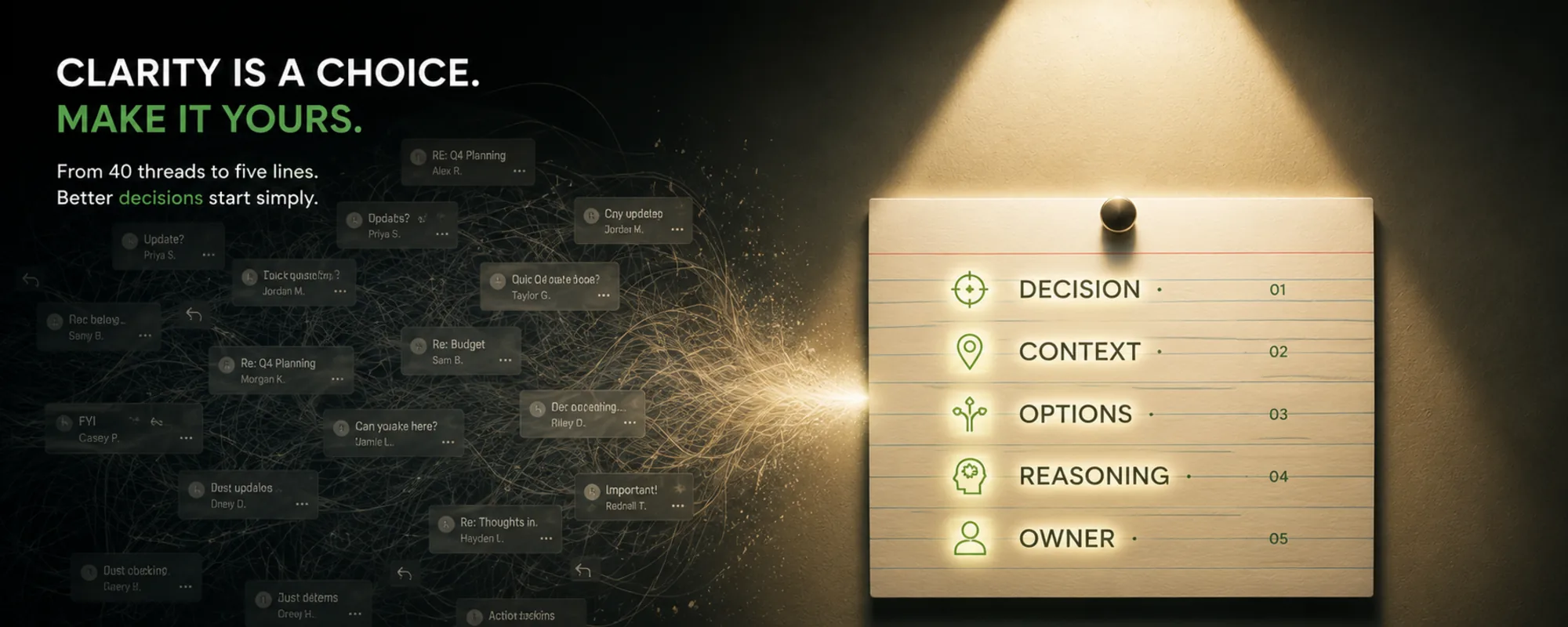
A decision record is a small artifact written at the moment of deciding that captures not only what was chosen but why. It takes about two minutes to produce and saves hours each time the question returns. A useful record has five short fields: the decision in one clear sentence; the context that made it necessary and made it necessary now; the options considered and specifically why each one lost, which is the field teams skip and later wish they had not; the deciding argument, meaning the one or two reasons that actually tipped the outcome; and the owner plus the date. An optional sixth field, the revisit trigger, states the condition under which the decision should be reconsidered and tells a future reader when it has expired. The practice fits inside a meeting: spend the final two minutes while the context is still hot, have one rotating scribe read the five fields aloud, and read the record back to the room. Reading it back is the step that matters most, because saying the decision and its reasoning out loud surfaces disagreements that are still live and would otherwise resurface months later. The record must live somewhere visible and searchable rather than in private notes, since the value is not in writing it down but in being able to retrieve it. Done consistently this accumulates a memory of how a team thinks, so new joiners onboard by reading why rather than what, questions are answered with a link instead of a re-debate, and reversals become deliberate rather than accidental.
The Decision Record: How to Decide Once and Never Re-Argue It
Last time we counted the cost of decisions nobody writes down. Here's the two-minute habit that fixes it.
In the last piece, we put a number on decision debt — the slow, invisible cost of making good decisions and then forgetting why. Relitigation, reversals, lost institutional memory, politics.
The fix is almost insultingly simple. It's a decision record: a tiny artifact, written at the moment of deciding, that captures not just what you chose but why.
It takes about two minutes. It saves about two hours, every time the question comes back. Here's how to do it.
What goes in a decision record
Forget heavyweight documentation. A useful decision record is five short fields:
- ✓The decision — one clear sentence. ("We're moving the launch to March.")
- ✓The context — what made this necessary, and why now.
- ✓The options considered — the real alternatives, and why each lost. (This is the field everyone skips and later wishes they hadn't.)
- ✓The deciding argument — the one or two reasons that actually tipped it.
- ✓Owner + date — who made the call, and when.
Optionally, a sixth: the revisit trigger — "reconsider this if X changes." It tells future-you when the decision has expired.
That's it. Five lines. The magic isn't in the format; it's in capturing the reasoning before it evaporates. If you want one ready-made, the decision log template is the same idea in a reusable shape.
How to do it without killing the meeting
The objection is always the same: "we don't have time for process." You don't need much.
- •Spend the last two minutes. When a decision lands, one person says "let me capture this" and reads the five fields out loud while everyone's still in the room.
- •Read it back. This is the secret step. Saying the decision and its reasoning aloud surfaces disagreements you didn't know were still live — "wait, that's not what I thought we decided." Far better to find that now than in three months.
- •One scribe, rotating. It's not a manager's job or a junior's job. Whoever's closest to the keyboard.
Two minutes, while the context is hot, before everyone scatters and the why leaks out of the room.
Where it has to live
A decision record buried in someone's private notes is worthless. It has to be visible and searchable — somewhere the whole team (and next year's new hire) can find it by searching the topic.
That's the difference between a decision record and a decision graveyard. The value isn't in writing it down. It's in being able to pull it back up, six months later, when someone asks "wait, why did we do it this way?" — and having the answer, reasoning intact, right there.
What you're actually building
Do this consistently and something quietly powerful accumulates: a memory of how your team thinks.
- ✓New people onboard by reading why, not just what — so they stop blindly undoing settled decisions.
- ✓Questions get answered with a link instead of a re-debate.
- ✓Reversals become deliberate ("the revisit trigger fired") instead of accidental ("nobody remembered why we chose this").
- ✓And because the arguments are captured — not just the verdict — the best reasoning keeps winning, instead of getting overwritten by whoever argues loudest next quarter.
That last point is the whole game. A team that records its decisions and the arguments behind them doesn't just move faster — it compounds, getting wiser with every choice instead of resetting to zero. That's what it means to decide once.
So: does your team have anywhere that a decision and the reasoning behind it actually live — or does it all evaporate when the meeting ends? For most teams, the honest answer is "nowhere."
A decision record that writes itself
Argumentree captures the options, the arguments and the deciding reason as the discussion happens — so the record exists without anyone having to remember to write it.
Start Free 14-Day Trial →Related Reading
Decision Log Template
The five-field record in a reusable format you can start with today.
Decision Documentation
Where records have to live to be worth writing, and how teams keep them findable.
Jeff Bezos's 3 Decisions a Day
Why writing the reasoning down is what makes a high-quality decision repeatable.