Decision Fatigue: Why Judges Grant More Parole After Lunch
A famous 2011 study of judges' parole rulings reported that prisoners heard right after a food break were granted parole roughly 65% of the time while those seen just before a break dropped toward near zero, which made it one of the most-cited results in popular psychology. It is also one of the most contested. Researchers pointed out the same year that cases were not scheduled randomly, and that weaker or unrepresented cases tended to be heard later in each session, which would push grant rates down with no fatigue involved; later analyses argued the reported effect is implausibly large for a fatigue effect at all. The mechanism usually invoked has fared worse still: ego depletion, the idea that willpower is a finite reserve that gets used up, failed a large multi-lab registered replication in 2016 with an effect size indistinguishable from zero, so depleted willpower should be treated as a contested hypothesis rather than an established fact. What survives is the weaker and more practical claim that decision quality varies with fatigue, with time of day, and with how much deciding you have already done, and that a tired decision-maker tends to reach for the safe, easy, status-quo option, which for a judge is the low-risk no. The courtroom story is best used as a vivid illustration rather than proof. The practical advice stands on its own regardless of the mechanism: make important decisions early in the day, protect your judgment by spending less of it on trivial choices through routines and defaults, and refuse to decide big things while depleted, since sleeping on it is not procrastination. The same applies to groups. The most important call in a three-hour meeting should not be the last item decided by an exhausted room at minute 175, which is exactly where hard decisions usually land. Put the decisions that matter early while the room is fresh, notice when a group is grinding and grabbing the status-quo option to be done, and give big calls their own time rather than tacking them onto the end of everything else.
Decision Fatigue: Why Judges Grant More Parole After Lunch
Your decisions get worse as the day goes on — even when you don't feel tired. Here's the science, and the catch.
Here's one of the most unsettling findings in decision research — and one of the most contested.
A famous 2011 study of judges' parole rulings reported that prisoners who came up right after a food break were granted parole roughly 65% of the time — while those seen just before a break dropped toward near zero. Same judges. Same law. On the study's reading, the biggest predictor of freedom wasn't the crime. It was how long since the judge had eaten.
It's a startling illustration of something people really do experience — decision fatigue. But the story has a twist worth knowing, and it's a big one.
What decision fatigue is supposed to be
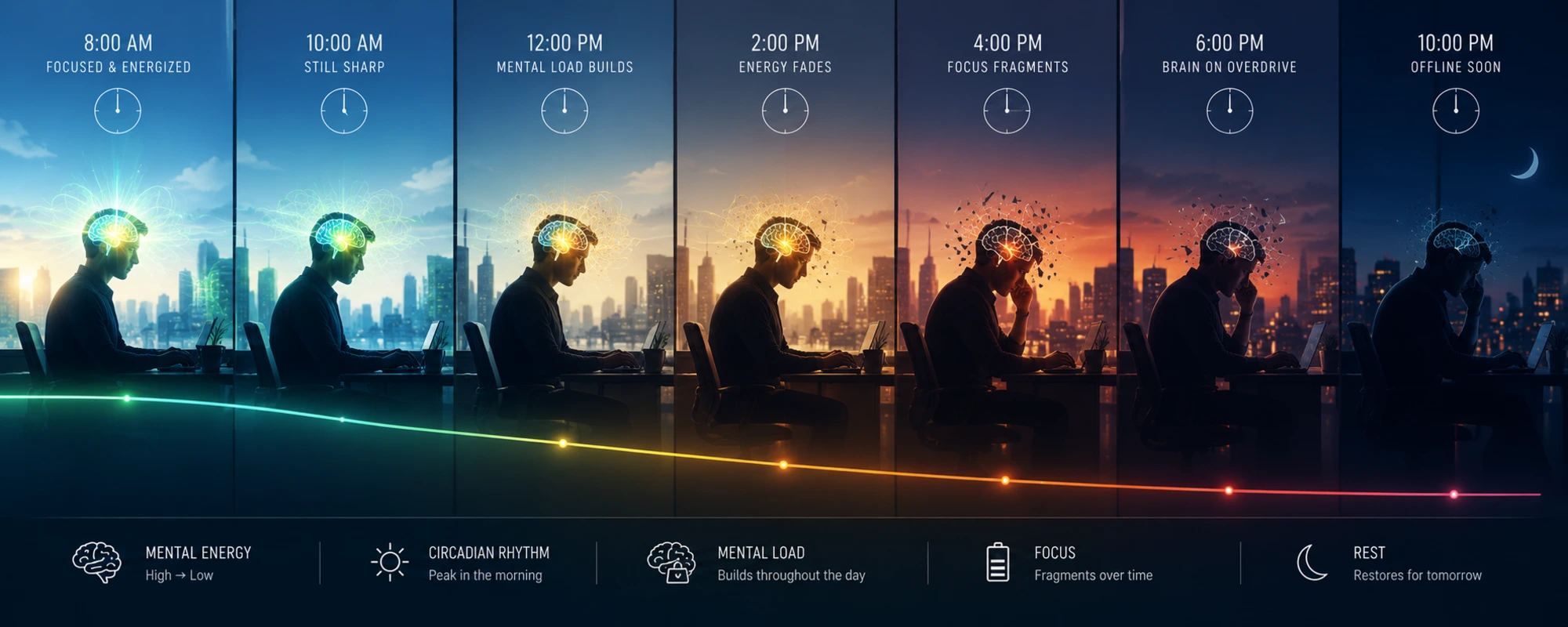
The standard account goes like this. Every decision you make draws down a limited mental reserve. As that reserve depletes — across a long day, a long meeting, a long list of choices — the quality of your decisions degrades, even if you don't consciously feel tired.
And on that account, depleted brains don't fail randomly. They default to the safe, easy, status-quo option — which, for a judge, means the low-risk "no." Denying parole is the cognitively cheap choice. So as the day grinds on, "no" wins more and more.
You've felt something like this. It's why you make a sensible dinner plan at noon and order pizza at 9pm. It's why a sharp morning decision-maker makes a sloppy 6pm call.
The honest caveat
The parole study is one of the most-cited results in pop psychology — and it has been seriously challenged. Cases were not scheduled at random, and researchers noted the same year it appeared that weaker or unrepresented cases tended to be heard later in each session, which would push grant rates down regardless of any "fatigue" (Weinshall-Margel and Shepard, 2011). Later analyses have gone further, arguing the reported swing is simply too large to be plausible as a fatigue effect at all.
The mechanism usually invoked has fared even worse. Ego depletion — the idea that willpower is a finite fuel tank that gets used up — failed a large multi-lab registered replication in 2016 (Hagger and colleagues, 23 labs, effect size d ≈ 0.04, statistically indistinguishable from zero). So "your willpower ran out" is a contested hypothesis, not an established fact, and you shouldn't repeat it as one.
Treat the judges as a vivid illustration, not as proof — and hold the explanation loosely too. What survives more comfortably is the weaker, more practical claim: decision quality varies with fatigue, with time of day, and with how much deciding you've already done. The size of the courtroom effect, and the reason behind it, are genuinely debated.
Being able to hold both of those at once — the pattern is worth acting on, the famous evidence for it is shaky — is, fittingly, good thinking. It's the same habit that keeps you honest about the rest of the cognitive-bias catalogue, where the memorable study and the replicated one are often not the same study.
What it means for you
Whatever the precise magnitude — and whatever the mechanism turns out to be — the practical lessons are cheap, low-risk, and stand on their own:
- ✓Make important decisions early. Your best judgment is a morning resource. Don't spend it on what to wear and then expect it to show up for the 5pm strategy call.
- ✓Protect it by spending less. This is why effective people automate trivial choices — same breakfast, fixed routines — keeping their attention for what matters.
- ✓Don't decide big things while depleted. "Let's sleep on it" isn't procrastination. It's waiting until you're in a better state to judge.
That middle one matters more than it sounds, because the volume is the problem rather than any single choice — which is the whole reason the sheer number of choices a day contains is worth taking seriously in the first place.
And in the room
Teams show the same pattern — or at least behave as if they do. The most important call in a three-hour meeting should not be the last item, made by an exhausted room at minute 175, yet that's exactly where the hard one usually lands.
Put the decisions that matter early, when the room is fresh. Notice when a group is grinding and depleted — that's when it grabs the lazy, status-quo option just to be done. And give big calls their own time instead of tacking them onto the end of everything else. (The team version, with the same honest caveats, is here.)
Treat your judgment as a budget rather than a constant. Spend it where it counts — and stop asking your worst, most-depleted self to make your most important decisions.
When in your day do you make your worst decisions — and what important call are you currently scheduling right into that window?
Reply and tell me. Most people are quietly deciding the big stuff at exactly the wrong time.
Take the hard call off the end of the agenda
Argumentree moves the arguments out of the room and onto the page, so a decision doesn't depend on who still has energy left at minute 175 — the reasoning is there to weigh whenever the team is actually sharp.
Start Free 14-Day Trial →Related Reading
Decision Fatigue in Teams: Why Your Last Decision of the Day Is Your Worst
The team-level version, including the honest science on ego depletion.
You Make 35,000 Decisions a Day. Nobody Ever Taught You How.
Why the sheer volume of daily choices is the thing worth managing.
Why Smart People Make Dumb Decisions
Intelligence is no defence when the conditions for judgment are wrong.
What Is Cognitive Bias?
The wider catalogue — and how to tell a replicated finding from a famous one.