

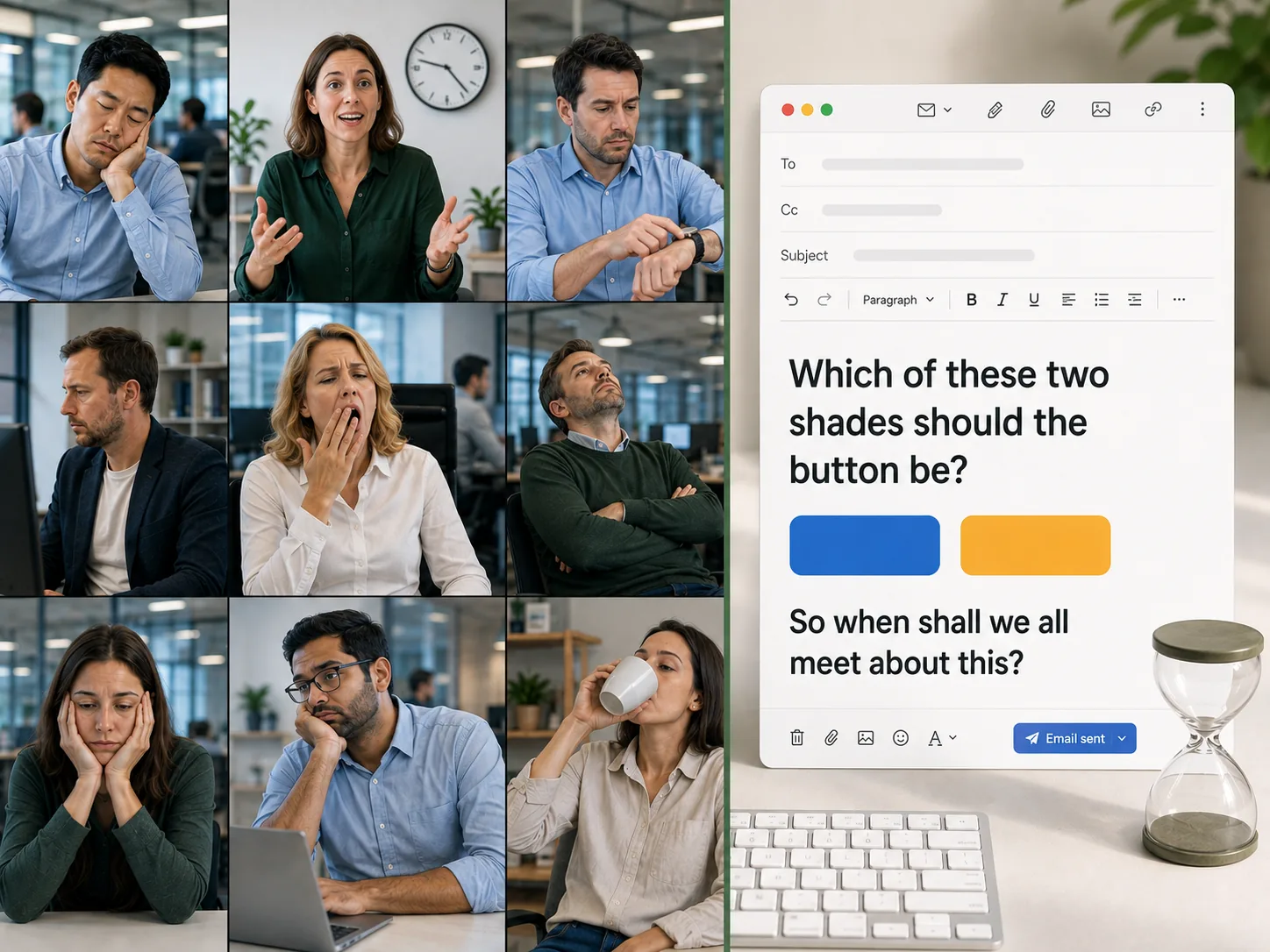
This meeting could have been an email: how to tell which meetings should have been written
A meeting could have been an email when it is one-way information transfer with no decision to make in the room and no disagreement to resolve. A meeting buys exactly two things a document cannot: simultaneity and social presence. If a session uses neither, the invite is doing the work of a document. The four-question test: Is there a decision to be made in the room? Is there disagreement to resolve? Does anyone need to read the room? Would the written version be worse? Four noes means write it instead. Five formats fail the test almost every time: the round-robin status update, the read-the-deck review, the FYI broadcast, the alignment meeting with no named decider, and the meeting that ends by scheduling another meeting. Atlassian's State of Teams 2024, a survey of 5,000 knowledge workers, found 62% of meetings are scheduled with no stated goal and 77% of workers are frequently in meetings that end in a decision to schedule a follow-up. Research by Steven Rogelberg with Otter.ai (2022, 632 workers across 20 industries) put roughly 31% of meetings in the unnecessary category. The inverse error is real too: a disagreement running past two rounds of replies has become a meeting with worse latency. The working rule is information gets written, disagreement gets witnessed, and a decision gets written first, decided live, then recorded.
"This meeting could have been an email" is not a complaint about length or boredom. It is a precise diagnosis: nothing happened that needed everyone present at the same moment. That failure has a test, and most meetings fail it.
- Four questions: a decision in the room, disagreement to resolve, a room to read, or a version that gets worse in writing. Four noes means write it.
- 62% of meetings are scheduled without a stated goal (Atlassian, 5,000 knowledge workers)
- 77% of workers are frequently in meetings that end by scheduling another meeting
- The inverse error is real: a disagreement past two rounds of replies has become a meeting with worse latency
You join the call. Someone shares their screen. They begin reading the slides. Word. For. Word. Thirty-eight minutes later nobody has disagreed with anything, nobody has decided anything, and you close your laptop thinking what half the attendees are thinking:
"This meeting could have been an email."
You are almost certainly right — but not for the reason the mug and the TikTok sound imply. The complaint is not that the meeting was long, or boring, or badly chaired. It is that nothing occurred in it that required everyone to be present at the same moment. That is a specific, diagnosable failure, and it has a test. Most meetings fail it. Some genuinely don't — and telling those apart is the entire skill.
Nothing happened in that meeting
that needed everyone there at the same time.
The actual complaint behind the meme
What the Phrase Actually Means
A meeting could have been an email when it is one-way information transfer: someone knows something, everyone else needs to know it, and the transfer has been scheduled as a synchronous event. No decision gets made. No disagreement gets resolved. The content would survive being read at 8pm by someone on another continent, and would probably be clearer.
Put the other way round: a meeting buys exactly two things a document cannot. Simultaneity — where my sentence changes yours before you finish it. And social presence — tone, hesitation, the pause before someone says "fine". If a session uses neither, the invite is doing the work of a document, badly.
How much this costs an organisation in aggregate is a separate subject, and we cover the numbers on meeting intelligence. This post is about the judgment call in front of you: this meeting, on this invite — could it have been written?
The Four-Question Test
Run this before you accept an invite, and before you send one. Each question asks whether the session needs simultaneity or presence.
1. Is there a decision to be made in the room?
Not reported, not announced — made, during the session, by people who are there. If the decision has already been taken elsewhere, this is an announcement, and announcements read better than they listen.
2. Is there disagreement to resolve?
Live, specific disagreement: two positions that need to meet. If everybody already agrees, there is nothing to resolve. If nobody has read enough to disagree yet, you are holding the meeting too early — send the reading.
3. Does anyone need to read the room?
Bad news, negotiation, feedback, conflict, a first conversation with someone you have never met — all of these turn on tone and hesitation. A status number does not. If you cannot name whose reaction you need to see, you do not need to see anyone.
4. Would the written version be worse?
Some things genuinely degrade on the page. Most status updates improve: shorter, searchable, skippable, and permanent. Be honest about which one you have.
Four noes and it should have been written. One clear yes is a real meeting — and deserves to be run like one, with the reading done in advance so the time goes on the disagreement rather than the briefing.
The Five Formats That Almost Always Fail
These recur across every company, and they fail the test for the same reason: the content is information, and the format is a broadcast.
The round-robin status update
Eight people report in sequence. Each one listens to seven updates that do not concern them in order to deliver the one that does. The information is a table, and a table is a document.
The read-the-deck review
Slides narrated aloud to people who can all read faster than the presenter can speak. If the deck stands alone, circulate it. If it doesn't, the deck is the problem.
The FYI broadcast
An announcement with ten minutes of Q&A appended in case anyone has questions. Usually nobody does, because questions arrive later, after people have had time to think — which is when a written thread is available and a meeting is not.
The alignment meeting with no decider
Called to "get aligned", with no question on the table and nobody named to answer it. Atlassian's State of Teams 2024, a survey of 5,000 knowledge workers, found 62% of meetings are scheduled without a stated goal — and a goal-less meeting is the clearest tell there is.
The meeting that ends by scheduling a meeting
The same research found 77% of workers are frequently in meetings that end in a decision to schedule a follow-up. A session whose only output is another session produced a calendar entry, not a decision.
Information wants to be written.
Disagreement wants to be witnessed.
But Some of My Best Work Happens in Meetings
It does, and the phrase is overused as a reflex. Deliberation genuinely is faster in a room: when four people are arguing about a trade-off, an hour of live argument covers ground that would take a week of replies, because objections get answered while they are still cheap to answer.
Written channels are also actively bad at some things. They harden positions: once your objection is on the record in writing, backing away from it feels like a loss. A room lets somebody change their mind mid-sentence at almost no social cost — which is exactly what you want when the goal is the best answer rather than the best-defended one. Conflict, ambiguity, bad news and negotiation all belong in the room for this reason.
So the honest version of the complaint is narrower than the meme: not meetings are waste, but this particular meeting spent presence on something that did not need it. The opposite failure is just as expensive — a real decision pushed out of the room, which we take apart in "Let's Take This Offline" Is Killing Your Decisions.
The Emails That Should Have Been Meetings
Watch for the reverse error, because it hides better. A thread has been running three days and nine replies. Two people are restating positions with increasing politeness. Somebody has started numbering their points. A disagreement that has gone past two rounds of replies has become a meeting with worse latency — you are paying meeting costs in calendar days instead of minutes, and nobody can see anyone's face.
Which gives a workable default. Information gets written. Disagreement gets witnessed. And a decision gets all three: written first so people arrive informed, decided live, then recorded so the reasoning survives — the shape we describe under asynchronous decision-making.
Why Email-able Meetings Get Scheduled Anyway
Nobody schedules a pointless meeting on purpose. Four ordinary pressures produce them reliably.
Scheduling feels like progress
Booking the meeting discharges the anxiety of owning the problem. The calendar entry is visible, immediate and satisfying in a way that drafting a document is not — even though the document is the work.
Presence reads as commitment
Attendance is the cheapest legible signal that you care. Declining a meeting to do the actual work looks, on a calendar, identical to not caring.
The organiser sees only their own calendar
Harvard Business School research on meeting overload describes an egocentric bias in scheduling: organisers weigh their own need for the meeting far more heavily than the collective cost of the hour they are spending on everyone else's behalf.
Meetings leave no receipts
This is the uncomfortable one. Writing creates a record of who claimed what and when. A meeting leaves an impression, and impressions are deniable — "I thought we were all aligned on this" is a sentence that only survives when nothing was written down. Some meetings are email-able and happen anyway precisely because nobody wants the email.
Why It Costs More Than the Half Hour
The half hour is not the price. People stop doing focused work 15 to 20 minutes before a meeting starts, because there is no point beginning anything, and lose more time refocusing afterwards — so a 30-minute status call routinely costs an hour of capacity per attendee (Psychology Today). Research by Steven Rogelberg with Otter.ai, surveying 632 workers across 20 industries, put roughly 31% of meetings in the unnecessary category. Multiply the second number by the first and the case for writing gets easier.
Ask yourself this
Open next week's calendar. How many of those meetings would survive all four questions — and if the rest quietly became documents tomorrow, who would actually notice?
What to Write Instead
"Send an email" is not the fix, and sending a 900-word wall of text is how async work gets a bad name. The replacement for an email-able meeting is a document with a decision-shaped spine: what is being decided, the options, your recommendation and why, what you need from the reader, and a date after which silence counts as agreement.
That last clause is what makes it work. An update with no deadline gets ignored; a recommendation with an objection window gets read, because saying nothing now means agreeing later. It is also how the reasoning survives contact with next quarter — the difference between a record of what was decided and a record of why, which is the argument we make in the meeting intelligence revolution.
And protect the meetings that pass. Give them the pre-read, open with the objections rather than the background, and record what was chosen and which arguments lost. A meeting that earns its hour should not spend the first twenty minutes catching people up.
The Real Question
The phrase survives on mugs because it is almost always true and almost never actionable. Said afterwards it is a complaint; applied before the invite goes out it is a filter — and the four questions are the filter.
Most meetings are information wearing a meeting's clothes. A few are genuine deliberation, and those are worth defending against the ones that are not. Getting that sorting right needs no tooling, no policy and no permission.
So the question was never whether this meeting could have been an email. It is which of next week's meetings could — and whether you will be the one to say so before the invite goes out.
For the meetings that should have been written
Argumentree turns a decision into a structured document — options, arguments for and against, and a recorded outcome — so the ones that could have been an email actually become one.
Sources
- Atlassian — State of Teams 2024Survey of 5,000 knowledge workers. Source of the 62% no-stated-goal and 77% meeting-begets-meeting figures.
- Steven G. Rogelberg with Otter.ai — The Cost of Unnecessary Meeting Attendance (2022)632 workers across 20 industries; roughly 31% of meeting attendance classed as unnecessary. Rogelberg is a professor of organisational science at UNC Charlotte and the author of The Surprising Science of Meetings.
- Harvard Business School — The Psychology Behind Meeting OverloadWorking paper describing the egocentric bias in meeting scheduling.
- Psychology Today — The Psychology of Pointless Meetings (2023)On the pre-meeting stall and the refocus cost that make a 30-minute meeting cost an hour.
- Steven G. Rogelberg — The Surprising Science of Meetings (Oxford University Press, 2019)Book-length treatment of meeting design, and the primary academic source on which meetings earn their time.
Frequently Asked Questions
What does "this meeting could have been an email" actually mean?
It means the session was one-way information transfer: no decision was made in the room and no disagreement was resolved. A meeting buys two things a document cannot — simultaneity and social presence — so when a session uses neither, the same content would have been clearer, faster and permanent in writing. The phrase is a complaint about format, not about length or boredom.
How can I tell if a meeting could have been an email?
Ask four questions. Is there a decision to be made in the room, rather than reported? Is there live disagreement to resolve? Does anyone need to read the room — tone, hesitation, reaction? Would the written version genuinely be worse? If the answer to all four is no, it should have been written. One clear yes means you have a real meeting.
Which meetings should never be an email?
Conflict, negotiation, bad news, performance feedback, and first conversations with someone you have not met. These turn on tone and on the ability to change your mind cheaply — writing hardens positions, because a published objection is harder to walk back than a spoken one. Genuine deliberation between several people is also faster live than in a thread.
What share of meetings are actually unnecessary?
Research by Steven Rogelberg with Otter.ai in 2022, surveying 632 workers across 20 industries, classed roughly 31% of meeting attendance as unnecessary. Atlassian's State of Teams 2024, a survey of 5,000 knowledge workers, found 62% of meetings are scheduled with no stated goal and 77% of workers are frequently in meetings that end by scheduling another meeting.
Is it rude to say a meeting could have been an email?
Said afterwards, it is a complaint and lands as one. Said beforehand, it is a useful question and usually welcomed, because the organiser is often the person most trapped by the invite. The productive form is not "this is a waste of time" but "what decision are we making, and who is making it?" — a question a goal-less meeting cannot answer.
What should replace a meeting that could have been an email?
Not a long email. A short document with a decision-shaped spine: what is being decided, the options, your recommendation and reasoning, what you need from the reader, and a date after which silence counts as agreement. The objection window is what makes people read it, and the written record is what makes the reasoning survive past next quarter.
Can an email have been a meeting?
Frequently, and it hides better. When a thread has run past two rounds of disagreement — positions being restated, points being numbered — it has become a meeting with worse latency, paid in calendar days rather than minutes and stripped of tone. The working rule is that information gets written, disagreement gets witnessed, and decisions get written, decided live, then recorded.
Stop holding meetings that should have been documents
Argumentree structures the decision — the options, the arguments on both sides, and the outcome — so presence is spent only where it is needed.
About Argumentree Team
Meeting Culture
The Argumentree team is pioneering structured decision intelligence for enterprises worldwide. Our mission is to transform how organizations make, document, and learn from decisions.
Related reading
Meeting Intelligence Revolution
What to do with the meetings that survive the test: capture the reasoning, not just the action items.
What Is Asynchronous Decision-Making?
The written alternative in full — proposal, objection window, named decider, recorded outcome.
Argumentree.AIAI Audit Trail
When the meeting does happen, structured argumentation keeps the reasoning — not just the conclusion.
Disagree with any of this?
Bring it to the forum and argue it out — structured, on the record, and open to anyone who has sat through the wrong meeting.
Join the discussion on Argumentree