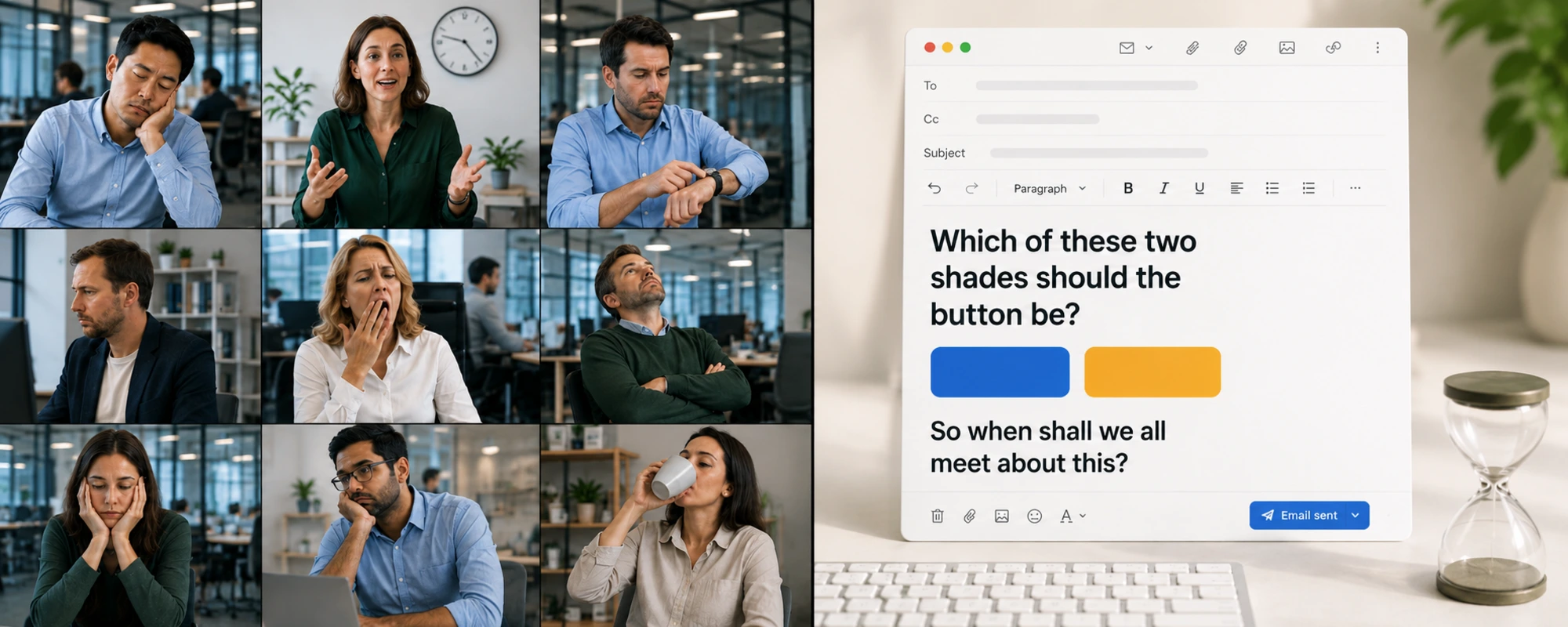
This Meeting Could Have Been an Email
The joke on the mug is really a diagnosis, and the cure most teams reach for is the wrong one. The scale is documented rather than anecdotal: Atlassian State of Teams 2024, surveying 5,000 knowledge workers, found 62% of meetings are scheduled with no stated goal and 77% of workers are frequently in meetings that end by scheduling another meeting, while research by Steven Rogelberg with Otter.ai in 2022, covering 632 workers across 20 industries, classed roughly 31% of meeting attendance as unnecessary. The reasons are human rather than malicious: FOMO, because we equate being in the room with being important; the mere-urgency effect, because scheduling a meeting feels productive even when it is not; the HiPPO problem, where the highest paid person's opinion dominates and the meeting becomes theatre in which people perform agreement instead of testing ideas; and fear of written records, because emails create receipts while meetings create plausible deniability. That last reason is the tell, since many meetings exist precisely because nobody wants the decision and its reasoning pinned down. Swinging to the opposite extreme does not fix it either, because unstructured async has its own failure mode: the thread explodes, context is buried in forty replies, and nobody wants to call the decision in a forty-seven-message chain, so meeting chaos simply becomes email chaos. Both fail for the same reason, which is that no structure forces the arguments out and lets the best one win. The real upgrade is structured decision-making in three steps: extract the arguments so the real case for and against leaves people's heads and reaches the page, map them so pros, cons and trade-offs are visible to everyone at once, and decide on the merits by having the team weigh and vote on the options, ideally anonymously, so the best logic wins rather than the loudest voice, the person who booked the room, or the most senior title. Separate the channel question from the real one: inform with an async update, discuss in a short timeboxed meeting with an agenda, and decide with structure so the reasoning stays visible and the best argument actually wins.
This Meeting Could Have Been an Email
But the real fix isn't email. It's something almost no team actually does.
You join the call. Someone shares their screen and starts reading the slides. Word. For. Word. Forty-three minutes later, no decision has been made, three people have quietly checked out, and you're thinking the thought that's echoed through offices for a decade:
"This meeting could have been an email."
It's on mugs. It's all over TikTok. It's the unofficial anthem of the modern knowledge worker. But here's what most people miss: it isn't just a joke. It's a diagnosis — and the cure most people reach for is the wrong one.
The numbers are brutal
This isn't "a few bad meetings." The data is genuinely alarming:
- ✕62% of meetings are scheduled with no stated goal — Atlassian, State of Teams 2024, surveying 5,000 knowledge workers.
- ✕77% of workers are frequently in meetings that end by scheduling another meeting (same survey). A session whose only output is another session did not have a question on the table.
- ✕Roughly 31% of meeting attendance is unnecessary — Steven Rogelberg with Otter.ai, 2022, 632 workers across 20 industries.
And the human toll: nearly half of workers admit to making excuses to skip meetings, and most have joined one purely to "appear engaged." When half your team is trying to avoid your meetings, that's not a people problem. It's a systems failure.
The full deep-dive, with sources for every number above, is on the blog: This Could Have Been an Email.
Why we keep having meetings that shouldn't exist
It's rarely malice or laziness. It's a perfect storm of very human reasons:
- •FOMO — we equate being in the room with being important.
- •The mere-urgency effect — scheduling a meeting feels productive, even when it isn't.
- •The HiPPO problem — the Highest Paid Person's Opinion dominates, so meetings become theater where people perform agreement instead of testing ideas.
- •Fear of written records — emails create receipts; meetings create plausible deniability. "I thought we were aligned" is easier than having your position in writing.
That last one is the tell. A lot of meetings exist precisely because nobody wants the decision — and its reasoning — pinned down.
And the HiPPO problem isn't unique to meetings. It's the everyday shape of the loudest-voice trap: volume and rank standing in for evidence, in a room where nobody is keeping score of the actual arguments.
"Just send an email" was never the fix
So teams swing to the opposite extreme: kill the meeting, put it in Slack, send an email. And it… half-helps.
Because unstructured async has its own failure mode. The thread explodes. Context gets buried in 40 replies. And the decision never actually gets made, because nobody wants to be the one to call it in a 47-message chain. One person famously cancelled a 30-minute meeting to be "efficient" — and ended up with 25 emails over three days and still no resolution.
The progression most teams live in: meeting chaos (read slides → no decision) → email chaos (endless threads → no decision).
Both fail for the same reason: there's no structure that forces the arguments out and lets the best one win.
The actual fix: structure, not channel
The real upgrade isn't "fewer meetings" or "more emails." It's structured decision-making, in three steps:
- ✓Extract the arguments — get the real case for and against out of people's heads and onto the page.
- ✓Map them — pros, cons, trade-offs, visible to everyone at once.
- ✓Decide on the merits — let the team weigh and vote on the options, ideally anonymously, so the best logic wins — not the loudest voice, not the person who booked the room, not the most senior title.
Done this way, "this could have been an email" becomes "this got resolved clearly, in writing, without losing an hour of everyone's life." That surface-then-weigh-then-conclude sequence is the method sitting underneath every good group decision.
That's the whole move: separate the channel question from the real one. Inform → send the async update. Discuss → a short, timeboxed meeting with an agenda. Decide → structure it, so the reasoning is visible and the best argument wins.
The companies that thrive aren't the ones with the fullest calendars. They're the ones that treat time as the non-renewable resource it is — and build a system where ideas rise on merit, not volume or rank.
The meme isn't going away, and that's a good thing — it means people are finally naming the dysfunction that's drained calendars for decades.
But the question was never really "could this have been an email?" The better one is:
What would your work look like if every real decision had a structure where the best argument actually won?
What's your worst "this meeting could have been an email" story — and was there a real decision hiding inside it that never actually got made?
Reply and tell me. We've all got one.
End the meeting with a decision, not a follow-up
Argumentree pulls the case for and against out of the discussion, lays the trade-offs side by side, and lets the team weigh them — so the reasoning stays visible and the best argument wins, whatever channel you started in.
Start Free 14-Day Trial →Related Reading
This Could Have Been an Email
The full deep-dive this piece is distilled from, with sources for every figure.
"Let's Take This Offline" Is Killing Your Decisions
The other way a meeting ends without deciding anything.
The Hidden Cost of Undocumented Decisions
What it costs when the reasoning never gets written down.
The Meeting Intelligence Revolution
What changes when meetings produce decisions instead of discussion.