Steel-Manning: How to Make Your Opponent's Argument Better Than They Can
Steel-manning is the practice of rebuilding someone's position into its strongest possible form — the version their smartest ally would give — and engaging that, before you argue against it. It is the exact inverse of the strawman, where you attack the weakest or most distorted version of the other side and feel as though you have won while having defeated a scarecrow you built yourself. The move in practice is a restatement offered back for confirmation: the best version of your view is this, and the strongest reason for it is this, have I got that right — and only then a response. The philosopher Daniel Dennett set out an order for criticising someone well: re-express their position so clearly and fairly that they say thanks, I wish I had put it that way; list the points you agree on, especially the non-obvious ones; say what you have learned from them; and only then rebut. Three of the four steps happen before you disagree, which is strategy rather than politeness. It does three things at once. It disarms, because someone who feels genuinely understood stops defending and starts listening — people soften because they were heard, not because they lost. It makes the disagreement bulletproof, because beating the strongest version of an argument leaves a solid conclusion while beating the weak version means you never actually won. And it protects you from being wrong, because sometimes, building the best case for the other side, you discover it is better than yours — which is the point, not a defeat. The brutal check on whether you have earned the right to dismiss a view is the Ideological Turing Test: can you state the opposing position so convincingly that a neutral observer could not tell you are not a true believer? If the best you can manage is a clumsy, obviously hostile version, you do not understand the argument well enough to reject it yet — you are disagreeing with your caricature of it. Most of the positions we are most certain are wrong we have never actually steel-manned. It is also the engine of good group decisions: a group only decides well if every real option gets its strongest hearing, and a team that strawmans the alternatives is choosing between one real option and a row of scarecrows.
Steel-Manning: How to Make Your Opponent's Argument Better Than They Can
The most disarming move in any disagreement — and the one almost nobody uses.
Last time, we landed on a hard truth: if you argue to win, you usually lose. The goal of a good argument is to find what's true, not to defeat a person.
So here's the single most powerful technique for actually doing that. It feels backwards. It works like nothing else.
Before you argue against someone's position, you make their case for them — stronger and clearer than they did.
It's called steel-manning, and it's the exact opposite of what most people do.
Strawman vs. steelman
The strawman is the move you already know. You take the weakest, dumbest version of the other person's argument — or a distortion of it — and demolish that. It feels like winning. It's actually fighting a scarecrow you built yourself. You've defeated no one.
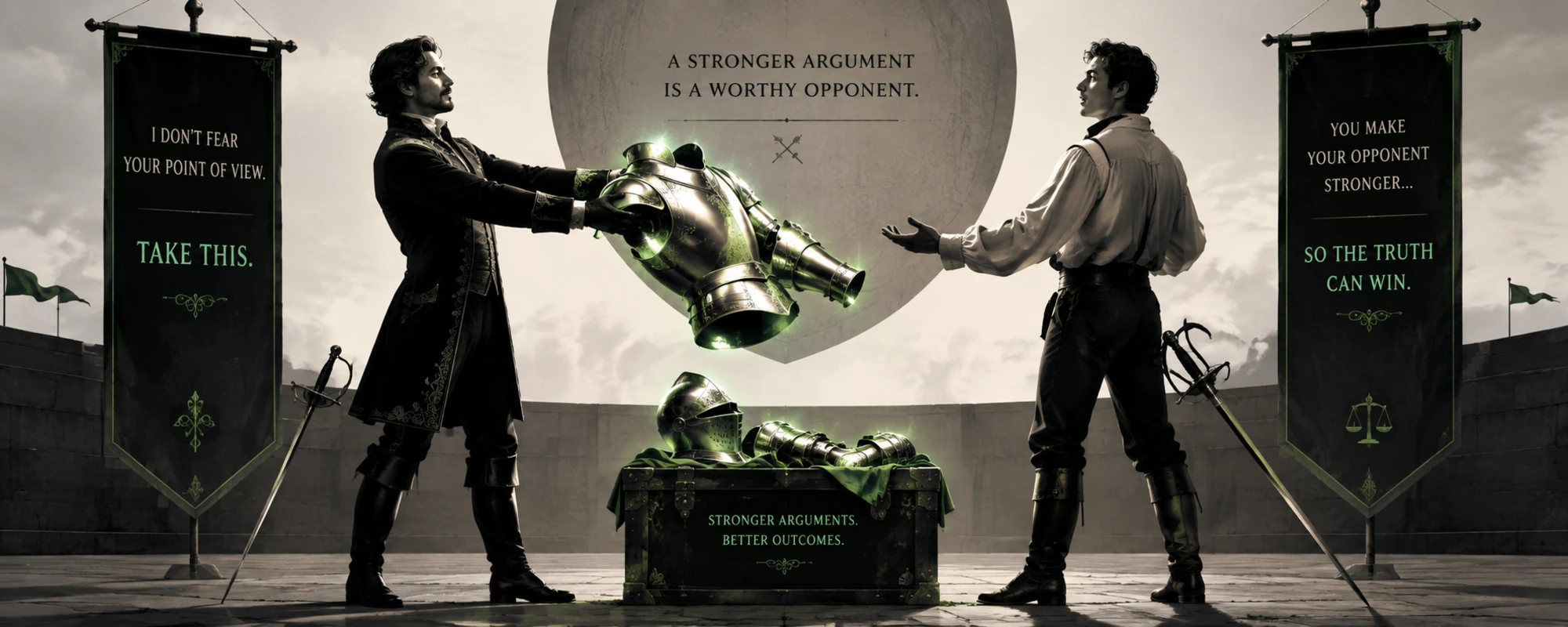
The steelman is the reverse. You take their argument and rebuild it into the strongest possible version — the one their smartest ally would make — and engage that.
"So the best version of your view is this: ___, and the strongest reason for it is ___. Have I got that right?"
Then, and only then, do you respond.
Dennett's rules
The philosopher Daniel Dennett laid out how to criticize someone well. The order matters:
- •Re-express their position so clearly and fairly that they say, "Thanks — I wish I'd put it that way."
- •List the points you agree on (especially anything non-obvious).
- •Say what you've learned from them.
- •Only now are you allowed to rebut.
Three of the four steps happen before you disagree. That's not politeness. It's strategy — and it's the same reason you can disagree hard without damaging the relationship.
Why it's so powerful
Steel-manning does three things at once, each worth the effort alone:
- ✓It disarms them. Someone who feels genuinely understood stops defending and starts listening. You've removed the threat, so they no longer need their armor. (People don't soften because they lost — they soften because they were heard.)
- ✓It makes your disagreement bulletproof. Beat the strongest version of their argument and your conclusion is solid. Beat only the weak version and you never actually won.
- ✓It protects you from being wrong. Sometimes, building the best case for the other side, you discover… it's better than yours. That's not a defeat. It's the entire point — you came to find the truth, and you found it.
The ultimate test
There's a brutal way to check whether you've earned the right to dismiss a view: the Ideological Turing Test. Can you state the opposing position so convincingly that a neutral observer couldn't tell you're not a true believer?
If you can't — if the best you can manage is a clumsy, obviously hostile version — then you don't understand the argument well enough to reject it yet. You're not disagreeing with their view. You're disagreeing with your caricature of it.
Most of the positions we're most sure are wrong, we've never actually steel-manned. That should make all of us a little less certain.
Why this is the engine of good decisions
Here's where it stops being a debate trick and becomes the core of how teams decide well.
A group only makes a good decision if every real option gets its strongest hearing. If the alternatives get strawmanned — "well, obviously we can't do X" — the team isn't choosing between the real options. It's choosing between one real option and a row of scarecrows.
Steel-manning is how you make sure the best argument actually wins: give each side its most powerful form, then let them compete. It's slower. It's also the difference between a decision that survives contact with reality and one that collapses the moment someone outside the room makes the case you never let anyone make. Building it into the process is what structure is for.
The strongest thing you can do for your own argument is to first make the other one as strong as it can possibly be.
The deeper treatment — where the technique comes from, the research on whether restating the other side first really makes you more persuasive, and how to run it in a meeting — is here: Steelmanning: argue the other side better than they can.
Pick a view you're confident is wrong. Can you state its strongest version — the one a smart believer would give — well enough that they'd nod? Try it in the replies.
I'll tell you honestly whether your steelman holds, or whether you've built a scarecrow.
Give every option its strongest hearing
Argumentree keeps the case for each side written down and side by side — so a team decides between the real options instead of between one option and a row of scarecrows.
Start Free 14-Day Trial →Related Reading
Steelmanning: Argue the Other Side Better Than They Can
The full treatment — origins, evidence, and how to run it in a meeting.
How to Disagree Without Destroying Relationships
Where the steel-man first appeared in this series, as one move among four.
McKinsey, Bridgewater, Amazon: The Disagreement Protocol
What elite decision cultures do to make sure the opposing case gets made.
The 7 Argument Traps
The failure modes steel-manning is built to defeat, named so you can call them mid-meeting.