The SPADE Framework for Team Decisions
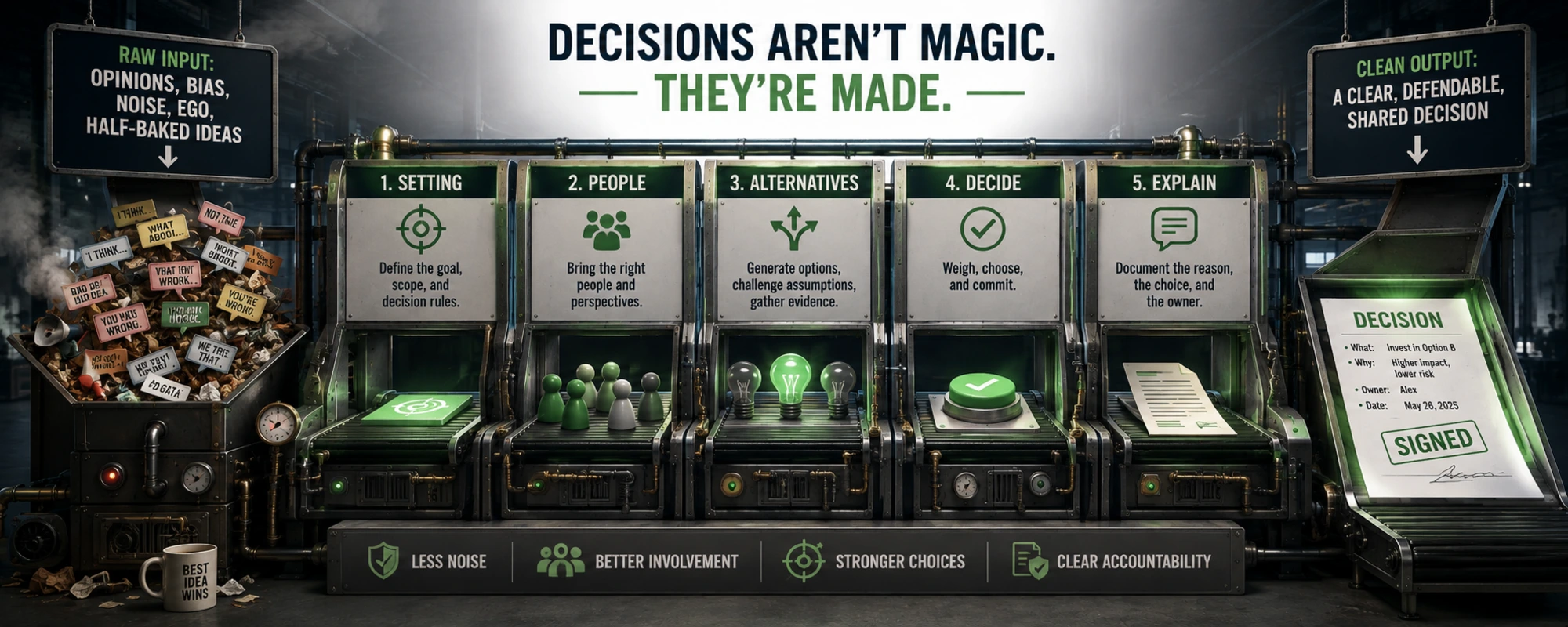
Most team decisions fail not because the team is unintelligent but because nobody was clear on how the decision would be made: who actually decides, what the real options are, whether a decision happened at all, and what the team landed on three weeks later. SPADE is a five-step framework for group decisions, popularized by Gokul Rajaram, who used it across Google, Facebook and Square. S is Setting: frame precisely what is being decided, by when, and why now, because most bad decisions are fuzzy at the root and people argue past each other while quietly answering different questions. P is People: name the roles out loud, with one Decider who owns the call rather than a committee, a Consulted group whose input genuinely shapes the outcome, and an Informed group who only need to know the result. This is the step teams skip and the most important one, because when nobody knows who decides, the decision defaults to whoever is loudest or most senior and everyone else quietly disengages. A is Alternatives: list at least a couple of genuine, distinct and plausible options rather than one favourite flanked by two strawmen, because if every option but one is obviously bad you have handed the team a rubber stamp rather than a decision. D is Decide: gather input first, since a written round or even an anonymous vote beats a live free-for-all where the first voice anchors everyone, and then the Decider makes the call, because there has to be a moment and we sort of agreed is how decisions die. E is Explain: communicate the decision and the reasoning to everyone affected, written down and visible, including what was considered and rejected, which is what stops the decision being relitigated the following week, since people accept decisions they disagreed with far more readily when they can see the reasoning was sound. What SPADE really does is make the process explicit and visible, so structure beats vibes and the best argument wins instead of the loudest voice. Reserve it for decisions big enough that not remembering what was decided would be expensive.
The SPADE Framework for Team Decisions
Five letters that turn a messy group decision into a clear one — used at Google, Facebook, and Square.
Most team decisions don't fail because the team is dumb. They fail because nobody was clear on how the decision would get made.
Who actually decides? What are we even choosing between? Did we decide, or just talk? And three weeks later: "wait — what did we land on?"
SPADE fixes that. It's a simple framework (popularized by Gokul Rajaram, who used it across Google, Facebook, and Square) for group decisions that actually stick. Five letters, five steps.
(We met it briefly when we ran through the simple frameworks that make decision-making easier — here's the full version.)
S — Setting
Frame the decision precisely: what exactly are we deciding, by when, and why now?
Most bad decisions are fuzzy at the root — people argue past each other because they're quietly answering different questions. Nail the setting and half the confusion disappears before it starts.
P — People
Name the roles, out loud:
- ✓The Decider — one person who owns the call. Not the committee. One.
- ✓Consulted — those whose input genuinely shapes it.
- ✓Informed — those who just need to know the outcome.
This is the step teams skip, and it's the most important. When nobody knows who decides, the decision defaults to whoever's loudest or most senior — and everyone else quietly disengages. Naming the Decider kills the popularity contest.
If you want the long version of this one letter, it's the entire subject of the decision-rights frameworks guide — RAPID, RACI, DACI and SPADE side by side, all answering the same question with different letters.
A — Alternatives
List the real options — at least a couple of genuine ones, not one favorite flanked by two strawmen.
Good alternatives are distinct and plausible. If every option but one is obviously bad, you haven't given the team a decision — you've given them a rubber stamp.
D — Decide
Now actually decide. Gather input first — a written round, even an anonymous vote, beats a live free-for-all where the first voice anchors everyone. Then the Decider makes the call.
The key is that there's a moment. "We sort of agreed" is how decisions die. Someone owns the call and says it plainly.
E — Explain
Communicate the decision and the reasoning to everyone affected.
This is what stops it getting relitigated next week. "Here's what we decided, here's why, here's what we considered and rejected" — written down, visible. People accept decisions they disagreed with far more readily when they can see the reasoning was sound.
Written down and visible, kept where anyone can go back to it later, is exactly what a decision audit trail is.
Why it works
Look at what SPADE actually does: it makes the whole process explicit and visible — what's being decided, who decides, what the real options are, when the call happens, and why.
That's the same principle under every good group decision: structure beats vibes, and visible reasoning lets the best argument win instead of the loudest voice. SPADE is just a clean, memorable way to install it.
You don't need it for every choice — reserve it for decisions big enough that "wait, what did we decide?" would be expensive. For those, it's the difference between a team that decides once and one that argues forever.
Think of a team decision that went sideways recently. Which SPADE letter was missing — unclear who decided (P)? fake alternatives (A)? no real moment of decision (D)?
Reply and diagnose one. It's almost always a missing letter.
Install the structure, not just the acronym
Argumentree gives a decision the five things SPADE asks for — a framed question, named roles, real alternatives with the arguments attached, a moment where the call is made, and the reasoning kept visible afterwards.
Start Free 14-Day Trial →Related Reading
RAPID, RACI, DACI, SPADE: Pick One, Then Actually Run It
The four decision-rights frameworks compared, and the workflow that's identical whichever you pick.
The Decision Record: How to Decide Once and Never Re-Argue It
What the E in SPADE looks like when you write it down properly.
Why Smart Teams Make Dumb Decisions (And the One Thing That Reverses It)
What goes wrong in a group when nobody has defined how the call gets made.
The Simple Frameworks That Make Decision-Making Easier
The short tour SPADE was one stop on.