Why Your Brain Thinks Plane Crashes Are Deadlier Than Cars
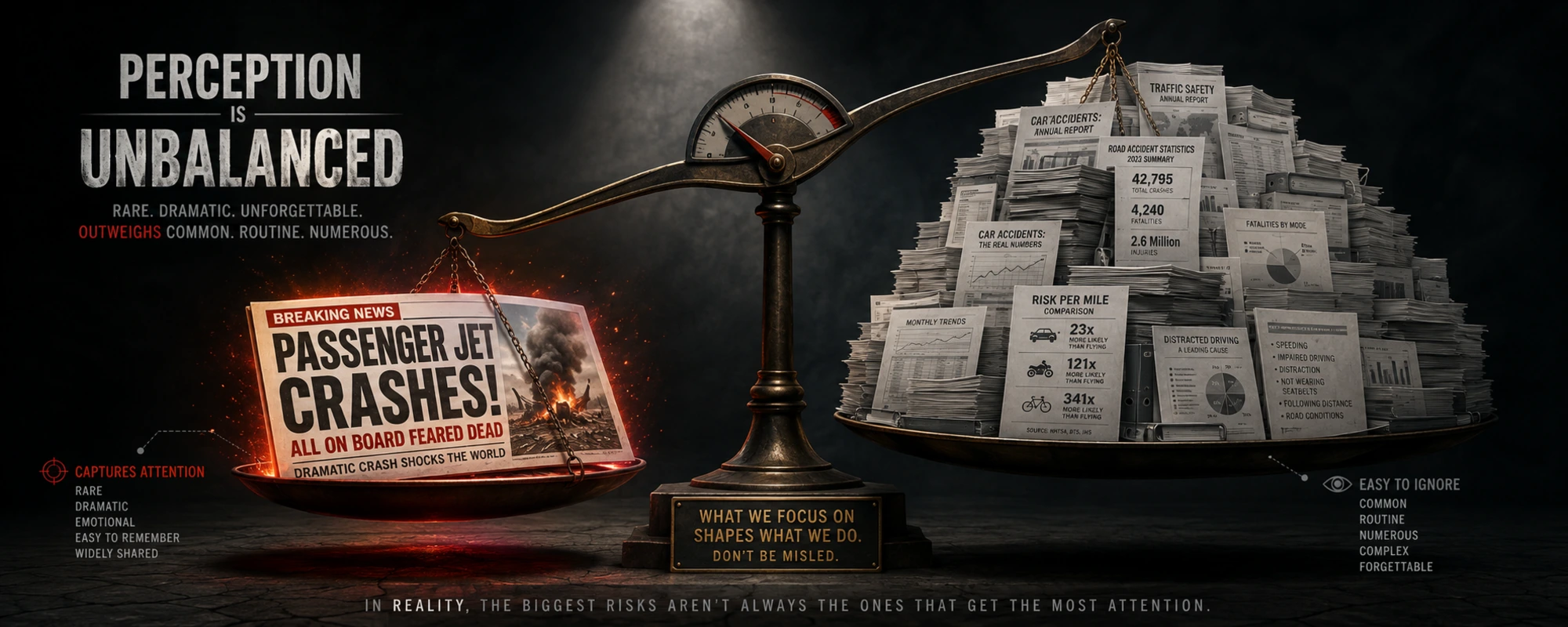
Most people are more nervous on a plane than in a car, and mile for mile the numbers say that is exactly backwards. The gap between how dangerous something feels and how dangerous it is has a name: the availability heuristic. Your brain estimates how likely something is by how easily an example comes to mind, so vivid, dramatic, heavily reported events feel common while mundane, statistically frequent ones feel rare. A plane crash is catastrophic and replayed for days, so the brain files plane equals danger in bold; road deaths happen one or two at a time, unfilmed, so it barely files them at all. That is not bad maths, it is availability substituting for maths because availability is fast and usually good enough. The same glitch gets expensive: we fear terror and shark attacks while ignoring heart disease and the drive to the airport, investors panic after a vivid crash and miss the larger quiet risk of not investing, and after one memorable failure we over-correct against that exact failure and walk into the one nobody filmed. It is worse in a room full of people, because the dramatic thing that just happened — the recent outage, the client that churned, the competitor's launch — dominates the discussion for being the most available risk rather than the biggest, and whole strategies bend around the last vivid event. The fix is a second question asked on purpose: forget how vivid this feels, what does the base rate actually say.
Why Your Brain Thinks Plane Crashes Are Deadlier Than Cars
The same mental shortcut that makes you scared of flying is quietly wrecking your decisions.
Most people are more nervous on a plane than in a car.
The numbers say that's exactly backwards. Mile for mile, driving is dramatically more dangerous than flying — it's not close. Yet the fear runs the other way, and almost everyone feels it.
That gap between how dangerous something feels and how dangerous it is has a cause. It's a mental shortcut called the availability heuristic, and once you see it, you'll catch it warping decisions everywhere — including yours.
The shortcut
Your brain estimates how likely something is by how easily an example comes to mind.
Vivid, dramatic, heavily-reported events come to mind instantly — so they feel common. Mundane, quiet, statistically-frequent events don't — so they feel rare.
A plane crash is catastrophic, front-page, replayed for days. So your brain files "plane = danger" in bold. The tens of thousands who die on roads each year do so one or two at a time, unfilmed, unremarkable — so your brain barely files them at all.
You're not bad at math. You're using availability instead of math, because availability is fast and free and usually good enough.
Where it actually costs you
The plane example is harmless. The same glitch gets expensive fast:
- ✕We fear the dramatic risk (terror attacks, shark attacks) and ignore the boring killer (heart disease, mosquitoes, the drive to the airport).
- ✕Investors panic after a vivid crash and miss the quiet, larger risk of not investing at all.
- ✕After one memorable failure, we over-correct against that exact failure — and walk straight into the one nobody made a movie about.
Whatever is vivid, recent, and emotional grabs the steering wheel from whatever is actually probable.
It's even worse in a room full of people
Now put this in a meeting. A team is deciding where the real risks are — and someone brings up the dramatic thing that just happened. The recent outage. The one big client that churned. The competitor's splashy launch.
That vivid story dominates the discussion — not because it's the biggest risk, but because it's the most available one. The quiet, statistically-larger risk, the one with no dramatic anecdote attached, never gets the airtime it deserves. Whole strategies get bent around the last vivid thing instead of the most likely one.
Availability doesn't just fool individuals. It fools whole teams — and the loudest recent anecdote beats the base rate almost every time.
The fix
You can't turn the shortcut off. But you can install a second question, on purpose:
"Forget how vivid this feels. What does the base rate actually say?"
Reach for the number, not the story. Ask how often this really happens, not how easily you can picture it. When a recent dramatic event is steering a decision, name it out loud — "we might be overweighting this because it just happened" — and go find the boring statistic it's drowning out.
The goal isn't to feel nothing about plane crashes. It's to stop letting the most memorable risk masquerade as the most likely one — in your own head, and in the room.
What's a risk you (or your team) are clearly overweighting right now just because it's vivid or recent — while a bigger, more boring one gets ignored?
Reply and name the pair. The boring one is usually the real story.
Make the base rate part of the record
When the reasoning behind a decision is written down, the vivid anecdote and the actual number sit side by side — and the loudest story stops winning by default.
Start Free 14-Day Trial →Related Reading
Why Smart People Make Dumb Decisions
Intelligence is no defence against a shortcut running underneath conscious thought.
The Cognitive Bias That Destroyed Kodak
What happens when an organisation protects the vivid status quo for decades.
Why Smart Teams Make Dumb Decisions
The group version: how a room amplifies the bias instead of cancelling it.